|
|
~
U.S. Riflemen Buttons 1798-1850's ~
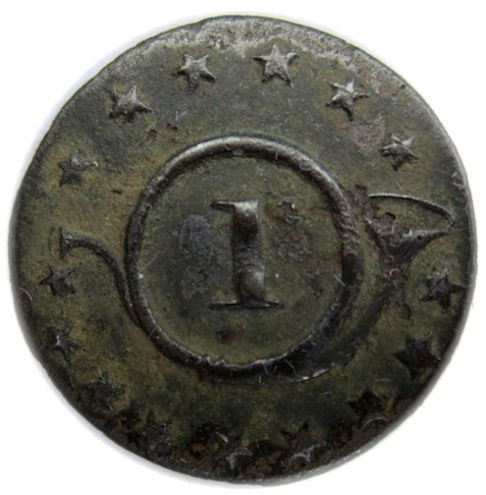
The meaning of the word, "Riflemen" first originated
from the soldiers in the 16th century who were known as
hand gunners. By the 17th century, they were known as
Musketeers, and then in the 18th century, the Infantry
soldiers were called Rifleman. The Riflemen were expert
marksmen who were good at guerrilla warfare. They were
usually sent in as an advanced guard for the infantry
companies to pick off officers, NCO's, and musicians
before major engagements. The first real use America had
for Riflemen was in the War of 1812, and it is noted
that the 1st Reg. of Riflemen were very active,
especially in the Niagara Campaign.
|
|
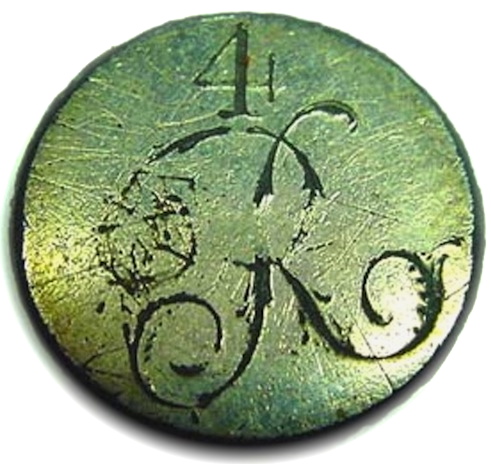
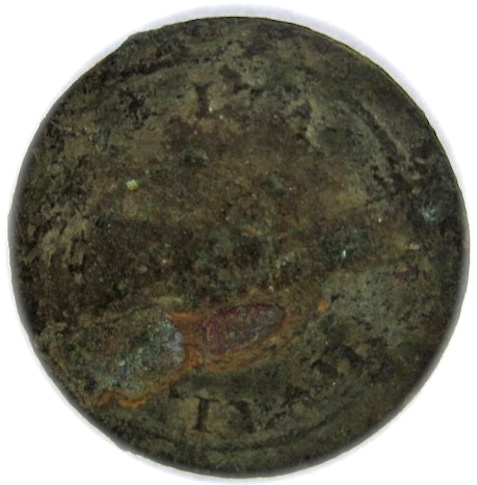
1792-96 The 4th Sub-Legion of the Battalion of
Riflemen of the Legion
Color: A Silvery Olive Grey.
Metal: Flat, 1-Piece, Impressed Design, Silver
Plated Copper.
Size: 16mm. Cuff Size.
Albert's: RF 9Cv RV: 75
Variation: Large Foliated Script R / 4th Regt.
Present Condition: An Excavated Example, Strong
Planchet Casting, Strong Impression.
Isabela's Notes: This rare button is usually
included with other Riflemen Buttons from the War of
1812. There is some descriptive written
documentation that suggest that it's pattern originates
as early as 1792-96. The button does posses
characteristics of earlier one-piece buttons, as well as
later productions. Either way, an extremely rare button,
RV 75+ most likely. The button's pattern depicts a large
foliated script "R" with a "4" above. The whole pattern
is engraved on a plain field with no edge border.
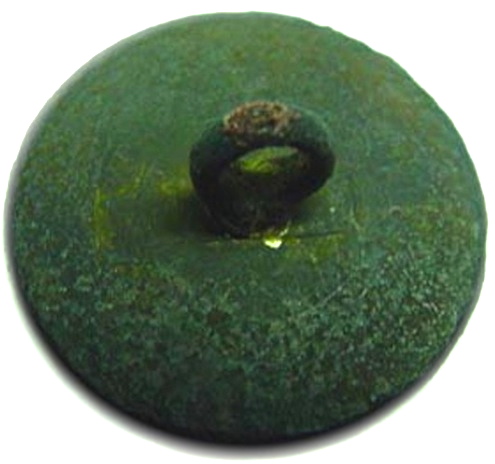
Reverse Button Analysis: This is a flat one-piece
button with a loop shank. The Shank is original,
straight, and intact.
Excavated at Fort Wilkinson which was later called
Ft. Hawkins near Milledgeville, GA.
The J. Baldwin Collection.~
Robert's Notes: Even though there was a battalion of
rifleman in each of the four sub-legions in 1792-96,
there was no buttons officially ordered or issued for
this designation. The Silver Plated button above could
have been a special order by a pride-full officer for
his unit. Just Speculation.-
|
|
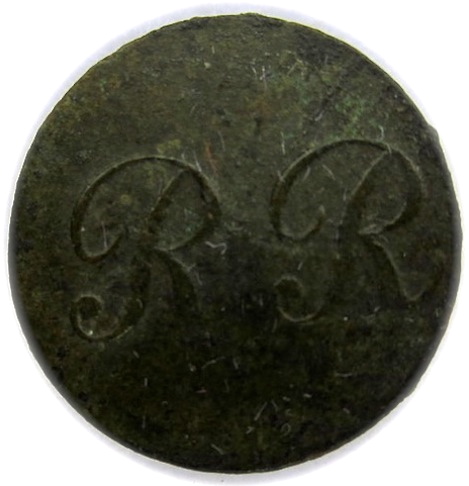
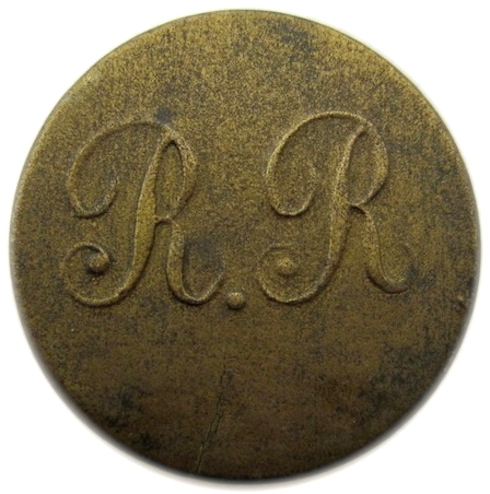
1808-11 Regiment of Riflemen
Color: An Ochre of Browns & Greens.
Metal: Flat, 1-Piece, Raised Design, Copper.
Size: 14.45mm. Cuff Size.
Albert's Number: RF 1-A:- Unlisted Size
Variant: RV: 35
Variation: Plain Script / Front Tail on Letter R
is Straight.
Present Condition: An Excavated Example, Good
Planchet Casting, Strong High Relief Pattern.
Isabela's Notes: This pattern button is probably
the first pattern officially issued for the Regiment of
Rifleman. In a letter dated in 1808 by Tench Coxe, he
does mention the fact that the Script style is preferred
over the Roman style font. He also mentions that a bugle
could be added if desired. So we know the bugle idea had
early roots. This pattern has two known die variants,
and two known sizes, 15mm & the more common 20mm. The
difference between the two known die variants is the
front tail on the two initials, "RR". One is straight,
the other is curled. This button's pattern depicts two
large plain script initials, "RR" in the center. The
front tail of the R's is straight. The pattern is set in
high relief on a plain field with no edge border.
Reverse Button Analysis: This is a flat one-piece
button with a loop shank. The shank is unfortunately
missing. ARMITAGE?
Excavated at Fort Brooke.
The RJ Silverstein Collection.
|
|
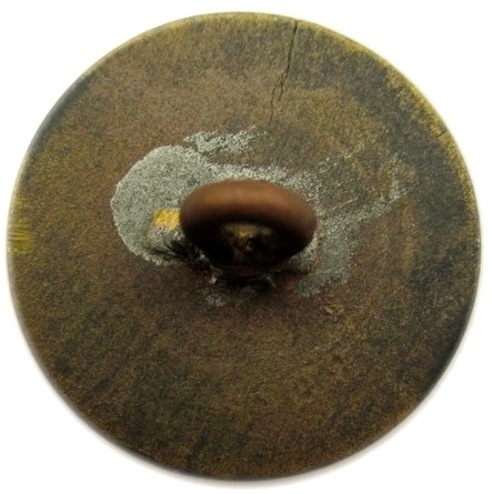
1808-11
Regiment of Riflemen
Color: Grass Green on Brown.
Metal: Flat, 1-Piece, Raised Design, Brass.
Size: 20.51mm. Coat Size
Albert's Number: RF 1-B RV: 35
Variation: Tail on Letter R is Curled / Back Tail
Swirl Before Knob
Present Condition: An Excavated Example, Strong
Planchet Casting, Strong High Relief Pattern.
Isabela's Notes: This pattern has two known die
variants. The difference between the two die variants is
the front tail on the two initials, "RR". The first one
is straight, the the other is curled. The button's
pattern depicts two large script initials, "RR" in the
center. The front tail of the "RR" is slightly Curled
inward. The back tail also shows more of a swirl curl in
the back before the knob end. The pattern is set in high
relief on a plain field with no edge border.
Reverse Button Analysis: This is a flat one-piece
button with a loop shank. The shank is straight and
intact, but glued on. No backmark can be identified.
The RJ Silverstein Collection. |
.jpg) 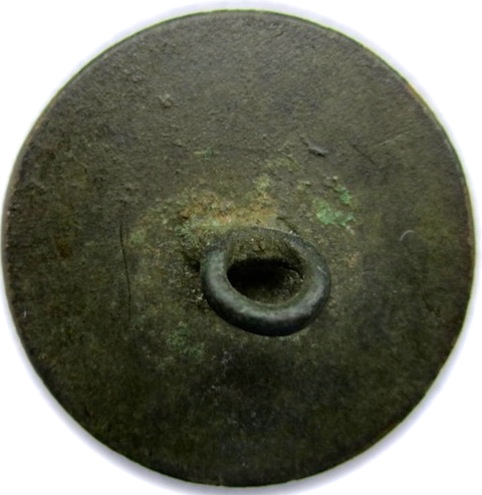
|
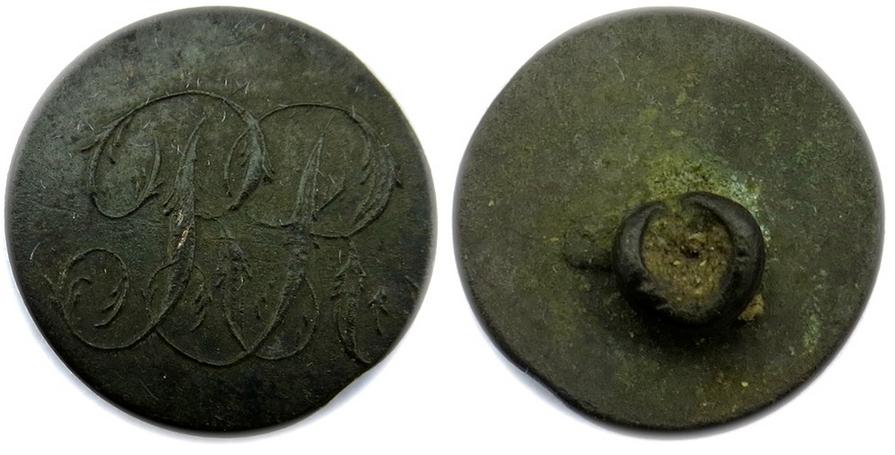
1809-12 Regiment of Riflemen
Color: A Sea Algae Green.
Metal: Flat, 1-Piece, Raised Design, Copper.
Size: 19.65mm.
Albert's Number: RF 2 A: RV: 35
Variation: Foliated Script Letters.
Present Condition: An Excavated Example, Strong
Planchet Casting, Strong High Relief Pattern.
Isabela's Notes: This pattern could have
premiered a few years before, but most military buttons
using foliated script date to around 1811. This short
lived pattern only has one known die variant. The
button's pattern depicts two largeintertwined foliated
script letters, "RR" in the center. The initials tails
are very curly. The high relief pattern is set on a
plain field with no edge border.
Reverse Button Analysis: This is a flat one-piece
button with a loop shank. The shank is original, intact,
but slightly bent. Blank backmark.
The RJ Silverstein Collection. |
|
1809-12 Regiment of Riflemen
Color: A Silvery Green.
Metal: Flat, 1-Piece, Raised Design, Copper.
Size: 14.98mm. Cuff size
Albert's Number: RF 2 Av: Unlisted Size Variant RV: 50
Variation: Foliated Script Letters.
Present Condition: An Excavated Example, Strong
Planchet Casting, Strong High Relief Pattern.
Isabela's Notes: This cuff button was most likely
part of the original general order. As with the coat,
there is only one known die variant for the cuff. Albert
doesn't even have this size listed in his book, and
might not have been aware of it's existence. The
button's pattern depicts two large intertwined foliated
script letters, "RR" in the center. The initials tails
are very curly. The high relief pattern is set on a
plain field with no edge border. Muck rarer then the
matching coat button.
Reverse Button Analysis: This is a flat one-piece
button with a loop shank. The shank is original, intact,
but slightly bent over. Blank backmark, no mold line.
The RJ Silverstein Collection. |
|
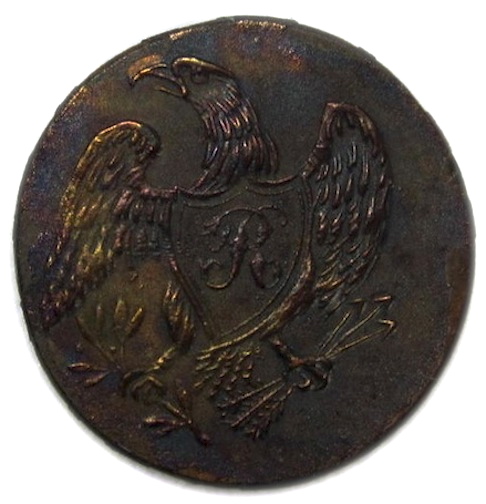
1812-13 Regiment of Riflemen
Color: An Ochre of Browns, Greens, Purples, &
Blues.
Metal: Flat, 1-Piece, Raised Design, Brass.
Size: 15.36mm. Cuff Size.
Albert's Number: RF-3 Unlisted Size Variant:
RV: 25
Variation: Single Script Foliated R on Shield.
Present Condition: An Excavated Example, Strong
Planchet Casting, Strong High Relief Pattern.
Isabela's Notes: The small cuff size is rare, and
especially so with the shank intact. Most likely this
button saw parallel usage with other Regiment of
Riflemen buttons during the war of 1812. According to
Duncan Campbell's notes, this was only made a short
period, maybe a year. The button's pattern depicts a
spread eagle facing right. In it's left claw there is a
small bundle of three arrows facing upward, In the
eagle's right talon is a six petaled laurel stem. Upon
the eagle's chest is a double lined recessed shield,
with a single script foliated letter,"R". This style is
very reminiscent of President Washington's federal style
spread-eagle buttons. The high relief pattern is set on
a plain field with no edge border.
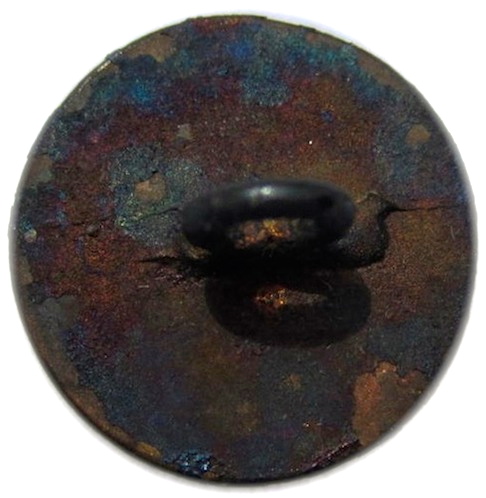
Reverse Button Analysis: This is a flat one-piece
button with a loop shank. The shank is original,
straight, and intact.
Excavated in Stono River, South Charleston
The RJ Silverstein Collection.
|
"Hello Rob, -just finished an extended phone conversation with Bruce
Bazelon. He states that Duncan Campbell's notes reflect an 1813-1815
date for the Regiments of Riflemen buttons with the bugle, and
number within. He believes they replace the order of 1812, and
suggests that there is a parallel usage in the 1814 cap plates". -
William Leigh.
|
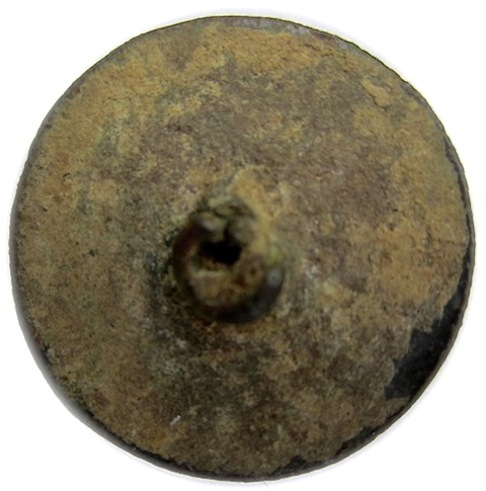
1813-15 1st Regiments of Riflemen
Color: A Shoe Polish Brown with Greenish-Brown
Encrustations.
Metal: Flat, 1-Piece, Raised Design, Brass.
Size: 19.85mm. Coat Size
Albert's Number: RF-5 A.1: RV: 20
Variation: 1st Reg. Pattern.
Present Condition: An Excavated Example, Strong
Planchet Casting, Strong High Relief.
Isabela's Notes: This pattern replaced both
earlier eagle buttons with the script "R" on the shield.
Most likely this was issued during the war, and then
worn for a short time after. The button's pattern
depicts a bugle or hunting horn around the center. The
regiment number "1" is in the center, within the bugle's
circle. Encircling the horn is 15 five-pointed stars
around the periphery. The high relief pattern is set on
a plain flat field with no edge border. Collectors seek
the rarer back mark of Leavenworth Hayden & Scovill
Waterbury/ as well specimens with an intact shank.
Reverse Button Analysis: This is a one-piece
button with a loop shank. The shank is original and
intact, but bent over. No back mark.
The RJ Silverstein Collection. |
|
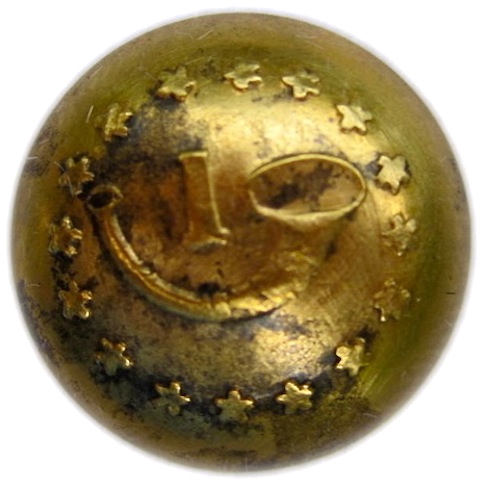
1814-15 1st Regiments of Riflemen Cuff
Color: A Tarnished Brass Yellow.
Metal: Convex, 1-Piece, Raised Design, Brass.
Size: 16.46mm. Cuff Size
Albert's Number: RF-6 A: RV: 25 / RV: 75
With Jackson Back Stamp
Variation: Jackson Victory Back mark Stamp.
Present Condition: A Non Excavated Example,
Exceptional Planchet Casting, Strong High Relief
Pattern.
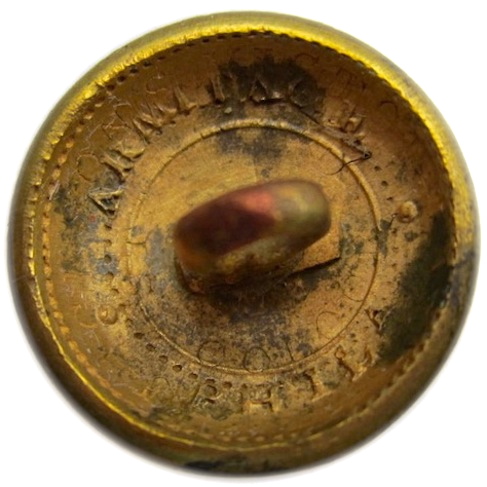
Isabela's Notes: This button's reverse has the
very desirable back mark over stamp that states,
"Jackson's Victory". This was added by the manufacturer
after Jackson defeated the British in the battle of New
Orleans. Most victory back stamps are extremely weak and
hard to see, esp with the Armitage rm back mark. The
button's pattern depicts a bugle with a small number "1"
slightly above. There are 16 five-pointed stars
encircling the one and the bugle. The whole pattern is
set in high relief on a convex plain field with no edge
border.
Reverse Button Analysis: This is a one-piece
convex button with a copper loop shank. The shank is
original, straight, and intact, ARMITAGE PHILA rm With
"Jackson's Victory" Back stamped over.
The RJ Silverstein Collection. |
|
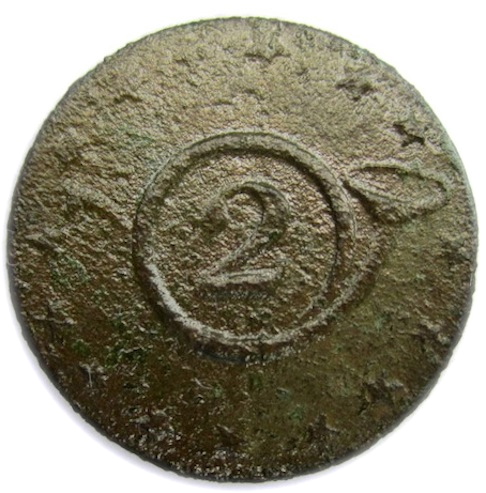
1813-15 2nd Regiments of Riflemen
Color: An Olive Brown.
Metal: Flat, 1-Piece, Raised Design, Brass.
Size: 19.71mm. Coat Size
Albert's Number: RF-7 A.1: RV: 20
Variation: 2nd Reg. Pattern.
Present Condition: An Excavated Example, Strong
Planchet Casting, Good High Relief Pattern.
Isabela's Notes: This pattern replaced both
earlier eagle buttons with the script "R" on the shield.
Most likely this was issued during the war, and then
worn for a short time after. The button's pattern
depicts a bugle or hunting horn around the center. The
regiment number "2" is in the center, within the bugle's
circle. Encircling the bugle is 15 five-pointed stars
around the periphery. The high relief pattern is set on
a plain flat field with no edge border. Collectors seek
the rarer back mark of Leavenworth Hayden & Scovill
Waterbury/ as well specimens with an intact shank.
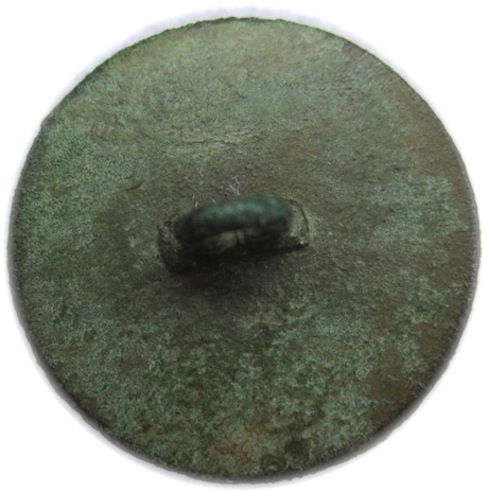
Reverse Button Analysis: This is a one-piece
button with a loop shank. The shank is original,
straight, and intact. No backmark.
The RJ Silverstein Collection. |
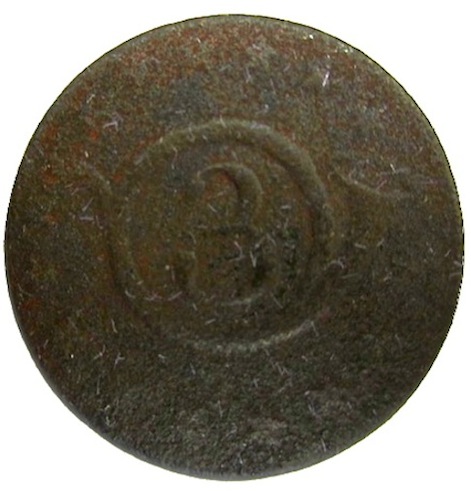 
|
1813-15 3rd Regiments of
Riflemen
Color: A Shoe Polish Brown with A Rusty Orange
Patina.
Metal: Flat, 1-Piece, Raised Design, Brass.
Size: 20.36mm. Coat Size
Albert's Number: RF-8 A.1:
RV: 20
Variation: 3rd Reg. Pattern.
Present Condition: An Excavated Example, Strong
Planchet Casting, Good High Relief Pattern.
Isabela's Notes: The button's pattern depicts a
bugle or hunting horn around the center. The regiment
number "3" is in the center, within the bugle's circle.
Encircling the horn is 15 five-pointed stars around the
periphery. The high relief pattern is set on a plain
flat field with no edge border. Collectors seek the
rarer back mark of Leavenworth Hayden & Scovill
Waterbury/ as well specimens with an intact shank.
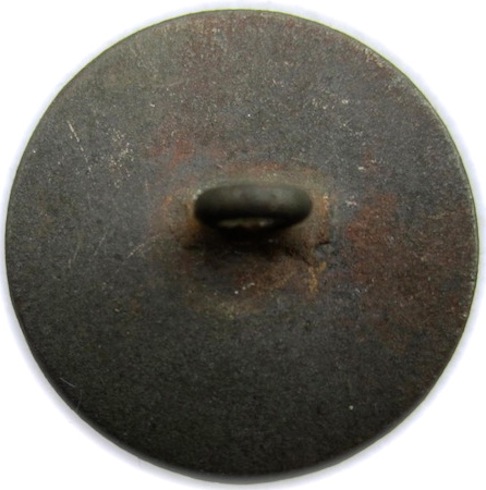
Reverse Button Analysis: This is a one-piece
button with a loop shank. The shank is original,
straight, and intact. No back mark.
The RJ Silverstein
Collection. |
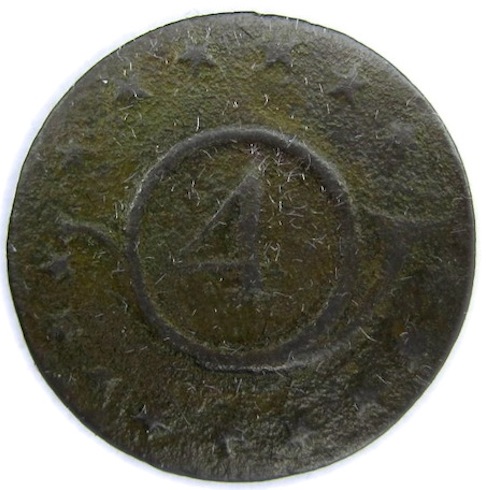 
|
1813-15 4th Regiments of Riflemen
Color: Sea Algae Green.
Metal: Flat, 1-Piece, Raised Design, Brass.
Size: 19.98mm. Coat Size
Albert's Number: RF 9 A.1:
RV: 20
Variation: 15 Five-Pointed Stars.
Present Condition: An Excavated Example, Good
Planchet Casting, Good High Relief Pattern.
Isabela's Notes: There are two known die variants
for this pattern. The first has 13 five-pointed stars,
and the second has 15 five pointed stars. The button's
pattern depicts a bugle or hunting horn around the
center. The regiment number "4" is in the center within
the bugle's circle. Encircling the horn is 15
five-pointed stars around the periphery. The high relief
pattern is set on a plain flat field with no edge
border. Collectors seek the 13 Star border with the
blank back mark, and also the 15 star L.H. & S.W. Con
backmark which is noted to have the "4" re-engraved over
the "1" in the die.
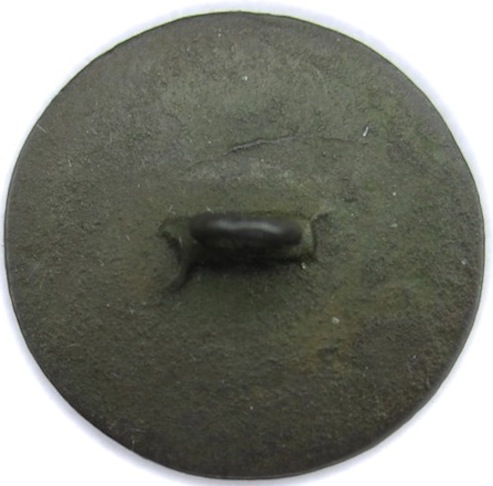
Reverse Button Analysis: This is a one-piece
button with a loop shank. The shank is original,
straight and intact. No backmark.
The RJ Silverstein Collection. |
|
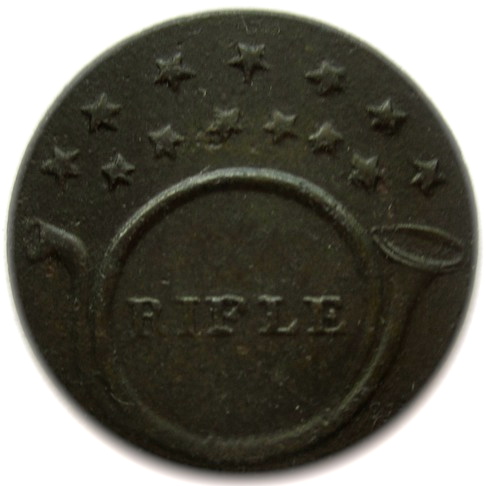
1812-14 Regiment of Rifleman
Color: Dark Sea Green.
Metal: Flat, 1-Piece, Raised Design, Brass.
Size: 19.94mm. Coat Size
Albert's Number: RF 11-A.1: RV: 20
Variation: 13 Star Pattern.
Present Condition: An Excavated Example,
Exceptional Planchet Casting, Exceptional High Relief
Pattern.
Isabela's Notes: This button's pattern depicts a
bugle or hunting horn around the center, with 13 stars
above. The word, "RIFLE" is written in capital letters
within the bugle's circle. The high relief pattern is
set on a plain field with no edge border. Collectors
find the 13 star pattern a bit tougher to find compared
to the 15 & 17 Star pattern. Most examples are found
without the shank.
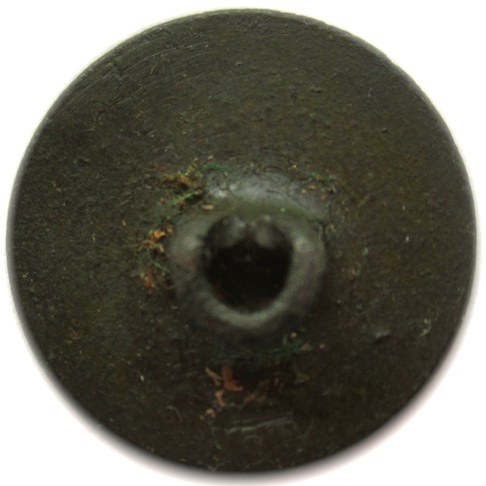
Reverse Button Analysis: This is a flat one-piece
button. The shank is original and intact, but slightly
bent over. No backmark.
Excavated in a Florida encampment.
The RJ & Debra Silverstein Collection. |
|
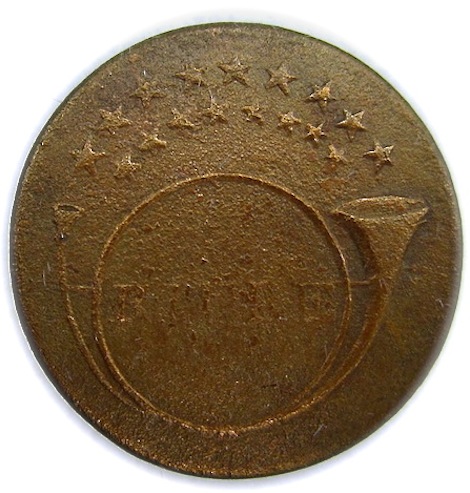
1814-Post Regiment of Rifleman
Color: A Coppery Brown.
Metal: Flat, 1-Piece, Raised Design, Copper.
Size: 20.44mm. Coat Size
Albert's Number: RF 13A.1: RV: 20
Variation: 17 Star Pattern.
Present Condition: An Excavated Example, Strong
Planchet Casting, Good/Strong High Relief.
Isabela's Notes: This is the final pattern to be
manufactured and worn by the rifleman during the War of
1812. The pattern does date to 1814, but might not have
reached the troops, or have been issued until 1815. This
button's pattern depicts a bugle or hunting horn around
the center, with 17 stars above. The word, "RIFLE" is
written in capital letters within the bugle's circle.
Collector's seek un-dug specimens, being the rarity.
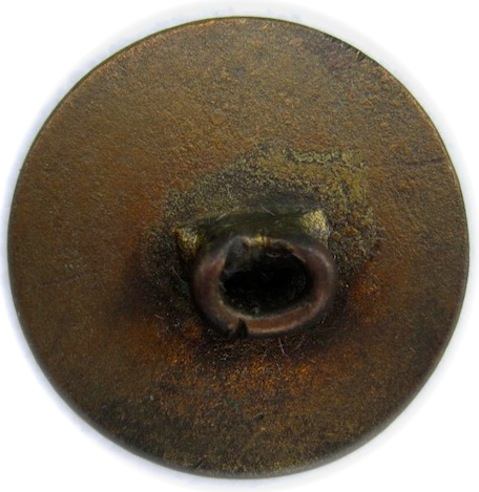
Reverse Button Analysis: This is a flat one-piece
button with a loop shank. The shank is original and
intact, but slightly bent over. No back mark.
Excavated in the Council
Bluffs, Iowa. This was a stop on the Missouri River on
the way to Fort Atkinson, Nebraska which was established
by the rifleman and the 6th infantry in 1819.
The RJ & Debra Silverstein Collection. |
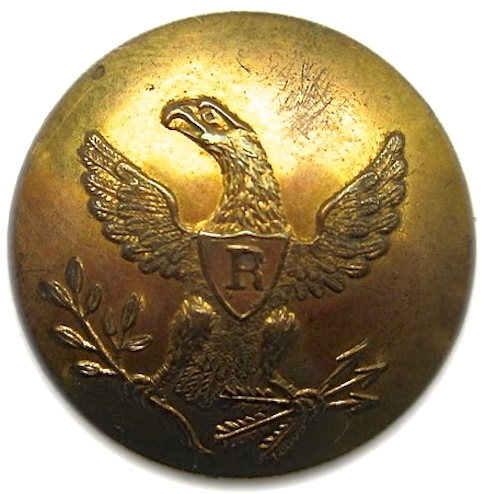 
1840's Federal Mounted
Riflemen
Color: An Aged Golden Brass Patina.
Metal: Convex, 1-Piece, Raised Design,
Gilt Brass.
Size: 19.72mm.
Albert's Number: RF 15-B Style: Unlisted
Back mark: RV: 10
Tice's: RF 200A.- Unlisted Back mark Variant
Variation: R in Small Shield / Long Stem
Laurel
Present Condition: A Non Excavated Example,
Exceptional Planchet Casting, Exceptional High
Relief Pattern.
Isabela's Notes: This one-piece button is
most likely the transition button for when the "2nd
Dragoons" became the Mounted Rifleman in 1842. From
the back mark on this button, it indicates an 1830's
manufacture date. This probably was one of the first
one-piece buttons issued to the New Mounted Service
of Riflemen, and was issued before the later
two-piece buttons replaced them. Tice does note in
his book, that the later 1842 two-piece buttons used
the same dies obverses as the earlier one-piece
buttons. This particular one-piece pattern has
several (5) die variants produced by manufacturers
in the 1840's. The button's pattern depicts a spread
eagle facing right with a slightly recessed small
shield on it's chest. Within the shield is a raised
letter, "R" for Riflemen. In the eagle's right talon
is a long stem eight petal laurel stem. In it's left
talon is a small bundle of three arrows pointing
left. The high relief pattern is set on a plain
convex field with no edge border. Albert did note in
his book that there are slight variations in the
letter,"R", and also the shape and size of the
shield. Records indicate these Mounted Rifleman most
likely used muzzle loading 1841 rifles. Not sure why
Albert gave this early one-piece a low RV rating, I
found early riflemen one-piece button very difficult
to come by, especially compared to the Artillery or
Infantry one-piece counterparts, and when i do see
them for sale, they usually demand a premium.
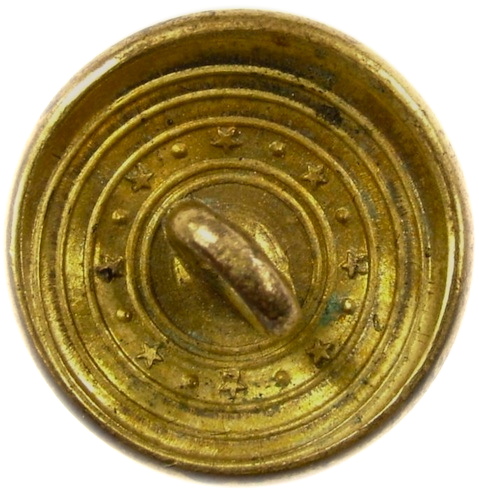
Reverse Button Analysis: This is a slightly
concave one-piece button with a soldered on loop
shank. The shank is original and intact. 5 rm rings
.*.*.*.*.*.*.*.*
The RJ & Debra Silverstein
Collection.
Robert's Notes: This doesn't mean that the all the
Dragoons turned into Mounted Rifleman at this point.
|
|
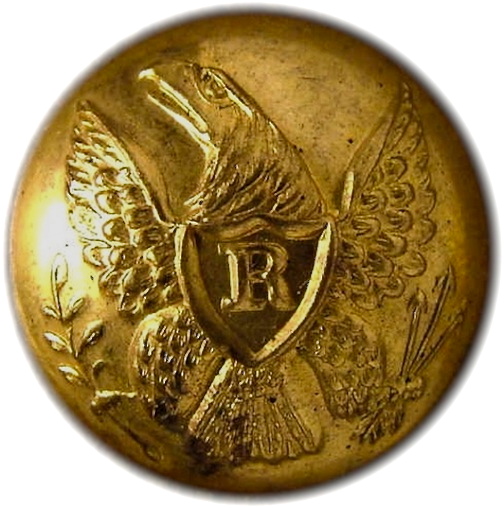
1840-50's Federal Mounted Riflemen
Color: A Golden Brass Yellow.
Metal: Convex, 2-Piece, Raised Design, Gilded
Brass.
Size: 22.4mm. Coat Size
Albert's Number: RF 17-D RV: 08
Tice's: RF 212A.39 (ScovillCO08)
Variation: Symmetrical Eagle / Depressed Shield.
Present Condition: A Non Excavated Example,
Exceptional Planchet Casting, Exceptional High Relief
Pattern.
Isabela's Notes: This button was intended for
officers who served in Riflemen units. At this time they
were highly skilled marksmen who eventually evolved into
modern sharpshooters. This pattern was made by many
manufacturers from the early 1840's up until the Civil
War. This would be a common button to have been found
around Civil War sites. There are different die variants
for this specific pattern, but all manufacturers depict
a symmetrical spread-eagle facing right with a depressed
shield. Inside the shield is a raised initial, "R" for
Riflemen. In the eagle's left talon is a small bundle of
three arrows pointing up, and in it's right claw is a
long seven petal laurel stem. This high relief pattern
is set on a low convex plain field with no edge border.
Other manufacturer's specimens can also be found on a
high convex field.
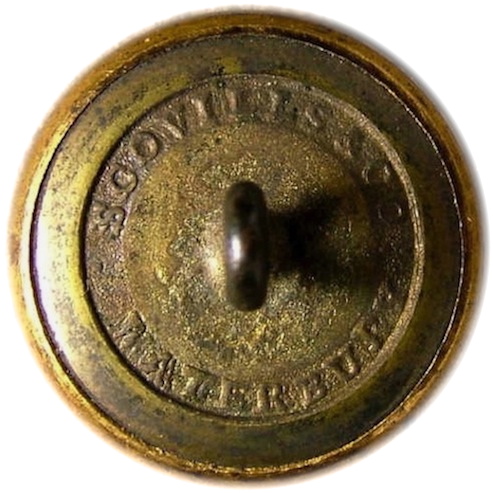
Reverse Button Analysis: This is a two-piece
button with a loop shank. The shank is original,
straight, and intact. SCOVILLS & CO./ WATERBURY.
Picture Courteous of Harry Ridgeway. |
|
1850's Federal Mounted Riflemen
Color: Polished Brass Yellow.
Metal: High Convex, 2-Piece, Raised Design,
Gilded Brass.
Size: 20.6mm. Coat Size
Albert's Number: RF 17-Unlisted Back mark RV: 08
Tice's: RF 212A.58 (Extra Q17)
Variation: Symmetrical Eagle / Depressed Shield.
Present Condition: A Non Excavated Example,
Exceptional Planchet Casting, Exceptional High Relief
Pattern.
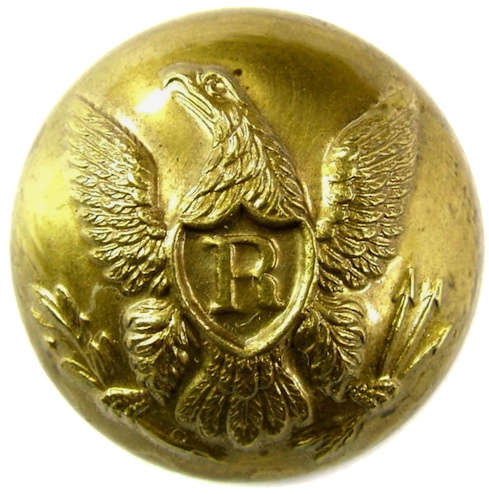
Isabela's Notes: This is another manufacturer's
die variant who's back mark dates to the 1850's. As with
all manufacturers of this specific pattern, it depict
a symmetrical spread-eagle facing right with a depressed
shield. Inside the shield is a raised initial, "R" for
Riflemen. In the eagle's left talon is a small bundle of
three arrows pointing upward and to the left. In it's
right claw is a laurel with a short stem. This high
relief pattern is set on a high convex plain field with
no edge border. This would be a common button to find
around Civil War sites.
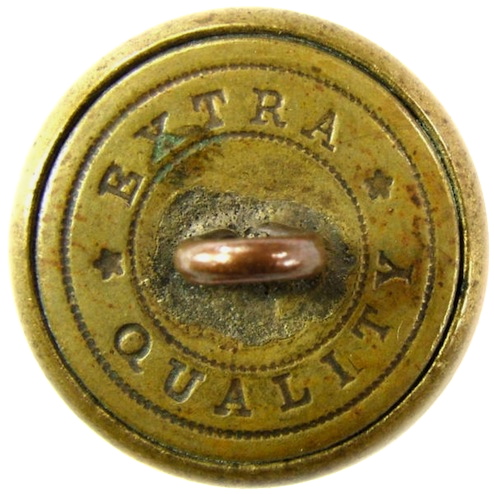
Reverse Button Analysis: This is a flat back
two-piece button with a copper loop shank. The shank is
original, straight, and intact. EXTRA* QUALITY * dm
between 2 rings of dots. |
|
1850's Federal Mounted Riflemen
Color: Polished Brass Yellow.
Metal: High Convex, 2-Piece, Raised Design,
Gilded Brass.
Size: 20.6mm. Coat Size
Albert's Number: RF 17-Unlisted Back mark
RV: 08
Tice's: RF 212A.58 (Extra Q17)
Variation: Symmetrical Eagle / Depressed Shield.
Present Condition: A Non Excavated Example,
Exceptional Planchet Casting, Exceptional High Relief
Pattern.
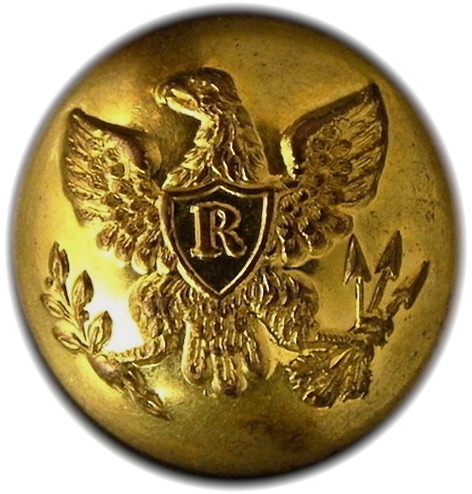
Isabela's Notes: This is another manufacturer's
die variant who's back mark dates to the 1850's. As with
all manufacturers of this specific pattern, it depict
a symmetrical spread-eagle facing right with a depressed
shield. Inside the shield is a raised initial, "R" for
Riflemen. In the eagle's left talon is a small bundle of
three arrows pointing upward and to the left. In it's
right claw is a laurel with a short stem. This high
relief pattern is set on a high convex plain field with
no edge border. This would be a common button to find
around Civil War sites.
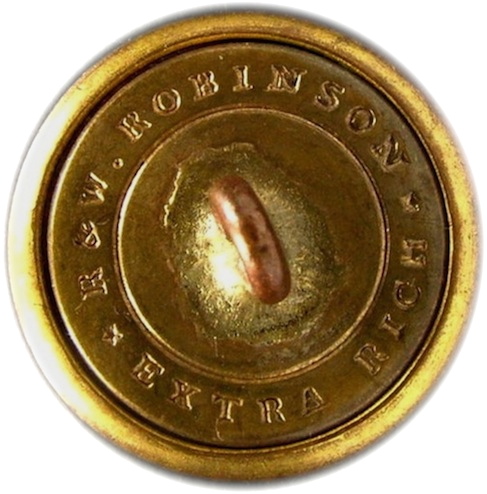
Reverse Button Analysis: This is a flat back
two-piece button with a copper loop shank. The shank is
original, straight, and intact. EXTRA* QUALITY * dm
between 2 rings of dots. |
|
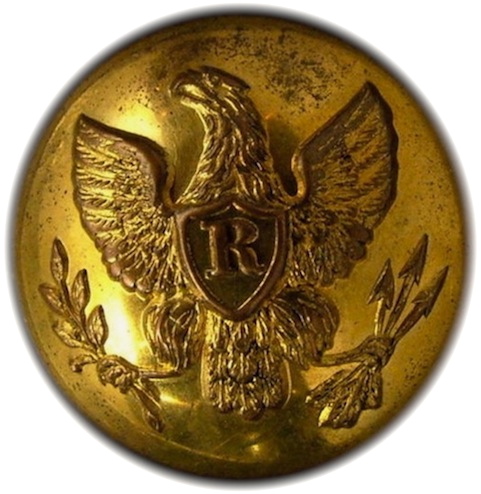
1840-50's Federal Mounted Riflemen
Color: A Tarnished Brass Yellow.
Metal: Convex, 2-Piece, Raised Design, Gilded
Brass.
Size: 23mm. Coat Size
Albert's Number: RF 20-A.1 RV: 05
Tice's: RF 222A.1 (Evans06)
Variation: Symmetrical Eagle / Raised Shield.
Present Condition: A Non Excavated Example,
Exceptional Planchet Casting, Exceptional High Relief
Pattern.
Isabela's Notes: This is the D. Evans die variant
that R & W Robinson produced which depicts a different
style eagle which is more symmetrical and fuller in
appearance. This variant was also made in a smaller
size. The button's pattern depicts a symmetrical
spread-eagle facing right, with a raised recessed
shield on it's chest. Inside the shield is a raised
initial, "R" for Riflemen. In the eagle's left talon is
a small bundle of three arrows pointing up, and in it's
right claw is a small five petal laurel stem. This high
relief pattern is set on a convex field with no edge
border. Thomas Dale of New York also produced a similar
pattern to this one.
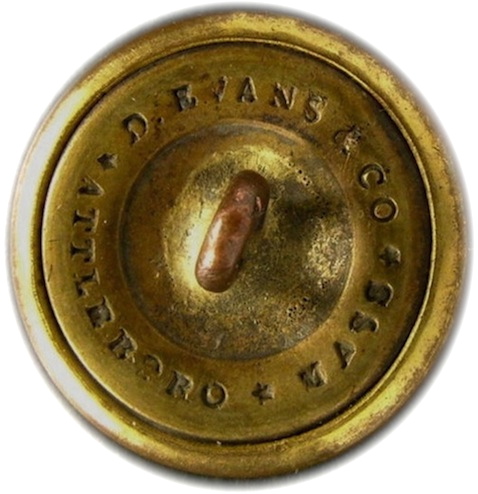
Reverse Button Analysis: This is a two-piece
button with a loop shank. The shank is original,
straight, and intact. * D.EVANS & CO*/ATTLEBORO*MASS dm
inner well around shank. |
|
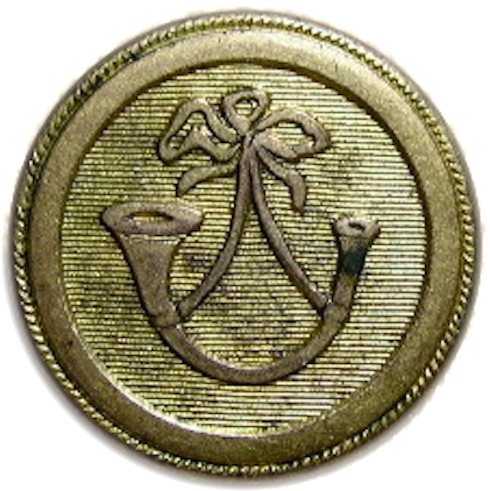
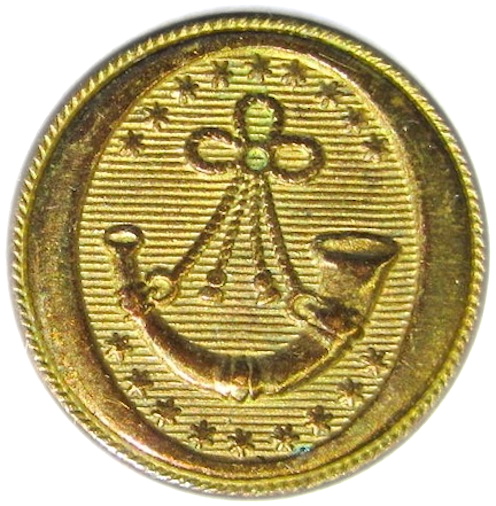
1820's Rifles State Militia Officer's Pattern
Color: A Brass Yellow.
Metal: Flat, 1-Piece, Raised Design, Gilt Brass.
Size: 21.29mm. Coat Size
Albert's Number: RF-29: RV: 05
Tice's: RM196.A
Variation: Hunting Horn Facing Right / Cord Tied
in Bow / Rope Edge
Present Condition: A Non Excavated Example,
Exceptional Planchet Casting, Exceptional High Relief
Pattern.
Isabela's Notes: This button's pattern depicts
a hunting horn facing right, and has a cord that is tied
in a bow. The high relief pattern is set on a lined
field that is within a flat circle border. Outside of
the border is a thin rope edge. This is a harder
specimen to obtain over other Rifles Militia Buttons.
Collector's seek un-dug specimens.
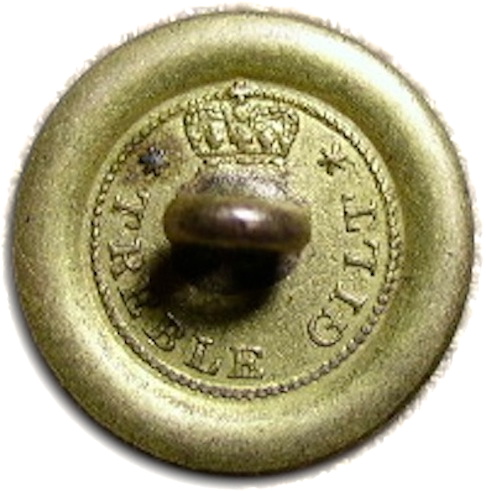
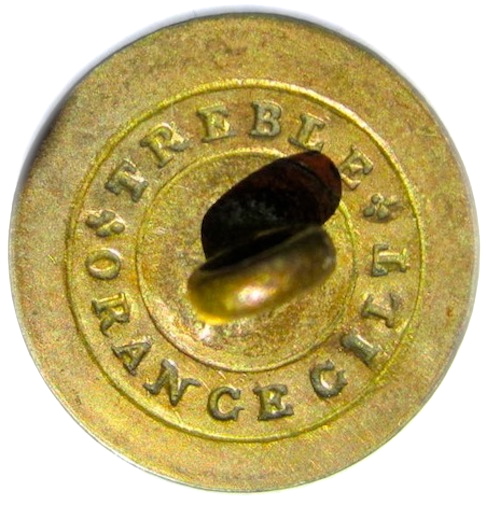
Reverse Button Analysis: This is a bulbous
one-piece button with a loop shank. The shank is
original and intact. *TREBLE GILT* surmounting crown
within a roped raised border.
The RJ & Debra Silverstein Collection. |
|
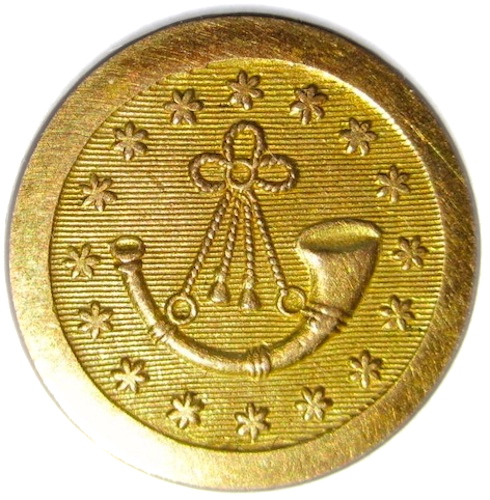
1820's Rifles State Militia Officer's Pattern
Color: A Brass Yellow With Tough of Red.
Metal: Flat, 1-Piece, Raised Design, Gilt Brass.
Size: 20.34mm. Coat Size
Albert's Number: RF 29: RV: 05
Tice's: RM193.A
Variation: Three Loop Knot / 18 Star Pattern /
Rope Edge.
Present Condition: A Non Excavated Example,
Exceptional Planchet Casting, Exceptional High Relief
Pattern.
Isabela's Notes: This button's pattern shows a
hunting horn facing left, with a cord that is tied in a
three loop knot. The high relief pattern is set on a
lined field within a wide flat oval border. Outside of
the border is a thin rope edge. Militia collectors
favorite. Usually available in both dug and non-dug
specimens.
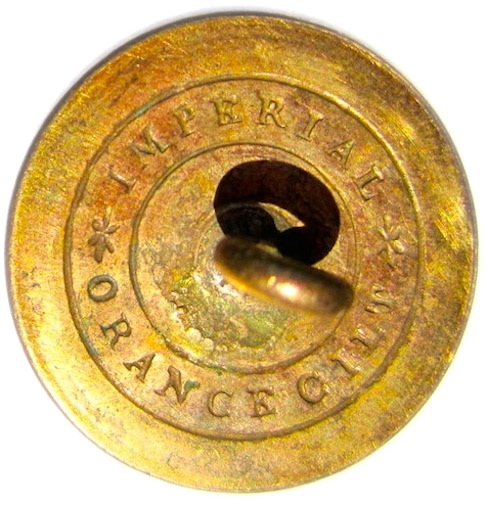
Reverse Button Analysis: This is a flat one-piece
button with a loop shank. The shank is original,
straight, and intact.+TREBLE+ ORANGE GILT* dm channel.
The RJ & Debra Silverstein Collection. |
|
1820's Rifles Militia Officer's Pattern
Color: A Golden Brass Yellow.
Metal: Flat, 1-Piece, Raised Design, Gilt Brass.
Size: 22.59mm. Coat Size
Albert's Number: RF 26: RV 08
Tice's: RM181A.Unlisted B/M
Variation: 16 Star Pattern.
Present Condition: A Non Excavated Example,
Exceptional Planchet Casting, Exceptional High Relief
Pattern.
Isabela's Notes: The button's pattern depicts a
hunting horn facing left, with a knotted cord and two
hanging tassels. There is 16 Asterisk type six pointed
stars encompassing the bugle. The high relief pattern is
set on a lined field with a wide flat border. Common
button that is usually available in both dug and non-dug
specimens.
Reverse Button Analysis: This is a flat one-piece
button with a soldered loop shank. The shank is original
and intact.*IMPERIAL ORANGE GILT* within 2 dms.
The RJ & Debra Silverstein Collection. |
|
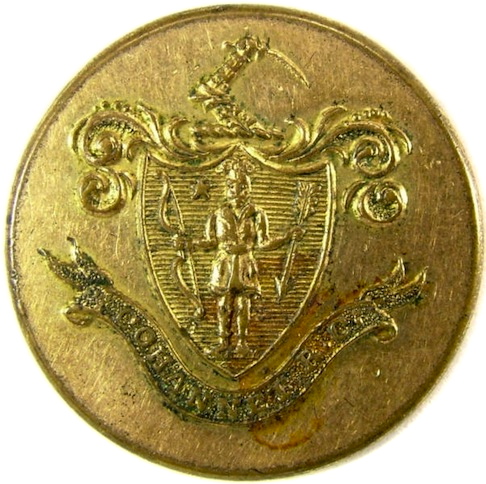
1830's Massachusetts Cohannet Rifle Corps
Color: A Golden Olive.
Metal: Flat, 1-Piece, Raised Design, Gilt Brass.
Size: 22mm. Coat Size
Albert's Number: MS86: RV: 25
Tice's: MS244A.1
Variation: Regimental Banner Ribbon.
Present Condition: A Non Excavated Example,
Exceptional Planchet Casting, Exceptional Low-Relief
Pattern.
Isabela's Notes: The Cohannet Rifle Corps was
organized in 1836 near Taunton Massachusetts. The
button's pattern depicts the Massachusetts coat of arms,
which is a native American Indian standing within a
shield, holding a bow in his right hand, and a large
arrow pointing downward in his left. There is a North
Star motif above the Indian's right shoulder. The motif
of the fighting arm and saber surmounts the top of the
shield, and there is a stippled regimental banner ribbon
underneath that reads, "COHANNET R.C." in capital
letters.
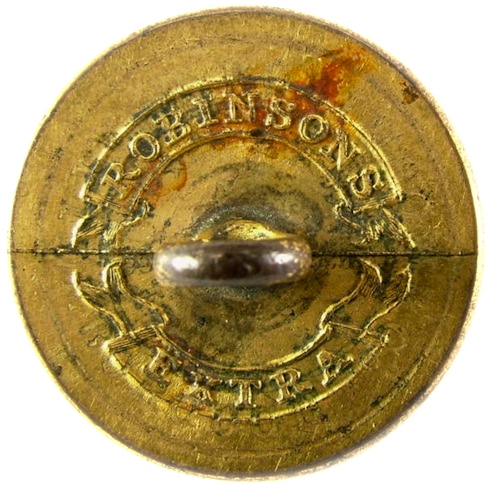
Reverse Button Analysis: This is a flat one-piece
button with a soldered loop shank. The shank is
original, straight, and intact. rm ROBINSON EXTRA each
word in separate ribbon. This was most likely pressed
over an earlier button surplus.
Picture Courteous of Harry Ridgeway. |
|
U.S.
Dragoon's & Mounted Riflemen Buttons
1760's-1861's
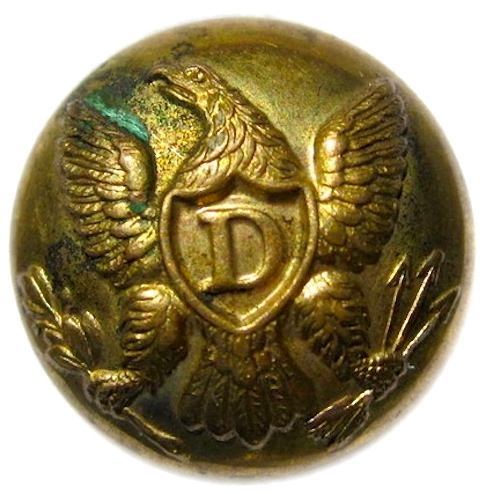
1770's to 1860's Dragoons & Mounted Riflemen
Dragoon Regiments were
established in most European armies during the late
17th, and early 18th centuries. The name "Dragoon"
is thought to be derived from a type of firearm
carried by the French Army. The term usage for
Dragoons usually meant mounted infantry. These were
professional soldiers who were trained in horseback
riding, as well as possessing infantry fighting
skills. Early Dragoon
units were
formed into companies like infantry soldiers, and
their officers bore infantry ranks. They were mainly
used for scouting, light skirmishes, and picket
duties. On the battlefield they were used as a
heavily armed force to shock infantry troops. Their
regiments used drummers to communicate orders on the
battlefield. There were a number of Regiments in the
American Revolution that were known as, Continental
Light Dragoons. Their
buttons were thought to be plain silver plated, or
pewter with regiment number and "LD", but most often
their buttons were ball shaped. After the Revolution
there wasn't any horse-back military service until
March of 1792. A squadron of Light
Dragoons was organized which consisted of four
troops. Each of the Sub-Legions was given their own
troop of Light Dragoons. Unfortunately this was very
short lived, and by 1796 there was only two troops
of Light Infantry left in US service. Two years
later in 1798, a whole regiment of Light Dragoons
was organized which consisted of six new troops of
Light Dragoons. In 1800, 1802, 1808, 1812, and 1814
Congress played a game of disbanding, and then
building the Light Dragoon Regiments until 1815 when
they consolidated into the Corps of Artillery. The
Army formed the 1st
Dragoon's Regiment in 1833, and the 2nd
Dragoons was
formed in 1836. The 2nd Dragoons Regiment was
converted to the Mounted Riflemen in
1842.
Mounted Infantry were
soldiers who rode on horses instead of marching, but
actually fought on foot. The first Mounted Infantry
units to be names as such, "The
Regiment of Mounted Rifleman, or Voltigeurs" came
around the time of the Mexican War. By 1861, the
Dragoons and Mounted riflemen arms were abolished
and the two old regiments were transformed into the 1st
& 2nd U.S. Cavalry Regiments. These
later Cavalry Regiments fought as Mounted Infantry
units, but were organized as troops, or into
squadrons, and they used buglers to communicate
orders on a battlefield. Unfortunately, with the
invention of more accurate and quick firing rifles
in the mid 1800's, the Cavalry became more
vulnerable to troops on foot; who could fire from
cover, and form defensive lines quickly.
|
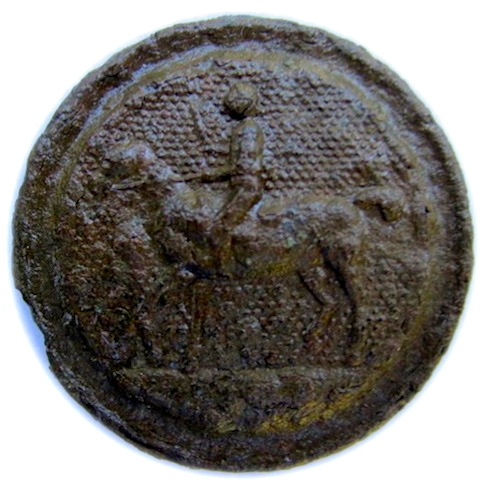 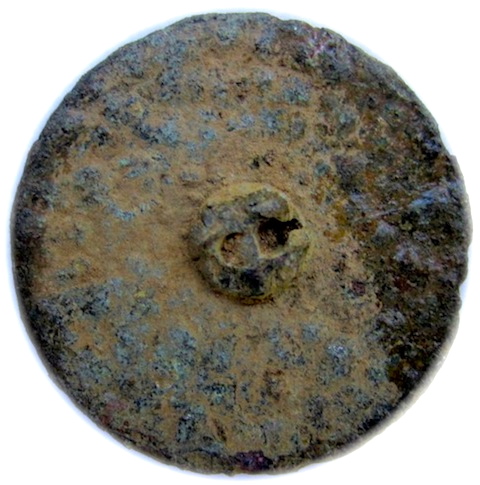
1770's Loyalist, South Carolina Mounted Unit
Color: A
Hershey's Chocolate With Olive Undertones.
Metal:
Flat, 1-Piece, Raised Design, Copper.
Size: 28.5mm.
Troiani's: ADSC.a
Present Condition: An
Excavated Example, Strong Planchet Casting,
Strong High Relief Pattern.
Isabela's Notes: The
current theory put forth for this button is
that it is a Loyalist Mounted Cavalry button
that belongs to the South Carolina Dragoons.
The loyalist in South Carolina were known to
have had a light cavalry unit, as well as an
infantry unit. The button's pattern depicts
an image of a mounted rider with a drawn
sword. The horse is shown charging upon a
grassy mound. The high relief pattern is set
on a stippled field with a deep channel
border. Since the fall 2010, several copper
and pewter examples have surfaced from metal
detector enthusiasts. No un-dug examples are
known to exist.
Reverse Button Analysis: This
is a flat one-piece button with a loop
shank. The Boss is still present, but the
loop shank is unfortunately broken off.
Excavated in South Carolina .~
The RJ & Debra Silverstein Collection.
|
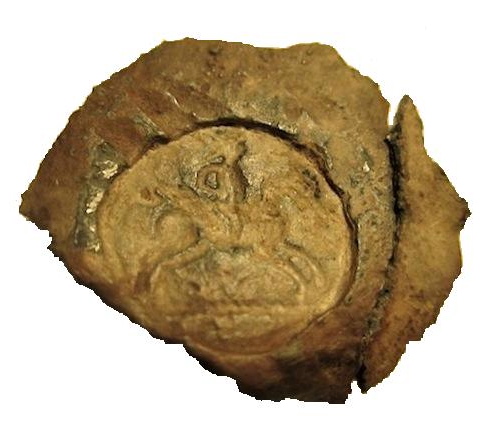 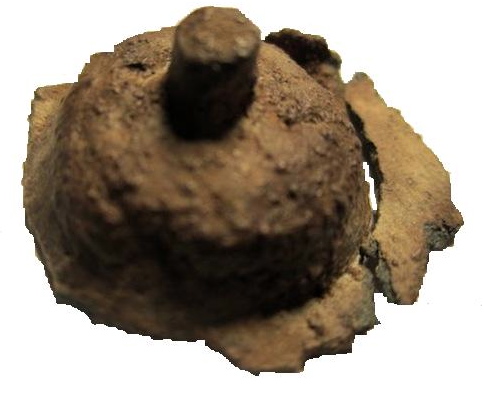
1776-83 2nd Continental Light Dragoons Button
Mold
Color: A Light Earthy Brown with Pewter
Undertones.
Metal: Lead Button Mold.
Size: 16mm. (The Button itself, not the
mold).
Rarity: R-7 (Only one Left in Existence)
Present Condition: An Excavated Example,
Strong Planchet Castor, Strong Impressions.
Robert's Notes: This is an ultra rare
one-piece
Lead Dragoon Mold
that goes inside of a wooden block. This is a single
mold that would be used by a soldier in the field to
make pewter buttons. These molds
"Do Not Require A Copper Repousse to Protect the
Lead".
The 2nd Continental Light Dragoons was also known
as,
"Sheldon's Horse",
after Elisha Sheldon. Sheldon was commissioned by
the Continental Congress on December 12, 1776, and
was first mustered in March 1777, in Wethersfield,
Connecticut for service in the Continental Army. The
regiment consisted of four troops from Connecticut,
one troop from Massachusetts, and one from New
Jersey. The unit almost never served as a whole.
Usually individual troops were assigned as
necessary.
Elements from this unit also comprised Washington's
personal Bodyguard.
The 2nd Continental Dragoons played many roles
during the American Revolution. To many people they
were known as,
"The Watchdogs of the Highlands"
or in some instances,
"Washington's Eyes".
The regiments main patrol areas were around Southern
Connecticut and New York. Their main duties were to
intercept British supplies, and fight off bands of
Loyalist Partisans who preyed on local citizens. The
regiment
performed numerous raids from Whaleboats
against the British and Loyalist installations on
Long Island. Some of there successful raised
included the capture of Fort ST. George, FT. Slongo,
and Lloyds Neck Long Island. The regiment also saw
action at the Battle of Woodbridge, Battle of
Brandywine, Battle of Kingston, Battle of Schoharie,
The Battle of Flocky
(Which was the first Cavalry Charge on American
Soil)
Battle of Paoli, Battle of Whitemarsh, Battle of
Morrisania, Battle of Saratoga, Battle of
Germantown, and the Battle of Yorktown. They were
known to have been instrumental in
Washington's Secret Spy Ring.
Major Benjamin Tallmadge became a master spy who ran
one of the most successful spy rings during the
American Revolution. He was able to infiltrate the
British Military Command in the City of New York. In
January of 1781, the regiment was reorganized by
dismounting two of it's six troops, and
re-designated the 2nd Legionary Corps. The regiment
was furloughed June 9, 1783 at Newburgh, NY, and
then discharged on November 20, 1783 by a
proclamation of General Washington. The 2nd Light
Dragoons are Prominent in Colonel John Trumbull's
paintings of the American Revolution.
Known Specimen Owners from this Mold: Fort
Stanwix Park Service / Yorktown, VA (Mass Burial
Site) Colonial Williamsburg / Connecticut Village
Winter Camp)
Excavated in Monterey Massachusetts.~
The Dale Collection.
|
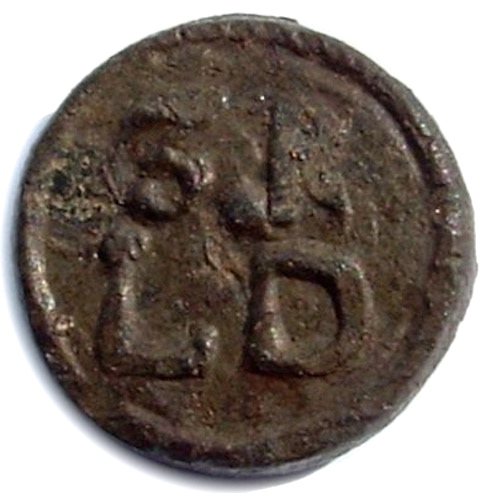 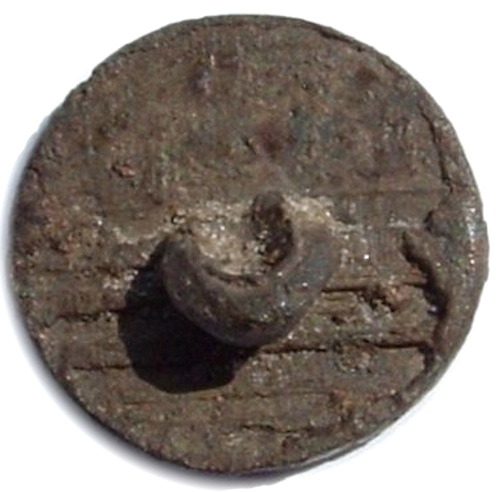
1777-1782 3rd Continental Light Dragoons
Color: A Pewter Gray with Brown Undertones.
Metal: Flat, 1-Piece, Raised Design, Cast
Pewter.
Size: 17mm.
Troiani's: A3LD
Present Condition: An Excavated Example,
Strong Planchet, Strong High Relief Pattern.
Isabela's Notes: The 3rd Continental Dragoons
was organized in Morristown New Jersey in January of
1777. This unit was mostly organized from the
earlier Maryland and Virginia units. the unit
briefly had some action in the northeastern states,
but primarily saw action in the southern states,
especially South Carolina. From recovery, this
button most likely dates to around 1781; when the
unit operated in South Carolina under Colonel
William Washington. The button's pattern depicts the
company's unit number and initials, "3RLD" on a flat
plain field with a raised edge border. The pewter
specimen is extremely rare, and in remarkable
condition.
Reverse Button Analysis: This is a flat
one-piece casting for the reverse shank. The shank
is original, intact, but bent over. No backmark.
Excavated near the water in Charleston, South
Carolina.~
The Keith Nixon Collection.
|
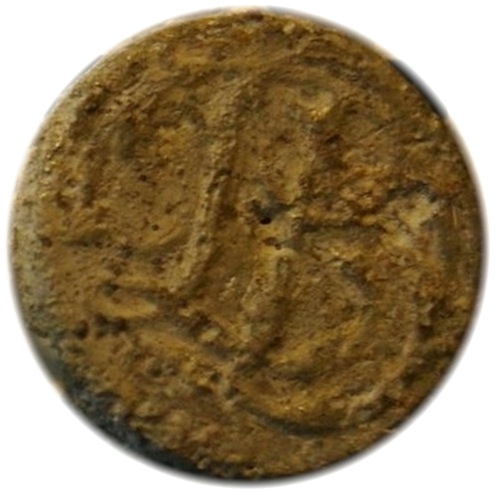
1777-1782 3rd Continental
Light Dragoons
Color: A Pewter Gray With Brown Undertones.
Metal: Flat, 1-Piece, Raised Design, Cast
Pewter.
Size: 25.4mm. (17mm)
Troiani's: A3LD.b.
Present Condition: An Excavated Example, Good
Planchet Casting, Fair/Good High Relief Pattern.
Isabela's Notes: From this button's recovery
area, it most likely dates to September 27, 1778
Baylor's Massacre. The unit was commanded by Colonel
George Baylor, and at least 69 Dragoons were either
killed, injured or taken prisoner in Tappan NY. The
button's pattern depicts large script initials, "L
D" on a plain field with no raised edge border.
Extremely rare specimen, collectors should seek any
specimen.
Reverse Button Analysis: This is a one-piece casting
for the reverse shank. The shank is reportedly
original, straight, and intact.
Excavated by Wayne Daniels
an Old Tappan Farm in New Jersey.
Location of Baylor's massacre.
|
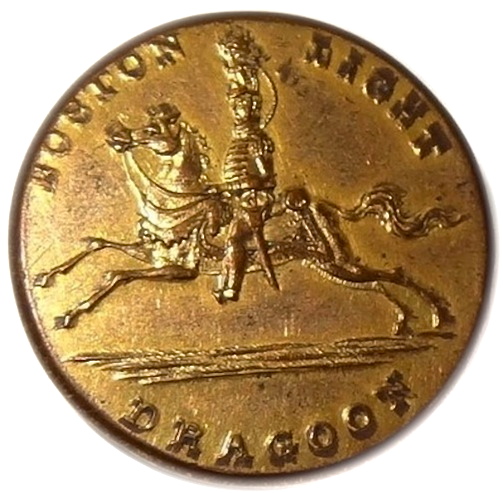
1828-34 Boston Light Dragoons, Co B. 1st
Battalion
Color: A Dull Golden Yellow.
Metal: Flat, 1-Piece, Raised Design, Gilt
Brass.
Size: 23mm.
Albert's Number: MS 64: RV 35
Tice's Number: MS234A.1
Present Condition: A Non Excavated Example,
Exceptional Planchet Casting, Exceptional
High-Relief Pattern.
Isabela's Notes: Robinson & Jones made most
of these buttons between 1828 and 1834. This
regiment had a long distinguished military career,
and fought in most of the eastern-state campaigns up
until 1864. The organization was first led by
Captain Henry Purkitt who served in Pulaski's
Cavalry Corps during the Revolution. They were later
merged with Boston's Hussars in 1810. These Dragoons
later formed Companies A & B of the 1st
Massachusetts Cavalry during the Civil War. The
button's pattern depicts a mounted Dragoon on a
galloping horse with the inscription, "BOSTON LIGHT
DRAGOON" in capital letters circling around the
legend. Like the RI Horse Guard's buttons, most of
these specimens were struck off center.
Reverse Button Analysis: This is a flat
one-piece button with a loop shank. The original
shank is original, straight, and intact. *ROBINSON,
JONES & Co/ATTLEBORO/.*.*.*.EXTRA.*.*.*.*RICH rm has
5 rings, one resembles a rope.
|
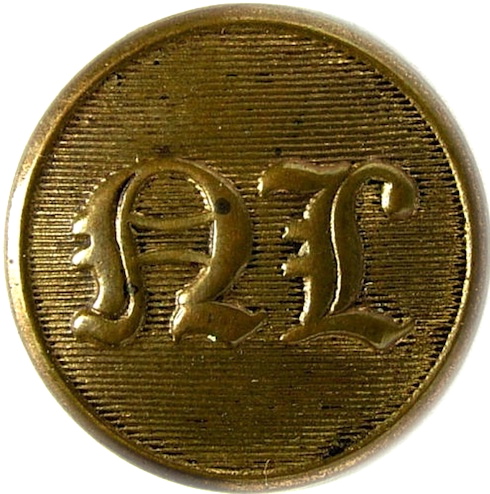 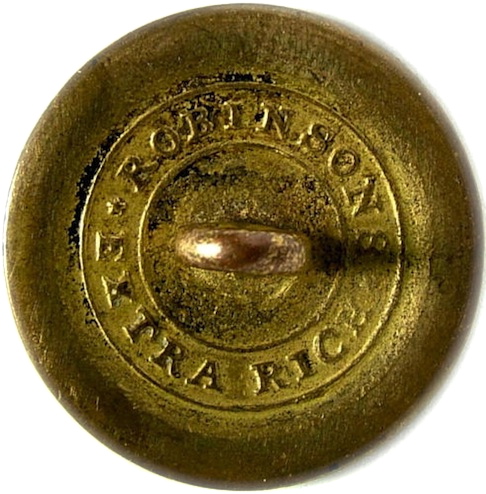
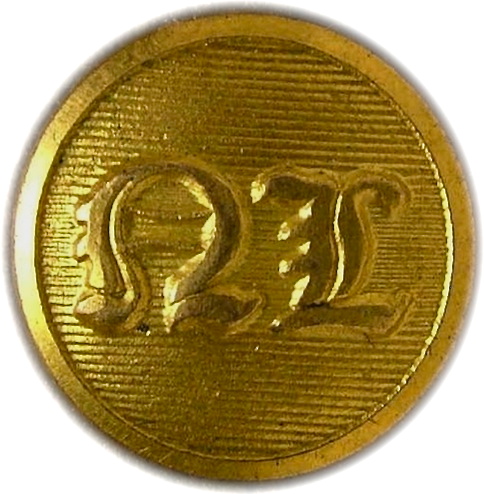
1830-40's Mass. National Lancers Co. A 1st
Battalion Light Dragoons
Color: A Golden Brass Yellow.
Metal: Low Convex, 1-Piece, Raised
Design, Gilt Brass.
Size: 22mm.
Albert's Number: MS73: RV 3
Tice's: MS258A.1
Variation: Coat Size.
Present Condition: A Non Excavated
Example, Exceptional Planchet Casting,
Exceptional High Relief Pattern.
Isabela's Notes: This Light Dragoon's
unit organized in Boston around 1837, even
though Robinson made these buttons around 1835.
This would be the earliest known pattern to be
used by this particular unit. The button's high
relief pattern depicts the old english initials,
"NL" in the center of a lined field. There is a
small thin border circling around the edge. In
the Civil War, this unit served in the 1st
Massachusetts Cavalry with distinction.
Reverse Button Analysis: This is a
slightly concave one-piece button with a loop
shank. The shank is original, straight, and
intact. *ROBINSON*/EXTRA RICH rm within 2 rm
rings.
|
 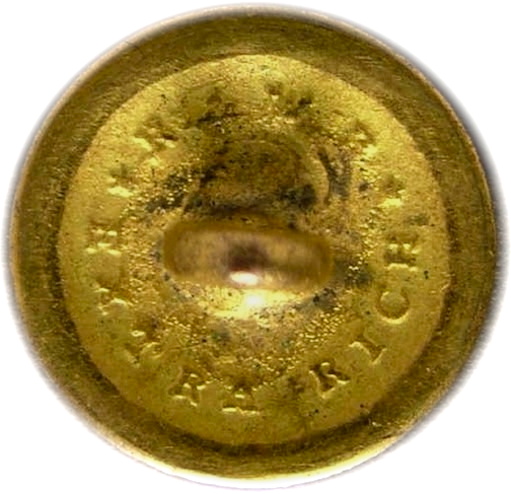
1830-40's Mass. National Lancers Co. A 1st
Battalion Light Dragoons
Color: A Golden Brass Yellow.
Metal: Low Convex, 1-Piece, Raised Design,
Gilt Brass.
Size: 14mm.
Albert's Number: Similar to MS73:-Unlisted
Cuff Size Variant
Tice's: MS258As.1
Variation: Hat or Cuff Size.
Present Condition: A Non Excavated Example,
Exceptional Planchet Casting, Exceptional High
Relief Pattern.
Isabela's Notes: This Light Dragoon's unit
organized in Boston in 1837, even though Robinson
made these buttons around 1835. This would be the
earliest known pattern to be used by this unit. The
button's high relief pattern depicts the old english
initials "NL" in the center of a lined field. There
is a thin flat border circling around the field's
edge. In the Civil War, this unit served in the 1st
Massachusetts Cavalry with distinction.
Reverse Button Analysis: This is a slightly
concave one-piece button with a loop shank. The
shank is original, straight, and intact. *R & W.R*
EXTRA RICH rm
|
 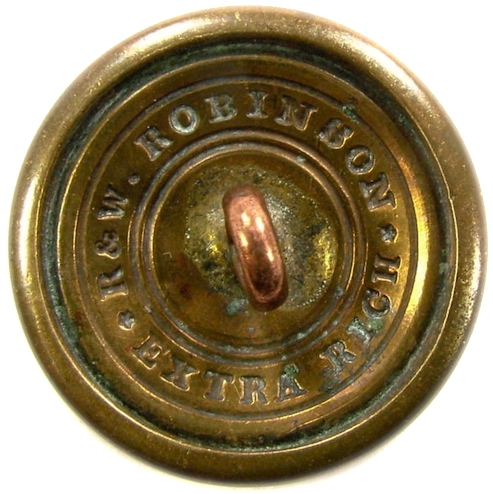
|
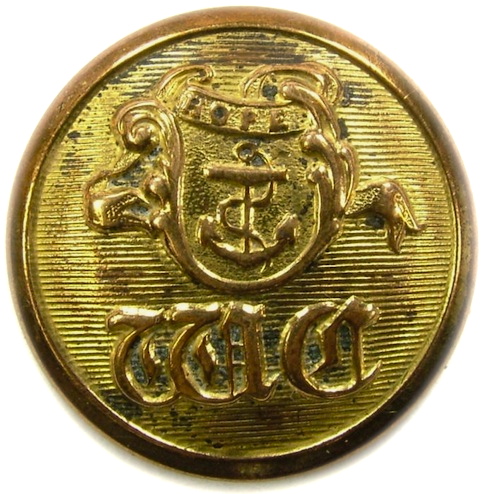
1835-55 Rhode Island's Washington Cavalry
Color: A Golden Brass.
Metal: Low Convex, 2-Piece, Raised Design, Gilt
Brass.
Size: 22.7mm.
Albert's Number: RI 35-A: RV 20
Tice's Number: RI 251A.1
Present Condition: A Non Excavated Example,
Strong Planchet Casting, Strong High Relief Pattern.
Isabela's Notes: The Washington Cavalry buttons
were produced by R & W Robinson for about 20 years, from
1835 to 1855. The button's pattern depicts Rhode
Island's state seal of a graphic style shield with a
raised anchor inside. The anchor has a rope coming off
the top ring's left hand-side that goes under the stock,
shaft, and fluke and hangs below the crown. The word
hope is in a small banner in capital letters on top of
the shield. The initials for Washington Cavalry,"WC" in
raised Old English letters below the shield. The pattern
is set on a convex lined field, with a thin raised flat
edge border. The Robinson back mark on the specimen
above dates to the early 1840's.
Reverse Button Analysis: This is a slightly concave
two-piece button with a copper loop shank. The original
shank is original, straight, and intact. There is a
slight push around the shank. *R & W. ROBINSON.* EXTRA
RICH* dm between one outer solid ring, and two inner
solid rings.
Picture Courteous of Harry Ridgeway. |
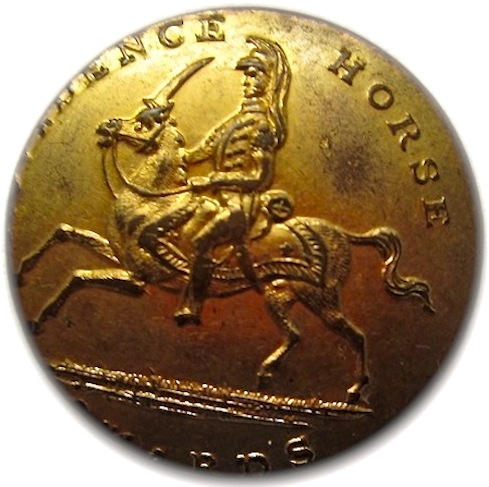 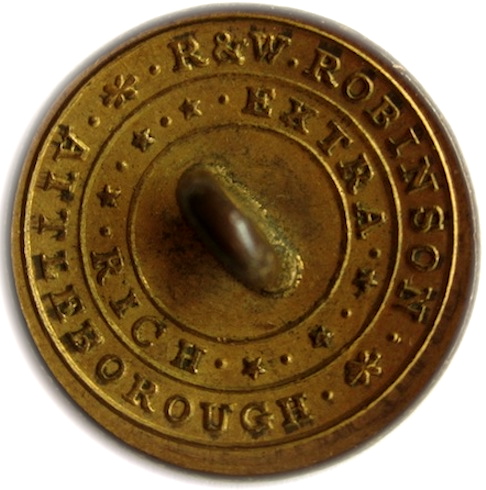
1842-48 Rhode Island
Providence Horse Guard
Color: A Golden Brassy Brown.
Metal: Low Convex, 1-Piece, Raised Design,
Gilt Brass.
Size: 22mm.
Albert's Number: RI 27-A: RV 25
Tice's Number: RI 233A.1
Present Condition: A Non Excavated Example,
Exceptional Planchet Casting, Exceptional High
Relief Pattern.
Isabela's Notes: The Providence Horse Guards
originally formed in 1842, but disbanded a few years
afterward because interest in military assemblages
wained. In 1861, they reformed again into a larger
size regiment for the Civil War. The 1st Rhode
Island Cavalry was composed of two parts, the RI
Horse Guard, and the New Hampshire cavalrymen. The
button's pattern depicts a mounted Dragoon or
Cavalryman on a galloping horse while wielding his
Saber. Most of the original early year buttons were
struck off center, and the examples found appear to
be in near mint condition. Robinson was accredited
to manufacturing this pattern throughout most of the
1840's.
Reverse Button Analysis: This is a slightly
concave one-piece button with a loop shank. The
original shank is original, straight, and intact.
.*.R & W. Robinson .* Attleborough.*/ *.*.*.
Extra.*.*.*. RICH Triple Raised Ring.
The RJ & Debra Silverstein
Collection.
|
|
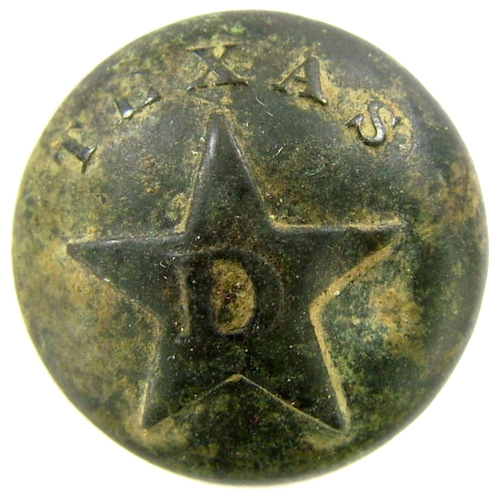
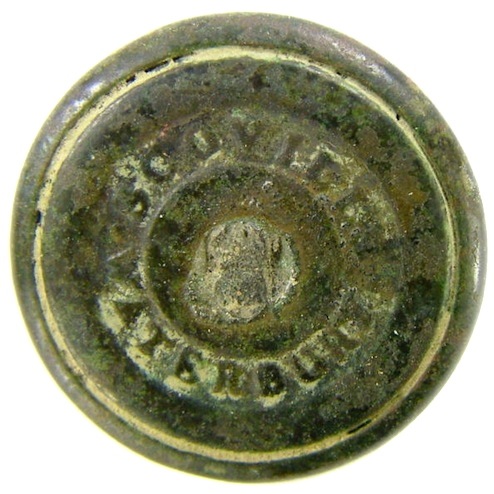
1830-40's Republic of Texas Dragoon's
Color: A Golden Brassy Brown.
Metal: 2-Piece, Low Convex, Raised Design, Gilt
Brass.
Size: 19.3mm.
Albert's Number: TX 9 RV 100
Tice's Number: TX 216-A.1
Present Condition: An Excavated Example, Strong
Planchet Casting, Strong High Relief Pattern.
Isabela's Notes: As an independent country from
the U.S., Texas needed to form their own Army to defend
against the Mexicans. The button's pattern depicts the
Lone Star in the center of the button with a raised, "D"
in the middle. The states name, "TEXAS" is arced above
in large capital letters. The whole pattern is set on a
low-convex plain field.
Reverse Button Analysis: This is a slightly
concave one-piece button with a loop shank. The original
shank is missing. SCOVILL / WATERBURY rmdc.
Picture Courteous of Harry Ridgeway. |
.
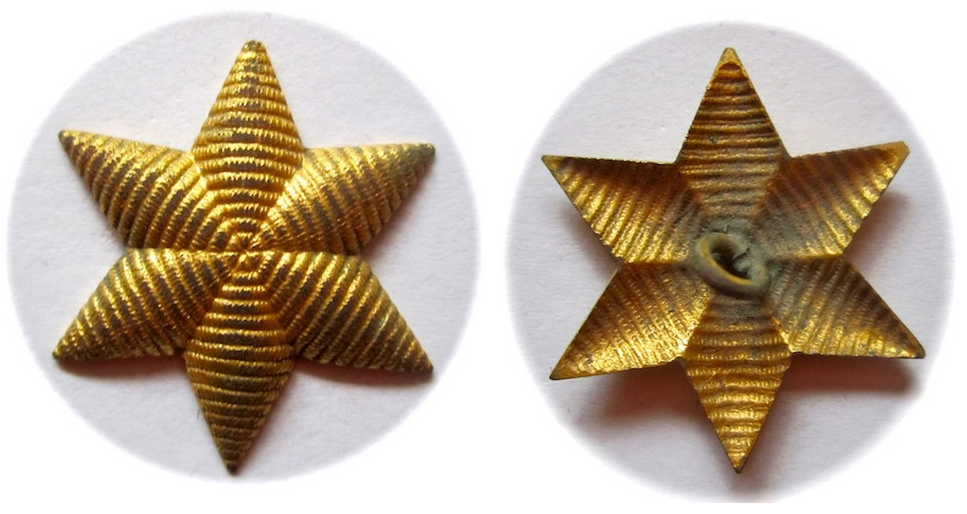
1833-42 U.S. Army
Officer's 6 Pointed Star False Embroidered
Insignia (DRAGOONS)
Color: Golden Age Yellow.
Metal: 1-Piece, Convex, Raised Embroidery
Design, Gilt Brass.
Size: 26mm.
Present Condition: An Excavated Example,
Exceptional Planchet Casting, Exceptional High
Relief Pattern.
Isabela's Notes: This button style
insignia was used on Officer's hats. The button
depicts a Six Pointed Embroidered Star.
Reverse Button Analysis: This is a
one-piece button with a loop Shank. The shank is
original, straight, and intact.
Excavated in a Confederate Camp in South
Alabama/Mississippi Border by Mike Singer.~
The RJ Silverstein
Collection.
|
.JPG) .JPG)
1840's Federal Mounted
Riflemen
Color: A Golden Brass Yellow.
Metal: Convex, 1-Piece, Raised Design,
Gilt Brass.
Size: 20mm.
Albert's Number: RF 15-B/Unlisted
Backmark: RV 10
Tice's: RF200A.-Unlisted Variant/Backmark
Variation: Raised R in Small Shield /
Eight Petal Laurel Stem
Present Condition: A Non Excavated
Example, Exceptional Planchet Casting,
Exceptional Bas-Relief Pattern.
Isabela's Notes: This early one-piece
button was most probably the transitional button
for when the "2nd Dragoons" became the Mounted
Rifleman in 1842. From the back mark on this
button it indicates 1830's manufacture. This
most likely was one of the first one-piece
buttons issued to the new mounted service of
Riflemen, and was issued before the two-piece
buttons later replaced them. Tice does note in
his book of Uniform Buttons of the US, that the
later 1842 buttons that were two-piece buttons
used the same dies as the earlier one-piece
buttons. For this early one-piece, there are
several (5) die variants known by 1840's
manufacturers for this pattern. Not sure why
Albert gave this early one-piece a low RV
rating, I found early riflemen one-piece buttons
very difficult to come by, compared to the
Artillery or Infantry one-piece counterparts,
and when i do see them for sale, they usually
demand a premium. The button's pattern depicts a
spread eagle facing right with a small recessed
shield on it's breast. Within the shield is
a raised initial, "R" for Riflemen. In the
Eagle' right talon is a long eight petal laurel
stem. In the eagle's left talon is a small
bundle of three arrows pointing left. The high
relief pattern is set on a convex plain field.
Albert did note in his book that there are
slight variations in the letter, "R", and also
the shape and size of the shield. Records
indicate these Mounted Rifleman most likely used
muzzle loading 1841 rifles.
Reverse Button Analysis: This is a
slightly concave one-piece button with a
soldered on loop shank. The shank is original
and intact. 5 rm rings .*.*.*.*.*.*.*.*
The RJ & Debra
Silverstein Collection.
Robert's Notes: This
doesn't mean that the all the Dragoons turned
into Mounted Rifleman at this point.
|
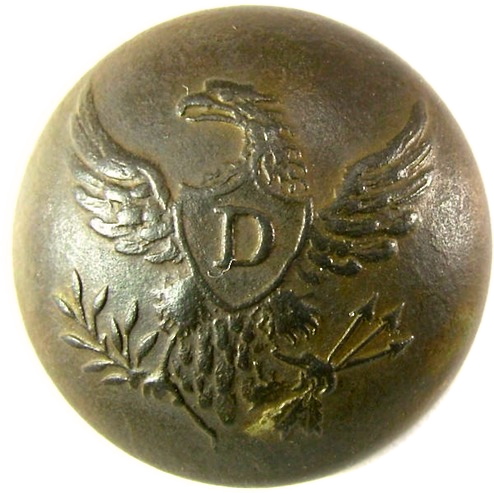 
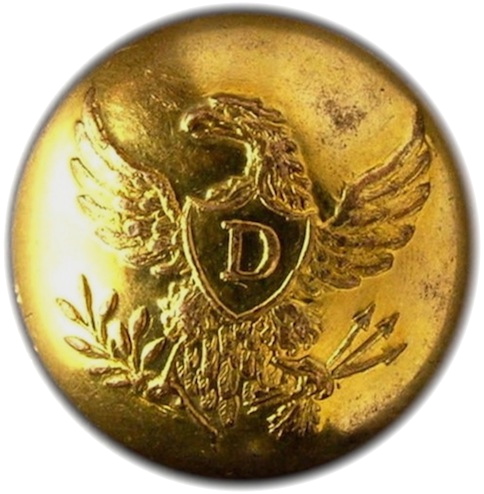
1830's U.S. Dragoons, Mounted Service
Color: A Deep Brown with Golden Highlights.
Metal: Convex, 2-Piece, Raised Design, Gilt
Brass.
Size: 19.3mm.
Albert's Number: DR 3A-5: RV 10
Tice's Number: DR206A.13
Variation: Goose Neck Eagle / Wide Shield /
Narrow Long Wings.
Present Condition: An Excavated Example,
Strong Planchet Casting, Strong High Relief
Pattern.
Isabela's Notes: This button was intended
for Dragoon officers. The button's pattern depicts
a goose-neck spread eagle facing right with long
narrow wings. In the eagle's right talon is a short
nine petal laurel stem, and in it's left claw is a
bundle of three arrows pointing upward to the left.
There is a wide raised shield on the eagle's chest
with a raised initial, "D" for dragoons. There are
over 20 manufacturer die variants for this pattern
between the sizes of 19-21mm. All were made during
the 1830-40's.
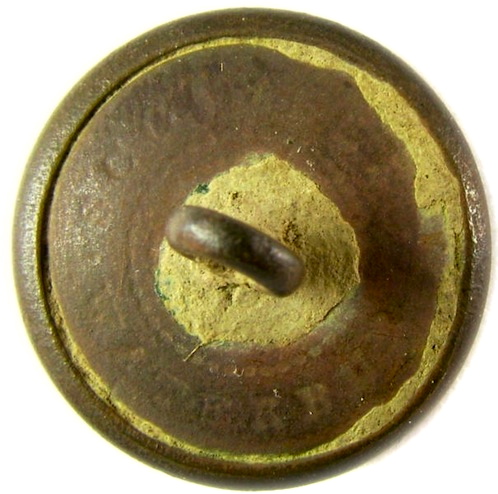
Reverse Button Analysis: This is a two-piece
button with a loop shank. The shank is original,
straight, and intact. .SCOVILLS./WATERBURYdm
Picture Courteous of Harry Ridgeway.
|
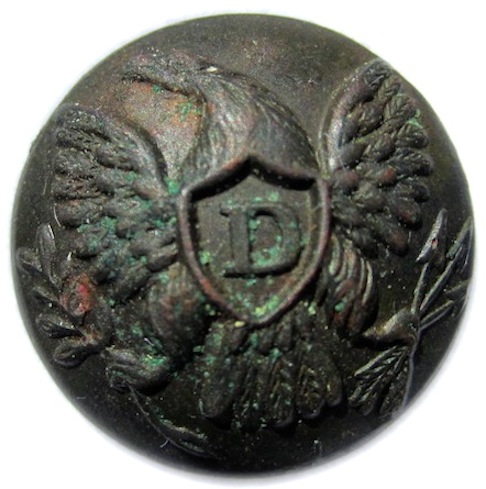 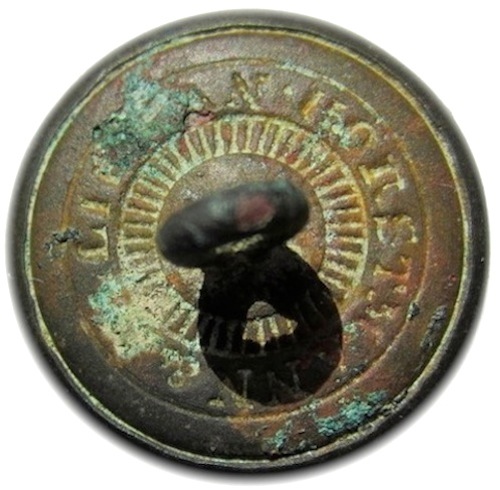
1842-61 U.S. Dragoons, Mounted Service
Color: Chocolate Brown with Green Encrustations.
Metal: High Convex, 2-Piece, Raised Design,
Brass.
Size: 21mm.
Albert's Number: DR 4: RV 10
Tice's Number: DR215A.12
Variation: Deep-Wide Recessed Shield /
Symmetrical Eagle
Present Condition: An Excavated Example, Strong
Planchet Casting, Strong High Relief Pattern.
Isabela's Notes: This button's pattern depicts
a symmetrical spread eagle facing right. On the eagle's
chest is a deep-wide recessed shield , that has a raised
initial, "D" for Dragoons within. In the eagle's right
talon is an eight petal laurel stem. In the eagle's left
talon is a small bundle of three arrows pointing upward.
The high relief pattern is set on a convex paladin field
with no edge border.
Reverse Button Analysis: This is a two-piece
button with a loop shank. The shank is original,
straight, and intact. . HORSTMANN & ALLIEN. NY dm ring.
Excavated at Fort Pendleton, North Carolina in 1976.~
The RJ& Debra Silverstein Collection. |
.jpg) 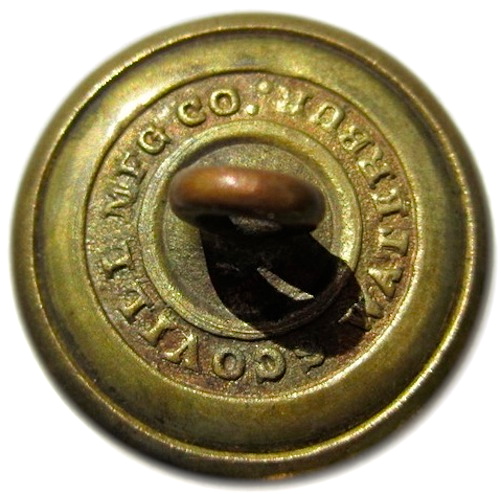
|
1842-61 U.S. Dragoons, Mounted Service
Color: An Olive Brass Yellow.
Metal: High Convex, 2-Piece, Raised Design, Gilt
Brass.
Size: 22mm.
Albert's Number: DR 4: RV 10
Tice's Number: DR215A.2
Variation: Symmetrical Spread Eagle / Wide Deep
Recessed Shield.
Present Condition: A Non Excavated Example,
Exceptional Planchet Casting, Exceptional Low-Relief
Pattern.
Isabela's Notes: This specimen is a different
die variant from scovill's manufacturing. The button's
pattern depicts a more fuller and symmetrical
spread-eagle facing right. There is a deep-wide recessed
shield with the raised initial, "D" for dragoons. In the
eagle's right talon is a short close petal laurel stem.
In it's left talon is a small bundle of three arrows
pointing upward. The high relief pattern is set on a
plain convex field with no edge border.
Reverse Button Analysis: This is a two-piece
button with a loop shank. The shank is original,
straight, and intact. . HORSTMANN & ALLIEN. NY dm ring.
Excavated also at Fort Pendleton, North Carolina in
1976.~
The RJ & Debra Silverstein Collection.
|
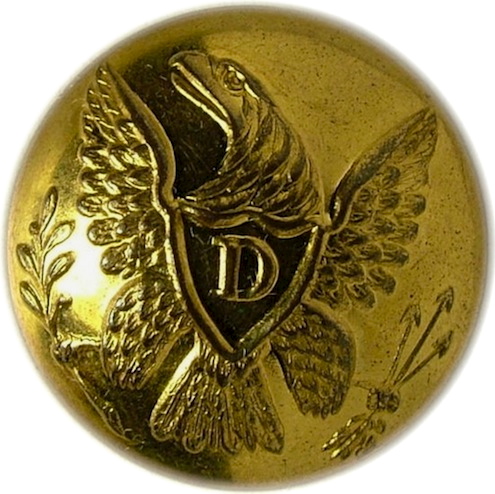 
|
1842-61 U.S. Dragoons,
Mounted Service
Color: A Deep Brown with Golden Highlights.
Metal: High Convex, 2-Piece, Raised Design, Gilt
Brass.
Size: 22.3mm.
Albert's Number: DR 4: RV 10
Tice's Number: DR215A.14
Variation: Twist Feather Neck
/ Narrow Pointed Recessed Shield.
Present Condition: A Non Excavated Example,
Exceptional Planchet Casting, Exceptional High Relief
Pattern.
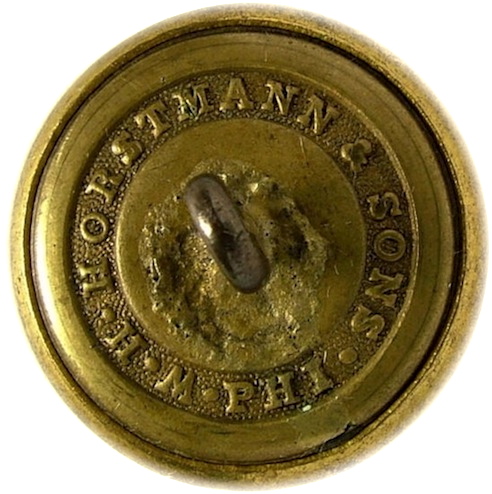
Isabela's Notes: This backmark indicates that it
was manufactured by Steele & Johnson in the 1850's. This
officer's button depicts a twist feather
neck spread-eagle facing right. On the eagle's chest is
a narrow pointed recessed shield with a raised initial
"D" for Dragoons. In the eagle's right talon is a long
stem seven petal laurel stem. In it's left claw is a
small bundle of three arrows pointing upward. The high
relief pattern is set on a high-convex plain field with
no edge border.
Reverse Button Analysis: This is a two-piece
button with a loop shank. The shank is re-soldered, but
straight, and intact. .W.H.HORSTMAN & SONS/PHI. rmdc
|
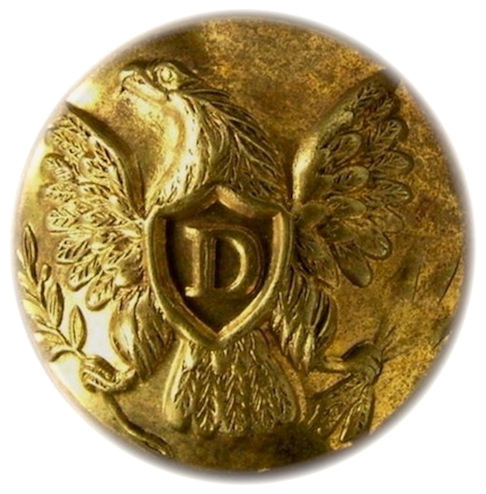 
1860-61 U.S. Dragoons, Mounted Service
Color: A Deep Brown with Golden Highlights.
Metal: Convex, 2-Piece, Raised Design, Gilt
Brass.
Size: 22.3mm.
Albert's Number: DR 4-A.2: RV 10
Tice's Number: DR215A.11
Variation: Wide Deep Recessed Shield.
Present Condition: A Non Excavated Example,
Exceptional Planchet Casting, Exceptional High
Relief Pattern.
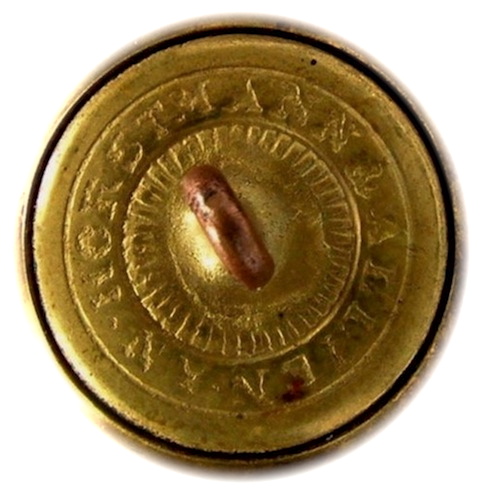
Isabela's Notes: This later backmark
indicates that it was manufactured by Steele &
Johnson in the early1860's. This officer's button
has a chased quality to it's conception. At this
point, manufacturers were taking orders from
officers for chasing their buttons. This button
depicts a symmetrical spread-eagle facing right. In
the eagle's right talon is a long stem seven petal
laurel stem. In it's left claw is a small bundle of
three arrows pointing up and to the left. On the
eagle's chest is a deep recessed shield with a
raised initial, "D" for Dragoons. The high relief
pattern is set on a convex plain field with no edge
border.
Reverse Button Analysis: This is a two-piece
button with a loop shank. The shank is re-soldered,
but straight, and intact. HORSTMAN & ALLIEN within 2
ring dm with inner ring of rays dm
|
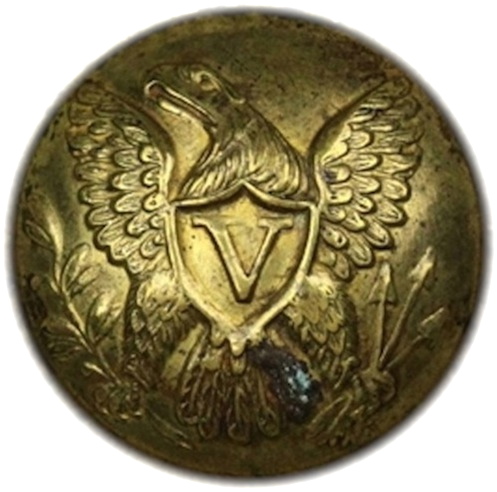 
|
1847-48/65 Voltigeurs & Foot Riflemen
Color: A Brass Yellow.
Metal: High Convex, 2-Piece, Raised Design, Gilt
Brass.
Size: 20mm.
Albert's Number: VG 2-A: RV 35
Tice's Number: VG215A.1
Variation: Raised "V" in Wide Recessed Shield.
Present Condition: A Non Excavated Example,
Exceptional Planchet Casting, Exceptional High Relief
Pattern.
Isabela's Notes: In 1847 during the Mexican War,
Congress authorized a Regiment of Voltigeurs and Foot
Rifleman to specialize in Mountain warfare. This
regiment was going to be organized and trained to fight
with long rifles within the mountainous terrain with the
support of both rocket, and howitzers. Originally the
idea was for a special unit, with half of it's men to be
mounted, and the other half were to be on foot. The
intent was for each horsemen to be paired with a foot
soldier who was to get up behind him for rapid
movements. However, this arrangement was never used, and
Voltigeurs became a Regiment of Foot Rifleman armed with
the muzzle loading model 1841 rifle. This was the same
as the Regiment of Mounted Rifleman. The term Voltigeurs
was taken from the french word,"Volitger" which means to
leap of tumble. The Voltigeurs was disbanded in 1848 at
the close of the Mexican War. Some advanced collectors
believe the left over stock was issued to Virginia
troops during the Civil War because the "V" within the
shield could stand for Virginia. The button's pattern
depicts a spread-eagle facing right. On the eagle's
chest is a wide recessed shield with the initial, V" for
Voltigeurs. In the eagle's right talon is a long stem
ten petal laurel stem In it's left talon is a small
bundle of three arrows pointing upward. The high relief
pattern is set on a plain high-convex field with no edge
border. General Order Number 7 > gilt same as for the
mounted rifleman, except they shall bear the letter
"V".
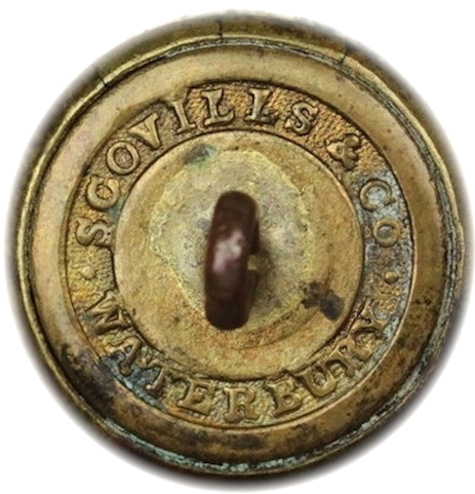
Reverse Button Analysis: This is a one-piece
button with a loop shank. rmdc . SCOVILLS &
Co/WATERBURY.
The RJ Silverstein Collection. |
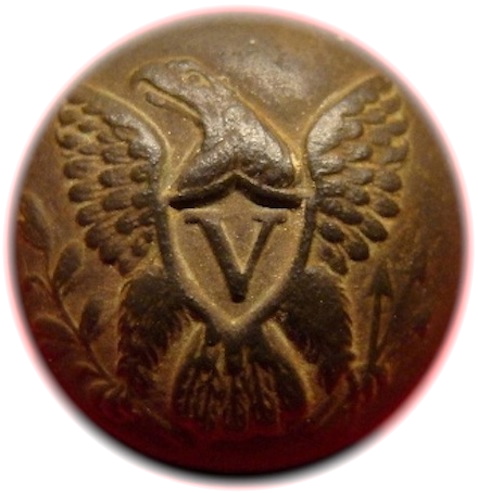 
|
1847-48/65 Voltigeurs & Foot
Riflemen
Color: A Golden Brown.
Metal: High Convex, 2-Piece, Raised Design, Gilt
Brass.
Size: 20mm.
Albert's Number: VG 2-A: RV 35
Tice's Number: VG215A.1
Variation: Raised "V" in Deep Recessed Shield.
Present Condition: An Excavated Example, Strong
Planchet Casting, Strong High Relief Pattern.
Isabela's Notes: In 1847 during the Mexican War,
Congress authorized a Regiment of Voltigeurs and
Rifleman to specialize in Mountain warfare. This
infantry regiment was going to be organized and trained
to fight with long rifles within the mountainous terrain
with the support of both rocket, and howitzers. The term
Voltigeurs was taken from the French word, "Volitger"
which means to leap of tumble. The regiment was
disbanded in 1848 at the close of the Mexican War. Some
collectors believe the left over stock was issued to
Virginia troops during the Civil War because the "V"
within the shield could stand for Virginia. The button's
pattern depicts a spread-eagle facing right. On the
eagle's chest is a wide recessed shield with the
initial, V" for Voltigeurs. In the eagle's right talon
is a long stem ten petal laurel stem In it's left talon
is a small bundle of three arrows pointing upward. The
high relief pattern is set on a plain high-convex field
with no edge border.
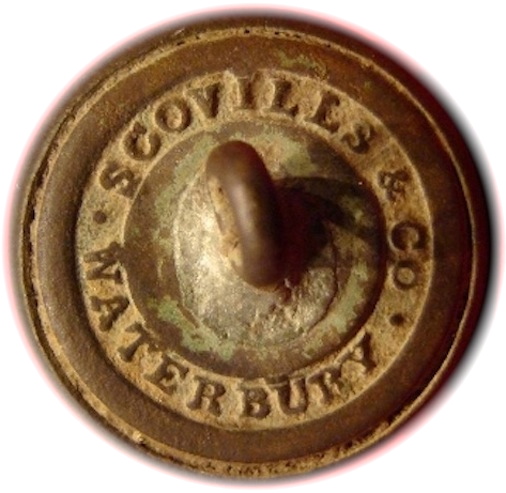
Reverse Button Analysis: This is a one-piece
button with a loop shank. rmdc . SCOVILLS &
Co/WATERBURY.
The N. Pruit Collection. |
GO BACK -
TOP
|