|
~
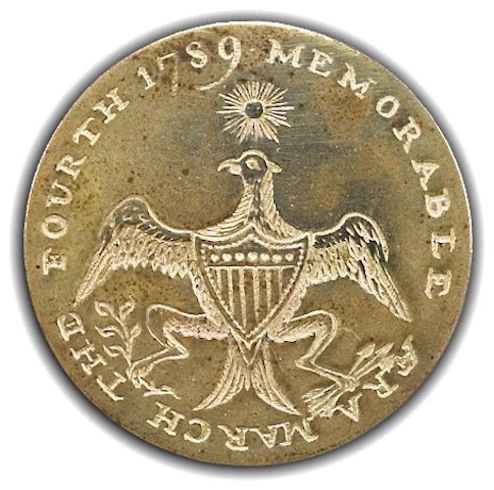
George Washington Inaugural Buttons *
1789 New Nation Tribute Buttons
* George Washington Inaugural Buttons
~
~ It's Been A Long
Journey, So lets
Begin with Some Basics
~
A Blank Metal
Disc:
A Planchet is the numismatics' name given to a blank metal disk that
is usually made through the combining of different metals together
through the action (heat degree) of a furnace. This process was used
for thousands of years to produce stronger metals such as: Brass, Bronze,
and Copper. There is also the pure elements (or diluted elements)
such as, Silver or Gold that was used for the manufacturing of coins or buttons.
In the late 18th Century, this was still considered secret knowledge
and only known by certain individuals who carefully guarded their
skill sets by living away from populated areas in isolation.
Metallurgy Mixes for Blank Planchets:
BRASS:
is a yellow alloy of Copper and Zinc.
BRONZE: is a yellowish alloy of Copper with up to
one-third Tin. (This was the second metal to be used by
humans).
COPPER: is a red-brown metal. The chemical
element of atomic number 29, periodic symbol Cu. (The
first metal to be used by humans).
GOLD: is a yellow precious metal. The chemical
element of atomic number 79, periodic symbol Au. When a
button is noted to be Gilt, this refers to Gold Leaf or
Gold Wash (Paint) this is referring
to a thin coating of Gold that is applied or brushed onto the
surface. A button might be completely made of Gold
also.
PEWTER: is a gray allow of Tin with Copper and
Antimony (Formally Tin and Led).
SILVER: is a shiny white-grayish metal, chemical
element of the atomic number 47, periodic symbol Ag.
When a button is noted to be Silvered, or Silver Washed
(White Washed) this is referring
to a thin coating of Silver that is applied or brushed
onto the
surface. A button might be completely made of Silver
also.
Learning the Color
of Metals in Buttons and Coins:
BRONZE: has the broadest Spectrum of Colors, Black,
Brown Blue, Green, Red, and a bright rich Gold.
BRASS: mostly known for Yellow, but can have Blue, a
Verde (Green Marble with white veins) Antique, Green, and
Dark Red/Burgundy.
COPPER: is a Reddish ~ Brown Metal that has various
combined color shades in-between.
GOLD: is a deep lustrous Yellow, or Yellow-Brown Color.
PEWTER: is a Silver-Gray Metal that can have various
lighter or darker shades.
SILVER: is a shiny Grayish-White metal.
What is the difference & benefits between
Silver-Wash and Silver-Plating:
Silver Wash is a term
used to define the process of how a button was Silvered by
a Jeweler before the introduction of electroplating in
the mid 1820's. Early officer's buttons during the War
of 1812-1815 were known to have used this
process. It would often serve as a distinguishing
characteristic to highlight the difference between an
officer and a regular enlisted men's uniform. These silver-wash
buttons used an
amalgam process, which unfortunately left worn or bare
spots from an individuals constant finger placement when
buttoning and un-buttoning their garments. The
silver-wash process usually entailed someone hand
brushing "Washing" liquefied Silver & Mercury onto the
button's surface. Then the button was placed in an oven,
and the heat would evaporate off the Mercury leaving a
thin silver coating that was fused onto the surface
of the button. This process was kind of archaic, and the
Silver-Wash on the button didn't hold up after extended
use/wear. A better manufacturing method was needed by
Jewelers to correct this problem and Silver-Plating
(Electroplating) was introduced somewhere in the early 1820's.
This new process coated the whole button uniformly, and gave
the button a more even coat throughout. Also, electroplated
buttons didn't wear down as fast or "rub-off" in
contact areas.
This new electroplating process with silver and gold was
a giant leap in the manufacturing of buttons. Jewelers
and metallurgist's noted that certain metals such as,
copper had an affinity
toward silver, and brass had an affinity toward
gold.
Who made George
Washington, New Nation Tribute, & Jacobite Buttons:
This section is just going to give GWI collectors who
subscribe to my web site an overview of my research, and
not the direct answers that I will publish later with
all my findings. GWI button
collectors have always believed that George Washington
Inaugural, New Nation, and Jacobite buttons were
crafted and designed by unknown "American-born" artisans and craftsman who made copper
hardware, jewelry, and coins.
This would be inaccurate to believe and not the case for
these three types of buttons.
One must put aside the aspect of American manufactures and look
at who was engraving items during this era. Before we
begin our journey, collectors must realize there
is a distinguishable difference in the
level of artistry
between these three
types of buttons and other manufactured buttons of the
era. These three types of buttons each have a
subcutaneous hidden
meaning that is overlooked when studying the symbolism of the pattern.
These engravers who were part of the guild would add a
subcutaneous meaning using symbols that were within the
engraved lines. Because of there microscopic nature of
these symbols or maker's marks, they would not be
apparent or noticed by the common
citizen (Collector) that was outside the guild or Freemasons. We
also see examples of hidden symbols and maker marks that are within
Masonic stone structures,
state and federal government currency notes, coins, official seals,
and maps. For thousands of years personal
family crests and seals would also have these
non-apparent symbols secretly engraved. So for these historical
GWI buttons a
collector should note that each button holds both a
historical subcutaneous meaning to the engravers as well
as an obvious political statement.
My historical
research into these button's symbols afforded me with a
conclusion that there is three distinguishing types of
buttons made for the celebration of events for April
30th 1789.
Before we begin, a collector must take note to the
significance of Rattlesnake buttons that were made prior
to 1789, and then it's continuance afterward for a short
period of time. These type of
patriotic buttons represent a political statement that
is just straight forward for all collectors and historians
understand. There is no hidden subcutaneous layer of meaning
within that have secret
Freemason symbols or Jacobite attributions.
From my research I have
come to conclude that there are three types of
celebratory 1789 buttons: George Washington
Inaugural buttons, New Nation Tribute buttons, and
Jacobite buttons.
These three distinguishable buttons were produced and sold at the same time, and
most likely offered for sale side by side.
All three types of buttons were made by the same group
of men that were all members of the engravers guild
who held the knowledge and secrets of several arts that
were not known to the
common Coppersmiths or Jewelers of the era. I was able
to learn all these peoples names by studying other
historical artifacts in the arts of map making, seal
making, state currency plates, coins, and even portrait
paintings.
(Actually several other fields, but list would be a paragraph
long).
All these buttons were made by a Jacobite Master and
his 4-5
Free-Craft level apprentices that operated within the
engraving guild. Each of the colonies/states had their
own apprentices and the Master would travel throughout
the states teaching them the skills needed for each
project they were commissioned for.
All had an association with
Freemasonry, but this should not be an emphasis when
studying these buttons aside from their member
association.
Only these men inside of the engraving guild would be
privy to the secret knowledge or have the skill set
necessary for engraving these higher quality buttons.
One should make special note that the Master Engraver
was the only true holder of the secret knowledge and
skills in the engraving arts.
Free-Craft level apprentices would only be taught what
was necessary for the project that was worked on. So,
one can conclude with the prominent social structure
that was in place, it was irrelevant that the Free-Craft
level apprentice might have possessed gifted skills to
the public.
All commissioned work would have been commissioned under
the Master Engraver's name.
All these men in the engraving guild protected their
skills by barring entry to the guild by the common
un-educated American-born Jewelers, Coppersmiths, or
even the blacksmiths who produced metals and tools for
their crafts. To these foreign-born social standing men,
America was a
work-address
that they have braved across the ocean in order to make
money, or a return on their families investments. The
ones that wanted to make America a home were looking to
get out from under their counties guilds that would have
already penetrated & saturated their commerce market. There are
several other fields outside of engraving that attracted
highly skilled artisans from other countries that a
collector should note such as, watch making, or stone
masonry. Remember, with a New Country there would be
financial opportunity and a
need for skilled products, and these men would have
wanted to have used their secret skills and knowledge for prosperity. Meaning
there was lots of opportunities in a new land without
the burden of 1000's of years of guild establishment.
Being a graduate in
Political Science from the Pennsylvania State
University, I was afforded the opportunity of an
in-depth study of the late 18th Century American business
infrastructure with the emergence of a new political
arena in conjunction with commerce. This allowed me to combine the knowledge of both
politics and the art of button making in finding the
right answers that have eluded collectors for centuries.
As many researchers before me, I traveled down the same
wrong roads
as many other button collectors when trying to determine
who really created these inaugural buttons. Researchers
tend to automatically look toward the Manufacturers who
made these buttons or where the raw materials came from.
If a researcher took this road he would only come up
blank.
This is the Trap, and the reason why historians came up
blank. I call it simply, "the wrong road".
I knew there was a larger piece of the puzzle missing,
and I would have to start my thinking out-side the box of
manufacturing! The study had to be on the people who
were in control of the American business infrastructure
in all areas of economic prosperity.
I knew
automatically these men would not be American-born
citizens simply because they would not have been privy to the
special skill sets necessary for the ornate master pieces of works these buttons
truly are.
This kind of
training was only afforded to the lucky ones of certain
bloodlines or from a marriage into the bloodlines. With
my
"New Revelation"
it became
crystal clear to me who these men are, and my new
path of investigation ended up giving me all the answers
to both the secret symbolism and men
who created these works of art. I will base all my conclusions with
concrete evidence with the use of other historical
products made during the
same time period.
Since
receiving my
degree in Political Science from Penn State University
in 1988, I can honestly say that history books have the post-colonial
American business infrastructure all wrong in most books up until the
early 1800's. I truly believe there are present-day scholars holding
back secret information from history books and the
American public. For some unknown reason they refuse to
share the reality of how the American business
infrastructure was controlled and by who. My theory is
that these men of the late 18th century were all foreign
born and not American-born citizens that were
privy to the skill sets needed to make America's dream
turn into reality. It will not be until much later when the real American-born entrepreneurs
like Rockefeller, and then later Ford come into the
fast-changing infrastructure of the Industrial
Revolution.
** I
will publish my New Findings by using a collaboration of
experts in several fields including, Alchemy,
Freemasonry Guilds, numismatics, and map & seal making. If everything
goes good I will publish my works in 2015-2016.
- Robert J. Silverstein
Who were the American
Manufacturer's that used the engraved Steel Dies for
Production:

There are a few specific coin makers who were attributed for some of the
raw materials used in the construction of these buttons.
There is also records and dug specimens attributed to
popular designs found in certain states, such as, New York, Connecticut,
South Carolina, and Pennsylvania.
Because England lost
the war, and the failing support for the French some
years later, we believe none of these inaugural
buttons would have been offered for sale in England
or France. I believe that to be true. Even though my New
introduction of GWI 24 was found in England, I was able
to attribute that to a specific person that was the son
of one of the original engravers who was a military
officer in Britain during post-colonial times.
Just to note, there is only one button in 225 years,
(GWI
24 Heraldic Eagle with Inverted Diamond shaped Indentees
that was excavated out of the United States (Northfolk,
England). Otherwise all these early patterns are
inherent to the US). Finding out a specific person or
manufacturer of a specific design or pattern is very difficult to discover.
On the manufacturing side of our investigation, all we can do is find out who
would have had the access to raw materials, or trace the
origins of the materials used in the construction of
these buttons. Fortunately for us there were some remaining manufacture's records
of ordered or supplied materials with dates. We know that Pennsylvania and
South Carolina obtained their copper from England, and
that North Carolina got theirs from Switzerland. New York got
their Brass, Bronze, and Copper from smelting down the
old canons and mortars that were left over from the
American Revolution. Most of these were left in the
Newburgh-West Point Area. The smelting process of canons and
mortars is done by the action temperature of a furnace.
The heat would part the Zinc from the Brass, and the
Copper would be procured through the fire, and then
poured into a mold for making a blank planchet. The Bronze
planchets were made in a similar fashion.
Once the Copper is procured from the smelting process,
Tin would be added-in to make Bronze. Massachusetts
obtained their metal from an old canon factory in Bridgewater. The factory still had the brass racks from
the machines that were used to bore out canon barrels.
The New Jersey artisans who made copper coins had
several sources available to them. They were able to buy
their Copper straight from local mines, and some was
also purchased from Thomas Machins of New York, and a
part of their supply was imported from England, who
in-turn bought it from Sweden. Connecticut obtained most
of their Copper from Granby-Simsbury Copper Mines. We
also know that the Federal Government had tons of Raw
Copper which was ear marked for coining in New Haven
Connecticut, so a portion of this might have been
indirectly available for buttons.
These are some of the manufactures who produced the blank
metal
Planchets for the G.W. buttons
1) Thomas Machin & Co. Of New Grange, (Newburgh) New
York: Records indicate that Machin Mills in New
Grange (Newburgh) N.Y. was able to salvage the Bronze,
Brass, and Copper by procuring the old Revolutionary War
Brass cannons and mortars and smelting them down.
T. Machins also furnished blanks for the coiners of
Vermont and Connecticut as well in 1789.
2) Weatherlee & Co. of Boston,
Massachusetts: They obtained their metal planchets
by smelting the old Brass Racks from the machines used
for boring out cannons. Records indicate there was an
old Cannon factory located in Bridgewater.
3) Broome & Platte, Morris Cove and Westville, and
Mark Leavenworth of New Haven, Connecticut: These
three companies were able to get their metal from John
Higley at Granby-Simsbury Copper Mines.
4) Walter Mould of New Jersey: Obtained his blanks
from Thomas Machin & Co. in Newburgh, N.Y., and also
furnished blanks to coiners of Vermont and Connecticut
in 1789.
5) Harmon & Buel, Town of Rupert, Vermont:
received it's blanks from Thomas Machin of New Grange
N.Y.
I like use a Five Point Scale for the
button's planchet condition, and remaining strike impressions:
1) Exceptional
2) Strong
3) Good
4) Fair
5) Poor
Digger's
Notes:
A visual inspection alone
of a GW or Birth of a New Nation button can not give us it's actual metallic
make-up. A button's metal content must sampled for a
metal ratio composition test to determine what the
actual composition is. This doesn't mean that
we can't visually tell the difference between Brass,
Copper, Bronze, Gilt, or Silver, but after being buried
for the better part of 225 years, and the metal has
succumbed to environmental decay and corrosion, we just cannot be 100%
certain by looking at it's color. If someone didn't tell
us they added Tin to Copper, how do we know that Black
button isn't Brass instead of really being Bronze? Plus
even if they weren't excavated, many GW were smelted
from other fabricated diluted materials, so the metal
purity percentage of each separated element would be a
different ratio from each batch of planchets produced
for blanks. So where does this leave us without testing?
One can use their vast experience of handling metals
over the years. One can formulate that Copper is a
softer metal then brass, and can take an impression much
deeper and clearer, or Bronze can be a certain array of
colors that other metals just wouldn't have. Other ways
would be from written documentation of what the
manufacturer said they were made of. Within my library
pages you will be able to gain knowledge about the
different aspects of buttons to help you formulate
knowledgeable answers on your own, but nothing could be
certain without a scientific metal composition test.
Steel Die Making: Engravers and
Blacksmiths:
The art of engraving steel dies by various Artisans
hasn't really changed in 250 years. It wasn't until the
introduction of pneumatic air tools that changed the art
for the better. In both Colonial and Post-Colonial times
an engraver would go to a blacksmith to have his various
tools made. There were several sizes and widths used by
these men and they had to be tougher then the soft metal
they engraved in. A blacksmith who was skilled at the
art of Alchemy and Metallurgy would forge and temper the
steel rod tips many times to achieve a desired hardness
in the metal that would be strong enough not to break or
dull. With these strengthened tools, the engraver would
cut a pattern into a soft round steel hub die. This
steel die was then given back to the Blacksmith to
temper & fire. This temper process would make the steel
die super strong. Probably stronger then the tools used.
This steel die had to stand up to multiple strikes or
pressures of machine rollers without degrading the
pattern. So in a nut shell, the engraver used a harder
steel tool to cut into a softer steel. Then the steel
hub would be fired to full strength to use in
production.
The Master's Engravings, Steel Dies, and
Numbers Known:
"When i began my quest 20 years ago there were around 750
:
Today I estimate 1300".
* There are only three
masters buttons known to exist that show the Hand Engraving Work
by an engraving tool by either the Freemason Master or his
Free-Craft level Apprentices. Contrary to the stamped
copies from a steel die and then sold to the population
to honor our country and George Washington. These three
buttons are, The GWI 3 the Jacobite button, GWI 26
which Celebrates our New Nation, and GWI 24 which was
attributed to George Washington as an Inaugural button.
It is my
opinion that these three buttons are the Most Important
American Historical Artifacts to exist today in the
United States
- Primarily because of the men who made them and their
role in establishing our new country economically in all
aspects of engraved objects. I like to reference them as
the , "White Collar Workers" of the American business
infrastructure. The list of their works would include:
state currency plates, seals for government document,
maps of all sorts, work for all of our founding fathers,
and tons of public sector work for the genteel and
populace. Without these individuals and their secret
guild crafts of the engraving the country would have
been in infrastructure chaos and economic trouble as
demonstrated right after the Revolutionary War's
end in 1783/4 and not turning around until 1788/9. As
you read more about the buttons on my web site you will
realize that each button has it's own particular meaning
that is wrapped in subcutaneous layers. I suggest you
start your quest with GWI 3 the Jacobite Button.-
Robert J. Silverstein
A Look into Rarity Scales, Buttons Conditions,
and Values:
Throw everything you think you know about Rarity in the
garbage when referencing Rattlesnake, George Washington
Inaugurals, and New Nation Tribute buttons. With my
new information on who made these buttons, all this will
change. Prices will have to increase to match other
works done by these men. I want you to look at these
buttons in a New Light from this point forward. So let
me explain the best i can. These three types of buttons
were made by the men who actually were the architects of
the American Business
infrastructure (I call
white-collar Freemasons as apposed to the commonly known
blue-collar brick and mortar Masons) during the framing
and building of our country. These Freemasons were in
every aspect of engraving. A long laundry list of items
and work given to them from our new government and also
businessmen throughout the private sector. They operated
in all the American Colonies/States as well as half the
world. They held the skills and secrets, and to these
men America was an address like you go to work in the
next town from you. When they made these buttons they
were demonstrating to their Scottish-English Freemason
brothers that their skills in engraving were un-matched
in the world. The history fools before me who didn't
understand what they were saying would say they were
sending a message to the famous Birmingham button makers
that their button making manufacturing was equal to
their or better. The flaw in this argument is that these
buttons were made by the oldest known Roman-Style
production process of using a Steel-Die and and stamping
out the engraved pattern. This button has NOTHING to do
with American manufacturing innovation process! Let me
say this another way, most diggers and sellers look at a
button and quickly quantify the condition of the button.
They look to see if it is a 1,2, or 3 piece button and
look at the manufacturing quality and innovations of the
manufacturing machining process that went into the
making of the button. The dollar amount is usually
quantified
by the condition and the
innovation of the manufacturing process for that
particular button. All these manufactured buttons were
made by machines for straighter lines and better
construction. Great examples can be shown in both
American English Civil War Buttons. What i am saying is
that
George Washington Inaugurals, and Birth of a New Nation
buttons are WORKS of ART that were engraved by the men
who made our Nation and controlled American Business
infrastructure during the period of 1770's through
1812-latest. Freemason association with foreign country
ties accounts for rattlesnake buttons. I tried to
catalog and present every one of these buttons on my web
site for study. Without giving too much away before i
publish my findings with these people,
none of the buttons were made by
American-Born citizens.
All these Rattlesnake, GW Inaugurals, and Birth of a New
Nation buttons were made by a Freemason Master who
had several apprentices who operated on the
Free-Craft level. The quality of work on these
buttons demonstrates they would not have been on either
the Freemason-Apprentice level. This means all the
buttons were made by 4-5 people, not one person for each
style button. As for American-Born Jewelers or
Coppersmiths, they would not have the mathematics or
skill set necessary to produce these. We can tell this
by the earliest replicas i studied from 1801 which were
made for the 1776 anniversary which was allowed by law
without patent infringements. These buttons show a
single jeweler cut the mold for 6 different patterns
which is contrary to a master and 4-5 apprentices. Also
there is a very big difference in quality of the
patterns image. This person would not have had the
training or skill set to match the originals from
1789-1797. Conclusions:
.
GWI Buttons are Kept as either an Heirloom or
Found as a Digger's
Treasure:
1) A non-excavated button is
one that would have been saved as a family heirloom, a
keep sake, or was part of a collector's coin collection.
Only these
buttons hold a market's premium and should.
2) An excavated button is one
that was extracted from the ground by someone digging it up. This
type of
button would have been buried for an unspecified amount
of time, and would have succumbed to the earths natural
elements that are found in both dirt and ground water. Most
serious collectors up until my publication will consider
these less desirable, and not consider these one of the
last of 1300 works from the Masters that founded or
American Business infrastructure.
This is a Mistake on the button collector's
part. All George Washington Inaugural, National Tribute,
and Jacobite buttons are
considered by me as "Mater Piece Paintings" with only a
small limited number of steel die reproduced buttons left to cherish.- Robert J.
Silverstein
* To date there have been no original
steel dies found or known to exist. Only real master is
the Jacobite button GWI 3 which is hand chased by the
engravers after stamping samples, and GWI 24 & GWI 26
(Jacobite) which are the original engravings done on
the metal planchet by the Master engraver and his
Free-Craft Level apprentices.
~
Old Fashioned Rarity Scales Should Not be used
for Determining a Button Value ~
1) R-7
1 or 2 Known to Exist >
GWI 3,GWI 4-B.1,GWI
4-D,
GWI 7-A,B,C,D,
GWI 14 A & B,
GWI 16,
GWI 17,
GWI 19-A, B, &C,
GWI 21-A&B,
GWI 24-A,
GWI 26,
GWI 28
- These Buttons should command the Highest
Values.
2) R-6 3 to 5 Known to Exist
3) R-5 6 -10 Known to Exist
4) R-4 11-25 Known to Exist
5) R-3 26-50 Known to Exist
6) R-2 51-75 Known to Exist
7) R-1 76-99 Known to Exist
* To date there have been no original
steel dies found or known to exist.

~ New Nation Tribute Buttons ~
It is my theory that these three types of buttons were
made to honor our New Country. I call them New Nation
Tribute buttons. They were crafted by the same
Freemason Master and Free-Craft Level Apprentices that
did all the GW Inaugurals, New Nation Tribute, and
Jacobite buttons. These New Nation
Tribute buttons would
have been
sold along side og GW Inaugural buttons.
These buttons
(along with Rattlesnake buttons prior)
were sold throughout
the states to everyone, and not just reserved for the
wealthy genteel class.
I do believe that men's fashion magazines or fancy
clothiers would have carried gilded or silvered editions
for their wealthy customers. BUT I truly believe the
common man was so patriotic and proud in this era that he would have
afforded himself copper or bronze button to show his
patriotism. People must realize that this celebration wasn't just one day on
April 30th 1789, but a celebration that lasted at least
a year
with Washington touring every major city. There are
documented historical accounts of Washington traveling
through on horseback though hundreds
of small towns in every state. Newspaper accounts tell
us that masses of citizens would come out to hopefully
catch a glimpse. Town and city officials were presenting
gifts and keys to their cities to just be honored to
formally meet him. I believe with all these written
accounts tell us that sentiment and patriotism was so
high that the
capitalistic wheels of merchandising were turning out
political memorabilia of all sorts to join on the
patriotic bandwagon. This is the sentiment in this era that
would have afforded even the poor man and soldier to get a George
Washington button so he can hold it up high on his chest.
Further proof to my theory tells of stories of poor
citizens wrapping copper over 1793 cents and filling the
empty shells
with lead. They would twist a copper wire in a loop and and insert
it to the back to serve as a wire shank. Further proof
to my theory would look to the past at expensive
Rattlesnake buttons. We know these are now made prior to 1789,
and were commonly found at civilian sites. Why here and
not family plantations? Because it supports my
conclusion that the common man was so
patriotic and political in this era that he afforded himself this
small luxury
to show the world his sentiment. So everything you read about
these buttons only made for the rich is Bullshit.
Stop believing what
someone wrote about 60 years ago about being reserved
for only the rich genteel class.
Yes, I read it also by our past collectors like Johnson
and Albert,
"Like an expensive
piece of jewelry that was carefully put away after a
days wear", Yes I
can see that certain high quality gilded brass examples,
or jeweled ones like GWI 21-A, or GWI 24-A would have
been treated like this, but
majority of the buttons were sold to the public not
ordered through men's magazines or obtained from
high-end jewelers who embellished them for profit. More
proof? Where do 95% of Inaugural, New Nation, and
Rattlesnake buttons come from? Passed down as heirlooms
that were kept in Jewelry boxes? Sounds kind of silly
writing it, reading it, and thinking it > Of course not!
They come from my digger
friends like Dale, Bill, Dave, and so many other
countless individuals on treasure hunter sites that find them in poor people
cellar holes that are in the middle of the woods and on old farms.
Lets
even look at this from another angle when we contemplate
if there is a difference between New Nation and GW
Inaugural buttons. We know that
foreign
countries saw the wheels of profit turning in America
and gambled that they could capitalize on it. Even in
the late 18th century news traveled across the oceans
and manufacturers realized there was a strong market for
American patriotic items,
aside from tribute items dedicated to Washington.
I am sure they gauged American Patriotism and sentiment
toward their newly found country and began manufacturing
all sorts of products and goods. So manufacturing
powerhouses like Britain, France, and Spain began
producing an assortment of memorabilia and cloths that
would easily turn a profit for their investments. Today
we can still find everything from popular patriotic
buttons depicting American Rattlesnakes, Liberty
Trees, to painted wood crafts, personal luxury items,
and even yes elegant knitted items. So why would it be
hard to believe that there were patriotic buttons made
and sold alongside GW Inaugural buttons?
~
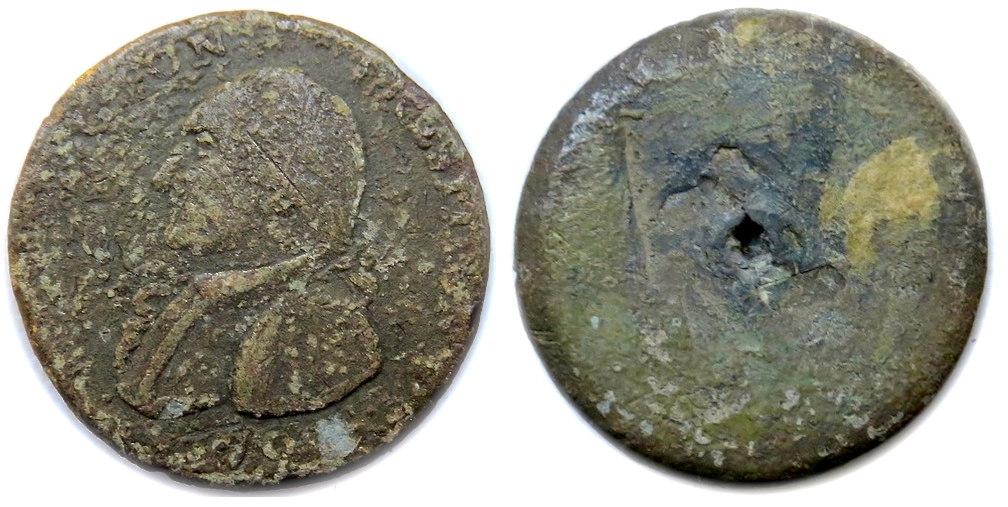
A 1793 Poor Man's GWI Button ~
Absolute Proof that Some of these GWI Buttons are Really A
Tribute to our New Nation:
The specimens I show below
were made by a local American Jeweler / Coppersmith /
Artisan in metal works that was "not" associated with
the Freemason guild. I know this because all of the
original 1789 GW Inaugurals & Nation Nation Tribute
buttons show a level of expertise in engraving that has
a clear understanding of geometry and mathematics that
are associated with the engraver's cuts. Meaning these
buttons do not show the expertise of a Freemason Master
or Apprentices on a Free-Craft Level. We can clearly
look at other engraved memorabilia of the era including,
official seals, state currency plates, documents, ect..
that all show an advanced level of skills within their
engraving cuts. The set of buttons do not depict the
level skill to be marketed or sold by the Freemason
Guild that was responsible for the original 1789
buttons. Meaning, there is a level of skill &
workmanship I have come to associate with all engraved
artifacts that was taught by the freemason guild in the
mid to late 18th century.
I believe all
the
specimens below would have been made by one individual
on the apprentice level. Most likely a person learning
the Jewelry/Coppersmith crafts. This individual would
have been learning how to cut molds and dies, and
crafted several types for a celebratory buttons for a
national celebration. We can see the proof of this when
we examine all the buttons together and look at the
birds head and feather features. I examined the line
structure and cuts within the wings, legs, neck, head,
and feathers, I postulated that all 5 specimens I
examined were made by same apprentice. From my research
I found that the original GW Inaugural & New Nation
Tribute buttons were crafted by a Master and 4-5
apprentices.
Meaning all would have worked on each piece, not just
one individual.
That is a smoking gun to be consistent with the
originals 1789 buttons. The specimens below shows strong
indication of one artist doing all five specimens.
Another note, is that the original patterns could have
been a copy righted/patented by the original engraving
guild. So local artisans outside of the engraving guild
couldn't copy these exactly, but they could have made
their own version (variation) of the original 1789
patterns. Another conclusion I have come to is that
these buttons were most likely sold in one particular
state. Otherwise there would have been other specimens
dug by metal detector enthusiasts if sold throughout the
known 13-15 states. Metal detecting has along way in the
20th & 21 century, and historical places un-dug are rare
to find. So I believe this would "not" have been
marketed in your bigger cities such as, Philadelphia,
New York, North & South Carolina, and Connecticut. More
likely states like Delaware and Rhode Island. These were
much smaller city at the time, but big enough to make
money off a limited production.
So, my conclusions is that
these set of buttons were done as an early commemorative
pieces for a 15-20 year national celebration such as
Independence day. A sort of commemorative re-issue. I
come up with two dates due to construction and the art
of engraving over the newly machine process. The button
is either 1801, the 1776 25th year Anniversary; or 1809
which is the 20th Anniversary of the Birth of our New
Nation and George Washington's inauguration. Any
earlier date would not be justified for several reasons.
There are some other facts one point out as well. We
know from the minting of coins and military buttons that
the craft of hand engraving dies was being replaced
through automation in manufacturing.
One must take note that in
the early 1800's this changed. The manufacturing of the
steel die by a machine process took the human element
out and gave better lines, and easier die replacement.
Manufacturers no longer had to wait for certain
individuals to cut new dies. This also helped me
originally date the button between 1797 to 1812.
I do not know how to
assign a proper value to these reproductions, but one
must remember when contemplating a purchase like this
that this is made after Washington died in 1799, and is
not from his administration period. You can still obtain
genuine 1789 period buttons for $1k to 3k. So, since it
is common for people to really want me to pin down a
price range I would say in 2014 dollars, $600 to $1200
being condition a strong factor. Why such a high premium
for a reproduction of the original? Collectors would
need specimens to demonstrate the craft of engraving
outside of the operating controlled Freemason engraving
guild.
Local American-Born Artists
throughout the
states also Pay
Tribute to Washington and Country:
In the three specimens below is three examples of
celebratory tribute buttons done by Local American-born Artisan's
who were at the apprentice level and not part of the engraving
guild. These three tribute buttons all show crude
depictions that pay tribute to either George Washington
or America. In my opinion, all of these specimens appear to be
geared towards patriotism of the country. As other
manufactured national celebratory items they
have depictions of their version of the Great Seal of the United States. All
three specimens are hand-engraved, and
are extremely rarer
and valuable in
their own
rights. Since these
buttons were hand engraved and not chased afterward,
they probably were Not marketed or produced to
sell throughout the states. When I look at these
wonderful specimens, I realize this is not the quality
of work that would have been allowed into circulation by
the guild. So, I come to the conclusion these were all custom orders
that was made by an engraving apprentice or local
Jeweler. Either for an order by a client or just sold
for some profit on an American celebration. Nevertheless,
I still place an early 1800's date that was after
Washington's Administration. I think these buttons should
be cherished and are considered one of America's
national celebratory heirlooms nonetheless.
 

Unauthenticated GW Button's That Have Manufacturing
Records of Production,
but No Examples are Found:
01) GW in Oval ~ Pewter ~ 34mm.
02) Linked States ~ Pewter ~ 34mm.
03) Eagle, GW and Liberty Cap ~ Copper ~ 25mm.
04) Washington at Valley Forge ~ Tombac Style ~ 32mm.
(Tombac engraved)
05) Washington, Warren and Marion ~ Copper ~ 33mm.
(hand engraved)
06) Engraved Initials “GW” ~ Copper ~ 38mm.
07) Foliated Script “GW” ~ Copper 25mm.
08) *Silver Flan “GW” and Plow ~ Silver ~ 13mm.
09) *Washington in Star ~ Brass ~ 34mm.
10) Foliated Script “GW” and Liberty Cap ~ Copper ~
25mm.
11) George Washington 1776 ~ Copper ~ 35mm.
12) *Vigilance-Cock-Rising Sun-Engraved ~ Tombac Style ~
37mm.
13) “GW” and Eagle~ Copper ~ 25mm.
|

