|
~The
Legionnaires 1792-96 ~
The U.S. Army was created by Congress on June 3, 1784 at the
end of the American Revolutionary War. This new United
States Army was to replace the disbanded Continental Army.
The colonies Continental Army was disbanded for several
reasons, but for the most part there was a big distrust by
the states, and our founding fathers for a government to
have a large standing army. The state militia's would assume
the role of protecting states individual rights, as well as
their self protected interests. This would become the
nation's military force (Army) with the exception of a sole
regiment which would guard the new Western Frontier; and
there was also one battery of a Federal Artillery Unit which
would be funded by Congress to guard the arsenal at West
Point. The idea of the state militia protector system was
not really a practical working idea. After a few years,
there became a civilian unrest with the unprofessionalism of
state militia units; and because of the continuing conflict
with the Native American Indians, it was soon realized that
a "field trained" standing Federal Army was necessary. The
first of these was called, "The Legion of the United
States". It was established in 1791. Certain factors led up
to this decision, First was General Arthur St. Clair's
disastrous defeat at the Battle of the Wabash by Blue Jacket
and Little Turtle's tribal confederacy. General St. Clair's
forces were drawn principally from the various state's
militias. They were unorganized, unprofessional, and lacked
the necessary unified training. This really impressed upon
Washington and our founding fathers that a states militia's
would not be adequate force for the nations defensive needs.
President Washington new he had to raise a professional Army
even with the unpopular support of congressional leaders and
state representatives. President Washington ended up
appointing his old friend lieutenant Anthony Wayne to lead
this new professional Army. At the recommendation of the
Secretary of War Henry Knox, it was decided to recruit and
train a new legion of soldiers for the United States.
The structure they decided upon was simple. The Legion would
be composed of four sub-legions, and each would be commanded
by a Brigadier General. The sub-legions were going to be all
self-contained units which would be composed of two
battalions of infantry, a rifle battalion, a troop of
dragoons, and a battery of artillery. A light infantry unit
would strictly used for skirmishes. These Light Infantry
soldiers were armed with Pennsylvania long rifles, and there
function would be to screen for the heavy infantry units. So
in a nut shell, were looking at a force that would combine
Cavalry, Artillery, Light and Heavy Infantry, into one
brigade sized force which would be divisible into separate
stand-alone combined arms teams. In June of 1792, this new
Legion started to recruit and train in Fort Lafayette, which
was located in Pittsburgh, Pennsylvania. The first two
sub-legions were actually created from the 1st and 2nd
regiments of the Continental Army, and the 3rd and 4th
sub-legions were raised from new recruits. By November of
1792, the Legion moved to the first U.S. basic training
facility in Legionville, PA. This new frontier fort was
built on the orders of General Anthony Wayne on the banks of
the Ohio River. General Wayne also was accredited for
establishing various forts along the line of march to ensure
the adequate re-supply for his soldiers. These forts were
garrisoned with the newly trained legionnaires. It was their
primary task to guard the entire frontier. There resources
were spread extremely thin for such an enormous frontier. It
is a common mis-belief that the U.S. Legion was officially
disbanded in 1796, after General Wayne's death. In fact,
what happen was that his second in command General James
Wilkinson (who was a secret spy for the Spanish Government)
had his own visions, and re-structured the Army into a more
formidable system. He was blamed for trying to undo
everything General Wayne had created; including the whole
Legion/ sub-legion structure, but each had their own system
for the times. First notable thing Wilkinson did was to
break apart the 1st, 2nd, 3rd, and 4th Sub-Legions, and
turned them into the 1st, 2nd, 3rd, 4th Regiments. There are
other structural introductions, but this should help give a
basic foundation, and understanding of early US Army button
regiment designations. It is said that understanding US Army
Insignia and button patterns comes from what was issued
between 1796, and the War of 1812. I believe this to be
true.
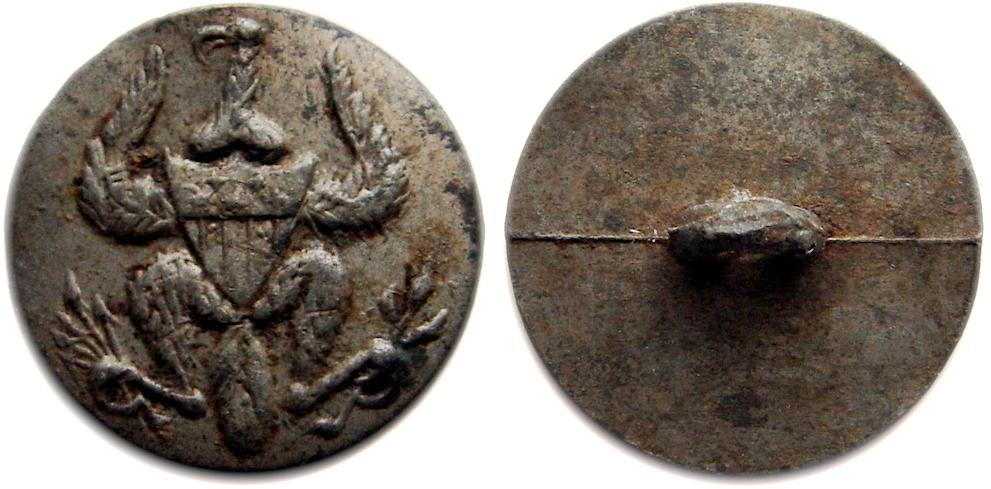
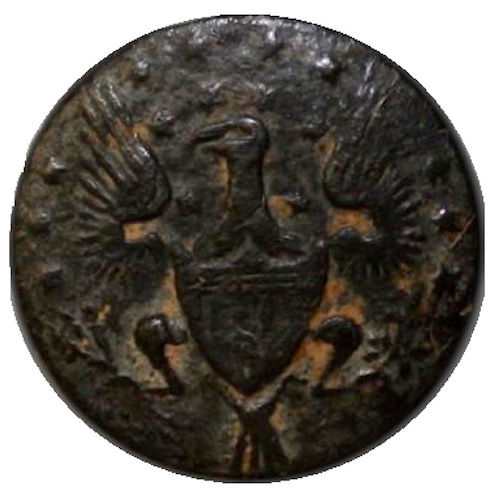
1792 U.S. Army
Color: A Pewter Gray with Clay Red.
Metal: Flat, 1-Piece, Raised Design, Cast Pewter.
Size: 23mm. Coat Size
Albert's: GI 24-A: RV 50
Variation: Eagle with Upraised Wings / Long Thin Neck
/ Federal Shield with Stars Inside the Field.
Present Condition: An Excavated Example, Strong
Planchet Casting, Strong High Relief Pattern.
Isabela's Notes: There appears to be only one known
die variant for this early Army button. The button
depicts an
Eagle
with Upraised Wings
facing right with
a
Long Thin Neck.
In the eagle's right talon is a small bundle of three arrows
pointing upward. In it's left talon is a short olive
branch
with petals. Over the eagle's chest is a
Federal Shield with Stars Inside the Field.
The stars go horizontally across the top portion of the
shield, and lines go vertically underneath.
The high relief pattern is set on a plain flat field. Some collectors
nickname this, "The Turkey Eagle" because of it's long
thin neck.
Collectors should obtain any specimen that becomes
available.
Reverse Button Analysis: This is a flat one-piece
molded button with a loop shank. No back mark, but mold line
present from casting.
This was Found in the 1920's when Workers Dug up A Walkway
of an 18th Century Home.
The Jacob W. Collection.
Robert's Notes: There was a 1960's recasting in pewter from
an original specimen. This reproduction can be identified by
a "13" on the reverse. The shank is a wedge shank with a
drilled hole (Imrie/Risley). Collectors should be ware, some
unorthodox people file the "13" away and also the wedge
shank down to fake a loop shank.
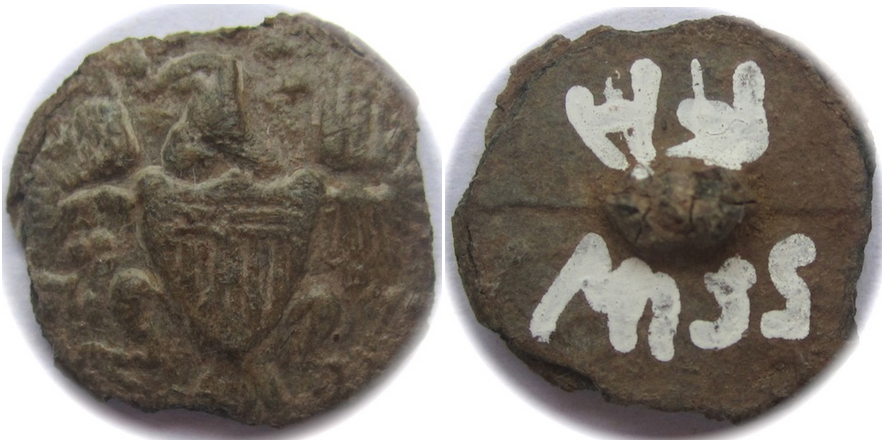
1792-98 U.S. Army Wayne's Legion
Color: A Pewter Grey.
Metal: Flat, 1-Piece, Raised Design, Cast Pewter.
Size: 21mm. (14mm.Remaining) Coat Size
Albert's: GI 25-A: RV 75
Variation: Eagle Facing Right / Upraised Wings /
Federal Striped Shield / Thirteen Five Pointed Stars /
Short & Stout.
Present Condition: An Excavated Example, Fair
Planchet Casting, Fair High Relief Pattern.
Isabela's Notes: There are four known die
variants in this series. Depending on which die variant,
they can have a differences in the length and fullness of
the eagle's neck, and also how many stars are in the field.
One die variant the olive branch and arrows switch
respective sides. This button depicts an
Eagle Facing Right
with
Upraised
Wings.
Over the eagle's chest is a
Federal Striped Shield. In the eagle's
left
talon is a small bundle of three arrows pointing upwards. In it's
right talon
is a short stem olive branch with petals. This die variant
is suppose to depict
Thirteen
Five-pointed Stars
surrounding the eagle in the
field. The eagle's neck in this variant appears to be
Short and
Stout.
The high relief pattern is set on a plain flat field.
Because of the Pewter. collectors find these dug buttons
hard to obtain
intact without edge loss. Un-dug specimens are the extreme
rarity.
Reverse Button Analysis: This is a one-piece molded
button with a loop shank. The shank is unfortunately
missing. No back mark, but mold line present from casting.
Excavated at Fort Adams, Mississippi.
The RJ Silverstein Collection.
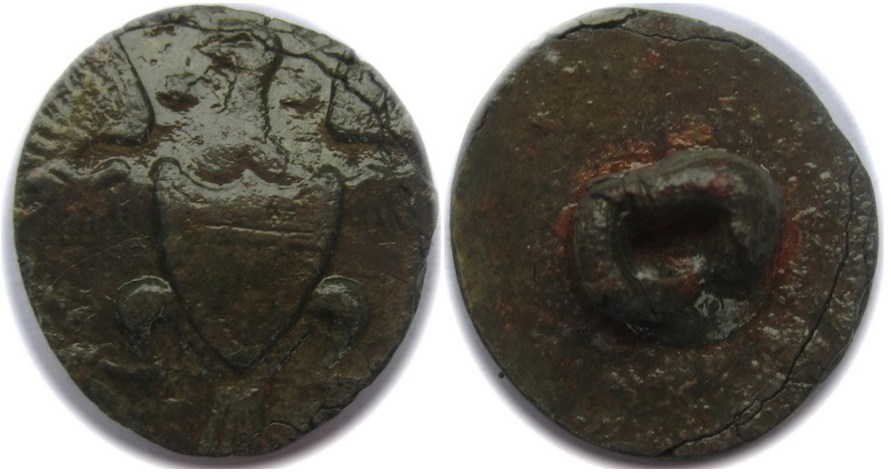
1792-98 U.S. Army Wayne's Legion
Color: A Dark Forest Green With Grey Undertones.
Metal: Flat, 1-Piece, Raised Design, Cast Pewter.
Size: 23mm (17mm remaining). Coat Size
Albert's: GI 25-C: RV 75
Variation: Eagle With Upraised Wings / Small Bundle
of Three Arrows / Short Stem Olive Branch / 16 Five Point
Stars.
Present Condition: An Excavated Example, Fair
Planchet Casting, Fair/Good High Relief Pattern.
Isabela's Notes: There are four known die
variants in this series. Depending on which die variant,
they can show differences in the length and fullness of the
eagle's neck, and also how many stars are in the field. The
button's pattern depicts an
Eagle with Upraised Wings
facing right. Over the eagle's chest is a crude style
Federal Striped Shield. In the eagle's
left talon is a
Small Bundle of Three Arrows
pointing upwards. In the eagle's right talon is a
Short Stem Olive Branch
with olives and petals. The die variant depicts
Sixteen Five-Point Stars
surrounding the eagle in the field.
The eagle's neck appears to be
Longer &
Fuller.
The high relief pattern is set on a plain flat field with no
raised edge border.
Reverse Button Analysis: This is a flat one-piece
molded button with a loop shank. The shank is original and
intact, but crushed inwards. No back mark or mold line
present. Cracks in the pewter are evident.
The RJ Silverstein Collection.
.png)
1792-98 U.S. Army Wayne's Legion
Color: A Light Silvery Gray.
Metal: Flat, 1-Piece, Raised Design, Cast Pewter.
Size: 22.37mm. Coat Size
Albert's: GI 25-C: RV 75
Variation: Eagle With Upraised Wings / Small Bundle
of Three Arrows / Short Stem Olive Branch / 16 Five Point
Stars.
Present Condition: An Excavated Example, Strong
Planchet Casting, Strong High Relief Pattern.
Isabela's Notes: Here is something pretty neat,
George Washington was our Commander and Chief when this
button was used. There are four known die variants in this
series. Depending on which die variant, they can show
differences in the length and fullness of the eagle's neck,
and also how many stars are in the field. The button's
pattern depicts an
Eagle with Upraised Wings
facing right. Over the eagle's chest is a crude style
Federal Striped Shield. In the eagle's
left talon is a
Small Bundle of Three Arrows
pointing upwards. In the eagle's right talon is a
Short Stem Olive Branch
with olives and petals. This die variant depicts
Sixteen Five-Point Stars
surrounding the eagle in the field.
The eagle's neck appears to be
Longer &
Fuller.
The high relief pattern is set on a plain flat field with no
raised edge border.
Collectors find these dug buttons hard to find without edge loss.
Buttons with missing shanks appear to be more common.
Reverse Button Analysis: This is a flat
one-piece button with a loop shank. The shank is
unfortunately missing. No back mark, just a mold line.
Dug by J.B. at an encampment site on the Oconee River near
Fort Wilkinson, Georgia.
The RJ. Silverstein Collection.
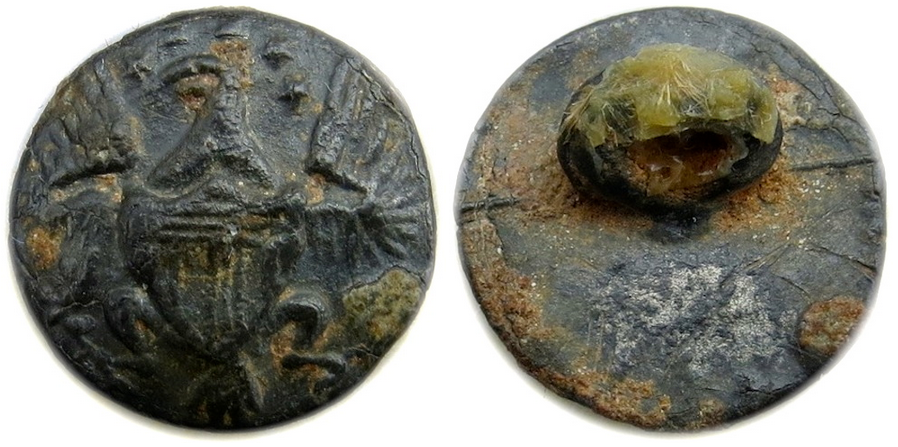
1792-98 U.S. Army Wayne's Legion
Color: A Dark Pewter Grey with Greenish Brown Specks.
Metal: Flat, 1-Piece, Raised Design, Cast Pewter.
Size: 13.84mm. Cuff Size
Albert's: GI 25-Cv: RV 75
Variation: Eagle
With Upraised Wings Facing Right / 5 Five Pointed Stars /
Federal Striped Shield / Short & Stout Neck.
Present Condition: An Excavated Example, Strong
Planchet Casting, Strong High Relief Pattern.
Isabela's Notes: There are three known die
variants for the smaller cuff buttons. Collectors often find
it difficult to associate the cuff with the proper coat
variant because of the limited depiction of stars. Using the
size of the eagle's neck & head along with the position of
the few stars directly above the head can be very helpful in
determination of the proper variant. This button's pattern depicts an
Eagle
with Upraised Wings Facing Right.
Over the eagle's chest is a crude style
Federal Striped Shield. In the eagle's left talon is a small bundle of three
arrows pointing upward. In it's right talon is a short
stem olive branch with
olives and petals. Since the cuff size is limited in space, the button
only depicts
5 Five-Pointed Stars
in the field above the eagle's head. The eagle's neck
in this die variant is
Short & Stout.
Early military button collectors find
Wayne's Legion pewter buttons hard to obtain intact without edge
loss. Un-dug specimens are the extreme rarity.
Reverse Button Analysis: This is a flat one-piece
molded button with a loop shank. The shank is original,
straight, and intact. No back mark, but mold line present
from casting.
Dug in
Milledgeville, Georgia by
J.B. at an encampment site on the Oconee River near Fort Wilkinson.
The RJ. Silverstein Collection.
* Robert's Notes: The way to tell which cuff variation (Av,Bv,Cv)
is to examine how the stars are depicted above the eagle's
head, and also the thickness and length of the neck.
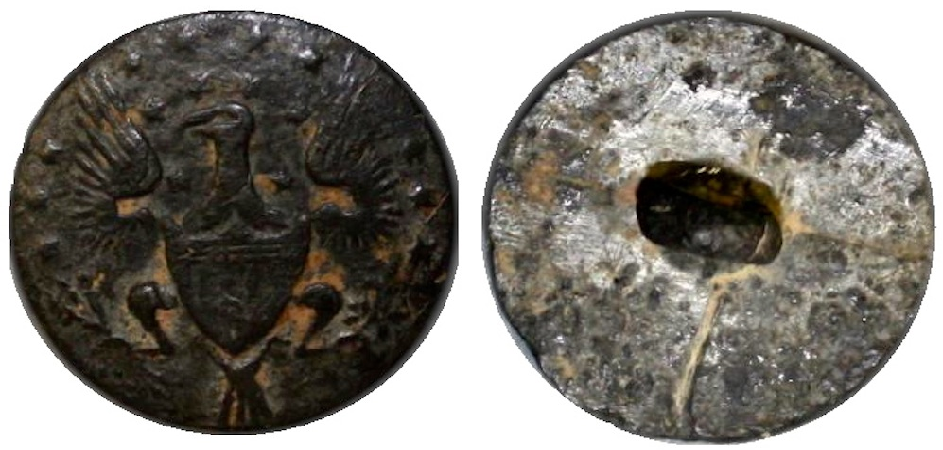
1792-98 United States Army Wayne's Legion
Color: Desert Clay.
Metal: Flat, 1-Piece, Raised Design, Cast Pewter.
Size: 23mm. Coat Size
Albert's: GI 25-D: RV 75
Variation: Upraised Wings / 16 Five Pointed Stars /
Arrows in Right Talon.
Present Condition: An Excavated Example, Strong
Planchet Casting, Good High Relief Pattern.
Isabela's Notes: This die variant differs from
the other three because the arrows and olive branch switch
respective sides. The button depicts a spread eagle facing
right with
upraised wings.
In the eagle's
right talon is the small bundle of arrows,
and in the eagle's left claw is short laurel stem with
petals. This die variant has
Sixteen
Five-Pointed Stars
surrounding the eagle in the field above.
The eagle's neck in this die variant appears to be longer &
thinner. There are four die known die variants for this
pattern. Depending on which die variant, they can show a
difference in the length and fullness of the eagle's neck,
and also how many stars are in the field above. There is no
smaller cuff button known to be associated with this die
pattern.
Reverse Button Analysis: This is a flat molded
one-piece button with a loop shank. The shank is original,
straight, and intact. No back mark.
The Dave Gerber Collection.
*
Last notes on the 1792-98 Wayne's Legion Series. I believe
there was a lot more molds created or die variants made then
the 4 Albert references. I have come across specimens with
subtle differences in the eagle's depicted. Wing spread
along with symmetry of spacing vary in specimens known.
Could it be possible there were some slightly larger buttons
made? Could one of the molds had 17 stars to fill up the
empty space? The only meaningful symbolism I know is when 13
Stars were depicted to represent the 13 original colonies or
states, or 15 Stars for the number of states when George
Washington started his second administration in 1792; which
happens to be when these buttons were fabricated!!
Robert, not sure if my button is a 16 or 17 Star. If I count
the spacing between the stars then 17. Hard to tell with the
pewter disintegrating. Albert doesn't have a 17 Star count,
but then not to say they weren't made. I believe your
assessment is correct, there were probably more variants
made not cataloged. -J.B.
~ U.S.
Federal Infantry Patterns from 1798 to 1802 ~
.jpg)
1798-1802 U.S. Infantry, 3rd Regiment
In 1798, our second President John Adams was the one responsible for
building up the Army and Navy because of an undeclared
naval war with France. There were several diplomatic, and
international commerce trading problems that attributed to
Adam's decision to lobby Congress for a larger more equipped
Army. First was America's neutrality stands in the war
between Britain and post-revolution France. Second, after
1794, America was unwilling to continue to pay it's war debt
to France on the grounds that the debt was owed to the
French Crown, and not the new Republic. Third, the United
States also passed a trade deal with Great Britain which
helped resolve several old contentions between the US and
England since the American Revolution. This was known as the
Jay Treaty. All these points infuriated France. It's
citizens felt that since it helped America gain it's own
freedom earlier, and was one of it's first allies since the
treat of Alliance in 1778, America owed a debt to France. In
the face of this rejection, and political circumstances,
French privateers started seizing American Ships trading
with Britain. President Adams understood America's
political climate and willingness to enter into a foreign conflict.
He also realized that the
Federal Government lacked the resources to make a military
commitment of this magnitude. There was also the hard cold
fact that the U.S. Army lacked the numbers, discipline, and
proper training to go to war. When he assumed the role as
the President, there was only four regiments of infantry,
and a very meager operating budget from Congress. At this time,
most states used, and supplied their own militia units.
Unfortunately, these
units lacked the proper discipline, experience, and training against
larger well trained foreign armies. Plus, there was also the underlying
notion that American citizens were unwilling to leave their
homes to fight in a foreign war.
He knew that President Washington had
foreseen foreign problems, and America needed it's own Army
so it would not be reliant on foreign mercenaries for it's
protection. With some political support, Congress granted
Washington it's legions. This was the strength base that
Adams inherited when he entered office. As with all smart
politicians, President Adams used his limited political
power to take what initiative he could. He was able to
augment the U.S. Army with an additional 12 Infantry
Regiments to make to total of 16 Regiments. Also there
wasn't a large revenue base the federal government could
draw from to supply it's new troops. So fancy uniforms, and
quality metal buttons wasn't high on the necessity priority
list. Inexpensive pewter was used for Wayne's legion uniform
buttons, and this was already known by the decision makers
of supplies to be an inexpensive alternative to brass or
copper. So most likely, Congress awarded contracts out to
the cheapest supplier, instead of quality the of
construction and workmanship.
There is some un-substantiated information
that these early infantry regiments were supplied some
pewter buttons with their uniforms as early
as 1798, but these could have been left old stock that
wasn't used for the earlier 4 infantry regiments, or
possibly Wayne's Legion pewter buttons. We do have
definitive records from the War Department
that show in 1800, Robert Martin of Philadelphia made and
delivered to the Purveyor of Public Supplies, numbered
Pewter buttons for the
first 16 Infantry Regiments. These were simple one-piece
pewter buttons with an Arabic number in the center, and the
country's name, "United States" circling the border in large
capital letters. There was no fancy manufacturer
identification back mark on these buttons. We also know
through excavation of early encampments, that field molds
were used by enlisted soldiers to replace buttons if
necessary. They were able to melt down Musket Balls or other
non ferries metals to cast 6 or more buttons in a scissor
like mold. These molds were easy to
use, and easily carried along with them on there journeys. These
field buttons were also simple
one-piece buttons that included the reverse shank as part of
the cast. The molds themselves carried no manufacturer
identification
for the creation of the molds, and the buttons produced
usually
showed mold lines on the reverse from the scissor like
molds.
Robert's Notes: In 1798-1802, the Regimental Infantry
buttons were ordered in two sizes, the large coats size 19
to 20mm, and a vest/cuff size of 15 to 16mm.
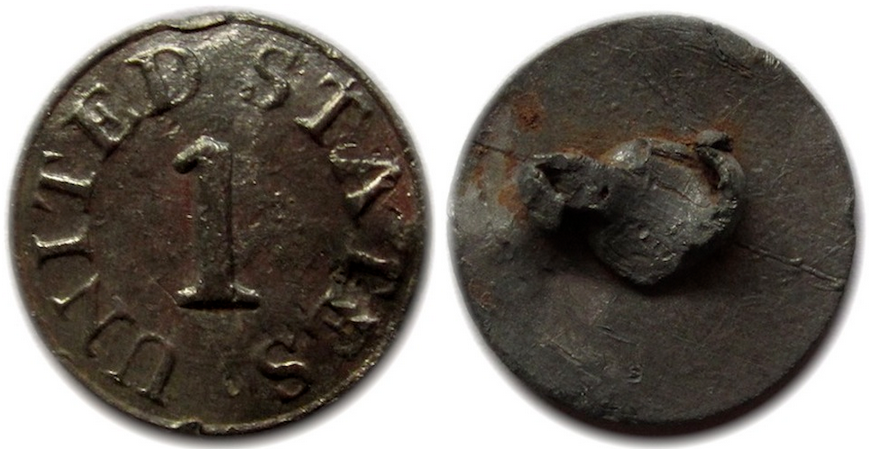
1798-1802 1st Regt. U.S. Infantry.
Color: A Flat Grey, & Hints of Red.
Metal: Flat, 1-Piece, Raised Design, Cast Pewter.
Size: 20mm. Coat Button
Albert's: GI 28 R1: RV 35
Variation: 1st regt.
Present Condition: An Excavated Example, Strong
Planchet Casting, Exceptional High-Relief Pattern.
Isabela's Notes: This button's pattern depicts a
large number "1" in the center, with the country's name,
"UNITED STATES" circling around the edge in capital letters.
The high relief pattern is set on a plain flat field with a
thin raised edge border.
Reverse Button Analysis: This is a One-Piece Casting
for the Reverse Shank. The Shank is crushed and broken open.
No back mark. Mold line is present.
The Isabela Collection.~
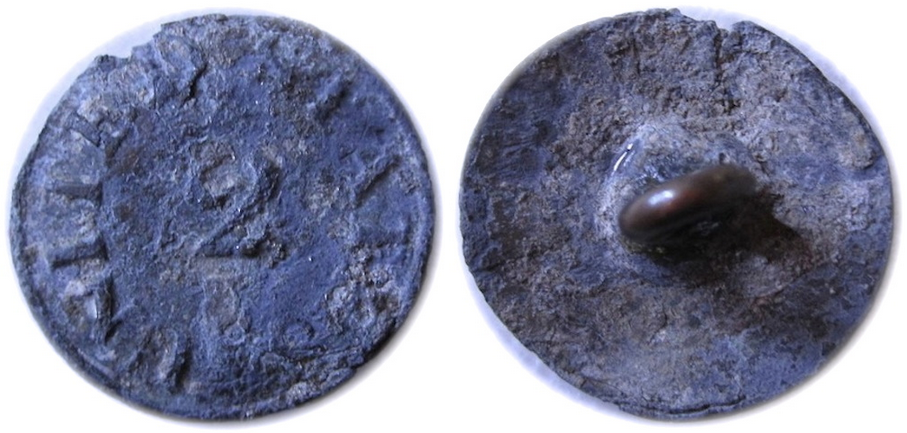
1798-1802 2nd Regt. U.S. Infantry.
Color: Pewter Grey with A Blue Undertone.
Metal: Flat, 1-Piece, Raised Design, Cast Pewter.
Size: 20mm. Coat Button
Albert's: GI 28 R2 : RV 35
Variation: No Star/Raised Rim
Present Condition: An Excavated Example, Good
Planchet Casting, Good High Relief Pattern.
Isabela's Notes: The 2nd Regiment has two known die
variants. This button's pattern depicts a number, "2" in the
center, with the country's name, "UNITED STATES" circling
around the edge in capital letters. The high relief pattern
is set on a plain flat field with a thin raised edge border.
Reverse Button Analysis: This is a One-Piece Casting
for the Reverse Shank. The Shank is professionally restored,
otherwise straight, and intact. No back mark.
The Isabela Collection.~
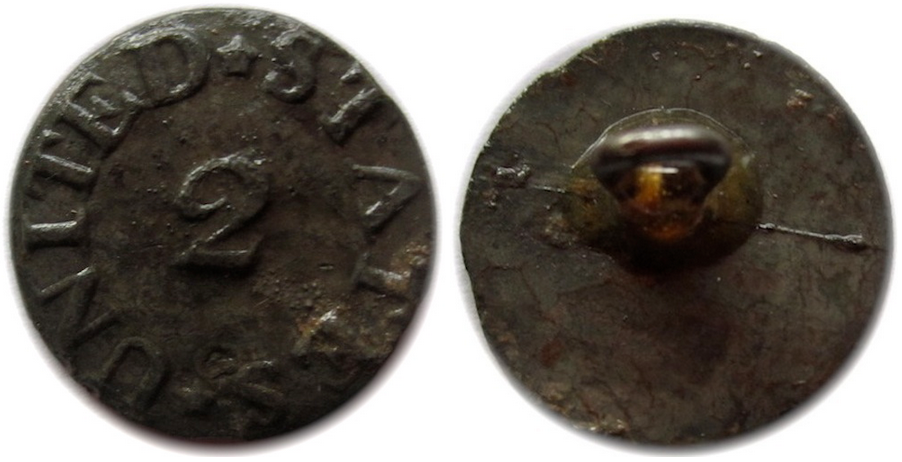
1798-1802 2nd Regt. U.S. Infantry (Star Pattern).
Color: A Dark Greenish-Grey.
Metal: Flat, 1-Piece, Raised Design, Cast Pewter.
Size: 20mm. Coat Button
Albert's: GI 28 R2C: RV 35
Variation: Five Point Star/ No Raised Edge Rim.
Present Condition: A Non Excavated Example, Strong
Planchet Casting, Strong High Relief Pattern.
Isabela's Notes: This would be the 2nd known die
variant. This button's pattern depicts a number, "2" in the
center, with the country's name, "UNITED * STATES * "
circling around the edge in capital letters. This pattern
has two five pointed star in between the country's name. The
high relief pattern is set on a plain flat field with a no
edge border. This is the only button known in the series of
1798-1802 to use a star as part of the pattern.
Reverse Button Analysis: This is a One-Piece Casting
for the Reverse Shank. The Shank is professionally restored,
and straight. No back mark. Mold line is present.
The Isabela Collection.~
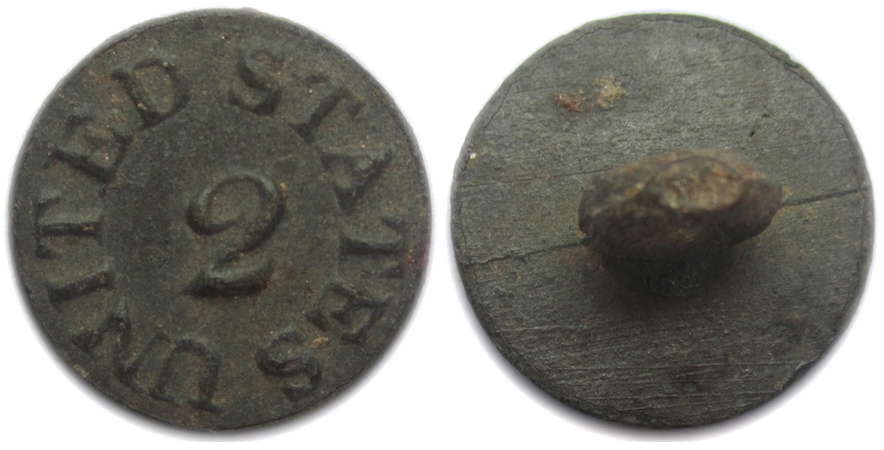
1798-1802 2nd Regt. U.S. Infantry.
Color: A Charcoal Ash Grey.
Metal: Flat, 1-Piece, Raised Design, Cast Pewter.
Size: 16mm. Cuff Button
Albert's: GI 28 R2: RV 20
Variation: 2nd Regt./Plain Edge.
Present Condition: A Non Excavated Example,
Exceptional Planchet Casting, Exceptional High Relief
Pattern.
Isabela's Notes: This is the smaller 2nd Regiment
vest button. Similar to the first die variant, this button
has a number, "2" in the center, with the country's name,
"UNITED STATES" circling around the edge in capital letters.
The high relief pattern is set on a plain flat field with a
thin raised edge border.
Reverse Button Analysis: This is a One-Piece Casting
for the Reverse Shank. The Shank is original, straight, and
intact. No back mark. Mold line is present.
The Isabela Collection.~
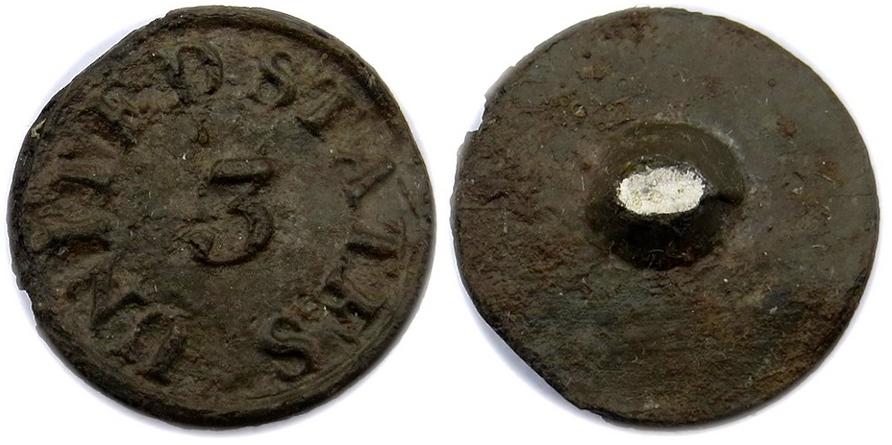
1798-1802 3rd Regt. U.S. Infantry.
Color: A Mud Brown .
Metal: Flat, 1-Piece, Raised Design, Cast Pewter.
Size: 20.54mm. Coat Size
Albert's: GI 28 R3: RV 20
Variation: 3rd Regt. / Raised Edge.
Present Condition: An Excavated Example, Good
Planchet Casting, Strong High Relief Pattern.
Isabela's Notes: This is the larger 3rd Regiment coat
button. This button depicts a large Arabic number, "3" in
the center, with the country's name, "UNITED STATES"
circling around the edge in capital letters. The high relief
pattern is set on a plain flat field with a thin raised edge
border.
Reverse Button Analysis: This is a One-Piece Casting
for the Reverse Shank. The Shank is unfortunately missing.
No back mark. Mold line is barely visible.
Excavated near Lake George, New York.
The Isabela Collection.~
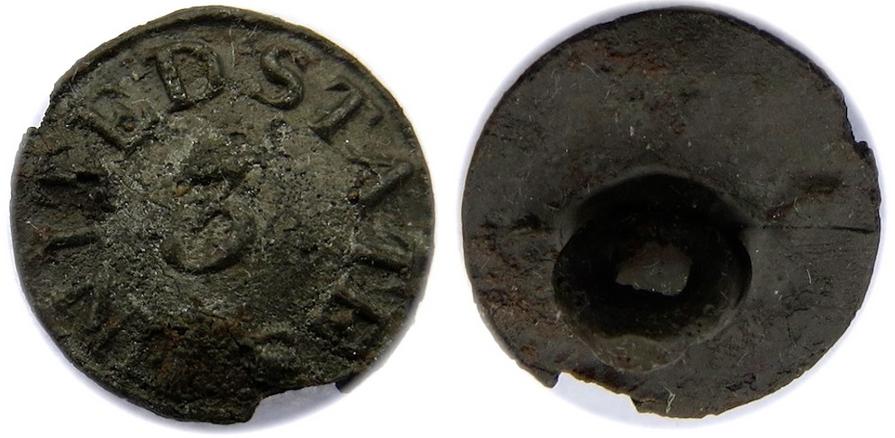
1798-1802 3rd Regt. U.S. Infantry.
Color: A Mud Brown .
Metal: Flat, 1-Piece, Raised Design, Cast Pewter.
Size: 15.89mm. Cuff Size
Albert's: GI 28 R3v: RV 20
Variation: 3rd Regt. / Raised Edge.
Present Condition: An Excavated Example, Good
Planchet Casting, Strong High Relief Pattern.
Isabela's Notes: This is the smaller 3rd Regiment
cuff button. This button depicts a small Arabic number, "3"
in the center, with the country's name, "UNITED STATES"
circling around the edge in capital letters. The high relief
pattern is set on a plain flat field with a thin raised edge
border.
Reverse Button Analysis: This is a One-Piece Casting
for the Reverse Shank. The Shank is original, straight, and
intact.
Excavated near Lake George, New York.
The Isabela Collection.~
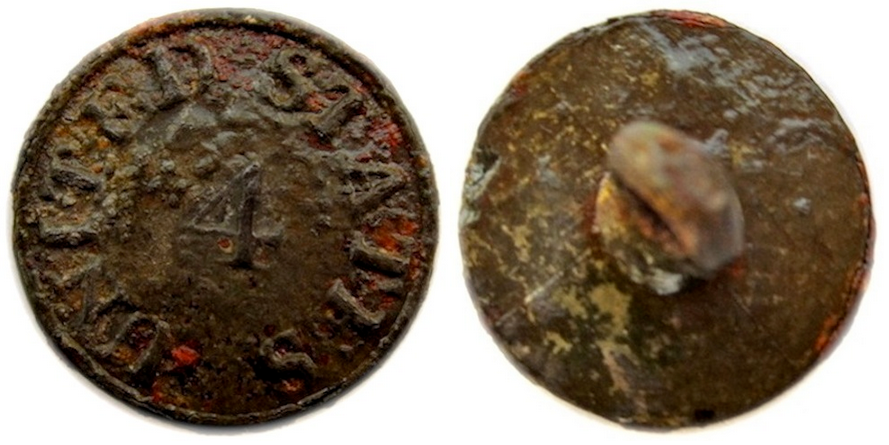
1798-1802 4th Regt. U.S. Infantry.
Color: An Ochre of Brown, Green and Red.
Metal: Flat, 1-Piece, Raised Design, Cast Pewter.
Size: 21mm. Coat Size
Albert's: GI 28 R4: RV 35
Variation: 4th Regt.
Present Condition: An Excavated Example, Strong
Planchet Casting, Good/Strong High Relief Pattern.
Isabela's Notes: This button's pattern depicts a
large number "4" in the center, with the country's name,
"UNITED STATES" circling around the edge in capital letters.
The high relief pattern is set on a plain flat field with a
thin raised edge border.
Reverse Button Analysis: This is a One-Piece Casting
for the Reverse Shank. The Shank is original, straight, and
intact. No back mark. Mold line is present.
The Isabela Collection.~
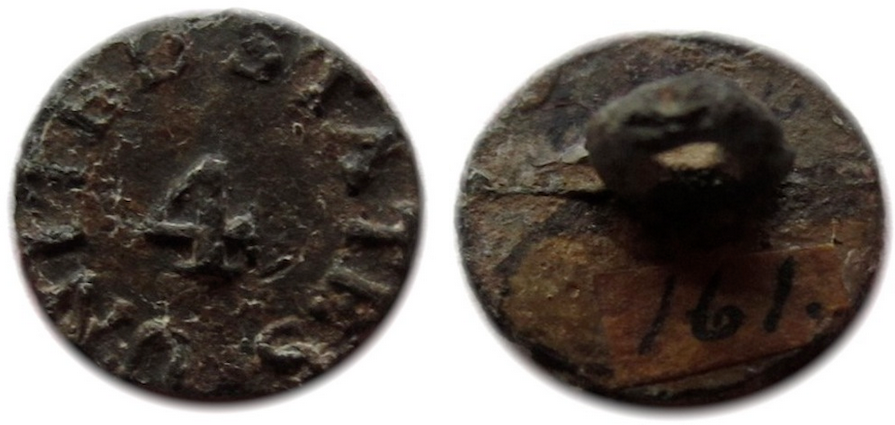
1798-1802 4th Regt. U.S. Infantry.
Color: A Pewter Brown.
Metal: Flat, 1-Piece, Raised Design, Cast Pewter.
Size: 15.5mm Cuff Size
Albert's: GI 28 R4v: RV 20
Variation: 4th Regt.
Present Condition: An Excavated Example, Strong
Planchet Casting, Good High Relief Pattern.
Isabela's Notes: This is the smaller 4th Regiment
vest button. Similar to the first die variant, this button
has a number, "4" in the center, with the country's name,
"UNITED STATES" circling around the edge in capital letters.
The high relief pattern is set on a plain flat field with a
thin raised edge border.
Reverse Button Analysis: This is a One-Piece Casting
for the Reverse Shank. The Shank is original, straight, and
intact. No back mark. Mold line is present.
The Isabela Collection.~
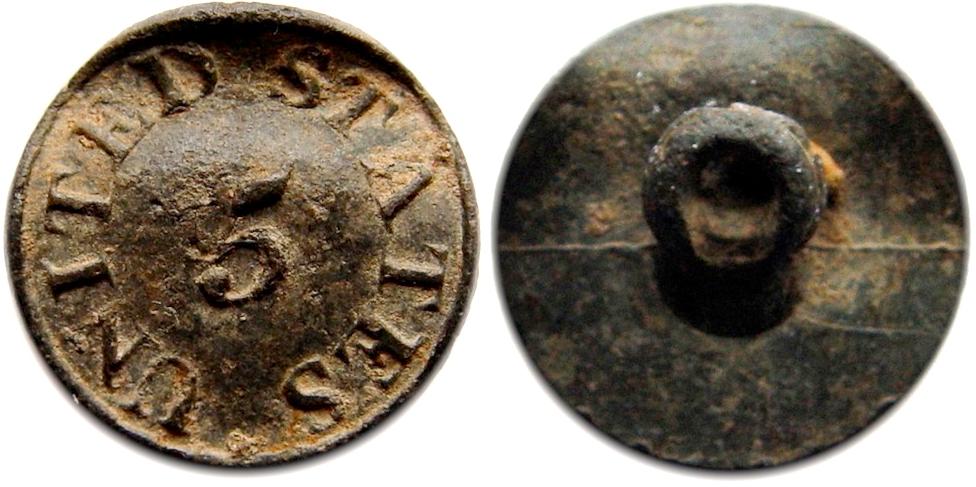
1798-1802 5th Regt. U.S. Infantry.
Color: An Ochre of Brown, Green and Red.
Metal: Flat, 1-Piece, Raised Design, Cast Pewter.
Size: 20mm. Coat Size
Albert's: GI 28 R5: RV 35
Variation: 5th Regt.
Present Condition: An Excavated Example, Strong
Planchet Casting, Good/Strong High Relief Pattern.
Isabela's Notes: This button's pattern depicts a
large number "5" in the center, with the country's name,
"UNITED STATES" circling around the edge in capital letters.
The high relief pattern is set on a plain flat field with a
thin raised edge border.
Reverse Button Analysis: This is a One-Piece Casting
for the Reverse Shank. The Shank is original, straight, and
intact. No back mark. Mold line is present.
Found Along the Ohio river in Sothern Illinois.
The Jacob W. Collection.
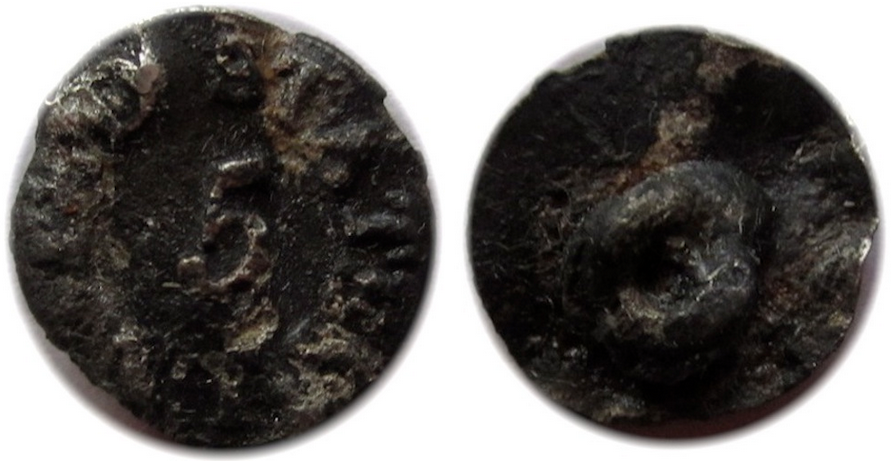
1798-1802 5th Regt. U.S. Infantry.
Color: A Charcoal With Hints of Grey.
Metal: Flat, 1-Piece, Raised Design, Cast Pewter.
Size: 15mm. Cuff Size
Albert's: GI 28 R5v: RV 20
Variation: 5th Regt.
Present Condition: An Excavated Example, Fair
Planchet Casting, Fair High Relief Pattern.
Isabela's Notes: This cuff button's pattern depicts a large
number "5" in the center, with the country's name, "UNITED
STATES" circling around the edge in capital letters. The
high relief pattern is set on a plain flat field with a thin
raised edge border.
Reverse Button Analysis: This is a One-Piece Casting
for the Reverse Shank. The Shank is original, straight, and
intact. No back mark. Mold line is present.
The Isabela Collection.~
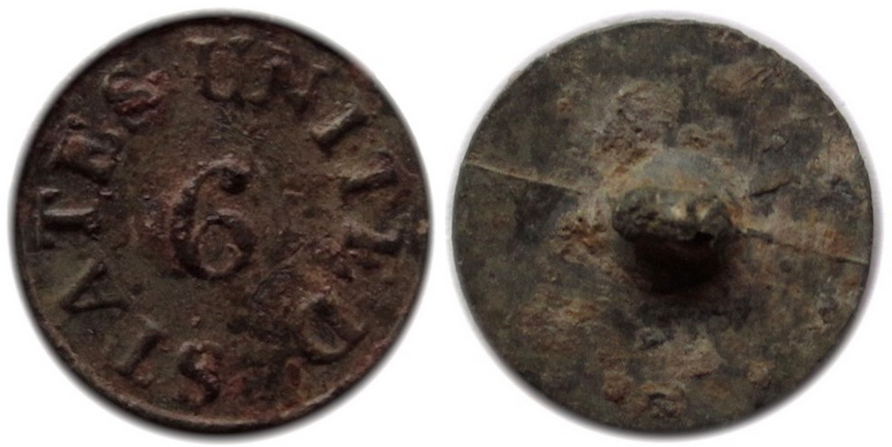
1798-1802 6th Regt. U.S. Infantry.
Color: An Ochre of Red and Brown Shades.
Metal: Flat, 1-Piece, Raised Design, Cast Pewter.
Size: 20.5mm Coat Size
Albert's: GI 28 R6: RV 35
Variation: 6th Regt.
Present Condition: An Excavated Example, Strong
Planchet Casting, Strong High Relief Pattern.
Isabela's Notes: This button's pattern depicts a
large number "6" in the center, with the country's name,
"UNITED STATES" circling around the edge in capital letters.
The high relief pattern is set on a plain flat field with a
thin raised edge border.
Reverse Button Analysis: This is a One-Piece Casting
for the Reverse Shank. The Shank is original, straight, and
intact. No back mark. Mold line is present.
Excavated in a Creek Bed near Fort Adams Mississippi.
The Isabela Collection.~
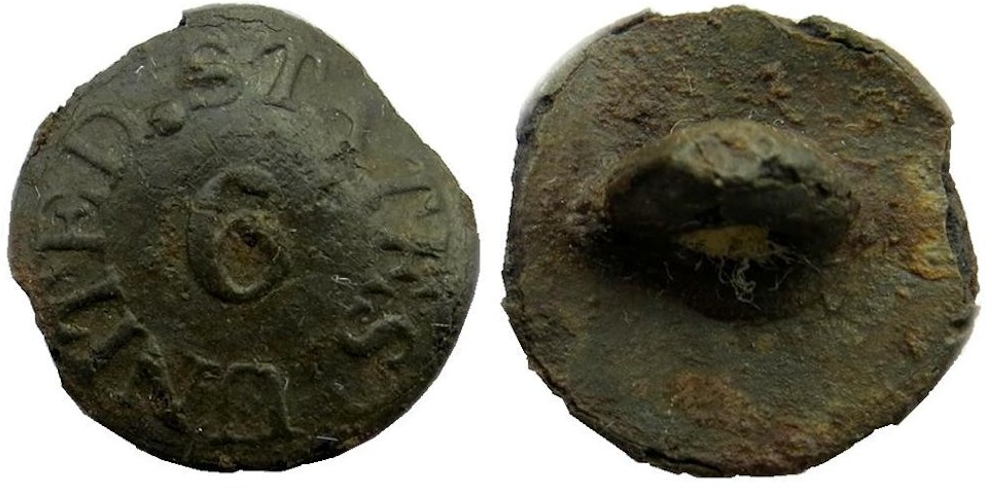
1798-1802 6th Regt. U.S. Infantry.
Color: An Algae Green with A Charcoal Background.
Metal: Flat, 1-Piece, Raised Design, Cast Pewter.
Size: 15.49mm Cuff Size
Albert's: GI 28 R6v: RV 35
Variation: 6th Regt.
Present Condition: An Excavated Example, Good
Planchet Casting, Strong High Relief Pattern.
Isabela's Notes: This button's pattern depicts a
large number "6" in the center, with the country's name,
"UNITED STATES" circling around the edge in capital letters.
The high relief pattern is set on a plain flat field with a
plain edge border. Cuff specimens for the 6th Regt. are a
rarity.
Reverse Button Analysis: This is a One-Piece Casting
for the Reverse Shank. The Shank is original, straight, and
intact. No back mark or mold line present.
Dug at Lake George, New York.
The Isabela Collection.~
Robert's Notes: An excavated specimen was found of this smaller
15mm. vest size (6th Regt) that was made in
Sheffield Silver.
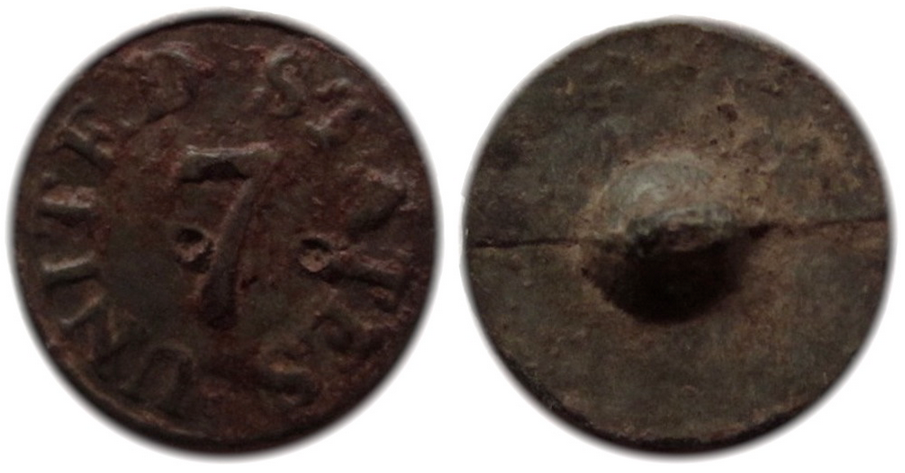
1798-1802 7th Regt. U.S. Infantry.
Color: A Rustic Brown.
Metal: Flat, 1-Piece, Raised Design, Cast Pewter.
Size: 20.5mm. Coat Size
Albert's: GI 28 R7: RV 35
Variation: 7th Regt.
Present Condition: An Excavated Example, Strong
Planchet Casting, Strong High Relief Pattern.
Isabela's Notes: This button's pattern depicts a
large number "7" in the center, with the country's name,
"UNITED STATES" circling around the edge in capital letters.
The high relief pattern is set on a plain flat field with a
thin raised edge border.
Reverse Button Analysis: This is a One-Piece Casting
for the Reverse Shank. The boss is present, but the shank is
missing. No back mark. Mold line is present.
Excavated in a Creek Bed near Fort Adams, Mississippi
together with several 5th, 6th, & 12th Regt. buttons.
The Isabela Collection.~
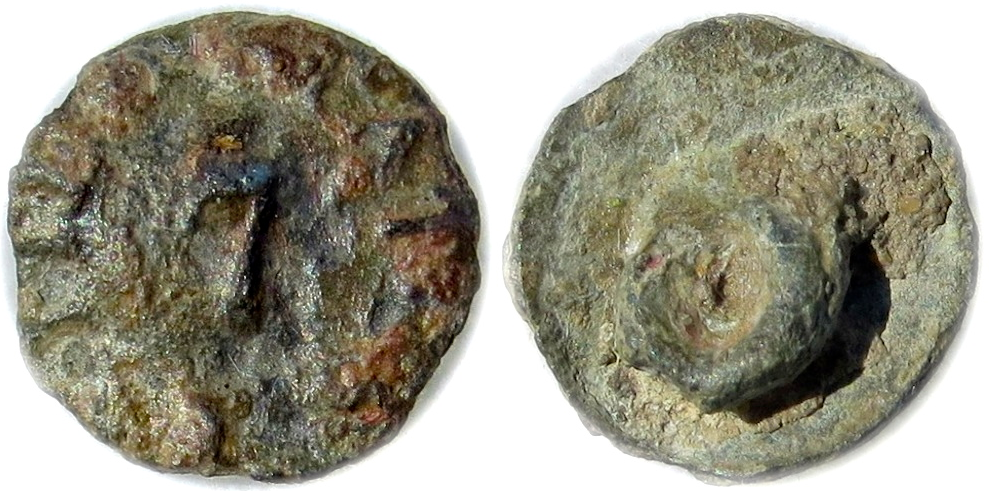
1798-1802 7th Regt. U.S. Infantry.
Color: A Rustic Brown.
Metal: Flat, 1-Piece, Raised Design, Cast Pewter.
Size: 15mm. Cuff Size
Albert's: GI 28 R7v: RV 35
Variation: 7th Regt.
Present Condition: An Excavated Example, Strong
Planchet Casting, Strong High Relief Pattern.
Isabela's Notes: This button's pattern depicts a
large number "7" in the center, with the country's name,
"UNITED STATES" circling around the edge in capital letters.
The high relief pattern is set on a plain flat field with a
thin raised edge border.
Reverse Button Analysis: This is a One-Piece Casting
for the Reverse Shank. The boss is present, but the shank is
missing. No back mark. Mold line is present.
Excavated in a Creek Bed near Fort Adams, Mississippi
together with several 5th, 6th, & 12th Regt. buttons.
The Isabela Collection.~
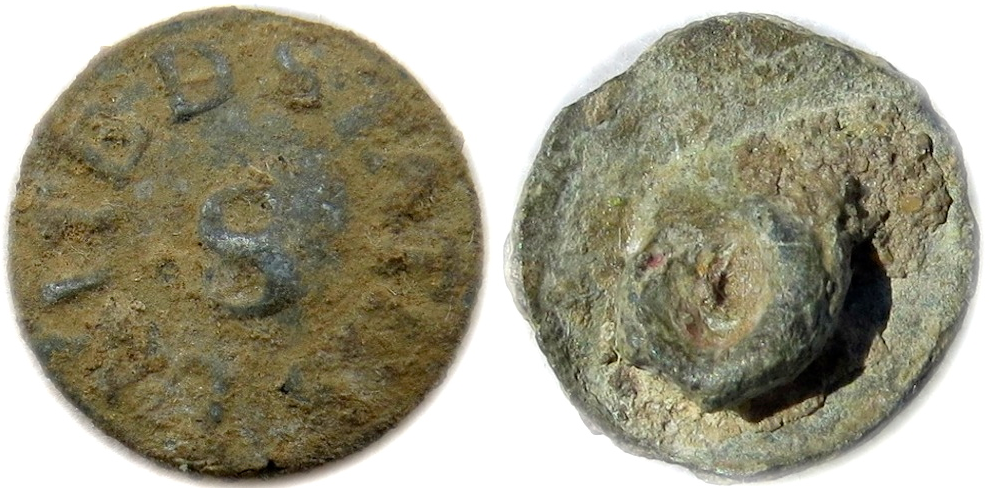
1798-1802 8th Regt. U.S. Infantry.
Color: Dirt Brown with Pewter Undertones Showing
Through.
Metal: Flat, 1-Piece, Raised Design, Cast Pewter.
Size: 15.56mm. Cuff Size
Albert's: GI 28 R8v: RV 35
Variation: 8th Regt.
Present Condition: An Excavated Example, Strong
Planchet Casting, Strong High Relief Pattern.
Isabela's Notes: This button's pattern depicts a
large number "8" in the center, with the country's name,
"UNITED STATES" circling around the edge in capital letters.
The high relief pattern is set on a plain flat field with a
thin raised edge border. The higher numbers are unusually
hard to obtain for collectors.
Reverse Button Analysis: This is a One-Piece Casting
for the Reverse Shank. The shank is original and intact, but
slightly bent.
Dug by Mike Bruce in 1997 in a known Encampment in
Winchester, Va.
The Isabela Collection.~
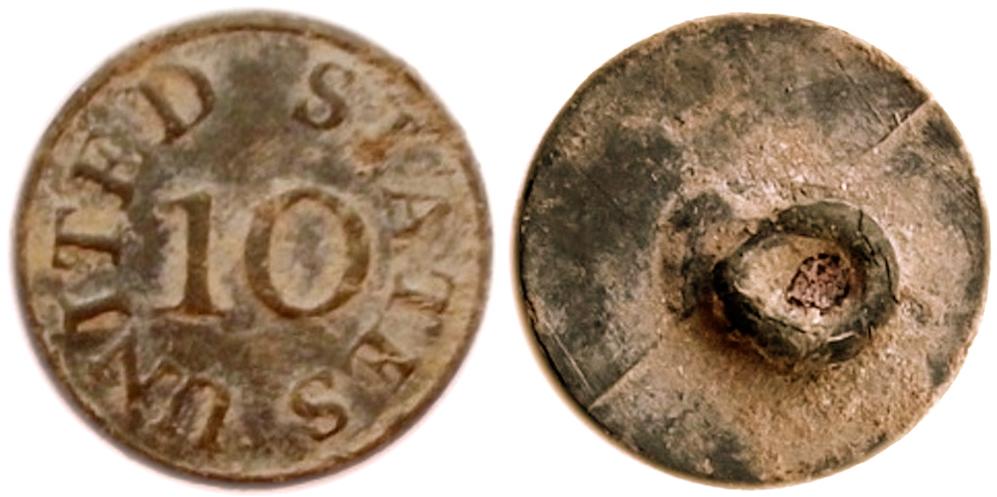
1798-1802 10th Regt. U.S. Infantry.
Color: A Clay Brown.
Metal: Flat, 1-Piece, Raised Design, Cast Pewter.
Size: 20mm. Coat Size
Albert's: GI 28 R10: RV 35
Variation: 10th Regt.
Present Condition: An Excavated Example, Strong
Planchet Casting, Strong High Relief Pattern.
Isabela's Notes: This button's pattern depicts a
large number "10" in the center, with the country's name,
"UNITED STATES" circling around the edge in capital letters.
The high relief pattern is set on a plain flat field with a
thin raised edge border. The higher regimental numbers are
much harder to find.
Reverse Button Analysis: This is a One-Piece Casting
for the Reverse Shank. The shank is original and intact, but
crushed inward. No back mark. No mold line is seen.
Dan dug in 1998 in an early Military Camp in South
Mississippi.
The Dan Patterson Collection.
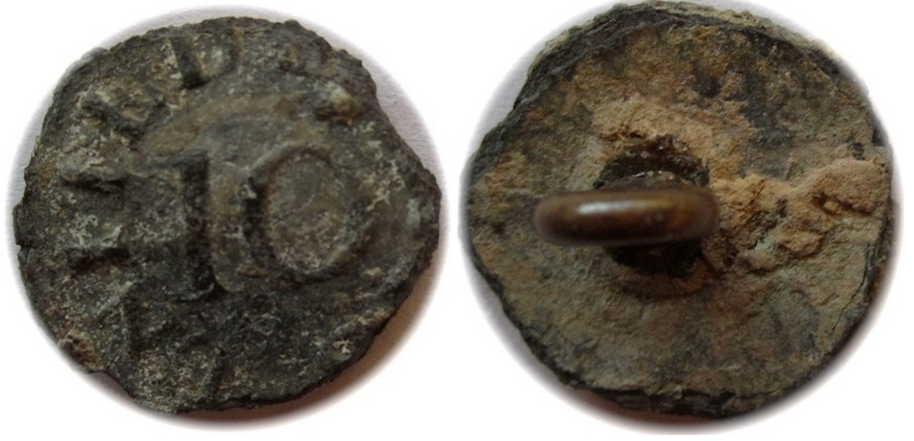
1798-1802 10th Regt. U.S. Infantry.
Color: A Silvery Grey.
Metal: Flat, 1-Piece, Raised Design, Cast Pewter.
Size: 18mm remaining. (20mm) Coat Size
Albert's: GI 28 R10: RV 35
Variation: 10th Regt.
Present Condition: An Excavated Example, Fair
Planchet Casting, Fair High Relief Pattern.
Isabela's Notes: This button's pattern depicts a
large number "10" in the center, with the country's name,
"UNITED STATES" circling around the edge in capital letters.
The high relief pattern is set on a plain flat field with a
thin raised edge border. The higher regimental numbers are
much harder to find.
Reverse Button Analysis: This is a One-Piece Casting
for the Reverse Shank. Professionally re-shanked and is
straight. No back mark. No mold line is seen.
The Isabela Collection.~
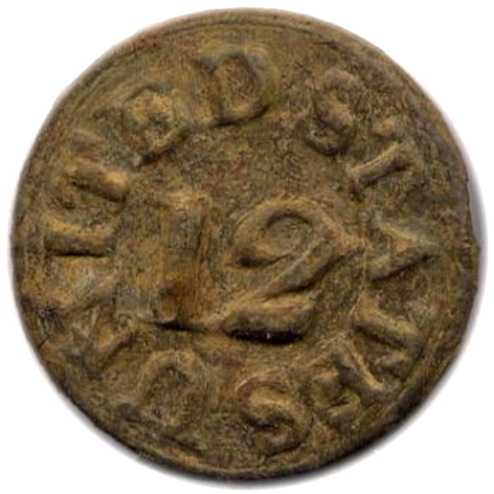
1798-1802 12th Regt. U.S. Infantry.
Color: A Silvery Grey.
Metal: Flat, 1-Piece, Raised Design, Cast Pewter.
Size: 15mm. Cuff Cize
Albert's: GI 28 R12: RV 20
Variation: 12th Regt.
Present Condition: An Excavated Example, Fair
Planchet Casting, Fair High Relief Pattern.
Isabela's Notes: This button's pattern depicts a
large number "12" in the center, with the country's name,
"UNITED STATES" circling around the edge in capital letters.
The high relief pattern is set on a plain flat field with a
thin raised edge border. The higher regimental numbers are
much harder to find.
Reverse Button Analysis: This is a One-Piece Casting
for the Reverse Shank. Professionally re-shanked and is
straight. No back mark. No mold line is seen.
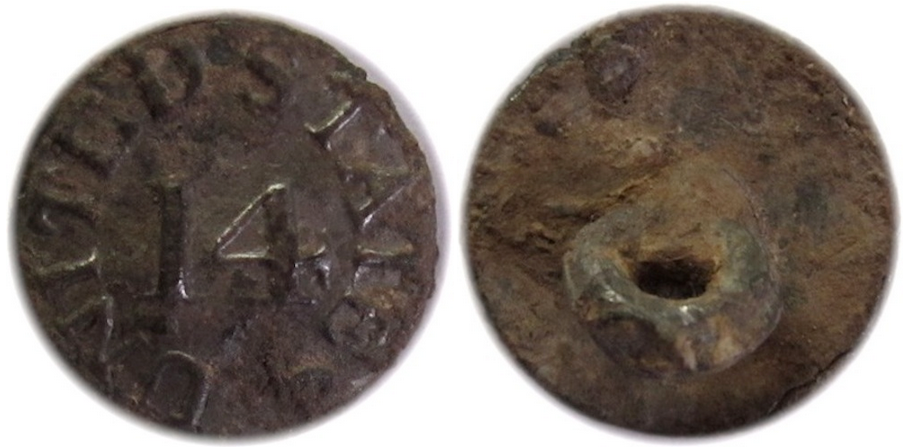
1798-1802 14th Regt. U.S. Infantry.
Color: An Earthy Grey.
Metal: Flat, 1-Piece, Raised Design, Cast Pewter.
Size: 15mm. Cuff Size
Albert's: GI 286 R14: RV 20
Variation: 14th Regt.
Present Condition: An Excavated Example, Fair
Planchet Casting, Fair High Relief Pattern.
Isabela's Notes: This button's pattern depicts a
large number "14" in the center, with the country's name,
"UNITED STATES" circling around the edge in capital letters.
The high relief pattern is set on a plain flat field with a
thin raised edge border. The higher regimental numbers are
much harder to find.
Reverse Button Analysis: This is a One-Piece Casting
for the Reverse Shank. The shank is original, straight, and
intact. No back mark. No mold line is seen.
The Isabela Collection.~
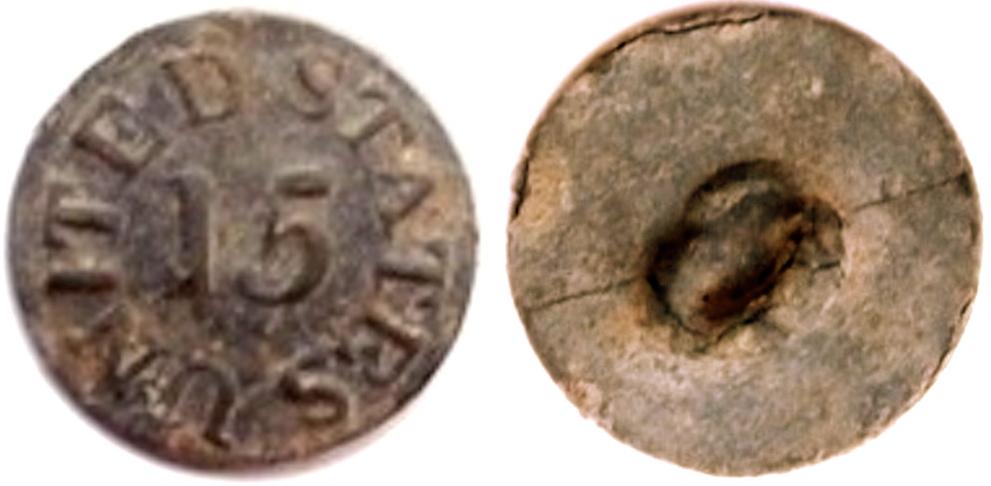
1798-1802 15th Regt. U.S. Infantry.
Color: A Pewter Brown.
Metal: Flat, 1-Piece, Raised Design, Cast Pewter.
Size: 15mm. Cuff Size
Albert's: GI 28 R15v: RV 35
Variation: 15th Regt.
Present Condition: An Excavated Example, Strong
Planchet Casting, Strong High Relief Pattern.
Isabela's Notes: This button's pattern depicts a
large number "15" in the center, with the country's name,
"UNITED STATES" circling around the edge in capital letters.
The high relief pattern is set on a plain flat field with a
plain edge border. Scarce button for collectors to find.
Reverse Button Analysis: This is a One-Piece Casting
for the Reverse Shank. The shank is original and intact,
butslightly crushed inward. No back mark. No mold line is seen.
Dan dug in 1998 in an early Military Camp in Central
Mississippi.
The Dan Patterson Collection.
~U.S.
Federal Infantry Patterns from 1808 to 1850's ~
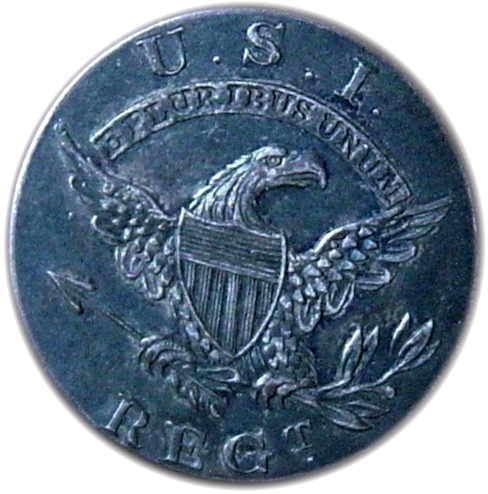
1808-12 1st Regiment, U.S. Infantry
By the early 1800's, American button manufacturing
was in full swing with flamboyant patterns, and better metal
compositions. Simple patterns with numbers were replaced
with fancy foliated letters, star patterns, and federal
eagles with shields. Pewter's composition changed from a tin
and lead composition to a tin, copper and antimony
composition. These buttons were more durable, and didn't
degrade as fast. The various states militia units often went
with the more expensive English made buttons that were known
to be of higher quality. These buttons were known for their
ornate patterns, and used stronger and more durable metals
like copper, brass, and bronze. These higher quality buttons
sometimes even showed manufacturer back marks, which started
to appear around this point. The section below will only
illustrate Federal Patterns, State Militia buttons will be
shown in another section dedicated to the various state
patterns used. An interesting note about state militia
button patterns is, when a militia unit ordered there
uniforms from the garment maker, If they did not have their
own unit motif, or wanted to use their state seal,
manufacturers would supply, "Federal Type Specimens" to the
garment maker.
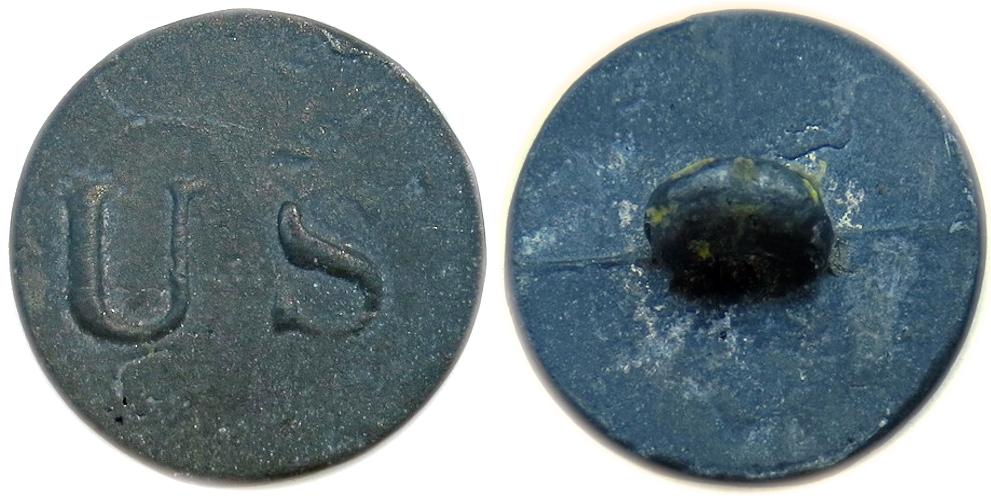
1808-30's U.S. Army General Service
Color: Pewter Grey with Hints of Red.
Metal: Flat, 1-Piece, Raised Design, Cast Pewter.
Size: 20mm. Coat Size
Albert's Number: GI 30-A RV 15
Variation: Thin Roman Block Font Letters / Letter
Size 3. 6.5mm
Present Condition: An Excavated Example, Exceptional
Planchet Casting, Exceptional High Relief Pattern.
Isabela's Notes: There appears to be at least four
known die variants for the coat size General Service button.
The differences are in the circumference size, the style
letters used, and if the field between the letters is blank,
or a six pointed star. This button's pattern depicts the
country's initials, "US" in
Thin Roman Block Font Letters.
Letter Size
for this die variant is
3. 6.5mm
. This die
variant has a Plain Field between the letters. The high
relief pattern is set on plain flat field with no raised
edge border.
Reverse Button Analysis: This is a flat one-piece
button with a loop shank. The boss is present, but the loop
is broken off.
This was excavated in South Carolina by the owner in Fresh
Water.
The Keith Nixon Collection.
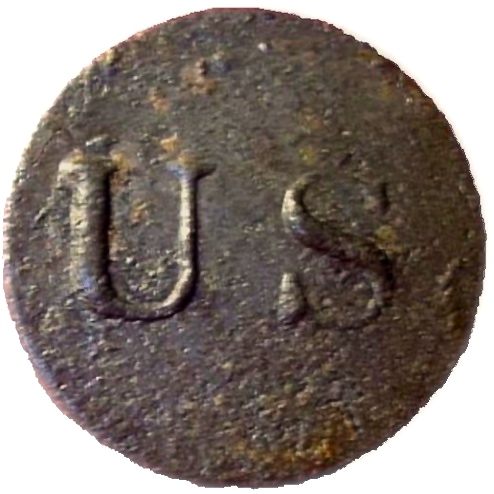
1808-30's U.S. Army General Service
Color: A Metallic Coppery Brown.
Metal: Flat, 1-Piece, Raised Design, Cast Pewter.
Size: 18.69mm. Cuff Size
Albert's Number: GI 30-A RV 15
Variation: Thick Roman Block Font Letters / Letter
Size 2mm x 7mm / Wide Plain Field.
Present Condition: An Excavated Example, Exceptional
Planchet Casting, Exceptional High Relief Pattern.
Isabela's Notes: There appears to be at least four
known die variants for the Army's coat size General Service button.
The differences are in the outer circumference size, the
style letters used, and if the field between the letters is
blank, or has a six pointed star. This button's pattern
depicts the country's initials, "US" in
Thick Roman Block
Font Letters. The right
hand side of the "U" and the middle of the "S" depicts
thicker lines. The letters size for this die variant is
5.02mmW x
6.73mmH
. This die variant has a
Wide Plain Field between the letters.
The high relief pattern is set on plain flat field with no
raised edge border.
Reverse Button Analysis: This is a flat one-piece
button with a loop shank. The shank is original, straight,
and intact.
The RJ. Silverstein Collection.
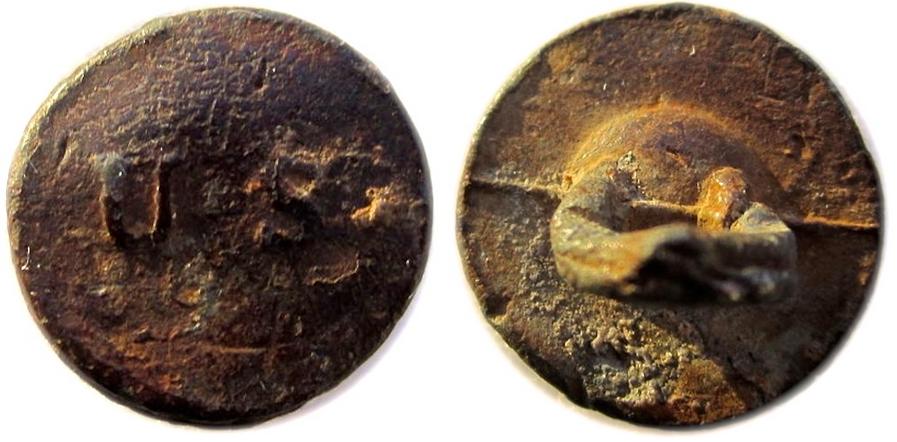
1808-30's U.S. Army General Service
Color: Silvery Gray With Rusty-Brown Patches.
Metal: Flat, 1-Piece, Raised Design, Cast Pewter.
Size: 13.3mm. Cuff Size
Albert's Number: GI 30-Av
RV 7
Variation: Thinner U for the Roman Block Font Letters
/ Letter Size 2mm x 3.5mm / Wide Plain Field.
Present Condition: An Excavated Example, Good
Planchet Casting, Good/Strong High Relief Pattern.
Isabela's Notes: There appears to be at least
three known die variants for the matching Cuff
button, but there were probably more made. The differences
are in the style of letters used. Some variants depict a
skinny "U", and some show a thicker "U" on
the right-side. There
is also a difference in the field between the letters. One
is is plain (blank), the other has a dot. The dot variant
was most likely made to match the GI
30-B coat variant. This button's pattern depicts the
country's initials, "US," and uses the
Thinner "U" for the
Roman Block Font Letter. The
Letter Size for this die
variant is 2mm x 3.5mm. This button has a
Wide Plain Field
in-between the letters. The high relief pattern is set on
plain flat field with a slightly elevated edge.
Reverse Button Analysis: This is a flat one-piece
button with a loop shank. The shank is original, straight,
and intact.
Excavation location unknown.
The RJ. Silverstein Collection.
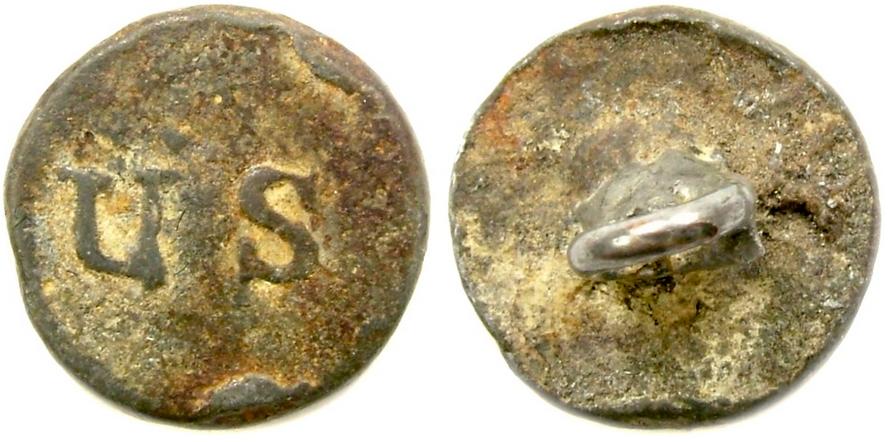
1808-30's U.S. Army General Service
Color: Pewter Grey with Rusty Orange Patches.
Metal: Flat, 1-Piece, Raised Design, Cast Pewter.
Size: 13.3mm. Cuff Size
Albert's Number: GI 30-Av : RV 7
Variation: Thick Roman Block Font Letters / Letter
Size 2mm x 3.5mm / Plain Field.
Present Condition: An Excavated Example, Good
Planchet Casting, Good/Strong High Relief Pattern.
Isabela's Notes: There appears to be at least two
known die variants for the matching General Service Cuff
button. The differences are in the style letters used, and
if the field between the letters is blank, or has a dot.
This button's pattern depicts the country's initials, "US"
in
Thick Roman Block Font Letters.
Letter Size for this die
variant is 2mm x 3.5mm
. This die has a
Plain
Field
between
the letters. The high relief pattern is set on plain flat
field with a slightly elevated edge.
Reverse Button Analysis: This is a flat one-piece
button with a loop shank. The shank is a soldered on
replacement, but straight, and intact.
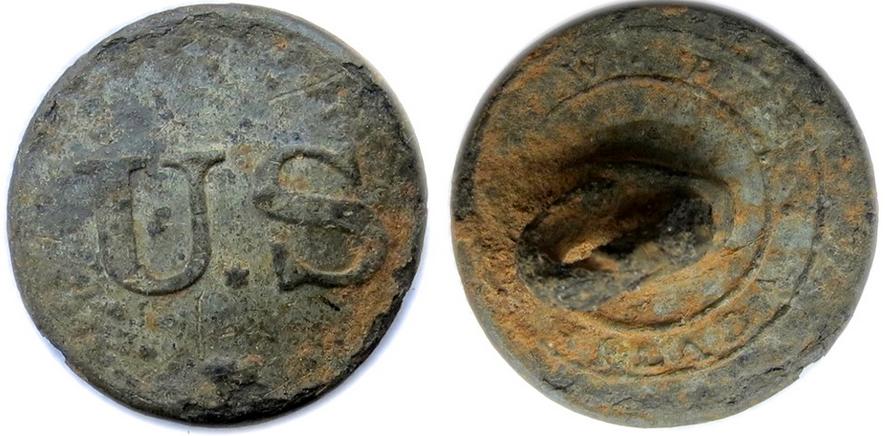
1808-30's U.S. Army General Service
Color: Pewter Grey with Rusty Orange.
Metal: Flat, 1-Piece, Raised Design, Cast Pewter.
Size: 19.55mm. Coat Size
Albert's Number: Similar to GI 30-B: RV 75
Variation: Small Thick Roman Block Letters / Slightly
Slanted Belly / Letter Size 2mm x 7mm / Six Pointed Star.
Present Condition: An Excavated Example, Exceptional
Planchet Casting, Exceptional High Relief Pattern.
Isabela's Notes: This particular specimen uses the
very scarce Philadelphia back mark used by William Pinchin
after he took over the business from George Armitage in
1825. The back mark reads, "WP PHILADa ". which would make
this the first issue for the Army after he took over. This
particular specimen is not listed in Albert's reference
book, and this specimen's die variant would make the 5th
known die variant. This is similar to Albert's GI 30-B, with
Star, but uses smaller letters. This button's pattern
depicts the country's initials, "US" in
Small Thick Roman
Block Letters. The "S" in this die variant also is
Slightly
Slanted Belly
Outward on the lower portion of the S.
Letter
Size for this die variant is 2mm x 7mm. There is a raised
Six Pointed Star in-between the country's initials. The high
relief pattern is set on plain flat field with a slightly
raised edge.
Reverse Button Analysis: This is a flat one-piece
button with a loop shank. The shank is original, straight,
and intact. Phila / W.P.
Excavation location unknown.
The RJ. Silverstein Collection.
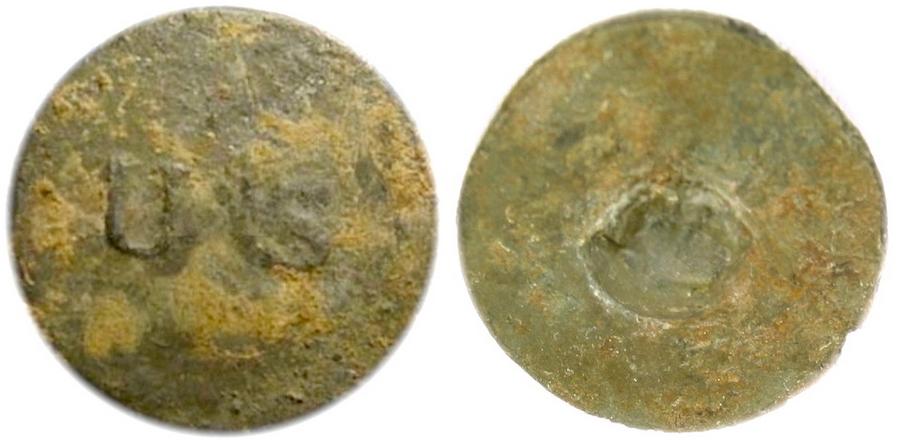
1808-30's U.S. Army General Service
Color: A Clay Orange Pewter.
Metal: Flat, 1-Piece, Raised Design, Cast Pewter.
Size: 15mm. Cuff Size
Albert's Number: GI 30-Bv RV 7
Variation: Thinner U for the Roman Block Font Letters
/ Dot In-Between the Letters.
Present Condition: An Excavated Example, Good
Planchet Casting, Good/Strong High Relief Pattern.
Isabela's Notes: There appears to be at least three
known die variants for the matching General Service Cuff
button, but there were probably more made. The differences
are in the style of letters used. Some variants depict a
skinny "U", and some show a thicker "U" on one side. There
is also a difference in the field between the letters. One
is is plain (blank), the other has a dot to match the GI
30-B coat variant. This button's pattern depicts the
country's initials, "US," and uses the Thinner "U" for the
Roman Block Font Letter. This button has a Dot In-Between
the Letters. The high relief pattern is set on plain flat
field with a plain edge.
Reverse Button Analysis: This is a flat one-piece
button with a loop shank. The shank is original and intact,
but slightly bent.
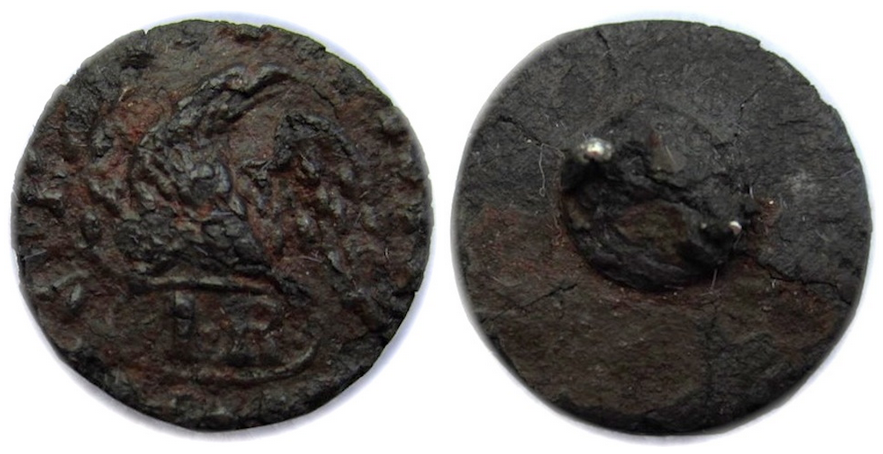
1808-11 1st Regt. U.S. Infantry.
Color: Pewter Grey with Hints of Red.
Metal: Flat, 1-Piece, Raised Design, Cast Pewter.
Size: 13.83mm. Cuff Size
Albert's Number: GI 32-R1v-S RV 10
Variation: 1st Regt. / 16 Star Pattern.
Present Condition: An Excavated Example, Fair
Planchet Casting, Fair High Relief Pattern.
Isabela's Notes: There appears to be at least four
known die variants for the 1st Regiment's button in coat
size, and two for cuff size. This cuff button's pattern
depicts an eagle facing left while perched on an oval
circle. Within the oval circle is the
1st regiment
designation, "1 . R .t". The eagle is holding small laurel
stem in it's right talon, and it's left talon is just
standing the oval. There are
16 Five-Pointed Stars
encircling the edge around the periphery. The high relief
pattern is set on a plain flat field without a raised edge.
Cuff variants with stars are a big more scarce then without
stars.
Reverse Button Analysis: This is a flat one-piece
button with a boss and loop shank. The boss and shank are
present, but loop is missing the top half. Blank back mark.
Excavated near Milledgeville, Georgia.
The RJ Silverstein Collection.
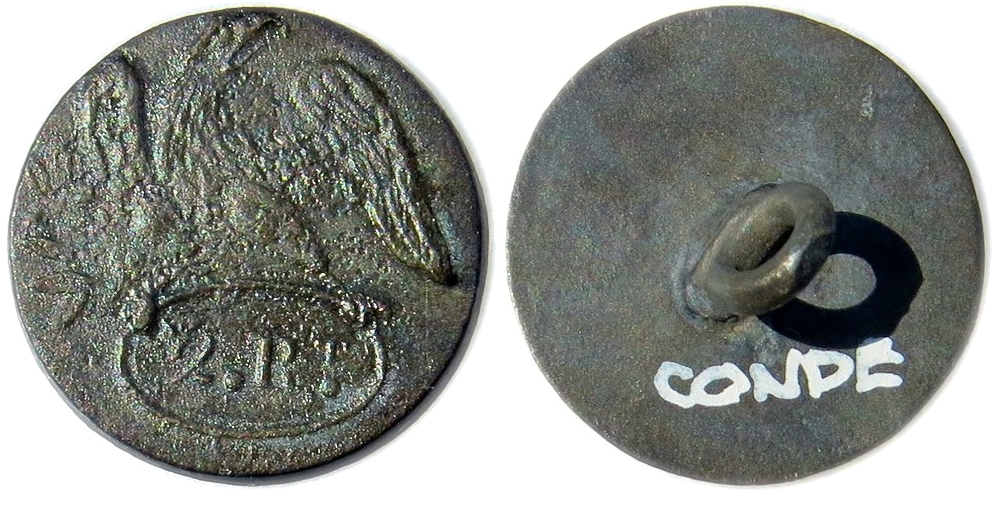
1808-11 2nd Regt. U.S. Infantry.
Color: A Flashy Silver.
Metal: Flat, 1-Piece, Raised Design, Cast Pewter.
Size: 20.66mm. Coat Size
Albert's Number: GI 32R2-C: RV
25
Variation: 2nd Regt. / Olive Branch with Olives.
Present Condition: An Excavated Example, Strong
Planchet Casting, Strong High Relief Pattern.
Isabela's Notes: There appears to be at least five
known die variants for the 2nd Regiment's button in coat
size, and three for the cuff size. Albert's book only lists four
patterns. The two main variations collectors should note is
in the Arabic number two's style, and the eagle depicted. This button's pattern depicts an eagle facing up &
to the left, while standing on an oval circle. The
2nd
Regiment designation, "2. R.t" is within the oval's center.
In the eagle's right talon is an
Olive Branch with Olives.
The high relief pattern is set on a flat plain field with no
raised edge border. The coat button is much rarer then the
cuff size example.
Reverse Button Analysis: This is a one-piece button
with a boss and loop shank. The shank is present, but loop
is broken off. Blank back mark.
Dug in 1960 at Fort Conde, Mobil Alabama.
The RJ Silverstein Collection.
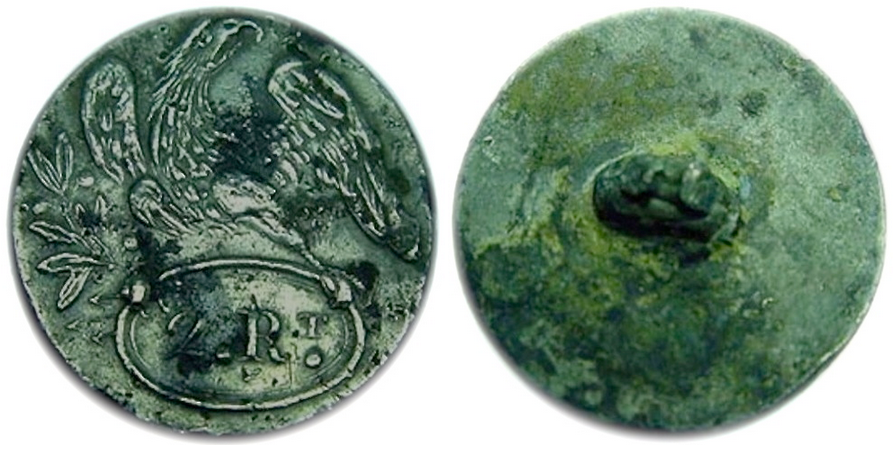
1808-11 2nd Regt. U.S. Infantry.
Color: A Pewter Grey with Hints of Green.
Metal: Flat, 1-Piece, Raised Design, Cast Pewter.
Size: 15mm. Cuff Size
Albert's Number: GI 32R2-E: RV 10
Variation: 2nd Regt. / Olive Branch with Olives.
Present Condition: An Excavated Example, Strong
Planchet Casting, Strong High Relief Pattern.
Isabela's Notes: This is another die variant that
was used for the 2nd Regt.. This cuff button's pattern depicts an eagle facing up &
to the left, while standing on an oval circle. The
2nd
Regiment designation "2. R.t" is within the oval's center.
In the eagle's right talon is an
Olive Branch with Olives.
The high relief pattern is set on a flat plain field with no
raised edge border.
Reverse Button Analysis: This is a one-piece button
with a boss and loop shank. The shank is present, but loop
is broken off. Blank back mark.
The J. Baldwin Collection.
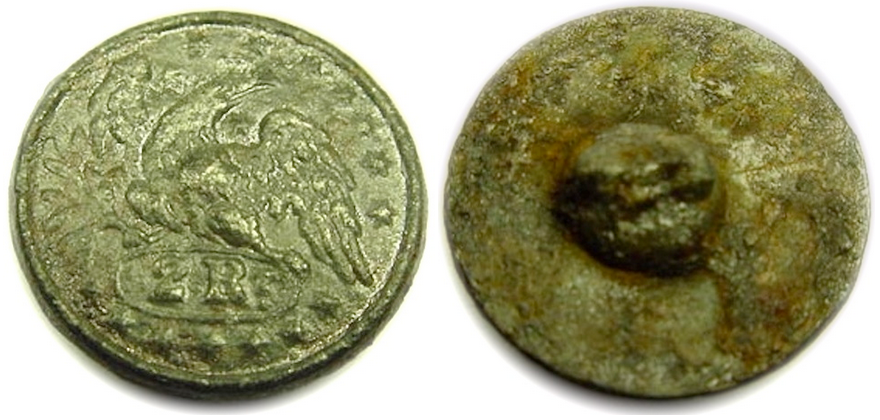
1808-11
2nd Regt. U.S. Infantry.
Color: A Silvery-Grey.
Metal: Flat, 1-Piece, Raised Design, Cast Pewter.
Size: 20mm. Coat Size
Albert's Number: GI 32-R2-S: RV 10
Variation: 2nd Regt. /16 Star Pattern / Small Oval.
Present Condition: An Excavated Example, Good/Strong
Planchet Casting, Strong High Relief Pattern.
Isabela's Notes: There appears to be at least five
known die variants for the 2nd Regiment's button in coat
size, and three for cuff size. Albert's book only lists four
patterns. This coat button's pattern depicts an eagle facing
up & to the left, while standing on a
Small Oval. The
2nd
Regiment
designation "2. R.t" is within the oval's center.
The eagle is holding an Olive Branch in it's right talon. In
this variant, there are
16 Six-Pointed Stars
circling around
the edge. The high relief pattern is set on a plain field
with a thin raised edge. Some collectors report this button
in both pewter and yellow metal.
Reverse Button Analysis: This is a one-piece button
with a boss and loop shank. The shank is present, but loop
is broken off. Blank back mark.
The J. Baldwin Collection.
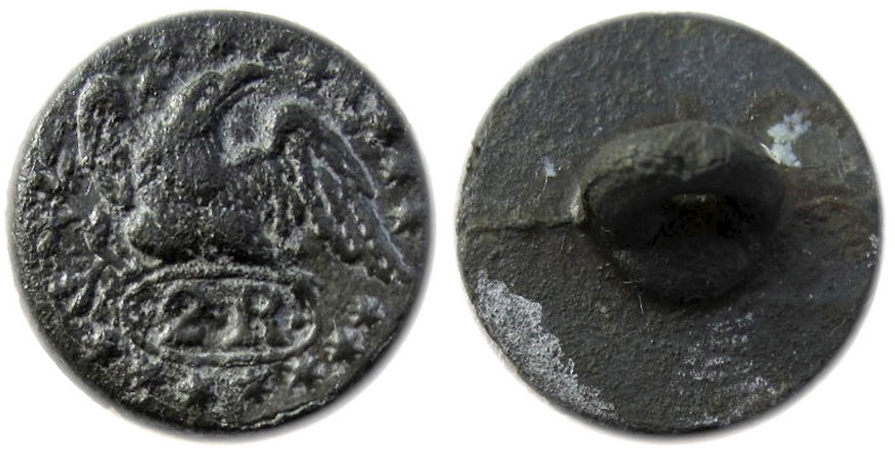
1808-11
2nd Regt. U.S. Infantry.
Color: A Pewter Grey with Hints of Red.
Metal: Flat, 1-Piece, Raised Design, Silver Wash,
Cast Pewter.
Size: 15mm. Cuff Size
Albert's Number: Similar to GI 32-S R2v: Unlisted
Variant RV 50
Variation: 2nd Regt. / 16 Six-Pointed Stars.
Present Condition: An Excavated Example, Good
Planchet Casting, Good/Strong High Relief Pattern.
Isabela's Notes: This die variant is not listed in
Albert's book. There appears to be at least three known die
variants for the 2nd Regiment cuff size button. This cuff
button's pattern depicts an eagle facing up & to the left,
while standing on a small oval. The
2nd Regiment designation
"2. R.t" is within the oval's center. The eagle is holding
an Olive Branch in it's right talon. In this variant, there
are
16 Six-Pointed Stars circling around the edge. The high
relief pattern is set on a plain field without a raised
edge. Silver Wash Pewter buttons are hard to find without
pewter degradation. Most example exhibit sever edge loss.
Reverse Button Analysis: This is a one-piece button
with a boss and loop shank. The shank is original, straight,
and intact. Blank back mark.
The RJ Silverstein
Collection.
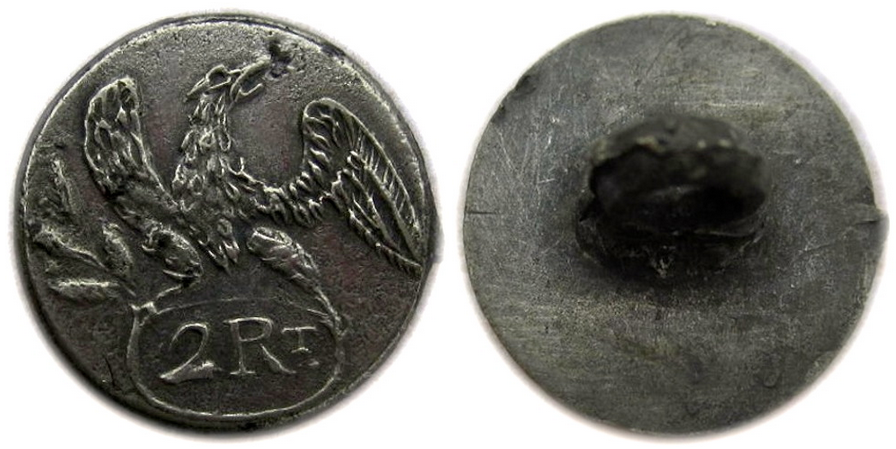
1808-11
2nd Regt. U.S. Infantry.
Color: A Silvery Grey.
Metal: Flat, 1-Piece, Raised Design, Cast Pewter.
Size: 14.67mm. Cuff Size
Albert's Number: Similar to GI 32 Unlisted Variant
RV 200
Variation: Large Circular Oval / 2nd Regt. / Olive
Branch.
Present Condition: A Non Excavated Example,
Exceptional Planchet Casting, Strong High Relief Pattern.
Isabela's Notes: This is rarest die variant for the
2nd Regiment cuff button. This is not listed in Albert's
book or any other book. Unlike the other four die variants,
there is a different style eagle depicted, along with a
larger more circular oval. As with the other variants in
this series, the button's pattern depicts an eagle facing up
& to the left, while standing on a
Large Circular Oval. The
2nd Regiment
designation "2. Rt" is within the oval's
center. The eagle is holding a crude style
Olive Branch
in
it's right talon. The high relief pattern is set on a plain
flat field without a raised edge.
Reverse Button Analysis: This is a flat one-piece
button with a soldered on loop shank. The shank is original,
straight, and intact. No back mark.
The RJ Silverstein Collection.
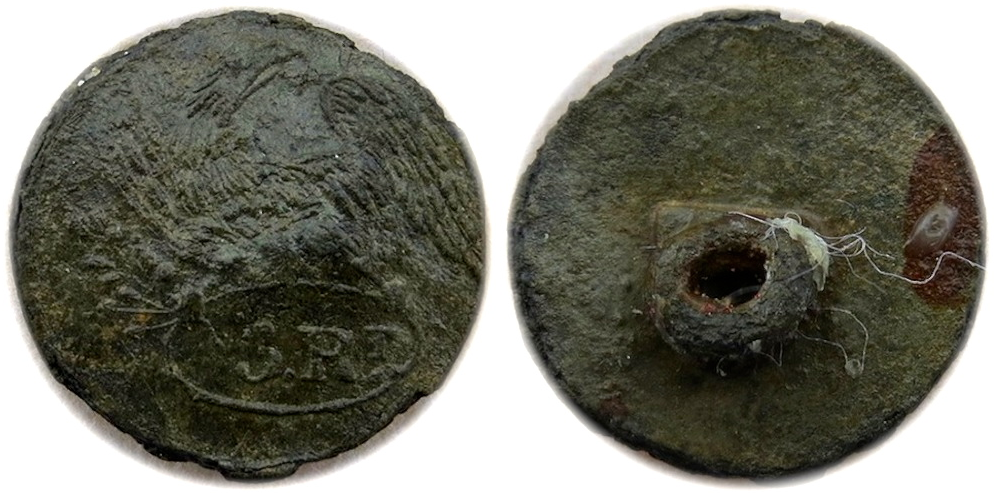
1808-11
3rd Regt. U.S. Infantry.
Color: Forest Green.
Metal: Flat, 1-Piece, Raised Design, Cast Pewter /
Yellow Metal.
Size: 20.97mm. Coat Size
Albert's Number: Very Similar to GI 32-C R3: Unlisted
Die Variant RV 50
Variation: 3rd Regt./ Olive Branch / Bundle of Three
Arrows
Present Condition: An Excavated Example, Good
Planchet Casting, Good/Strong High Relief Pattern.
Isabela's Notes: Albert only lists one die variant
for the 3rd Regt. in his book. There are at least two with
this specimen. There could possibly be more,
just none I can find pictured in any books. This die variant
shows a different Arabic Style number and eagle depicted
then Albert's plate specimen. This scarce button's pattern depicts an eagle looking left while
perched on a large oval. The
3rd Regiment
designation, "3. Rt" is in the center. In the eagle's right talon is both a
small
Olive Branch, and
Bundle of Three Arrows
that are
pointing to the right. The high relief pattern is set on a
plain flat field with no edge border.
Reverse Button Analysis: This is a one-piece button
with a loop shank. The shank is original and intact, but
slightly bent over. No back mark or mold line.
Another
one dug by
J.B. at a ferry crossing on the Ocilla River in Lamont
Florida.~
The RJ. Silverstein Collection.
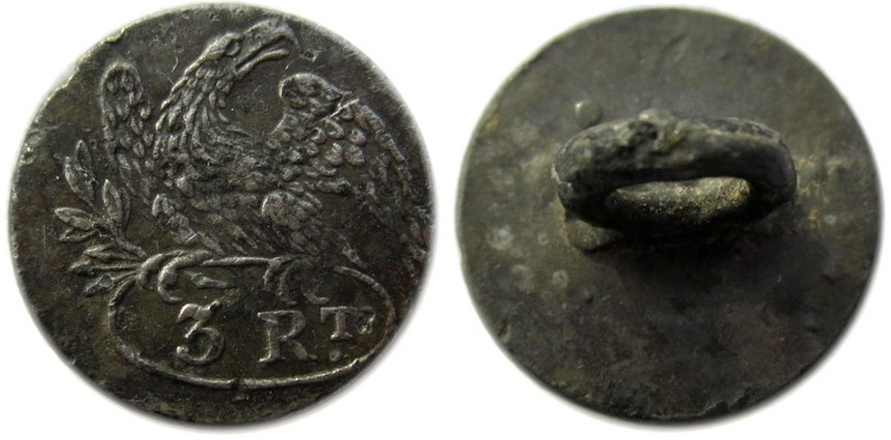
1808-11
3rd Regt. U.S. Infantry.
Color: Silver Wash Grey.
Metal: Flat, 1-Piece, Raised Design, Cast Pewter /
Yellow Metal.
Size: 15mm. Cuff Size
Albert's Number: Similar to GI 32-C Rv3: Unlisted
Variant RV 50
Variation: 3rd Regt./ Olive Branch / Bundle of Three
Arrows
Present Condition: An Excavated Example, Strong
Planchet Casting, Strong High Relief Pattern.
Isabela's Notes: Albert only lists one die variant
for the 3rd Regt. in his book. There could possibly be more,
just no current known or listed specimens in any books. This
cuff button's pattern depicts an eagle looking left while
perched on a large oval. The
3rd Regiment
designation, "3 R.t" is in the center. In the eagle's right talon is both a
small
Olive Branch, and
Bundle of Three Arrows
that are
pointing to the right. The high relief pattern is set on a
plain flat field with no edge border.
Reverse Button Analysis: This is a one-piece button
with pewter loop shank. The shank is present, but loop is
broken off. Blank back mark.
Dug by
J.B. at a ferry crossing on the Ocilla River in Lamont
Florida.~
The RJ. Silverstein Collection.
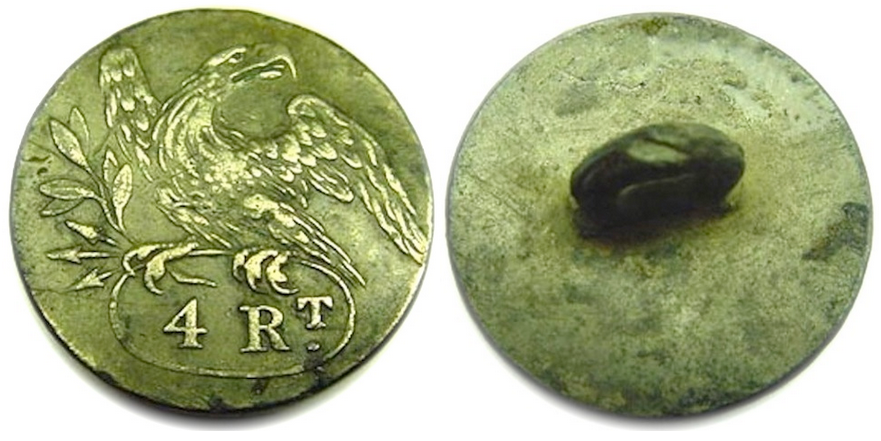
1808-11
4th Regt. U.S. Infantry.
Color: An Olive Grey.
Metal: Flat, 1-Piece, Raised Design, Cast Pewter /
Yellow Metal.
Size: 15mm. Cuff Size
Albert's Number: GI 32-R4-C RV 7
Variation: 4th Regt./ Arrows Spread Proportionately /
Six Petal Olive Branch
Present Condition: An Excavated Example, Strong
Planchet Casting, Strong High Relief Pattern.
Isabela's Notes: Albert lists two die variants for
the 4th Regt. in his book. This cuff button's pattern
depicts an eagle facing left while perched on a large oval
circle. The
4th Regiment designation, "4 R.t" is in the
center. In the eagle's right talon, is a small Bundle of
Three Arrows with large tips that are
Spread Proportionately
from each other. The eagle is also holding a
Six Petal Olive
Branch. The pattern is set in high relief on a plain field
with no edge border.
Reverse Button Analysis: This is a one-piece button
with a boss and loop shank. The shank is original, straight,
and intact. Blank back mark.
The J. Baldwin Collection.
Robert's Notes: Even though most of these patterns
are dug from War of 1812 sites, most of the patterns used
were issued by the U.S. Military several years before the
war. Armitage and Wishart were both making military buttons
as far back as 1808, so some of these earlier ones would
have been used by both officers, and enlisted men. Congress
wasn't that free with their spending on soldiers supplies
and uniforms, and your fancier uniforms and better buttons
would have been owned by state's militia who would have went
for English quality.
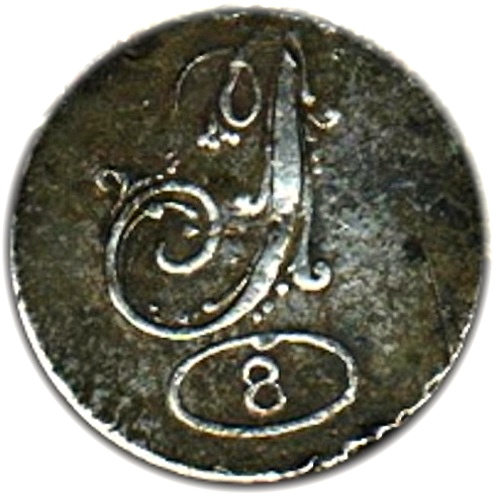
1812 8th Regiment, U.S. Infantry
Color: A Pewter Grey With A Film of Seaweed Green.
Metal: Flat, 1-Piece, Raised Design, Cast Pewter.
Size: 20mm. Coat Size
Albert's Number: GI 34-R8: RV
25
Variation: Foliated Script I with Decorative Dots /
Regiment Number,"8" / Arabic style.
Present Condition: An Excavated Example, Strong
Planchet Casting, Strong High Relief Pattern.
Isabela's Notes: We know that at least ten
regiments (8-18) were issued this infantry pattern. We also
know that matching cuffs were made to compliment the coat
size. This button's pattern depicts a
large
Foliated Script Letter "I"
with A Decorative Dot
pattern flaring from it. This added flair of dots kind of
gives it a fireworks feel. Underneath is a medium size oval containing
the infantry's
Regiment Number,"8"
in an
Arabic style
number. These infantry regiment coat buttons rarely surface
to market, and are much rarer then the common Star versions.
Cuff size are a little less scarce, but still difficult to
obtain. Specimens usually show edge loss, cracks or just
pewter disintegration or with a shank.
Reverse Button Analysis: This is a flat one-piece
button with a soldered on loop shank.
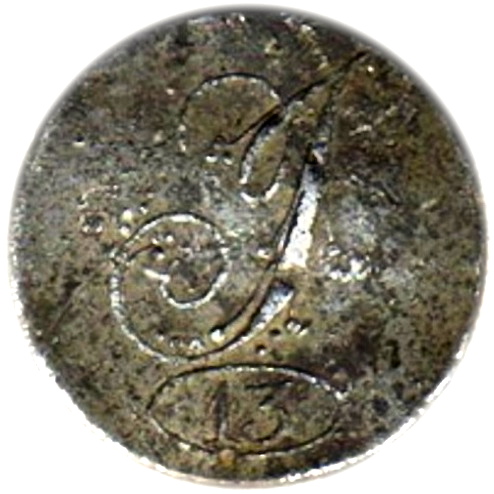
1812 13th Regiment, U.S. Infantry
Color: A Pewter Grey With A Film of Seaweed Green.
Metal: Flat, 1-Piece, Raised Design, Cast Pewter.
Size: 20mm. Coat Size
Albert's Number: GI 34-R13: RV
25
Variation: Foliated Script I with Decorative Dots /
Regiment Number,"13" / Arabic style.
Present Condition: An Excavated Example, Strong
Planchet Casting, Strong High Relief Pattern.
Isabela's Notes: We know that at least ten
regiments (8-18) were issued this infantry pattern. We also
know that matching cuffs were made to compliment the coat
size. This button's pattern depicts a
large
Foliated Script Letter "I"
with A Decorative Dot
pattern flaring from it. This added flair of dots kind of
gives it a fireworks feel. Underneath is a medium size oval containing
the infantry's
Regiment Number,"13"
in an
Arabic style
number. These infantry regiment coat buttons rarely surface
to market, and are much rarer then the common Star versions.
Cuff size are a little less scarce, but still difficult to
obtain. Specimens usually show edge loss, cracks or just
pewter disintegration or with a shank.
Reverse Button Analysis: This is a flat one-piece
button with a soldered on loop shank.
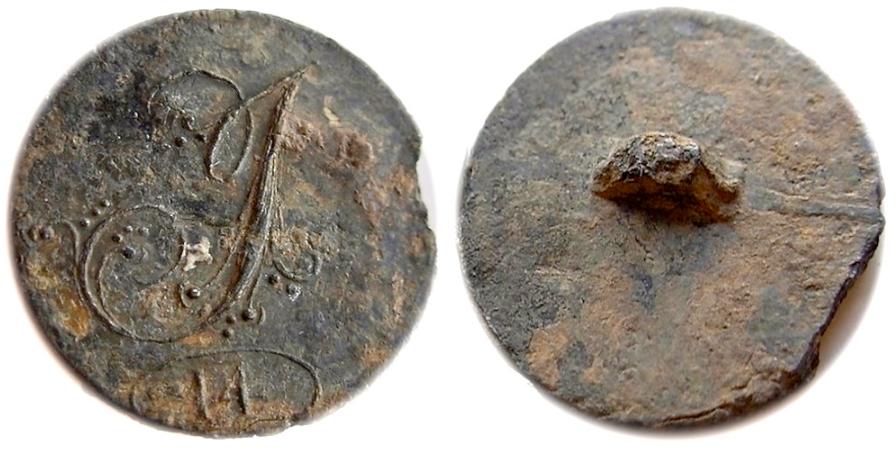
1812 14th Regiment, U.S. Infantry
Color: A Pewter Grey With Orangey Brown Patches.
Metal: Flat, 1-Piece, Raised Design, Cast Pewter.
Size: 20mm. Coat Size
Albert's Number: GI 34-R14: RV
25
Variation: Foliated Script I with Decorative Dots /
Regiment Number,"14" / Arabic style.
Present Condition: An Excavated Example, Strong
Planchet Casting, Strong High Relief Pattern.
Isabela's Notes: We know that at least ten
regiments (8-18) were issued this infantry pattern. We also
know that matching cuffs were made to compliment the coat
size. This button's pattern depicts a
large
Foliated Script Letter "I"
with A Decorative Dot
pattern flaring from it. This added flair of dots kind of
gives it a fireworks feel. Underneath is a medium size oval containing
the infantry's
Regiment Number,"14"
in an
Arabic style
number. These infantry regiment coat buttons rarely surface
to market, and are much rarer then the common Star versions.
Cuff size are a little less scarce, but still difficult to
obtain. Specimens usually show edge loss, cracks or just
pewter disintegration or with a shank.
Reverse Button Analysis: This is a flat one-piece
button with a soldered on loop shank. The shank is missing.
Dug at Sackets Harbor, NY.
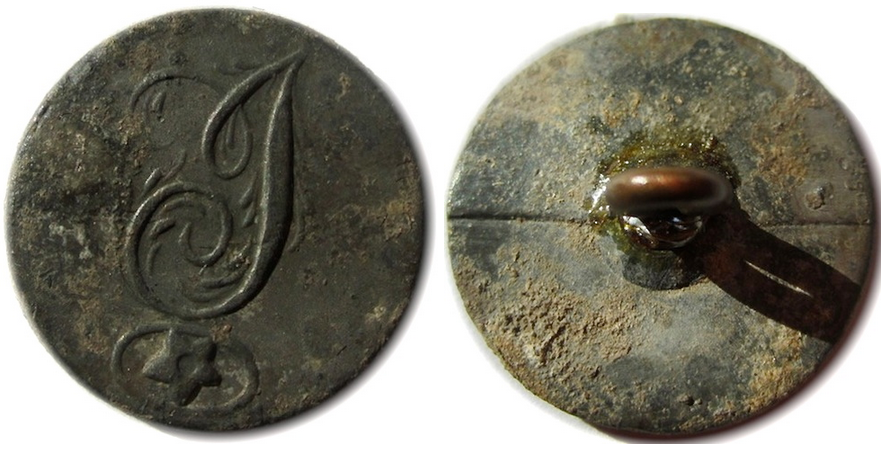
1812-15 U.S. Infantry
Color: An Army Green with Gray Undertones.
Metal: Flat, 1-Piece, Raised Design, Cast Pewter.
Size: 19.96 mm. Coat Size
Albert's Number: GI 36-A.3: RV 6
Variation: Foliated Script I / Open Center 5 Point
Star / Star's Prime Point Down.
Present Condition: An Excavated Example, Strong
Planchet Casting, Strong High Relief Pattern.
Isabela's Notes: This button's pattern depicts a
large
Foliated Script Letter "I"
in the center. Underneath is a small oval containing an
Open Center Five Pointed Star.
This die variant shows the
Star's Prime Point Down. There
are twelve known different die variants in this particular
series. Some show the letter, "I" with wide, narrow, or
medium loops. There are also a few die variants for the star
itself. First, is the different directions of the prime
point. Second, if the center is solid or hollow; and third
is how many points the star has, "5, 6, 8, or 10". The
different variations of obtainable specimens one can obtain
makes this a strong collectors favorite.
Reverse Button Analysis: This is a flat one-piece
button with a soldered on loop shank. The shank is
professionally re-shanked, straight & intact.
Excavated in Sackets Harbor, New York
The RJ Silverstein Collection.
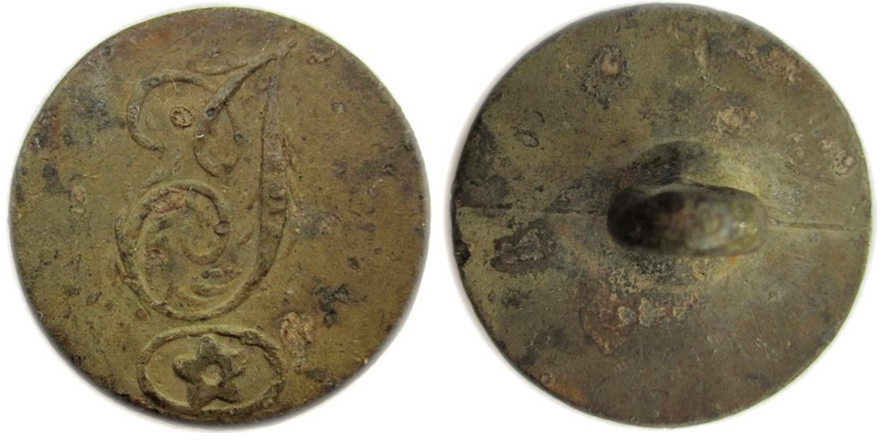
1812-15 U.S. Infantry
Color: An Army Green with Gray Undertones.
Metal: Flat, 1-Piece, Raised Design, Cast Pewter.
Size: 19.43mm. Coat Size
Albert's Number: GI 36-A.2: RV 6
Variation: Foliated Script I / Open Center 5 Point
Star / Star's Prime Point Up.
Present Condition: An Excavated Example, Strong
Planchet Casting, Strong High Relief Pattern.
Isabela's Notes: This button's pattern depicts a
large
Foliated Script Letter "I"
in the center. Underneath
is a small oval containing an
Open Center Five Pointed Star.
This die variant shows the
Star's Prime Point Up. There are
twelve known different die variants in this particular
series. Some show the letter, "I" with wide, narrow, or
medium loops. There are also a few die variants for the star
itself. First, is the different directions of the prime
point. Second, if the center is solid or hollow; and third
is how many points the star has, "5, 6, 8, or 10". The
different variations of obtainable specimens one can obtain
makes this a strong collectors favorite.
Reverse Button Analysis: This is a one-piece button
with a loop shank. The shank is original, straight & intact.
No back mark. Mold line present.
The RJ Silverstein Collection.
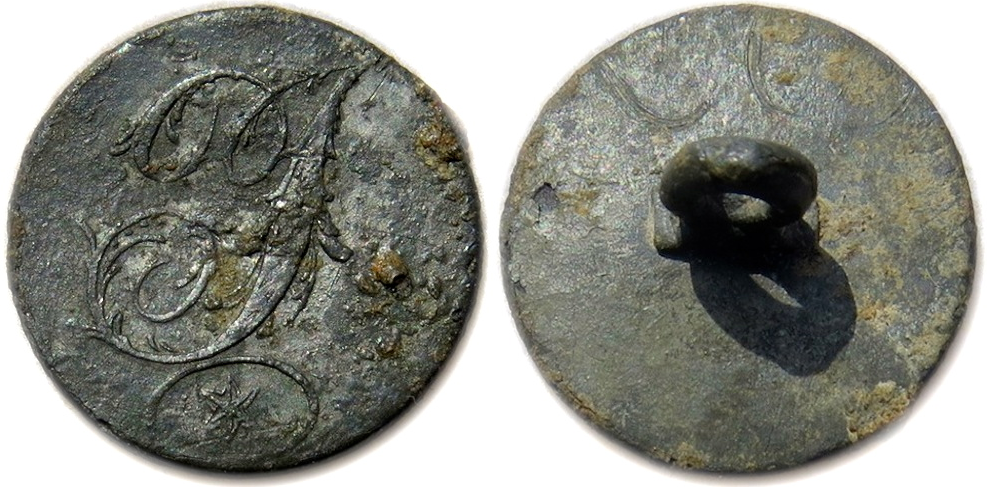
1812-15 U.S. Infantry
Color: A Pewter Gray With Silvery Highlights.
Metal: Flat, 1-Piece, Raised Design, Cast Pewter.
Size: 21.01mm. Coat Size
Albert's Number: GI 36-B: RV 25
Variation: Foliated Script I / Outlined 6 Point Star
/ Star's Prime Point Up.
Present Condition: An Excavated Example, Strong
Planchet Casting, Strong High Relief Pattern.
Isabela's Notes: This button's pattern depicts a
large
Foliated Script Letter "I" in the center. Underneath
is a medium size oval containing an
An Outlined Six Point
Star. There is only one die variant for the coat and cuff
button which depicts a six pointed star. Aside from the
numbered regiments, the six point star is the hardest to
obtain. Collectors should seek any example when available.
Reverse Button Analysis: This is a one-piece button
with a loop shank. The shank is original, straight & intact.
No back mark. Mold line present
The RJ Silverstein Collection.
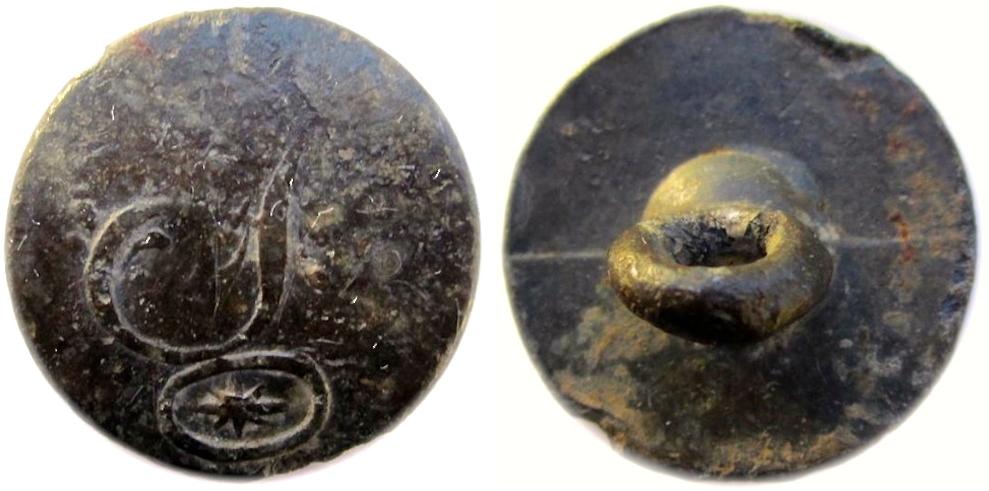
1812-15 U.S. Infantry
Color: A Deep Brown.
Metal: Flat, 1-Piece, Raised Design, Cast Pewter.
Size: 19.82mm. Coat Size
Albert's Number: GI 36-C: RV
12
Variation: Larger Vertical Foliated Script I / Eight
Point Star / Wider Birth Hook Tail.
Present Condition: An Excavated Example, Strong
Planchet Casting, Good High Relief Pattern.
Isabela's Notes: We know there are at least two
die variants made with a raised eight pointed star. One die
variant depicts a slightly slanted "I" and shows a more
curled tail. Instead of having foliated leaf pattern it has
flair dots. The other die variant shows a more vertical "I"
that has a wide birth tail. This variant depicts a foliated
"I". This variant's pattern depicts a
Large Vertical Foliated Script Letter "I"
with a
Wider Birth
Hook Tail.
In this variant the tale rests on top of a small raised
outline oval. Centered inside of the oval is a raised
Eight Point Star.
The high relief pattern is set on a plain flat field with no
edge border. This foliated variant is commonly found in the
market at a reasonable price.
Reverse Button Analysis: This is a one-piece casting
for the reverse shank. The shank is original, straight &
intact. No back mark. The mold line present.
The RJ Silverstein Collection.
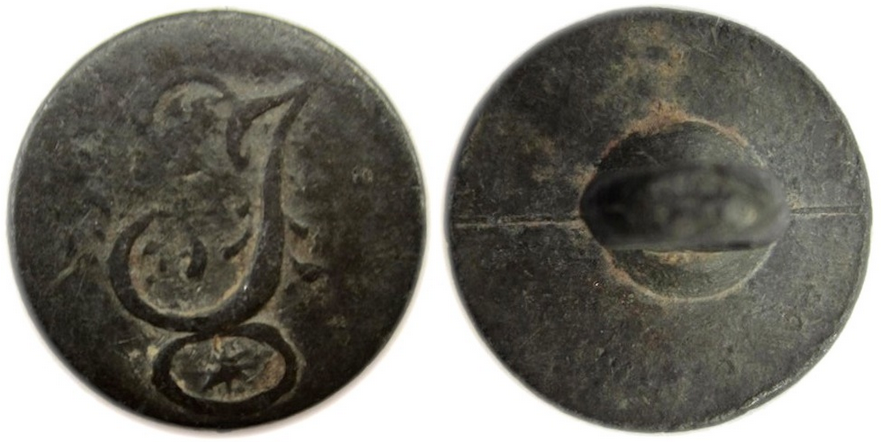
1812-15 U.S. Infantry
Color: A Silvery Blue.
Metal: Flat, 1-Piece, Raised Design, Cast Pewter.
Size: 15.96mm. Cuff Size
Albert's Number: GI 36-Cv: RV 15
Variation: Vertical Foliated Script I / Eight Point
Star / Wider Birth Hook Tail.
Present Condition: An Excavated Example, Strong
Planchet Casting, Good High Relief Pattern.
Isabela's Notes: This is the matching cuff button
for the foliated "I" with the eight pointed star. The
button's pattern depicts a
Vertical Foliated Script Letter "I"
with a
Wider Birth
Hook Tail.
In this variant the tale rests on top of a small raised
outline oval. Centered inside of the oval is a raised
Eight Point Star.
The high relief pattern is set on a plain flat field with no
edge border. The cuff size button is much harder to obtain
then the coat size. Specimens without a worn down pattern
that have a shank are rare.
Reverse Button Analysis: This is a one-piece casting
for the reverse shank. The shank is original, straight &
intact. No back mark. The mold line present.
The RJ Silverstein Collection.
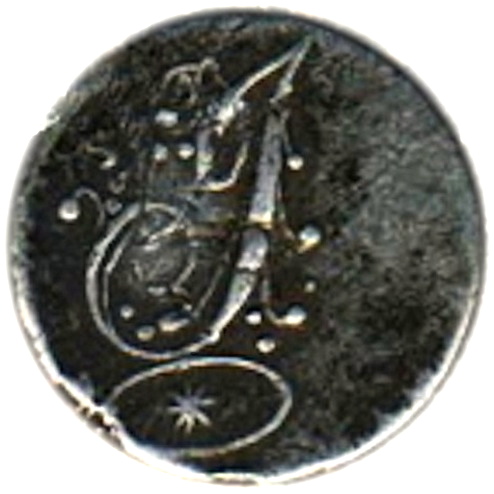
1812-15 U.S. Infantry
Color: A Silvery Base With An Ochre of Browns &
Greens.
Metal: Flat, 1-Piece, Raised Design, Cast Pewter.
Size: 16mm. Cuff Size
Albert's Number: Similar to GI 36-Cv: Unlisted
Die Variant RV
?
Variation: Slightly Slanted Script I / Curled Tail /
Flair Dots Coming Off and Surrounding / Eight Point Star.
Present Condition: An Excavated Example, Strong
Planchet Casting, Strong High Relief Pattern.
Isabela's Notes: This is the second known
die variant with flair dots. It shows a slightly thinner "I"
that is slanted. The tail is also more curled. The
button's pattern depicts a
Slightly Slanted Script Letter "I"
with a
more
Curled Tail.
The letter "I" depicts
Flair Dots Coming Off and Surrounding
it. In this variant the tale barely touches top of the oval
below. Centered inside of the oval is a raised
Eight Point Star.
The high relief pattern is set on a plain flat field with no
edge border.
Reverse Button Analysis: This is a one-piece casting
for the reverse shank. The shank is original, straight &
intact. No back mark. The mold line present.
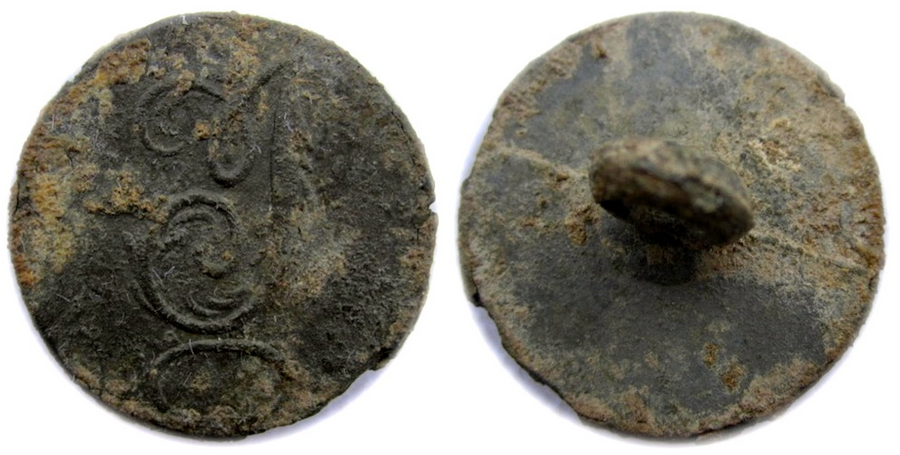
1812-15 U.S. Infantry
Color: Pewter Grey with Brown and Yellow
Encrustations.
Metal: Flat, 1-Piece, Raised Design, Cast Pewter.
Size: 19.86mm. Coat Size
Albert's Number: GI 36-D.1: RV 15
Variation: Foliated I / Narrow Loops / Empty Oval.
Present Condition: An Excavated Example, Strong
Planchet Casting, Strong High Relief Pattern.
Isabela's Notes: There are three known die variants
in this series that show an Empty Oval that bares no
regiment number or star. The first variation is the size of
the foliated script I's loops. One has narrow loops, one has
medium loops, and one has wide loops. Also the one with the
narrow loops appears to be a little bit more foliated then
the other two. This button's pattern depicts a large
Foliated Script Letter "I"
in the center of a plain field.
The "I" in this button has
Narrow Loops. There is an
Empty
Oval
underneath that is void of a star or regiment number.
There might have been a possibility that a regiment or
company number could have been stamped inside at a later
date when issued. (As noted, earlier Infantry Regiment
buttons Albert's GI 34 were manufactured with reg. numbers
1-18 already in the oval). The high relief pattern is set on
a plain flat field with no raised edge border.
Reverse Button Analysis: This is a flat one-piece
button with a loop shank. The shank is original, straight &
intact. No back mark. The mold line present.
The RJ Silverstein Collection.

1812-15 U.S. Infantry
Color: A Charcoal Brown With Light Green
Encrustations.
Metal: Flat, 1-Piece, Raised Design, Cast Pewter/
Brass?
Size: 14.31mm. Vest Size
Albert's Number: GI 36Av Unlisted Variant: RV 25
Variation: Foliated Script I With A Wide Birth Hook
Tail / Medium Size 5 Point Star / Star's Prime Point Facing
Downward.
Present Condition: An Excavated Example, Good
Planchet Casting, Good High Relief Pattern.
Isabela's Notes: So far I know of two die variants
for this solid 5 point star pattern. This button's pattern
depicts a Large Foliated Script letter "I" with a Wide Birth
Hook Tail in the center. There is a small oval underneath
with Medium Size (Solid-Center) Five Point Star. This die
variant has the Star's Prime Point facing Downward. The high
relief pattern is set on a plain flat field with a flat edge
border. Un-dug specimens are hard to come by.
Reverse Button Analysis: This is a flat one-piece
button with a loop shank. The shank is missing. No back
mark, but mold line present.
Dug at Gross Point (Portsmouth) Naval Yard, VA in the
1990's.~
RJ Silverstein Collection.
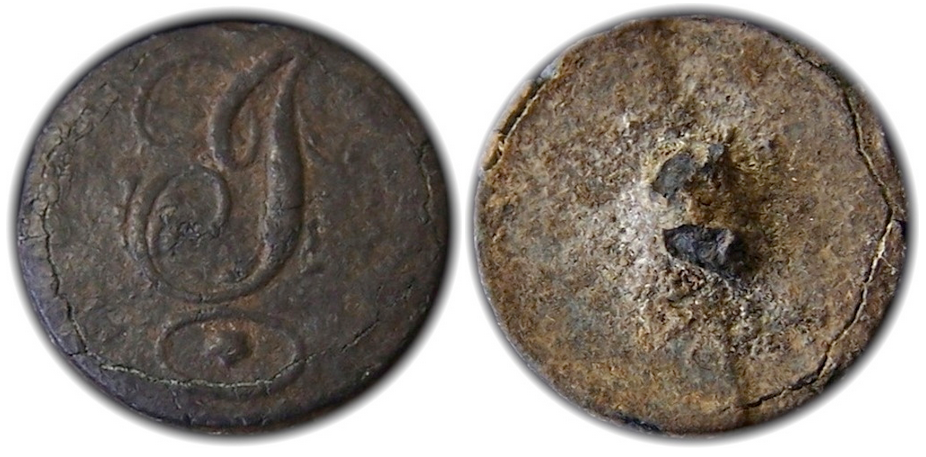
1812-15 U.S. Infantry
Color: An Army Green with Gray Undertones.
Metal: Flat, 1-Piece, Raised Design, Cast Pewter.
Size: 15mm. Vest Size
Albert's Number: GI 36Av Unlisted Variant: RV
6
Variation: Foliated Script I With A Wide Birth Hook
Tail / Solid Center 5 Point Star / Star Prime Point down.
Present Condition: An Excavated Example, Good
Planchet Casting, Good High Relief Pattern.
Isabela's Notes: This button's pattern depicts a
Large Foliated Script letter "I"
with a
Wide Birth Hook Tail
in the center. There is a small oval underneath with small
Solid Center Five Pointed Star. This die variant has the
Star's Prime Point Down. The high relief pattern is set on a
plain flat field with no raised edge border.
Reverse Button Analysis: This is a flat one-piece
button with a loop shank. The shank is missing. No back
mark, but mold line present.
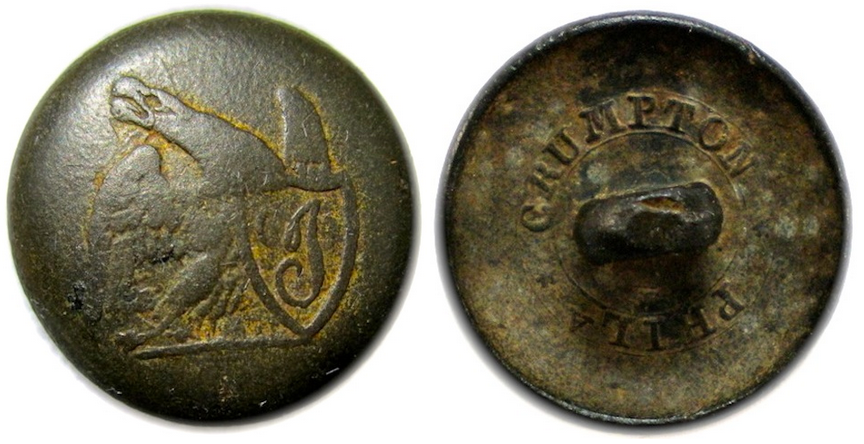
1815-21 U.S. Federal Infantry
Color: Leather Brown with Orange-Gold Highlights.
Metal: Convex, 1-Piece, Raised Design, Cast Pewter.
Size: 19.74mm. Coat Size
Albert's Number: GI 38-A.1: RV 10
Variation: Standing Eagle / Long Narrow Vertical Spade Shield
/ No Arrows.
Present Condition: An Excavated Example, Strong
Planchet Casting, Good High-Relief Pattern.
Isabela's Notes: This series of infantry buttons
was manufactured by several companies, and has
at least six known die variants. The differences are in the
depiction of the eagle, the eagle's wing length (concerning
the shield), and how many arrows the example portrays: 0, 3,
or 5. This button's pattern depicts a
Standing Eagle
with upraised wings. The eagle is looking up and toward the
right. Covering over the eagle's left wing is a
Long Narrow
Vertical Spade Shape Shield with a raised outline.
In this variant the eagle's wing does not reach the edge of
the shield. Within the shield is a raised script letter, "I"
for infantry. There are
No Arrows
in the eagle's talon. The high relief pattern is set on a
plain convex field with rounded edges.
Reverse Button Analysis: This is a slightly concave
one-piece button with a loop shank. The shank is original,
straight & intact. CRUMPTON PHILA * within a arm channel.
Excavated at Fort Fisher, North Carolina.
The Robert J. Silverstein Collection.
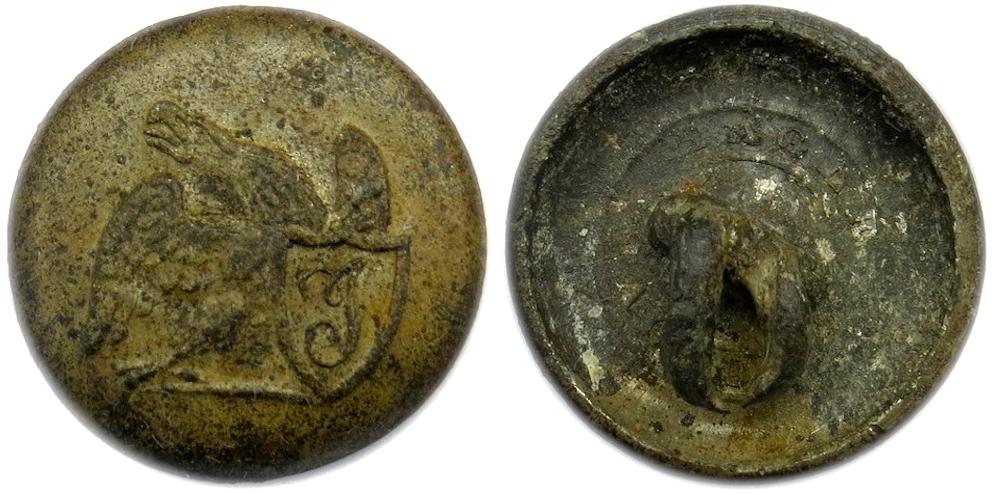
1815-21 U.S. Federal Infantry
Color: A Brown Speckled Orangey Brown.
Metal: Convex, 1-Piece, Raised Design, Cast Pewter.
Size: 19.56mm. Coat Size
Albert's Number: GI 38-A.2: RV 10
Variation: Standing Eagle / Large Wide Spade Shield /
No Arrows.
Present Condition: An Excavated Example, Strong
Planchet Casting, Good High-Relief Pattern.
Isabela's Notes: There are at least six
manufacturers that made die variants for this button. The differences are in the
depiction of the eagle, the eagle's wing length (concerning
the shield), and how many arrows the example portrays: 0, 3,
or 5. This button's pattern depicts a
Standing Eagle
with upraised wings. The eagle is looking up and toward the
right. Covering over the eagle's left wing is a
Large Wide
Spade Shape Shield with a raised outline.
In this variant the eagle's wing does not reach the edge of
the shield. Within the shield is a raised script letter, "I"
for infantry. There are
No Arrows
in the eagle's talon. The high relief pattern is set on a
plain convex field with rounded edges.
Reverse Button Analysis: This is a slightly concave
one-piece button with a loop shank. The shank is original,
and intact, but bent over. EAGLE FACTORY rm.
The Robert J. Silverstein Collection.
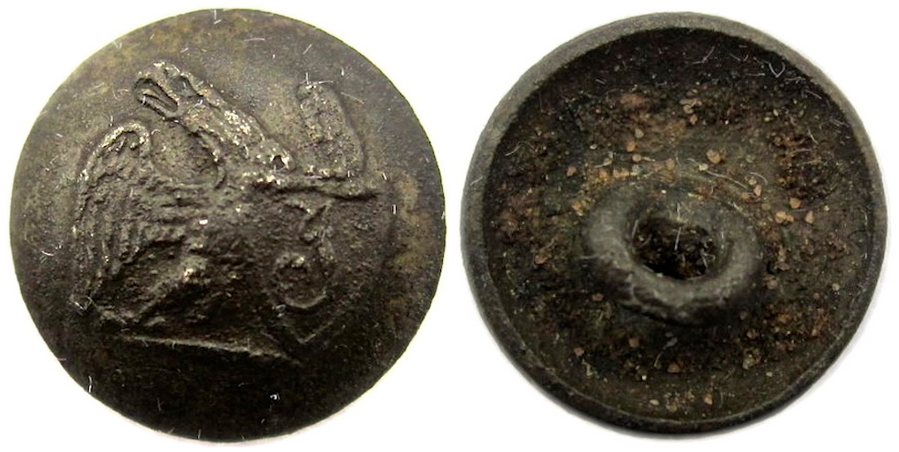
1815-21 U.S. Federal Infantry
Color: A Brown Pewter Mix.
Metal: Slightly Convex, 1-Piece, Raised Design, Cast
Pewter.
Size: 14.34mm. Cuff / Vest Size
Albert's Number: GI 38-Av: RV 05
Variation: Standing Eagle with Upraised Wings / Large Wide Spade Shape Shield / Three Arrows in
Right Talon?
Present Condition: An Excavated Example, Strong
Planchet Casting, Good High Relief Pattern.
Isabela's Notes: This small cuff button's pattern
depicts a
Standing Eagle with Upraised Wings
that is looking up and to
the right. There is a
Large Wide
Spade Shape Shield
covering partially over
it's left wing. The eagle's wing in this die variant
only goes to the middle of the shield. There is a script letter "I" for
infantry depicted on the shield. There are no arrows
depicted in this cuff's die variant. The high relief pattern
is set on a plain convex field with rounded edges.
Reverse Button Analysis: This is a slightly concave
one-piece button with a loop shank. The shank is original,
slightly bent, but intact. ********
Excavated at Fort St. Marks, Florida
The RJ Silverstein Collection.
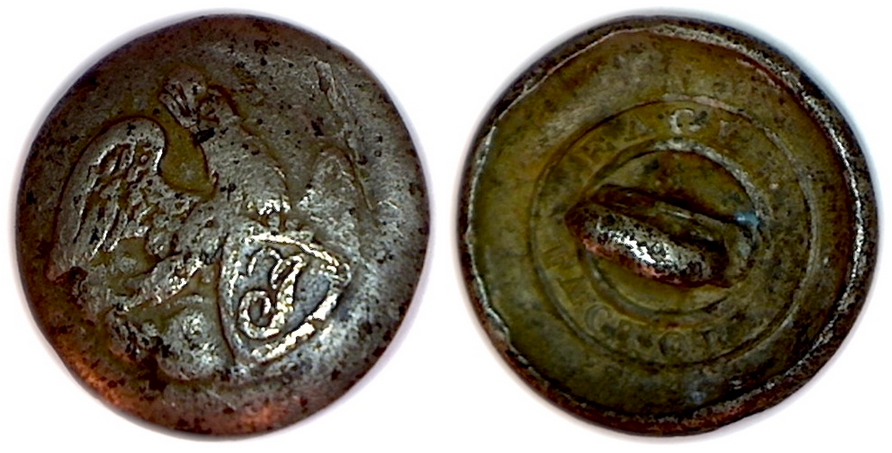
1815-21 U.S. Federal Infantry
Color: A Black Speckled Pewter Gray.
Metal: Low Convex, 1-Piece, Raised Design, Cast
Pewter.
Size: 19mm. Coat Size
Albert's Number: GI 38-B.2 RV 10
Variation: Standing Droop Wing Eagle /Small Spade Shape Shield / Three
Short Arrows Pointing Downward.
Present Condition: An Excavated Example, Good
Planchet Casting, Good High Relief Pattern.
Isabela's Notes: We know of at least two
companies that produced this die variant that depicts three
arrows in the eagle's right talon. This button's pattern
depicts a
Standing Droop Wing Eagle
that is looking up and to
the right. There is a
Small Spade Shape Shield
covering partially over
it's left wing. The eagle's wing in this die variant
reaches the edge of the shield. There is a script letter "I" for
infantry depicted on the shield. In the eagle's right talon
is
Three
Short Arrows Pointing Downward. The high relief pattern is
set on a plain convex field with rounded-off edges.
Reverse Button Analysis: This is a slightly concave
one-piece button with a loop shank. The shank is original,
straight & intact. EAGLE / FACTORY rm.
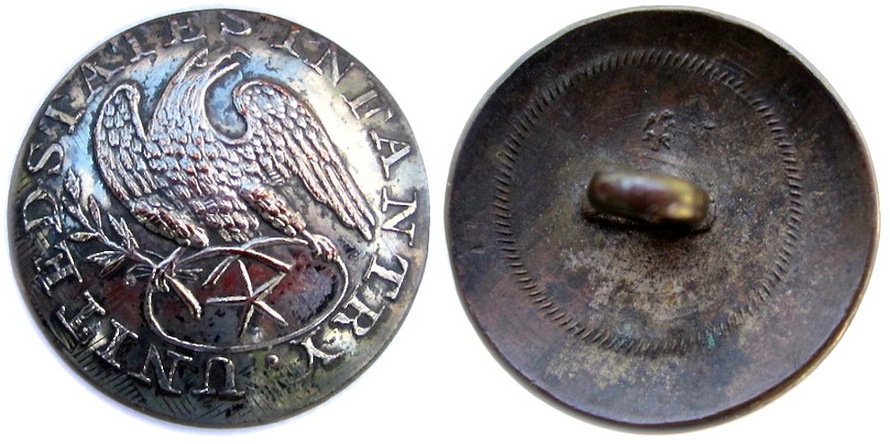
1812-15 U.S. Infantry Officer
Color: Silvery Black.
Metal: Slightly Convex, 1-Piece, Raised Design,
Silver Plated Copper.
Size: 21.78mm. Coat Size
Albert's Number: GI 40-A: RV 50
Variation: Oval with Cross Open-Ends / Twigs & Olive
Branch / Thin Five Point Star.
Present Condition: A Non Excavated Example, Exceptional
Planchet Casting, Exceptional High Relief Pattern.
Isabela's Notes: This Silver Officer's button is the
rarest in the series. It depicts a droop wing eagle facing
left, while standing on an
Oval with Cross Open-Ends. There
is a
Thin Five-Point Star
within the center of the oval. In
the eagle's right talon is some
Twigs and an Olive Branch.
Circling around the outside edge is the country's name and
military designation, "UNITED STATES INFANTRY ." in large
Roman Font capital letters. There is a raised
Dot Marker
in
the bottom legend between the words Infantry and United. The
high relief pattern is set on a convex plain field. There
are five known die variants in the series with a Star in the
Oval. There are variances in the stars design, and also if
the pattern includes an olive branch. All officers buttons
were made with a Sheffield Silver finish.
Reverse Button Analysis: This is a slightly concave
one-piece button with a loop shank. The shank is original,
straight & intact. "Giles/Richards" eagle rm with lines.
The RJ Silverstein Collection.
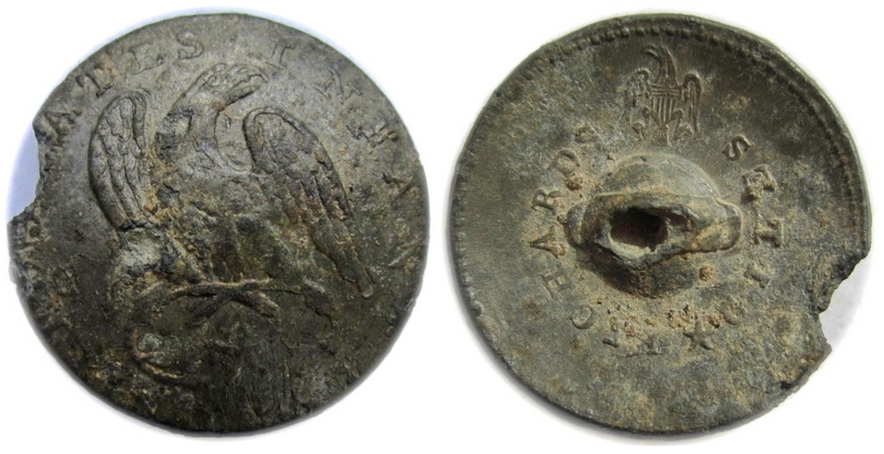
1812-15 U.S. Infantry Officer
Color: Pewter Grey.
Metal: Slightly Convex, 1-Piece, Raised Design,
Pewter.
Size: 20.41mm. Coat Size
Albert's Number: GI 40-B: RV 35
Variation: Oval with Cross Open-Ends / Thin Five
Point Star / Dot Marker.
Present Condition: An Excavated Example, Good
Planchet Casting, Good High Relief Pattern.
Isabela's Notes: This is the second die variant known
in the series. The button's pattern depicts a droop wing
eagle facing left, while while standing on an
Oval with
Cross Open-Ends. There is a
Thin Five-Point Star
within the
center of the oval. In this die variant, the eagle is "Not"
holding an olive branch in it's right talon. Circling around
the outside edge is the country's name and military
designation, "UNITED STATES INFANTRY ." in large Roman Font
capital letters. There is a raised
Dot Marker
in the bottom
legend between the words Infantry and United. The high
relief pattern is set on a slightly convex plain field.
There are five known die variants in the series with a Star
in the Oval. There are variances in the stars design, and
also if the pattern includes an olive branch. All officers
buttons were made with a Sheffield Silver finish.
Reverse Button Analysis: This is a slightly concave
one-piece slightly button with a loop shank. The shank is
unfortunately missing. "Giles/Richards" eagle rm with lines.
The RJ Silverstein Collection.
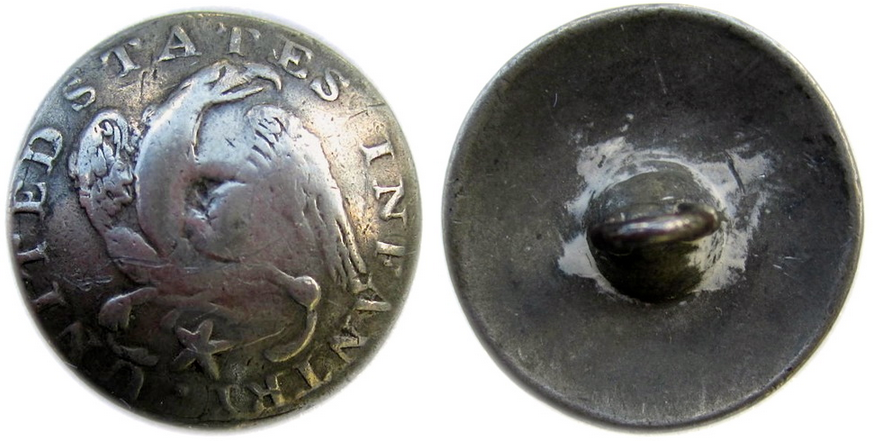
1812-15 U.S. Infantry Officer
Color: The Silver Ghost.
Metal: Slightly Convex, 1-Piece, Raised Design,
Silver Plated Copper. (Pewter Variant Known)
Size: 20.97mm. Coat Size
Albert's Number: GI 41-B: RV 35
Variation: Oval with Cross Open-Ends / Thick Five
Point Star / Dot Marker.
Present Condition: A Non Excavated Example, Strong
Planchet Casting, Good/Strong High Relief Pattern.
Isabela's Notes: This is another die variant for the
officer's infantry button. The button's pattern depicts a
droop wing eagle facing left, while while standing on an
Oval with Cross Open-Ends. There is a
Thick Five-Point Star
within the center of the oval. Circling around the outside
edge is the country's name and military designation, "UNITED
STATES INFANTRY ." in large Roman Font capital letters.
There is a raised
Dot Marker
in the bottom legend between
the words Infantry and United. The high relief pattern is
set on a slightly convex plain field. There are five known
die variants in the series with the Star in the Oval. All
officers buttons were made with a Sheffield Silver finish.
Reverse Button Analysis: This is a concave one-piece
button with a loop shank. The shank is original, straight &
intact. Plating is partially chipped off. No back mark
The RJ Silverstein Collection.
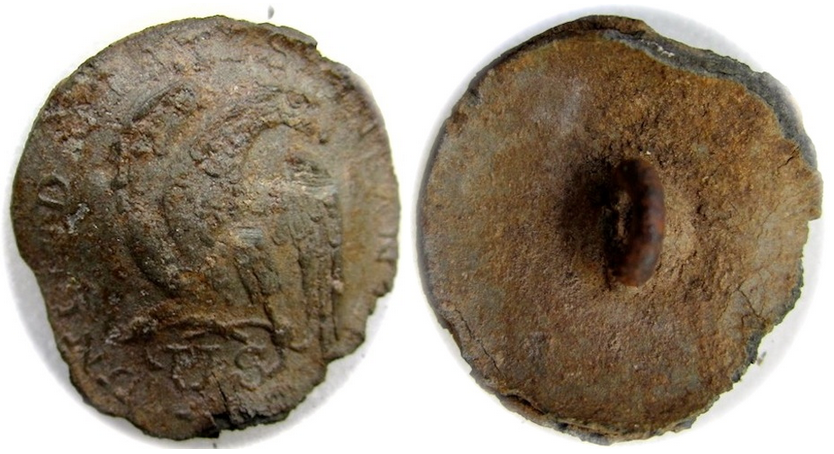
1812-15 U.S. Infantry Officer
Color: Silver Ghost.
Metal: Slightly Convex, 1-Piece, Raised Design,
Pewter (Silver Variant Known).
Size: 21.91mm. Coat Size
Albert's Number: GI 42: RV 35
Variation: Oval with Cross Open-Ends / U.S. in Roman
Block Letters.
Present Condition: An Excavated Example, Fair
Planchet Casting, Good High Relief Pattern.
Isabela's Notes: This button with the "US" in the
Oval with Cross Open-Ends, and the country's name only has
one die variant. Since there are both pewter and silver
variants, this could have been intended for officers and
enlisted men. The button's pattern depicts a droop wing
eagle facing left, while while standing on an
Oval with
Cross Open-Ends. The country's initials,
"U.S " is in Roman
Font block Letters within the center of the oval. Circling
around the outside edge is the country's name, and military
designation, "UNITED STATES INFANTRY " in large Roman Font
capital letters. The high relief pattern is set on a
slightly convex plain field. Since Pewter breaks down and
disintegrates, these are much more rarer then the silvered
copper officer specimens.
Reverse Button Analysis: This is a one-piece button
with a soldered on Iron loop shank. The shank is original,
straight & intact. Plating is partially chipped off. No Back
mark.
The RJ Silverstein Collection.
Robert's Notes: There is another series of buttons
not listed that have the same pattern of an Eagle over an
Oval with Cross Open-Ends, that has stars circling around
the periphery instead of the country's name. (This is not to
confuse the later patterns of the eagle with the "US"
initials in regular ovals)
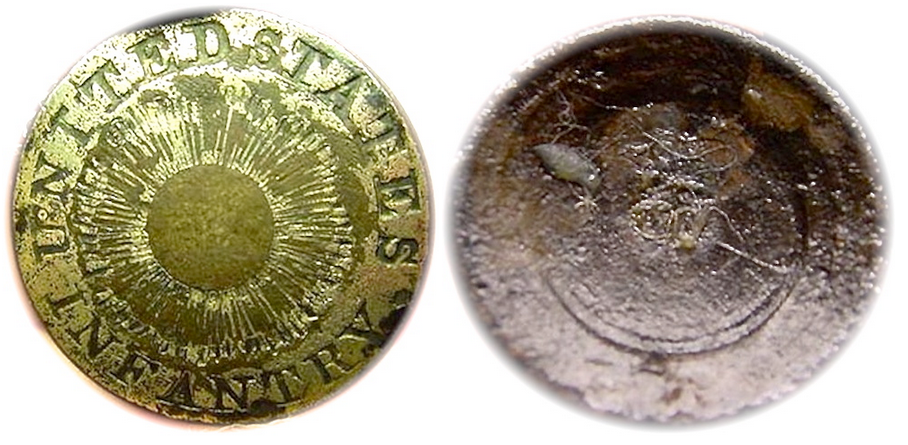
1808-12 United States Infantry Officer
Color: A Silvery Brown.
Metal: Slightly Convex, 1-Piece, Raised Design,
Silver Plated Copper.
Size: 22mm. Coat Size
Albert's Number: GI 44: Isabela's RV 50
Variation: Disk Shaped Center With Long Emanating
Rays.
Present Condition: An Excavated Example, Strong
Planchet Casting, Strong Impressed Pattern.
Isabela's Notes: This early officer's button could
have been manufactured as early as 1808, but most likely
around 1812. This is the only known die variant for this
pattern, and was most likely intended for Infantry Officers.
The button's pattern depicts a raised
Disk Shaped Center
with
Long Emanating Rays.
Encircling the rays in the legend is the country's name and
military designation,
"UNITED
STATES INFANTRY"
in large Roman font capital letters. The impressed pattern
is set on a low-convex plain field. Most likely produced for
a specific military rank or designation. The button's design
symbolizes a shinning sun or sunburst.
Reverse Button Analysis: This is a one-piece button
with a loop shank. Armitage backmark with 2 ring rm.
The J. Baldwin Collection.
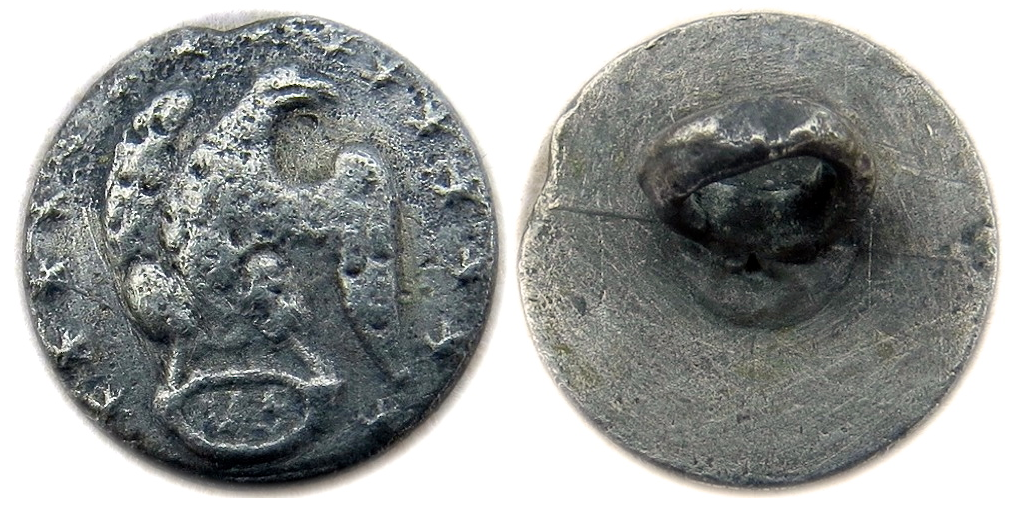
1808-12 US Federal Infantry
Color: A Steel Grey With Hints of Blue & Gold.
Metal: Flat, 1-Piece, Raised Design, Cast Pewter.
Size: 13.65 mm. Cuff Size
Albert's Number: GI 46Av: RV
06
Variation: Small Oval / Country's Initials / 15 Six
Pointed Stars.
Present Condition: An Excavated Example, Good
Planchet Casting, Fair/Good High Relief Pattern.
Isabela's Notes: There appears to be three die
variants with this style eagle. They differentiate by how
many stars are depicted circling the eagle. Variant A has
15, B:16, and C has 17 Stars. Any of the cuff variants in this series could have
accompanied the larger officer's coat buttons with this
pattern. This button's pattern depicts a droop
wing eagle perched on a
Small oval facing left. Within the
oval is the
Country's Initials, "US" for United States.
Encircling the eagle around the outside edge is
15 raised
Six-Pointed Stars. The high relief pattern is set on a plain
flat field with no edge border. This pattern was most likely
made around 1811. Un-dug specimens are extremely rare.
Collectors should seek specimens without too much edge loss.
Not sure why Albert gave this series a low RV value,
obtaining all three variants in good condition appears
difficult.
Reverse Button Analysis: This is a one-piece casting
for the reverse shank originally. The shank is original,
straight, and intact. No back mark and cast mold line is present.
The RJ Silverstein Collection.
Collector's Note: The cuff link series of 1808-12 has at
least six known
die variants. Each of these die variants have their own style eagle,
and decorative border. Some have no stars, and some variants
show 3, 12, 14, 15, 16, or 17 stars.
It appears Albert broke this series up into separate numbers
by the eagle depicted, and not how many stars encircle.
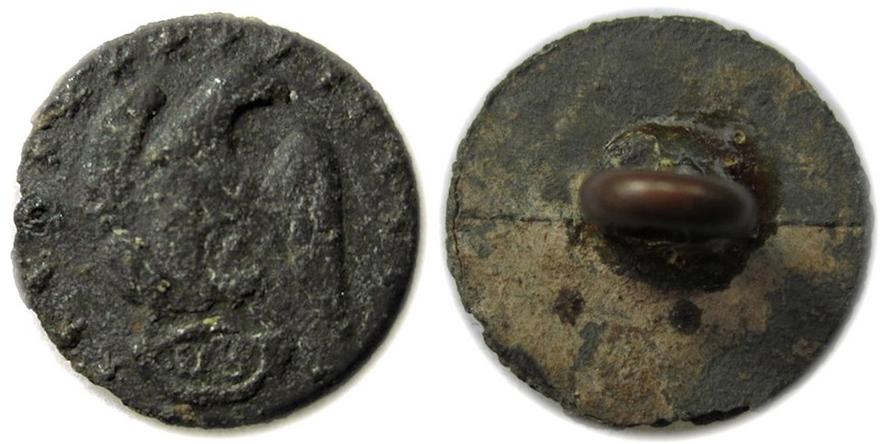
1808-12 US Federal Infantry
Color: Dark Charcoal Grey.
Metal: Flat, 1-Piece, Raised Design, Cast Pewter.
Size: 13.65 mm. Cuff Size
Albert's Number: GI 46Av-C: RV
06
Variation: Small Oval / Country's Initials / 17 Six
Pointed Stars.
Present Condition: An Excavated Example, Good
Planchet Casting, Fair/Good High Relief Pattern.
Isabela's Notes: There appears to be three
die variants with this style eagle. They differentiate by
how many stars are depicted circling the eagle. Variant A
has 15, B:16, and C has 17 Stars. Any of the cuff variants in this series could have
accompanied the larger officer's coat buttons with this
pattern. This button's pattern depicts a droop
wing eagle perched on a
Small oval facing left. Within the
oval is the
Country's Initials, "US" for United States.
Encircling the eagle around the outside edge is
17 raised
Six-Pointed Stars. The high
relief pattern is set on a plain flat field with no edge
border. This pattern was most likely made around 1811.
Un-dug specimens are extremely rare.
Reverse Button Analysis: This is a one-piece casting
for the reverse shank originally. The shank appears to be a
replacement shank. No back mark and cast mold line is present.
The RJ Silverstein Collection.
Collector's Note: The cuff link series of 1808-12 has at
least six known
die variants. Each of these die variants have their own style eagle,
and decorative border. Some have no stars, and some variants
show 3, 12, 14, 15, 16, or 17 stars.
It appears Albert broke this series up into separate numbers
by the eagle depicted, and not how many stars encircle.
|
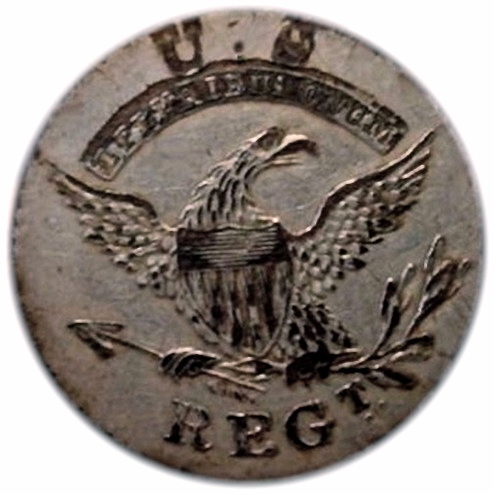
1808-12 United States Infantry (Officer's Button).
Color: Flat Grey.
Metal: Flat, 1-Piece, Raised Design, Silver Plated
Copper.
Size: 24mm. Coat Size
Albert's Number: GI 50-A:
RV 65
Variation: Eagle Facing Left /Slightly Slanted Lined
Federal Shield / Upward Angled Olive Branch / Arrow Pointing
to the Right / U.S
Present Condition: An Excavated Example, Strong
Planchet Casting, Strong High Relief Pattern.
Isabela's Notes: This is one of the earlier designs
for the US Infantry pattern. There are two known pattern
variations for that use the "US" initials by itself. The
difference between the two patterns is the direction the
eagle is facing, and the arrow and olive branches are
depicted on opposite sides. This die variants pattern
depicts a spread wing
Eagle Facing Left,
with a
Slightly Slanted Lined Federal Shield
on it's chest. In the eagle's left talon is an
Upward Angled Olive Branch
with seven petals, and an olive. In the eagle's right talon
is an
Arrow Pointing to the Right.
Above the eagle's head, is a small arced banner with, "E
PLURIBUS UNUM"
inscribed. Slightly above that is the abbreviation for
United States, "U.S" in
large raised Roman Font letters. Below the eagle is the
abbreviation for regiment, "REGt" in capital letters. The
high relief pattern is set on a plain flat field with no
raised border edge.
Reverse Button Analysis: This is a flat one-piece
button with a soldered on loop shank. The shank is un
pictured for examination.
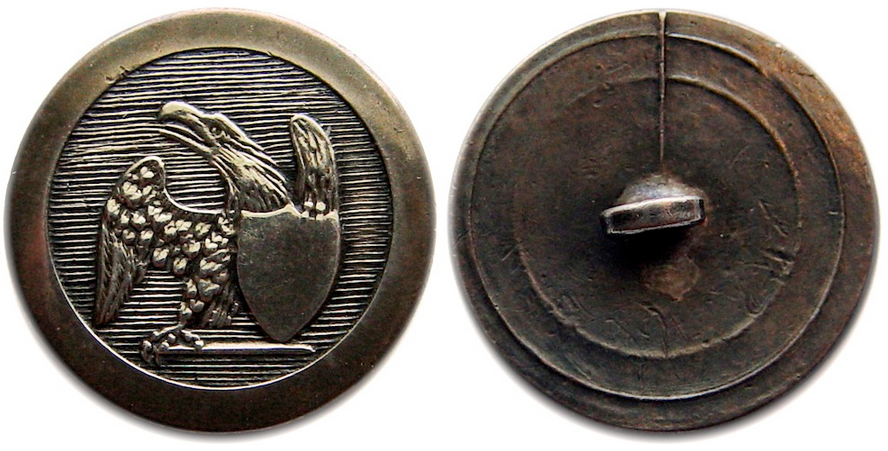
1811-24 Federal Infantry Officer Jeweler Cut Coat Button
Color: A Jeweler's Oiled Silver.
Metal: Flat, 1-Piece, Raised Design, Silver.
Size: 21.5mm. Coat Size
Albert's Number: Similar to GI 51-F: RV
200
Tice's Number: Unlisted - Predecessor to GM206 -Two
Piece
Variation: Standing Eagle with Upraised Wings / Head Tilted Up / Round Lined Field /
Round Wide Flat Border.
Present Condition: An Excavated Example, Strong
Planchet Casting, Strong High Relief Pattern.
Isabela's Notes: This series was originally
manufactured by Armitage around 1808, and the pattern was
used by Infantry officers. This button's pattern has all the
tell tale signs of being made by a
high end Jeweler. We know there were other Jewelers besides John De Larue of New
Orleans who made special order buttons. These buttons are extremely well
crafted, and usually retain 95% of their original patterns.
This button was most likely purchased by a well-to-do
officers to show his signature button with pride (or ego). This button's pattern
depicts a
Standing Eagle with Upraised Wings
facing right.
In this die variant, the eagle's
Head is Tilted Up,
with beak open. Over the eagle's left wing is a
large blank unstamped shield. The high relief pattern is set
on a flat
Round Lined Field,
with a picture frame
Round Wide Flat Border.
Reverse Button Analysis: This is slightly concave one-piece
button with a Silver loop shank. The shank is original,
straight & intact. NEW. ORLEANS J DELARUE rm script
lettering in-between 2 solid rings.
The Jacob W.
Collection.
|
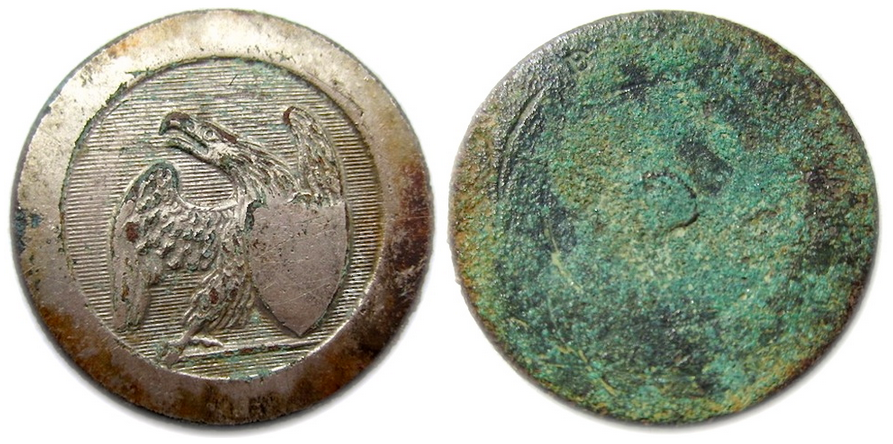
1808-25 Federal Infantry Officer
Color: A Tarnished Silvery Brown.
Metal: Slightly Convex, 1-Piece, Raised Design,
Silver Plated Copper.
Size: 22.27mm. Coat Size
Albert's Number: GI 51-F: RV 35
Tice's Number: Unlisted - Predecessor to GM206 -Two
Piece
Variation: Head Tilted Up / Round Lined Field / Wide
Edge Border.
Present Condition: An Excavated Example, Strong
Planchet Casting, Strong High Relief Pattern.
Isabela's Notes: This series was originally
manufactured by Armitage, and was intended for Infantry
officers. It was manufactured in large quantities, and the
stock was bought many years later by W. Wallace. Some
specimens can be found with his back stamp over Armitage. We
also know that smaller buttons with this pattern were used
by the US Army on their forge caps during the Mexican. Some
where along the line, the pattern was made into a two piece,
and the surplus was issued for use during the Civil War.
Most specimens found today have blank shields. The
regiment's number was not usually put on by the
manufacturer, the button's regiment number was stamped on
the shield after it was issued. Then again, some research
indicates that (along with several other patterns in the GI
51 & GI 53 series) issued buttons never had the regiment
number stamped on for the soldiers afterwards. Under close
examination of my own personal specimen, and other examples
I further illustrate, I found two minor pattern variations
in the dies used in both the GI 51 & 53 series. First, is
the width size of the edge border. One die variant has a
wide edge, and the other has a thin edge. Second, is the
angle of the eagle head. One die variant has the eagle's
head a little more tilted up, and away from the top of the
right wing. The other variant has the eagle's head almost
touching the wing. Since the button is an easy pattern to
cut, I am sure more then one die was fashioned over it's
long history. Other research even shows this button was used
by various state militia units. This button's pattern
depicts a standing eagle with upraised wings facing right.
In this die variant, the eagle's
Head is Tilted Up, and away
from the top of the wing. Under the eagle's left wing is a
large blank unstamped shield. The high relief pattern is set
on a flat
Round Lined Field,
that has an angled
Wide Edge Border.
Reverse Button Analysis: This is a flat one-piece
button with loop shank. The shank is missing. Armitage/Phila
dm. Wreath
The RJ Silverstein Collection.
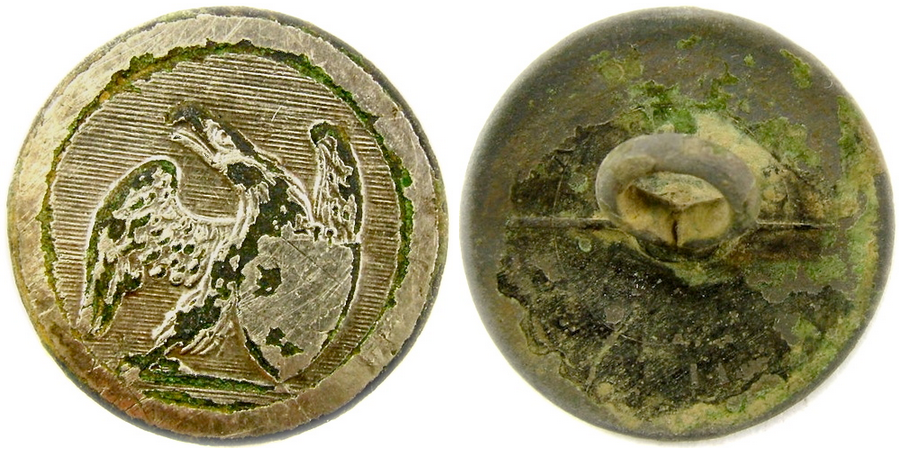
1808-25 Infantry Officer's Button
Color: Silver with Green Encrustations.
Metal: Flat, 1-Piece, Raised Design, Silver Plated
Copper.
Size: 20.5mm.
Albert's Number: GI 51 or 53 Series, Un pictured
Border Frame Size: RV 35
Tice's Number: Unlisted - Predecessor to GM206 -Two
Piece
Variation: Head Tilted Up / Round Lined Field / Wide
Edge Border.
Present Condition: An Excavated Example, Strong
Planchet Casting, Strong High Relief Pattern.
Isabela's Notes: This series was originally
manufactured by Armitage, and was intended for Infantry
officers. It was manufactured in large quantities, and the
stock was bought many years later by W. Wallace. Some
specimens can be found with his back stamp over Armitage. We
also know that smaller buttons with this pattern were used
by the US Army on their forge caps during the Mexican. Some
where along the line, the pattern was made into a two piece,
and the surplus was issued for use during the Civil War.
Most specimens found today have blank shields. The
regiment's number was not usually put on by the
manufacturer, the button's regiment number was stamped on
the shield after it was issued. Then again, some research
indicates that (along with several other patterns in the GI
51 & GI 53 series) issued buttons never had the regiment
number stamped on for the soldiers afterwards. Under close
examination of my own personal specimen, and other examples
I further illustrate, I found two minor pattern variations
in the dies used in both the GI 51 & 53 series. First, is
the width size of the edge border. One die variant has a
wide edge, and the other has a thin edge. Second, is the
angle of the eagle head. One die variant has the eagle's
head a little more tilted up, and away from the top of the
right wing. The other variant has the eagle's head almost
touching the wing. Since the button is an easy pattern to
replicate, I am sure more then one die was fashioned over
it's long history. Other research even shows this button was
used by various state militia units. This button's pattern
depicts a standing eagle with upraised wings facing right.
In this die variant, the eagle's
Head is Tilted Up, and away
from the top of the wing. Under the eagle's left wing is a
large blank unstamped shield. The high relief pattern is set
on a flat Lined Field, that is within a round picture frame
that has an angled Narrow Edge Border.
Reverse Button Analysis: This is a flat one-piece
button with loop shank. The shank is missing. Armitage/Phila
dm. The shank is original, but crushed inward. **ARMITAGE
PHILA* rm inner solid ring.
The Old Court House Civil War Museum Collection.
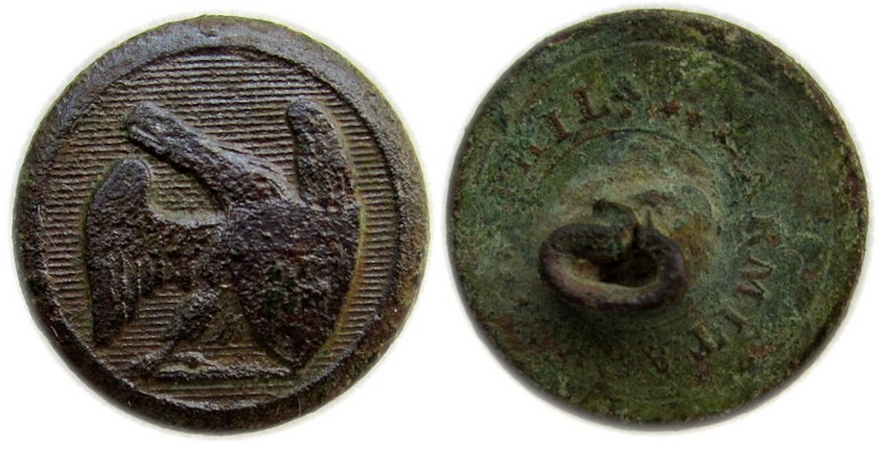
1808-25 Infantry Officer's Button
Color: An Orange Brown.
Metal: Flat, 1-Piece, Raised Design, Silver Plated
Copper.
Size: 14.66mm. Cuff Size.
Albert's Number: GI 51 or 53: Unlisted Size Variant
RV 45-60
Tice's Number: Unlisted: Predecessor to GM206 -Two
Piece
Variation: Head Angled Closer / Round Lined Field /
Narrow Edge Border.
Present Condition: An Excavated Example, Good
Planchet Casting, Good High Relief Pattern.
Isabela's Notes: George Armitage of Philadelphia made
buttons for the US Government between 1808-1825. This
Pattern would be one of the earliest Federal Eagle Style
buttons to be used by the U.S. Infantry, or by the State
Militia in later years. (Johnson's 257, and Tice's GM206
show this exact pattern dedicated for militia use in later
years, but it's construction is the 1830's two-piece
construction). Albert doesn't list this exact size in his
book, but this button can compliment the Infantry Officer's
coat size pattern of GI 51-F, GI 53R2-F, GI-53R6-F, or GI
53R8-F. All of those buttons use the same pattern, would be
an exact match for this cuff or hat size variant. Bottom
line, without us knowing what number was stamped on the
shield when issued, we would never know which infantry
regiment it belonged to. This button's pattern depicts a
standing eagle with upraised wings facing right. This die
variant shows the eagle's
Head is Angled a Little Closer
the
top of the wing. Under the eagle's left wing is a large
blank unstamped shield. The high relief pattern is set on a
flat
Lined Field, that is within a round picture frame that
has an angled
Narrow Edge Border.
Reverse Button Analysis: This is a one-piece button
with a loop shank. The shank is original, but crushed
inward. **ARMITAGE PHILA* rm inner solid ring.
The RJ Silverstein Collection.
*Roberts Notes: (Johnson's 257, and Tice's GM206 show this
exact pattern dedicated for militia use in later years, but
it's construction is the 1830's two-piece construction).
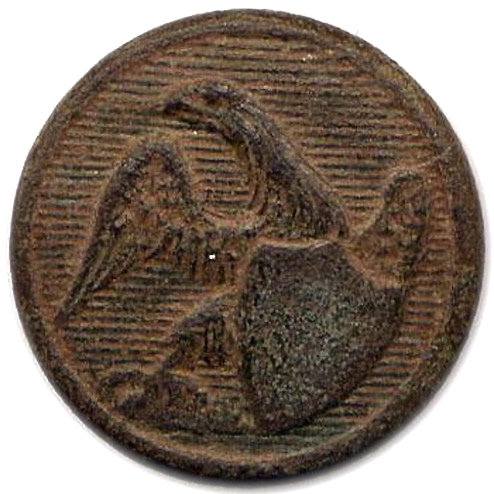
1826-50's US Army Forge Cap Button
Color: A Rusty Brown.
Metal: Flat, 2-Piece, Raised Design, Brass.
Size: 15mm. Cuff or Forge Cap Size.
Albert's Number: Unlisted Variant RV 10
Tice's Number: GM-206As.1 (Variant)
Variation: Head Angled Closer / Slanted Shield /
Narrow Edge Border.
Present Condition: An Excavated Example, Strong
Planchet Casting, Good High Relief Pattern.
Isabela's Notes: Johnson's 257, and Tice's GM206 show
this pattern was originally used on US Army Forge Caps
during the Mexican War, and then was dedicated for militia
use in later years, but it's construction is the 1830's
two-piece construction. This die variant shows the eagle's
Head is Angled a Little Closer
to the top of the wing. Under
the eagle's left wing is a
Slanted Blank Unstamped Shield.
The high relief pattern is set on a flat Lined Field, that
is within a round picture frame that has an angled
Narrow
Edge Border.
Reverse Button Analysis: This is a two-piece button
with a loop shank. The shank is .
*Robert's Notes:
Tice notes that a 2-piece was found was
found in a camp in Harrison's Landing, Virginia; which was
occupied by Federal Troops from Vermont and New York.
:13.8mm blank back mark 2-piece: GM206As.1
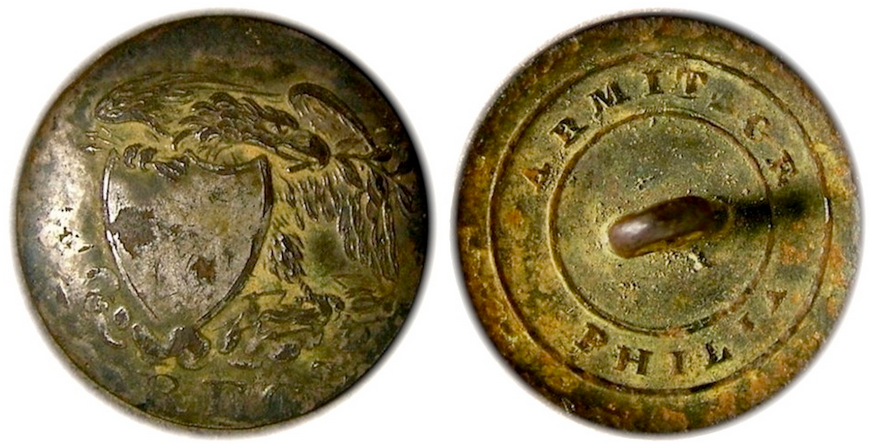
1810-1820's Regt. U.S. Infantry Officer's Button.
Color: A Silvery Brown with Golden Brown Highlights
Metal: Slightly Convex, 1-Piece, Raised Design,
Silver Plated Copper.
Size: 22mm. Coat Size
Albert's Number: GI 51-G: RV 50
Tice Back marks: Armitage 01-Page 97 (B-12-2)
Variation: Eagle Facing Left / Six Petal Olive Branch
/ Short Lightening Bolts / Three Short Arrows.
Present Condition: An Excavated Example, Strong
Planchet Casting, Good/Strong High Relief Pattern.
Isabela's Notes: This die pattern was made by
Armitage in the early 19th century, and used by a number of
different regiments. The button's pattern depicts a standing
Eagle Facing Left
with a
Six Petal Olive Branch
hanging from
it's beak. In the eagle's left talon is a group of
Short
Lightening Bolts. In it's right talon is a small bundle of
Three Short Arrows
on top of the shield. A large shield
stands on the right hand-side, on top of circular or roiling
clouds. In the lower bottom legend there is the military
regiment designation,
"REGt"
in large capital letters. The
high relief pattern is set on a plain slightly convex field with no raised
edge. This is a scarce pattern and rarely comes on the market
for sale. Most specimens
known are dug examples without a regiment number stamped on the
shield. This officer's pattern appears to be
the signature of Moritz Furst. He was an engraver and
die-sinker from Hungry who worked in Philadelphia in the
early 1800's. He was known to have engraved many of the
steel button dies,
and also various medals that were awarded by Congress to the
soldiers in the War of 1812.
Reverse Button Analysis: This is a slightly concave
one-piece button with a loop shank. The shank is original,
straight, and intact. Armitage/Phila rm in-between 2 raised
rings.
Picture Courtesy of Harry Ridgeway.
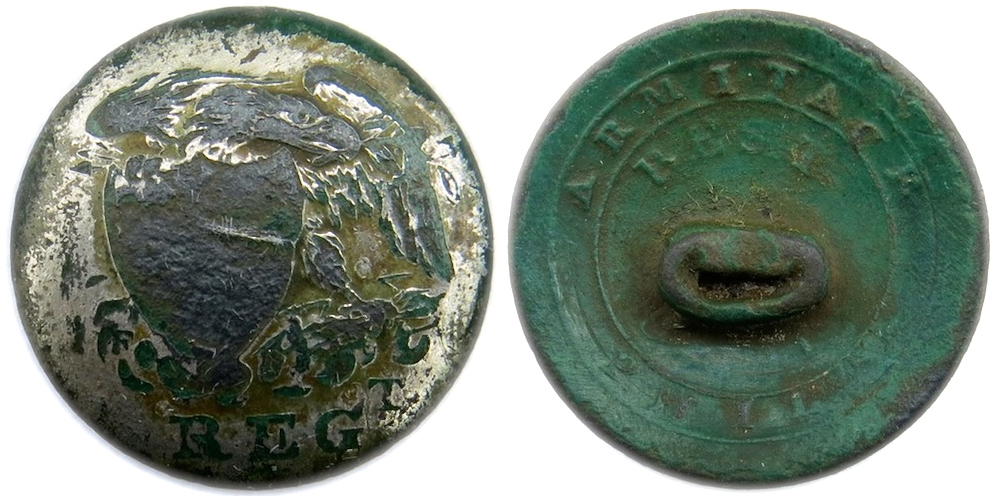
1810-1820's Regt. U.S. Infantry Officer's Coat Button.
Color: A Silvery Brown with Golden Brown Highlights
Metal: Slightly Convex, 1-Piece, Raised Design,
Silver Plated Copper.
Size: 22mm. Coat Size
Albert's Number: GI 51-G: RV 50
Variation: Eagle Facing Left / Six Petal Olive Branch
/ Short Lightening Bolts / Three Short Arrows.
Present Condition: An Excavated Example, Strong
Planchet Casting, Good/Strong High Relief Pattern.
Isabela's Notes: This die pattern was made by
Armitage in the early 19th century, and used by a number of
different regiments. The button's pattern depicts a standing
Eagle Facing Left
with a
Six Petal Olive Branch
hanging from
it's beak. In the eagle's left talon is a group of
Short
Lightening Bolts. In it's right talon is a small bundle of
Three Short Arrows
on top of the shield. A large shield
stands on the right hand-side, on top of circular or roiling
clouds. In the lower bottom legend there is the military
regiment designation,
"REGt"
in large capital letters. The
high relief pattern is set on a plain slightly convex field with no raised
edge. This is a scarce pattern and rarely comes on the market
for sale. Most specimens
known are dug examples without a regiment number stamped on the
shield. This officer's pattern appears to be
the signature of Moritz Furst. He was an engraver and
die-sinker from Hungry who worked in Philadelphia in the
early 1800's. He was known to have engraved many of the
steel button dies,
and also various medals that were awarded by Congress to the
soldiers in the War of 1812.
Reverse Button Analysis: This is a slightly concave
one-piece button with a loop shank. The shank is original,
straight, and intact. Armitage/Phila rm in-between 2 raised
rings BEST in inner circle.
The Robert J. Silverstein Collection.
*Robert's Notes: This is one of the pattern's Armitage
made blank as shown in Albert's GI 51-G series. We know from
records that the Regiment number was later applied with a
separate stamp when issued. Albert lists several examples of
different regiments in his GI 53 series. Blank ones that are found in the market
might never have been issued (extra stock), and then some
issued might never have gotten around to being stamped with
the regiment number. So an unstamped one might not
automatically mean GI 51-G. Unfortunately, A. Albert tried to
analyze these by Regiment numbers instead of the pattern
itself; showing multiple regiments using the same buttons at
different manufactured dates. I believe this might have been
a mistake by Albert, because modern collectors who look to
his book for understanding die variants have problems
identifying the particular regiment's issued pattern. So
nuts and bolts, Armitage manufactured a certain pattern in large
quantity, and then when issued the button they would use a stamp to
identify which infantry regiment the officer was from. On an
economical note, this
would cut the expense of making a new die pattern for each
regiment, and would also have the benefit of a surplus for
easy replacement. Also
years down the road, any old stock not sold by the
manufacturer could be re-utilized and back stamped with the
appropriate markers.
"Debra,
I agree with Robert. Let me give you
the history behind my buttons I dug them at Fort Scott Ga.
In 1816 the 4th US Inf built Fort Scott in 1817 the 7th US
Infantry joined them, then in 1818 Andrew Jackson and his
Tennessee Boys went to Fort Scott and from there he invaded
Spanish Florida. All of the buttons I dug at Fort Scott none
had 4 or 7 Stamped on the shield . Fort Scott was from 1816
to 1821. Take Care" ~Jim B
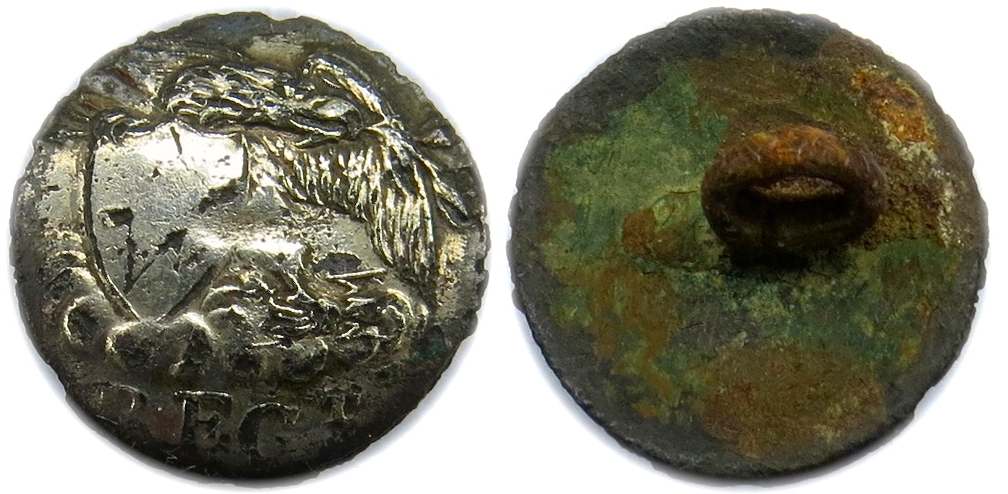
1810-1820 United States Infantry Officer's Cuff Button
Color: Silver On Grey.
Metal: Slightly Convex, 1-Piece, Raised Design,
Sheffield Silver Plate.
Size: 13.62mm. Cuff Size
Albert's Number: GI 51 Gv Unlisted
Size Variant RV
75
Variation:
Eagle with Upraised Wings /
Short Stem Limp Olive Branch with Four Double Petals / Lightening Bolt.
Present Condition: An Excavated Example, Good
Planchet Casting, Good/Strong High Relief Pattern.
Isabela's Notes: This GI 51-Gv cuff button
could have been issued to a
few different infantry regiments making it a GI 53 series
button (GI 53R6-G/GI 53R16-Ga/ GI 53 R22-G/GI
53R32-G), but we won't ever know for sure.
What makes this die variant unique is the
Wide Spread Arrow Tips
that reach the button's edge. The coat size variant depicts
the arrows close together, angled upward, and far from the
button's edge. The button's pattern depicts an
Eagle with Upraised Wings standing on top of the
rolling clouds while looking toward the left. Hanging from
the eagle's beak is a Short
Stem Limp Olive Branch with
Four Double Petals.
In the eagle's left talon is a few
Lightening Bolts, and in it's right talon is
a small bundle of Three Wide
Spread Arrows sticking out
from behind the top of the shield. There is a large
unstamped shield on the right hand side, with a raised
outline. The empty shield space is where they
would have stamped a regiment number when issued. In the
bottom legend is an offset abbreviation for regiment, "REGt".
Since there is no border space for the pattern, the die was
most likely cut for a slightly larger 16-18mm planchet. The
high relief pattern is set on a plain convex field with no
raised border. This is a highly sought button for War of
1812 collectors.
Reverse Button Analysis: This is a slightly concave
one-piece button with a soldered on loop shank. The shank is
original, straight, and intact. ARMITAGE rm.
The Robert J. Silverstein Collection.
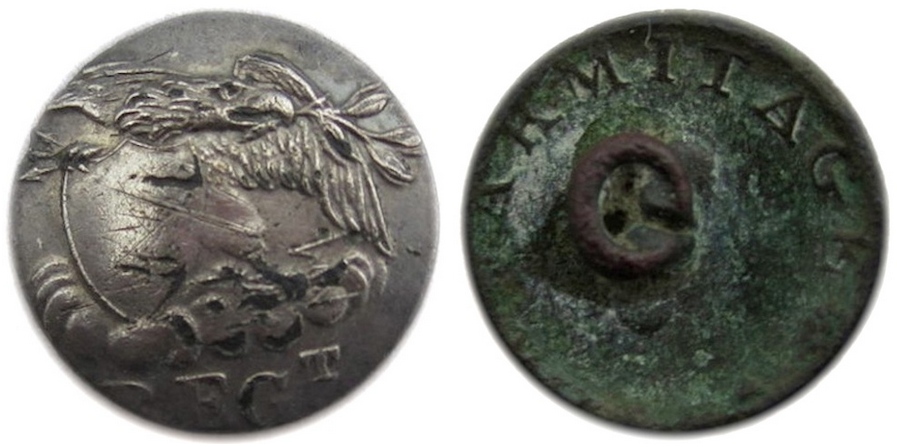
1810-1820 Regt. U.S. Infantry Officer's
Cuff Button
Color: True Silver.
Metal: Slightly Convex, 1-Piece, Raised Design,
Silver Plated Copper.
Size: 13.47mm. Cuff Size
Albert's Number: GI 51Gv /53 Series Unlisted Size Variant
RV 75
Variation: Eagle with Upraised Wings / Short Stem
Limp Olive Branch with Four Double Petals / Lightening Bolt.
Present Condition: An Excavated Example, Strong
Planchet Casting, Strong/Exceptional High Relief Pattern.
Isabela's Notes: This GI 51-Gv cuff button
could have been issued to a
few different infantry regiments making it a GI 53 series
button (GI 53R6-G/GI 53R16-Ga/ GI 53 R22-G/GI
53R32-G), but we won't ever know for sure.
What makes this die variant unique is the
Wide Spread Arrow Tips
that reach the button's edge. The coat size variant depicts
the arrows close together, angled upward, and far from the
button's edge. The button's pattern depicts an
Eagle with Upraised Wings standing on top of the
rolling clouds while looking toward the left. Hanging from
the eagle's beak is a Short
Stem Limp Olive Branch with
Four Double Petals.
In the eagle's left talon is a few
Lightening Bolts, and in it's right talon is
a small bundle of Three Wide
Spread Arrows sticking out
from behind the top of the shield. There is a large
unstamped shield on the right hand side, with a raised
outline. The empty shield space is where they
would have stamped a regiment number when issued. In the
bottom legend is an offset abbreviation for regiment, "REGt".
Since there is no border space for the pattern, the die was
most likely cut for a slightly larger 16-18mm planchet. The
high relief pattern is set on a plain convex field with no
raised border. This is a highly sought button for War of
1812 collectors.
Dug by J. Baldwin at Fort Scott Georgia.
The RJ. Silverstein Collection.
"Debra, when Albert's first did his book a lot of
buttons and size were yet to be discovered. Also In Albert's
day manual calipers were the norm and he would round the
size off. With today's digital calipers, the size may be off
from what he says in his book example; the true size for
this button per a digital caliper is 13.95mm Albert would
round it out to 14mm. I have in my collection one that is
considered a coat size per Albert's 51-G at 22mm, but yet
mine by a digital caliper is 21.46mm with a Armitage back
mark. Albert's would round that out that to 22mm. That's why
once in a while one will say unlisted it can be because of
size or a variant or a completely different rarely seen type
button. Take Care" ~Jim B
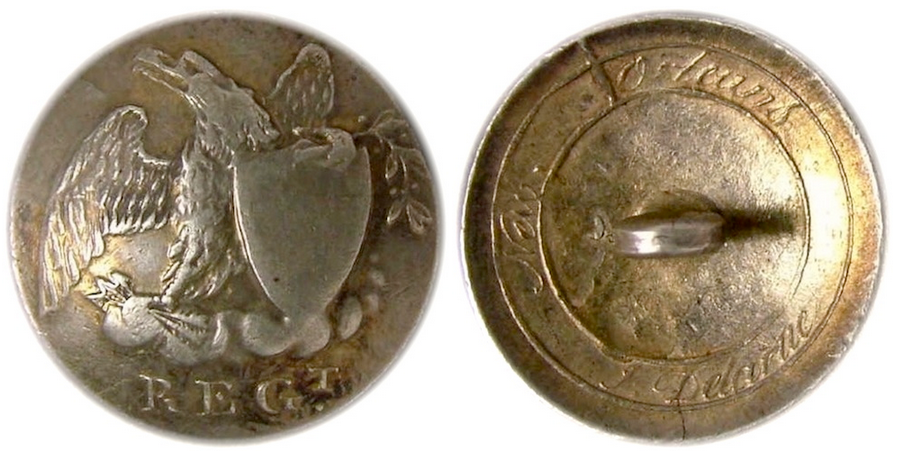
1811-1824 U.S. Infantry Officer Regiment Jeweler Cut
Button
Color: Silver With A Golden Outline.
Metal: Slightly Convex, 1-Piece, Raised Design, Silver.
Size: 21.2mm. Coat Size
Albert's Number: Unlisted: Isabela's RV 200
Variation: Eagle Facing Right / Olive Branch with Six
Olives / Small Bundle of Three Arrows.
Present Condition: A Non Excavated Example, Exceptional
Planchet Casting, Strong High Relief Pattern.
Isabela's Notes: John Delarue was a Jeweler in
New Orleans who made high end buttons for officers between
1811-24. His buttons are extremely well crafted, and usually
retain 95% of their original patterns. His buttons are
extremely well crafted, and usually retain 95% of their
original patterns. We know he has done other military
patterns from specimens found. There may
have been other die variants produced of this pattern, but
as of date, this specimen is
the only one to surface with this pattern for REGT. The button's
pattern depicts an eagle with upraised wings standing on
roiling clouds while
Facing Right. The eagle's left talon is
resting on top of a shield, while clutching an
Olive Branch
with Six Olives. In the eagle's right talon is a
Small
Bundle of Three Arrows. Under the Eagle's left wing is a
large un-numbered spade shaped shield. Below the roiling
clouds in the bottom legend is the initials for regiment, "REGt.
This button has a superb design, and is a real jewel in any
collection of War of 1812 buttons.
Reverse Button Analysis: This is slightly concave one-piece
button with a Silver loop shank. The shank is original,
straight & intact. NEW. ORLEANS J DELARUE rm script
lettering in-between 2 solid rings.
Picture Courtesy of Harry Ridgeway.
"Yes Robert I agree, there are a number of different die
variants, and I doubt Albert listed more then a fraction of
them. There were a lot of regiments ordering uniforms at
different times. You would have to have a lot of submissions
by collectors to do more of a complete list."
- Harry Ridgeway
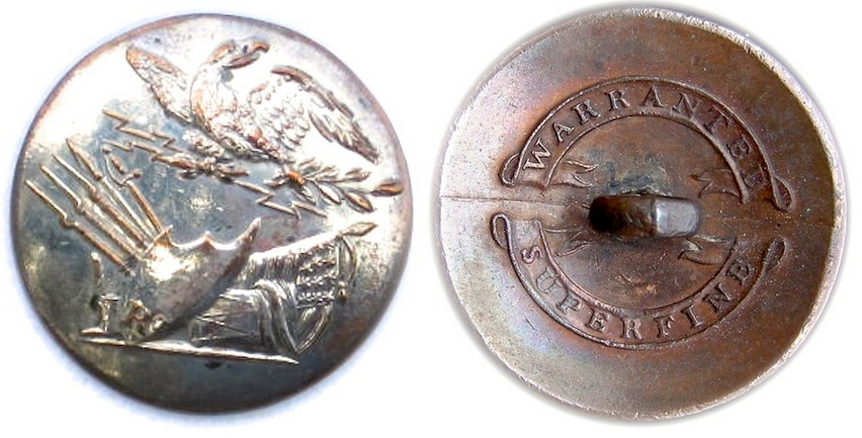
1808-1812 United States Infantry Officer
Color: The Silver Ghost.
Metal: Slightly Convex, 1-Piece, Raised Design,
Sheffield Silver Plated Copper.
Size: 24.31mm. Coat Size
Albert's Number: GI 51-I : RV 50
Variation: Forked Lightening Bolt / Olive Branch /
Military Trophy Collection.
Present Condition: A Non Excavated Example,
Exceptional Planchet Casting, Exceptional High Relief
Pattern.
Isabela's Notes: In this series, there are two
known manufacturers die variants for this pattern. This
silver plated copper button was most likely manufactured for
Infantry Officers. The button's pattern depicts a flying
eagle facing left, while clutching a
Forked Lightening Bolt
in it's right claw, and a
Small Petal Olive Branch
in it's
left. Below the eagle is a
Military Trophy Collection
of
objects. In the center of the collection is a pointed shield
with the initials, "R t" for regiment in the bottom tip of
the spade. On the right hand-side is a downward sword, an
upward spear, and three rifle bayonets that are pointing
diagonally upward from behind the shield. On the ground
below is a small forge cap with a feather. On the left hand
side of the shield, is a draped American flag with a top
tassel. The flag is partially laying over a sideways drum.
This high relief pattern is set on a plain convex field with
no edge border. An extremely hard button to obtain,
Collectors should seek any specimen available.
Reverse Button Analysis: This is a slightly concave
one-piece button with a soldered on loop shank. The shank is
original, straight, and intact. dm WARRANTED SUPERFINE each
within it's own dm Ribbon.
The RJ Silverstein Collection.
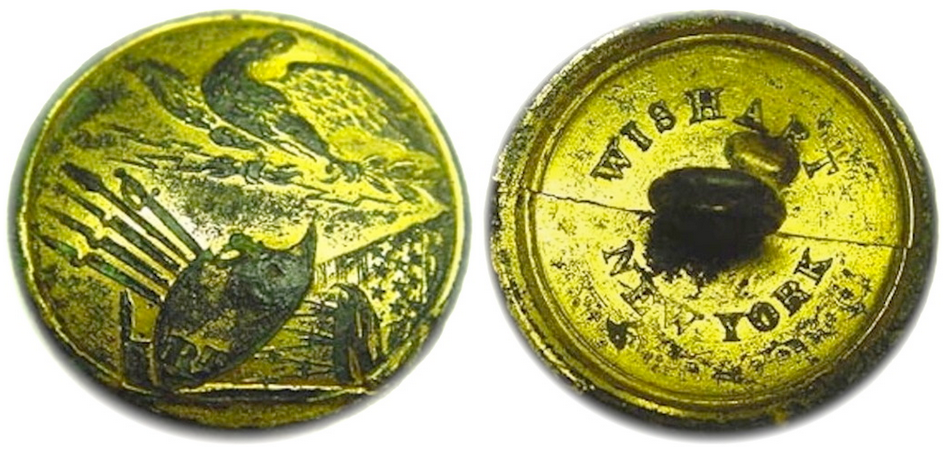
1808-1812 United States Infantry Officer
Color: Golden Brown.
Metal: Slightly Convex, 1-Piece, Raised Design,
Silver Plated Copper.
Size: 24mm. Coat Size
Albert's Number: GI 51-I : RV 50
Variation: Forked Lightening Bolt / Large Petal Olive
Branch / Military Trophy Collection.
Present Condition: An Excavated Example, Strong
Planchet Casting, Strong High Relief Pattern.
Isabela's Notes: This is the second known die variant
for this pattern. Manufactured by Wishart in the early
1800's, their pattern has subtle little differences in the
petals in the olive branch, the draped flag size and stars
within, the sideways drum size, and also more noticeably
there is a thin border edge. The button's pattern depicts a
flying eagle facing left, while clutching a
Forked Lightening Bolt
in it's right claw, and a
Large Petal Olive
Branch
in it's left. Below the eagle is a
Military Trophy
Collection of objects. In the center of the collection is a
pointed shield with the initials, "R t" for regiment in the
bottom tip of the spade. On the right hand-side is a
downward sword, an upward spear, and three rifle bayonets
that are pointing diagonally upward from behind the shield.
On the ground below is a large forge cap with a feather. On
the left hand side of the shield, is a large draped American
flag with a top tassel. The flag is partially laying over a
big sideways drum. This high relief pattern is set on a
plain convex field with a thin raised edge border.
Reverse Button Analysis: This is a slightly concave
one-piece button with a soldered on loop shank. The shank is
original, straight, and intact. rm WISHART NEW YORK
The J. Baldwin Collection.
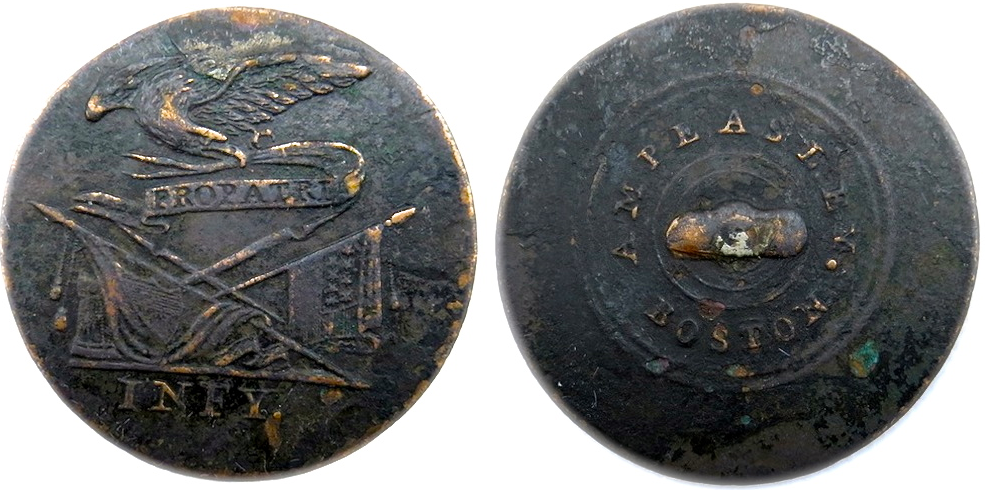
1810-12 United States Infantry
Officer
Color: A Coppery Brown.
Metal: Flat, 1-Piece, Raised Design, Silvered
Copper.
Size: 24.84mm. Coat Size
Albert's Number: GI 51-J: RV 60
Variation: Pro Patria Ribbon in it's Beak / Pro
Patria / Military Trophy Collection.
Present Condition: An Excavated Example, Strong
Planchet Casting, Good/Strong High Relief Pattern.
Isabela's Notes: There are three known die variants
for this pattern. One with a Rosette stamped before the
initials, "INFY."; One without a Rosette before the
initials; and a third pattern with an infantry number, "6"
before "INFY". Most War of 1812 button collectors nicknamed it, "The Pro Patria Pattern".
This is Latin
for, "One's Country". The button's pattern depicts a flying
eagle facing left, with a
Ribbon Grasped in it's Beak.
The ribbon's inscription says, "Pro Patria" in all
Roman font capital letters. Below this
is a
Military Trophy Collection. This includes a set of
crossed muskets with bayonets pointing upwards, two crossed
draped flags: one with a federal shield within and two top tassels,
and the other is an American Flag with eight stars; The
flag's pole has a single
tassel hanging just below the pole cap. On the right-hand
side there is a standing
drum that is partially covered by the draped flag. In the bottom
legend is the abbreviation for infantry, "INFY." The high relief
pattern is set on a plain flat field with no edge border.
This is a real collector's favorite for 1812 War collectors.
Specimens are rarely offered. Non Dug are the rarity.
Reverse Button Analysis: This is a flat one-piece button
with a loop shank. The shank is unfortunately missing.
The RJ. Silverstein Collection.
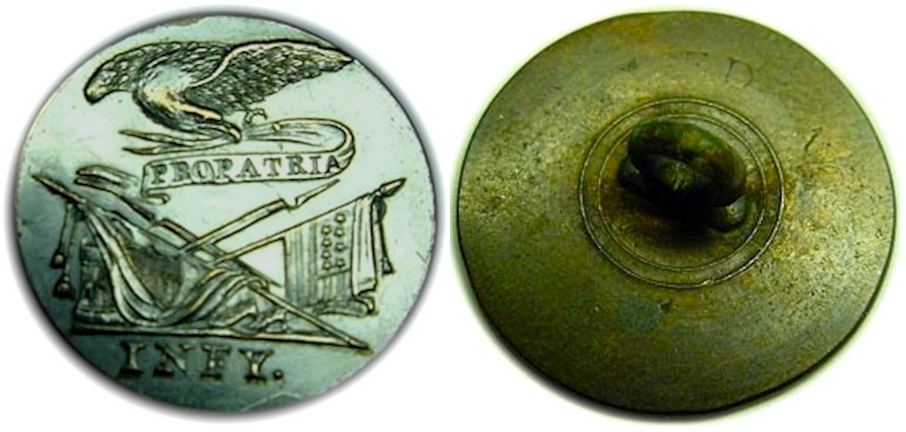
1810-12 United States Infantry
Officer
Color: A Silvery Brown.
Metal: Flat, 1-Piece, Raised Design, Silver Plated
Copper.
Size: 26mm. Coat Size
Albert's Number: GI 51-J: RV 60
Variation: Pro Patria Ribbon in it's Beak / Pro
Patria / Military Trophy Collection.
Present Condition: An Excavated Example, Strong
Planchet Casting, Exceptional High Relief Pattern.
Isabela's Notes: There are three known die variants
for this pattern. One with a Rosette stamped before the
initials, "INFY."; One without a Rosette before the
initials; and a third pattern with an infantry number, "6"
before "INFY". Most War of 1812 button collectors nicknamed it, "The Pro Patria Pattern".
This is Latin
for, "One's Country". The button's pattern depicts a flying
eagle facing left, with a
Ribbon Grasped in it's Beak.
The ribbon's inscription says, "Pro Patria" in all
Roman font capital letters. Below this
is a
Military Trophy Collection. This includes a set of
crossed muskets with bayonets pointing upwards, two crossed
draped flags: one with a federal shield within and two top tassels,
and the other is an American Flag with eight stars; The
flag's pole has a single
tassel hanging just below the pole cap. On the right-hand
side there is a standing
drum that is partially covered by the draped flag. In the bottom
legend is the abbreviation for infantry, "INFY." The high relief
pattern is set on a plain flat field with no edge border.
This is a real collector's favorite for 1812 War collectors.
Specimens are rarely offered. Non Dug are the rarity.
Reverse Button Analysis: This is a one-piece button
with a loop shank. The shank is original, straight, and
intact.
The J. Baldwin Collection.
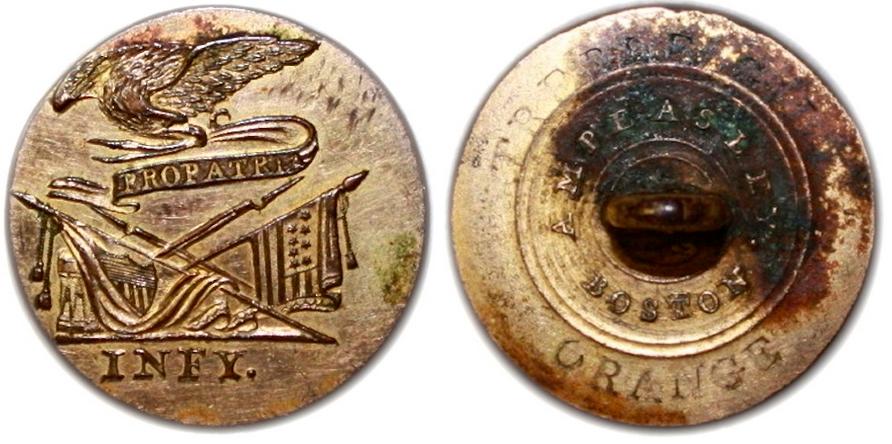
1810-12 United States Infantry Officer
Color: A Silvery Brown.
Metal: Flat, 1-Piece, Raised Design, Silver Plated
Copper.
Size: 26mm. Coat Size
Albert's Number: GI 51-J: RV 60
Variation: Ribbon Grasped in it's Beak / Pro Patria /
Military Trophy Collection /
Present Condition: An Excavated Example, Strong
Planchet Casting, Exceptional High Relief Pattern.
Isabela's Notes: There are three known die variants
for this pattern. One with a Rosette stamped before the
initials, "INFY."; One without a Rosette before the
initials; and a third pattern with an infantry number, "6"
before "INFY". Most War of 1812 button collectors nicknamed it, "The Pro Patria Pattern".
This is Latin
for, "One's Country". The button's pattern depicts a flying
eagle facing left, with a
Ribbon Grasped in it's Beak.
The ribbon's inscription says, "Pro Patria" in all
Roman font capital letters. Below this
is a
Military Trophy Collection. This includes a set of
crossed muskets with bayonets pointing upwards, two crossed
draped flags: one with a federal shield within and two top tassels,
and the other is an American Flag with eight stars; The
flag's pole has a single
tassel hanging just below the pole cap. On the right-hand
side there is a standing
drum that is partially covered by the draped flag. In the bottom
legend is the abbreviation for infantry, "INFY." The high relief
pattern is set on a plain flat field with no edge border.
This is a real collector's favorite for 1812 War collectors.
Specimens are rarely offered. Non Dug are the rarity.
Reverse Button Analysis: This is a one-piece button
with a loop shank. The shank is original, straight, and
intact. A M Peasley within a 2 ring rm / stamped over TREBLE
GILT ORANGE
The David Gerber Collection.
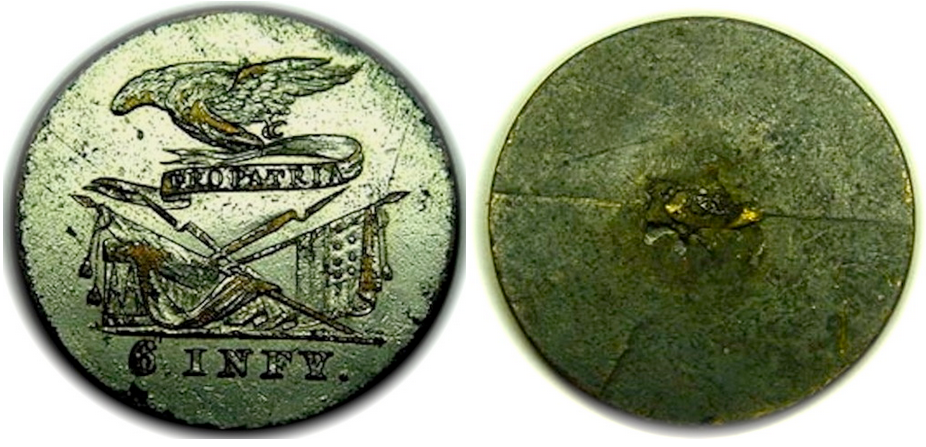
1808-1812 6th Regt. U.S. Infantry (Officer's Button)
Color: A Silvery Brown.
Metal: Flat, 1-Piece, Raised Design, Sheffield Silver
Plated Copper.
Size: 27mm. Coat Size
Albert's Number: GI 53R6.J:
RV 60
Variation: Pro Patria Ribbon in it's Beak / Pro
Patria / Military Trophy Collection.
Present Condition: An Excavated Example, Strong
Planchet Casting, Strong/Exceptional High Relief Pattern.
Isabela's Notes: This would be the third die variant
known with the number "6" in front of the Infantry initials,
"INFY.". The button's pattern depicts a flying eagle facing
left, with a
Ribbon in it's Beak
which says,
"Pro Patria"
in
all capital letters. Directly underneath is a
Military
Trophy Collection.
This includes a set of crossed muskets with bayonets
pointing upwards, two crossed draped flags: one with a
Federal Shield
with tassels, and the other and
American Flag
with a ribbon draped over the top. On the
right, there is a standing drum partially covered by the
draped flag. In the bottom legend there is an infantry
number, "6" before the infantry initials, "INFY". The high
relief pattern is set on a flat plain field with no edge
border.
Reverse Button Analysis: This is a one-piece button
with a loop shank. The shank is unfortunately missing.
The Baldwin Collection.
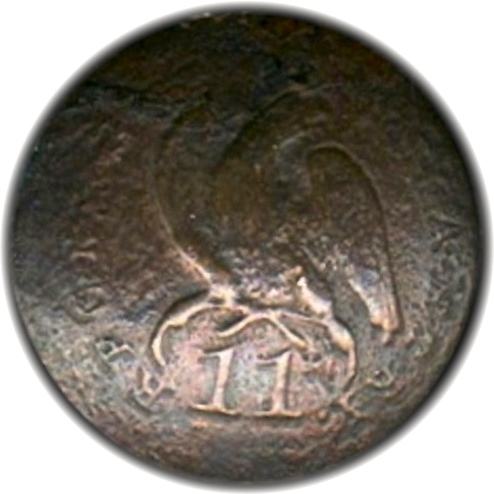
1812-15 11th Regt. U.S. Infantry.
Color: Brown with Grey Undertones.
Metal: Slightly Convex, 1-Piece, Raised Design, Cast
Pewter.
Size: 22mm. Coat Size
Albert's Number: GI 53-Dp: RV 35
Variation: Oval with Cross Open-Ends / Regiment of
Infantry / 11th Regiment.
Present Condition: An Excavated Example, Good
Planchet Casting, Fair/Good High Relief Pattern.
Isabela's Notes: This button could have been
manufactured as early as 1808-11, but I could not get enough
information. I do know it was used during the war of
1812-15. There are two known sizes for this pattern. One is
a coat at 23mm, the other is a cuff at 20mm. The button's
pattern depicts a droop wing eagle facing left, while
standing on an Oval with Cross Open-Ends. The Regiment's
Number,"11" is within the oval's center. Circling around the
outside edge is the military designation, "REGIMENT OF
INFANTRY ." in all Roman Font capital letters. There is a
raised Dot Marker in the bottom legend after the word
Infantry and United. The high relief pattern is set on a
plain convex field. Albert rated this particular die variant
an RV 35, I would afford this a little more rarer then that.
Reverse Button Analysis: This is a slightly concave
one-piece button with a loop shank. The shank is original,
straight & intact. "Giles/Richards" eagle rm with lines.
Rich Eldon's Dug Collection. (RIP)
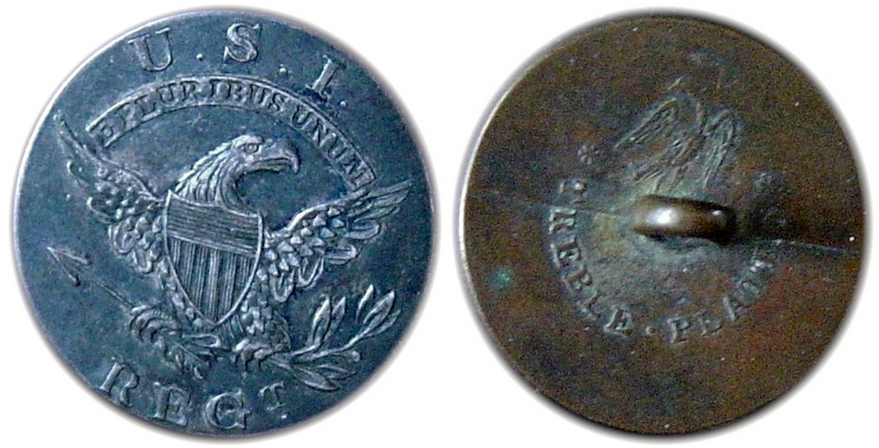
1808-12 1st Regt. U.S. Infantry (Officer's Button).
Color: Silvery Gray.
Metal: Flat, 1-Piece, Raised Design, Silver Plated
Copper.
Size: 26mm. Coat Size
Albert's Number: Similar to GI 53R1-A Unlisted
Pattern Variation: RV 50
Variation: Spread Wing Eagle / Upward Angled Olive
Branch / U.S.I
Present Condition: A Non Excavated Example,
Exceptional Planchet Casting, Exceptional High Relief
Pattern.
Isabela's Notes: There is a whole series of these
buttons manufactured with slightly different patterns.
(Later die variants of this pattern included Roman numerals
for their intended regiment designations). These earlier
specimens without a regiment number could have been
automatically intended for the 1st Regiment. The button
above is very similar to GI 53R1.A in Albert's book, but a
slightly different variation in the pattern is depicted.
This manufacturer's example shows less spacing with various
items being depicted. The button's pattern depicts a
Spread Wing Eagle
with a lined Federal Shield on it's chest. In the eagle's
left talon is an
Upward Angled Olive Branch
with
seven petals, and a berry. In the eagle's right talon is a
single arrow pointing to the right. Above the eagle's head,
is an arced banner with, "E PLURIBUS UNUM" inscribed within.
Slightly above that, in the top legend is the abbreviation
for
United States Infantry, "U.S.I"
in large Roman Font
letters. Below the eagle is the abbreviation for regiment,
"REGt.".
The high relief pattern is set on a plain flat field with no
raised edge.
Reverse Button Analysis: This is a flat one-piece
button with a soldered on loop shank. The shank is original,
straight, and intact. *TREBLE.PLATED* raise Eagle above.
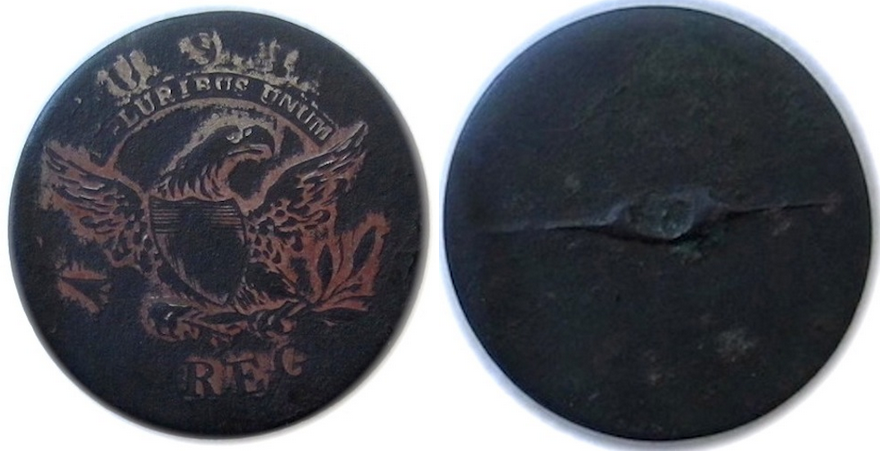
1808-12 1st Regt. U.S. Infantry
(Officer's Button).
Color: Silvery Brown.
Metal: Flat, 1-Piece, Raised Design, Silver Plated
Copper.
Size: 25.60mm. Coat Size
Albert's Number: Similar to GI 53R1-A Unlisted
Pattern Variation: RV 50
Variation: Spread Wing Eagle /Large Tip Arrow /
Upward Angled Olive Branch / U.S.I
Present Condition: A Non Excavated Example,
Exceptional Planchet Casting, Exceptional High Relief
Pattern.
Isabela's Notes: This is another unlisted die variant
with the same pattern. This die was cut to give the pattern
more room on the planchet. The pattern shows a larger arrow
tip, a space between the inscription banner and wings, a
space between the olive branch and edge, and there is no,
"T" after regiment. The button's pattern depicts a
Spread Wing Eagle
with a lined Federal Shield on it's chest. In the eagle's
left talon is an
Upward Angled Olive Branch with
five petals, and an Olive. In the eagle's right talon is a
Large Tip Arrow pointing to the right. Above the eagle's
head, is an arced banner with, "E PLURIBUS UNUM". Just above
that, is the abbreviation for United States Infantry, "U.S.I"
in large Roman Font letters. Below the eagle is the
abbreviation for regiment, "REG". The high relief pattern is
set on a plain flat field with no raised border edge.
Reverse Button Analysis: This is a flat one-piece
button with a soldered on loop shank. The shank is
unfortunately missing.
The RJ Silverstein Collection.
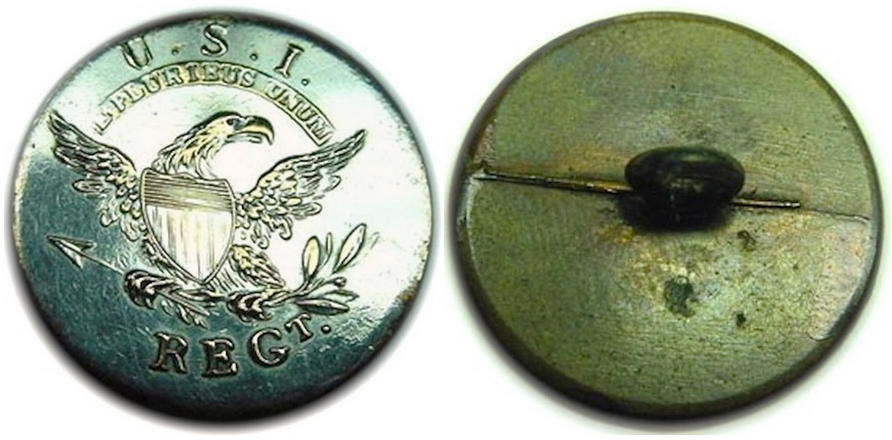
1808-12 1st Regt. U.S. Infantry
(Officer's Button).
Color: Bright Silver.
Metal: Flat, 1-Piece, Raised Design, Silver Plated
Copper.
Size: 25.89mm. Coat Size
Albert's Number: Similar to GI 53R1-A Unlisted
Pattern Variation: RV 50
Variation: Spread Wing Eagle /Large Tip Arrow /
Upward Angled Olive Branch / U.S.I
Present Condition: A Non Excavated Example,
Exceptional Planchet Casting, Exceptional High Relief
Pattern.
Isabela's Notes: This is yet another unlisted die
variant with the same pattern. Extremely similar to the
specimen pictured above, but with a smaller Arrow point, no
space between the banner and wings, and there is a "T" in
REGt. The button's pattern depicts a
Spread Wing Eagle,
with a lined Federal lined Shield on it's chest. In the
eagle's left talon is an
Upward Angled Olive Branch
with Five Petals, and a Olive. In the eagle's right talon is
a single arrow pointing to the right. Above the eagle's
head, is an arced banner with, "E PLURIBUS UNUM" inscribed
within. Slightly above that, in the top legend is the
abbreviation for
United States Infantry, "U.S.I"
in large Roman Font
letters. Below the eagle is the abbreviation for regiment, "REGt.".
The high relief pattern is set on a plain flat field with no
raised border edge.
Reverse Button Analysis: This is a flat one-piece
button. The shank is original, straight, and intact. Blank
back mark.
The J. Baldwin Collection.
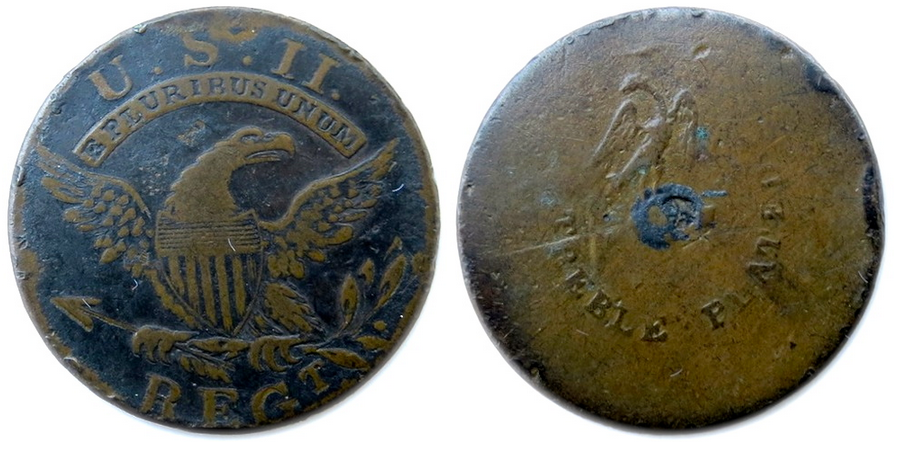
1808-12 2nd Regt. U.S. Infantry (Officer's Button).
Color: Silvery Grey.
Metal: Flat, 1-Piece, Raised Design, Silver Plated
Copper.
Size: 23mm. Coat Size
Albert's Number: GI 53R2-A: RV 50
Variation: Federal Spread Wing Eagle /Large Tip Arrow /
Upward Angled Olive Branch / U.S.II.
Present Condition: An Excavated Example, Strong
Planchet Casting, strong High Relief Pattern.
Isabela's Notes: This button was made in
Sheffield Silver, and was intended for Infantry Officers.
There is only one die variant known in this pattern for
officer's of the 2nd regiment. The button's pattern depicts a
Federal Spread Wing Eagle
facing left, with a lined Federal Shield on it's chest. In
the eagle's left talon is an
Upward Angled Olive Branch
with five petals, and an Olive. In the eagle's right talon
is a
Large Tip Arrow
pointing to the right. Above the eagle's head, is a small
raised arced banner with, "E
PLURIBUS UNUM"
inscribed. Just above that, is the abbreviation for United
States Infantry 2nd Regiment, "U.S.II."
in large raised Roman Font letters. Below the eagle is the
abbreviation for regiment, "REGt" in capital letters. The
high relief pattern is set on a flat field with plain edge.
Reverse Button Analysis: This is a flat one-piece
button with a soldered on loop shank. The shank is
unfortunately missing. TREBLE PLATED/ EAGLE design above.
The RJ. Silverstein Collection.
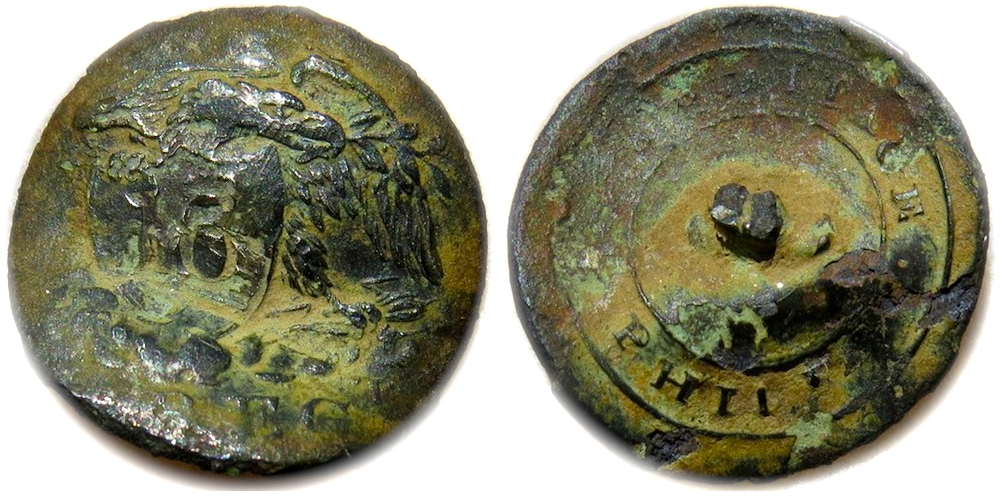
1810-20's 16th Regiment Infantry Officer
Color: Tri Color Of Greens & Browns.
Metal: Slightly Convex, 1-Piece, Raised Design,
Silver Plated Copper.
Size: 21.09mm. Coat Size
Albert's Number: GI 53 R16G.b RV 50
Variation: Six Petal Olive Branch / Lightening Bolts
/ Small Bundle of Three Arrows / 4mm. Arabic Number 16.
Present Condition: An Excavated Example, Fair/Good
Planchet Casting, Fair/Good High Relief Pattern.
Isabela's Notes: Armitage manufactured this pattern
for several infantry regiments. Collector's should note
there were two size numbers stamped on the shield for the
16th regiment. One with 3mm and one with 4mm. There was a
third pattern made by Armitage for the 16th Regt., but used
a completely different pattern. The button's pattern depicts
an eagle standing on top of the heavenly clouds while
looking toward the left. Hanging from the eagle's beak is a
Six Petal Olive Branch. In the eagle's left talon is a set
of Lightening Bolts, and in it's right talon is a Small
Bundle of Three Arrows sticking out from behind the top of
the shield. On the right hand side, there is a large shield
with a 4mm. Arabic Number 16 stamped in the center to denote
the regt. number. In the bottom legend is the abbreviation,
"REGt" for regiment. The high relief pattern is set on a
plain convex field with no raised edge border. This is an
extremely rare officer's button and collectors should seek
any specimen made available.
Reverse Button Analysis: This is a one-piece button
with a loop shank. The shank is unfortunately broken off. rm
ARMITAGE PHILa. within a 2 ring rm.
Dug by Neil in Clifton Heights, Pennsylvania.
The RJ. Silverstein Collection.
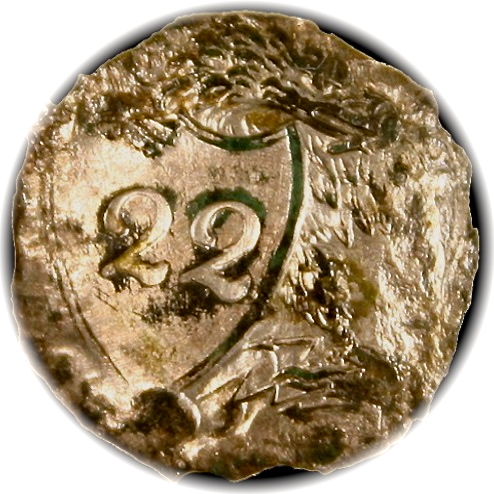
1810-20 22nd Regt. U.S. Infantry (Officer's Button).
Color: Polished Silver.
Metal: Slightly Convex, 1-Piece, Raised Design,
Sheffield Silver Plated Copper.
Size: 22mm. Coat Size
Albert's Number: GI 53R-22: RV 50
Variation: Eagle Standing on Roiling Clouds / Limp
Olive Branch / Three Lightening Bolts / Regiment's Number
22.
Present Condition: An Excavated Example, Strong
Planchet Casting, Strong/Exceptional High Relief Pattern.
Isabela's Notes: Armitage manufactured this pattern
in large quantities for infantry officers in various
regiments. This button was most likely stamped after it was
issued to the 22nd Regiment. The button's pattern depicts an
Eagle Standing on Roiling Clouds while looking to the left.
There is a long Limp Olive Branch held in it's beak. In the
eagle's left claw is a set of Three Lightening Bolt, and in
it's right talon is small bundle of short arrows sticking
out from behind the top of the shield. Stamped on the shield
is the Regiment's number,"22" in large Arabic numbers. In
the bottom legend is the offset abbreviation, "REGt" to
designate regiment. The high relief pattern is set on a
plain convex field with no raised edge border. Collectors
should take advantage of any specimen that becomes available
for purchase.
Reverse Button Analysis: This is a slightly concave
one-piece button with a soldered on loop shank. The shank is
broken off. ARMITAGE /PHIL rm.
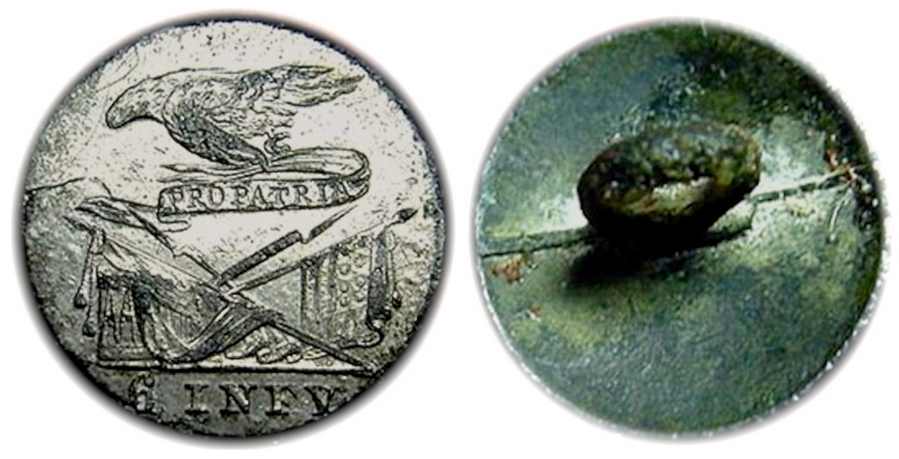
1808-1812 6th Regt. U.S. Infantry (Officer's Button).
Color: Silver.
Metal: Flat, 1-Piece, Raised Design, Sheffield Silver
Plated Copper.
Size: 20mm. Cuff Size
Albert's Number: Unlisted Size Variant Similar to GI
53R6.J: RV 75
Variation: Pro Patria Ribbon in it's Beak / Pro
Patria / Military Trophy Collection.
Present Condition: An Excavated Example, Strong
Planchet Casting, Strong/Exceptional High Relief Pattern.
Isabela's Notes: This would be the third die variant
known with the number "6" in front of the Infantry initials,
"INFY.". The button's pattern depicts a flying eagle facing
left, with a Ribbon in it's Beak which says, "Pro Patria" in
all capital letters. Directly underneath is a Military
Trophy Collection. This includes a set of crossed muskets
with bayonets pointing upwards, two crossed draped flags:
one with a Federal Shield with tassels, and the other and
American Flag with a ribbon draped over the top. On the
right, there is a standing drum partially covered by the
draped flag. In the bottom legend there is an infantry
number, "6" before the infantry initials, "INFY". The high
relief pattern is set on a flat plain field with no edge
border.
Reverse Button Analysis: This is a one-piece button
with a loop shank. The shank is original, straight, and
intact.
The J. Baldwin Collection.
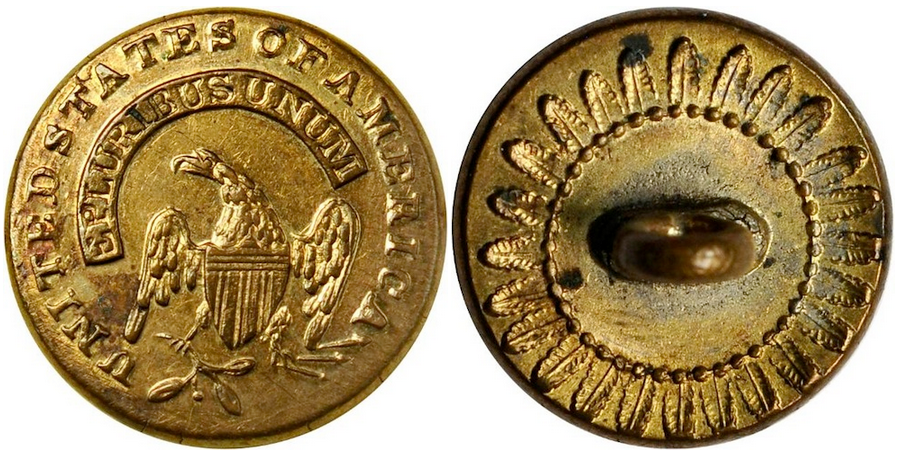
1812-20 Army Infantry Officer's Cockade Button
Color: A Golden Brown.
Metal: Flat, 1-Piece, Raised Design, Gilt Brass.
Size: 13.80mm. Hat Size
Albert's Number: Unlisted Die Variant Similar to UU132 RV
25
Tice:
Variation: Droop Wing Eagle / Three Spread Arrows / Three Petal
& One Berry Olive Branch /Slanted Lined Federal Shield.
Present Condition: An Excavated Example, Exceptional
Planchet Casting, Exceptional High Relief Pattern.
Isabela's Notes: This small button was actually worn
on the side of a military issued US Infantry
Officer's hat. I am told This was sewn on the side of
their black silk cockade. We know of at least four
manufacturers that made this style button. So there appears
to be few different die variants. They mainly differentiate
in the eagle depicted, the motto-some
have the "E", and some omit the "E" in
E Pluribus Unum; how many arrows depicted, and style and
direction of the Olive Branch. This buttons pattern depicts a
Droop Wing
Eagle
in the Center facing right. In it's left talon is
Three Spread Arrows
pointing leftward. In it's right talon
is a
Three Petal and One Berry Olive Branch
pointing
downward. On the eagle's chest is a slightly
Slanted Lined
Federal Shield. Inscribed in a half arc just above the
eagle's head is, "E PLURIBUS UNUM" in Roman font capital
letters. Circling around the legend is, "UNITED STATES OF
AMERICA" in raised Roman font capital letters. The high
relief pattern is set on a flat field with a plain edge.
Reverse Button Analysis: This is a flat one-piece
button with a soldered on loop shank. Twenty Four Eagle
Feathers Circling a raised dotted circle.
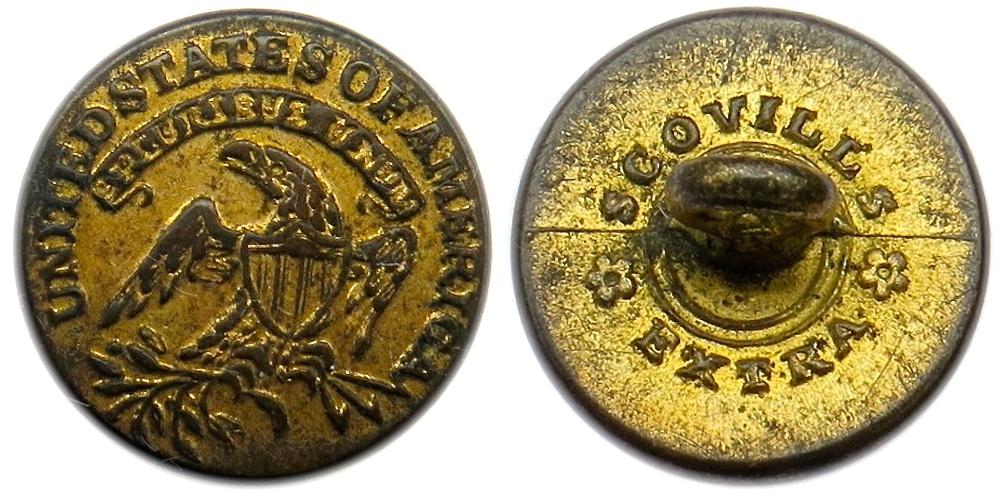
1812-20 Army Infantry Officer's Cockade Button
Color: A Golden Metal Color Mix.
Metal: Flat, 1-Piece, Raised Design, Gilt Brass.
Size: 14.52mm. Hat Size
Albert's Number: Unlisted Die Variant Similar to UU132 RV
25
Tice:
Variation: Droop Wing Eagle / Three Spread Arrows / Three Petal
& One Berry Olive Branch /Slanted Lined Federal Shield.
Present Condition: An Excavated Example, Exceptional
Planchet Casting, Exceptional High Relief Pattern.
Isabela's Notes: Here is another die variant made
by Scovills. This button would be the earliest example known
for this pattern. We know of at least four
manufacturers that made this style button. So there appears
to be few different die variants. They mainly differentiate
in the eagle depicted, the motto-some
have the "E", and some omit the "E" in
E Pluribus Unum; how many arrows depicted, and style and
direction of the Olive Branch. This small button was
actually worn on the side of a military issued US Infantry
Officer's hat. I am told This was sewn on the side of their
black silk cockade. This buttons pattern depicts a
Droop Wing
Eagle
in the Center facing right. In it's left talon is
Three Spread Arrows
pointing leftward. In it's right talon
is a
Three Petal and One Berry Olive Branch
pointing
downward. On the eagle's chest is a slightly
Slanted Lined
Federal Shield. Inscribed in a half arc just above the
eagle's head is, "E PLURIBUS UNUM" in Roman font capital
letters. Circling around the legend is, "UNITED STATES OF
AMERICA" in raised Roman font capital letters. The high
relief pattern is set on a flat field with a plain edge.
Reverse Button Analysis: This is a flat one-piece
button with a soldered on loop shank. The shank is original,
straight, and intact. * SCOVILLS * / EXTRA rm with 2 ring rm
around the shank.
The RJ. Silverstein Collection.
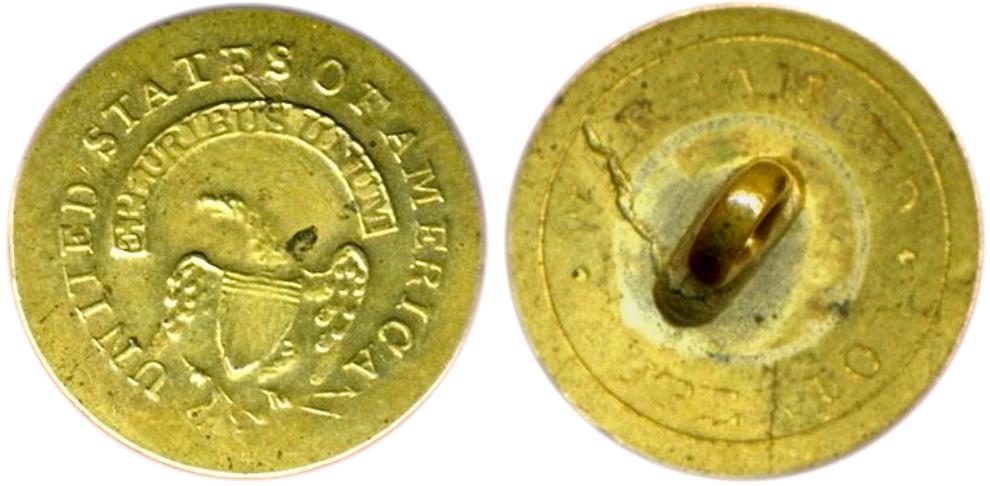
1812-20 Army Infantry Officer's Cockade Button
Color: A Brass Yellow with Olive Undertones.
Metal: Flat, 1-Piece, Raised Design, Gilt Brass.
Size: 16mm. Hat Size
Albert's Number: Unlisted Die Variant Similar to UU132 RV
25
Tice:
Variation: Droop Wing Eagle / Two Spread Arrows / Two
Petal & Three Berry Olive Branch /Slanted Lined Federal Shield.
Present Condition: An Excavated Example, Exceptional
Planchet Casting, Exceptional High Relief Pattern.
Isabela's Notes: This is another die variant that
has a Warranted Superior back mark. This also appears to be
the largest size of this type. We know at least four
manufacturers made this style button. So there appears to be few
different die
variants. They mainly differentiate in the eagle depicted,
the motto-some
have the "E", and some omit the "E" in
E Pluribus Unum; how many arrows depicted, and style and direction of the Olive
Branch. This button was actually worn on the side of a
military issued US Infantry Officer's hat. I am told This
was sewn on the side of their black silk cockade. This buttons pattern depicts a
Droop Wing
Eagle
in the Center facing right. In it's left talon is
Two Spread Arrows
pointing leftward. In it's right talon
is a
Three Petal and One Berry Olive Branch
pointing
downward. On the eagle's chest is a slightly
Slanted Lined
Federal Shield. Inscribed in a half arc just above the
eagle's head is, "E PLURIBUS UNUM" in Roman font capital
letters. Circling around the legend is, "UNITED STATES OF
AMERICA" in raised Roman font capital letters. The high
relief pattern is set on a flat field with a plain edge.
Reverse Button Analysis: This is a flat one-piece
button with a soldered on loop shank. The shank is original,
straight, and intact. WARRANTED SUPERIOR.
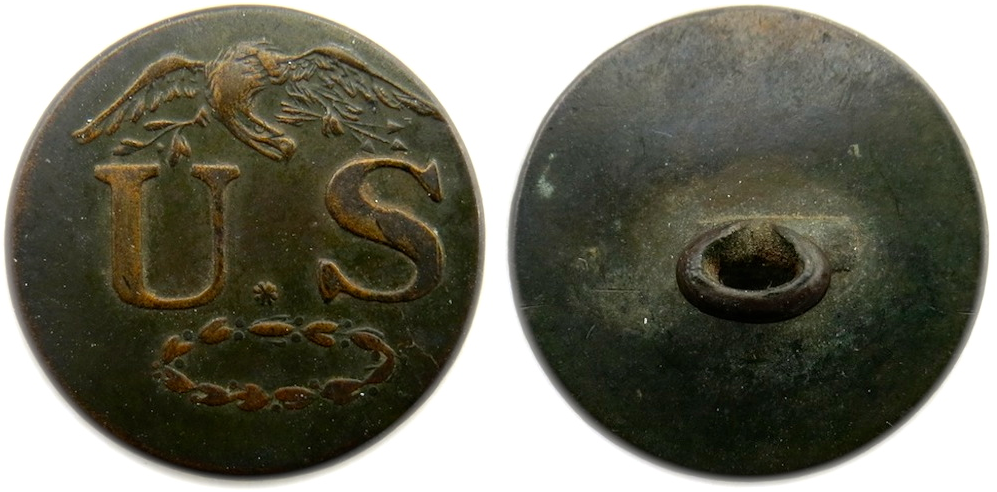
1820's Army General Service "The
Great Coat Buttons"
Color: Army Green with Coppery Brass Undertones.
Metal: Flat, 1-Piece, Raised Design, Cast Brass.
Size: 20.88mm. Coat Size
Albert's Number: GI 70-A RV 25
Tice: GEN 199 A.1
Variation: Outward Over the Letter S / Wide Space
Initials / Eight Pointed Star / Arrow Heads Pointing Left.
Present Condition: A Non Excavated Example,
Exceptional
Planchet Casting, Exceptional High Relief Pattern.
Isabela's Notes: The Scovill Company submitted
samples of the new design in early April of 1820, and by
September 5, they were ordered to make 75 gro. of the large,
and 50 gro of the small Great Coat buttons. There is some
debate among collectors if the original specimens had blank
back marks, or used the L.H. & Scovill back mark. There are
two known die variants for the original one-piece coat
button, and one for the cuff. One pattern has an eight
pointed star between the wide spaced initials; and the
other uses a period between the close spaced initials. The
cuff size variant uses the period between the initials. The
button's pattern depicts a flying spread-wing eagle. The
eagle's head shows a side profile that is turned downward,
and facing toward the left. In the eagle's left talon is a
small bundle of three arrows, that are pointing
Outward Over
the Letter "S" toward the left. In the eagle's right talon
is a small Olive Branch with four petals over the initial,
"U". In the center of the button are two large
Roman style
font Wide Space Initials, "U * S" for United States.
In-between the initials is an
Eight Pointed Star. Underneath
the country's initials is an oval of
Arrow Heads Pointing
toward the Left, with two raised dots flanking each side of
the arrow head. The high relief pattern is set on a plain
flat field with no raised edge border. Both dug and un-dug
specimens are obtainable. Getting one with a clearly defined
eight point star is the hard part for collectors.
Reverse Button Analysis: This is a flat one-piece
button with a loop shank. The shank is original and intact,
but slightly bent.
The RJ. Silverstein Collection.
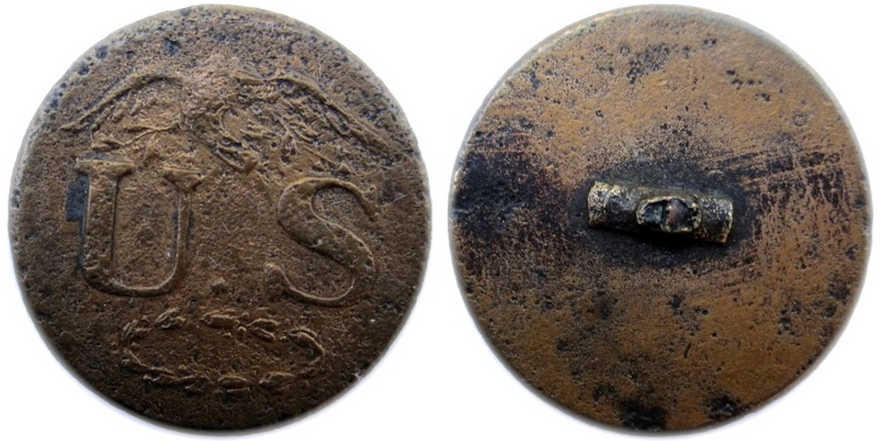
1820's Army General Service "The
Great Coat Buttons"
Color: A Milk Chocolate Desert Brown.
Metal: Flat, 1-Piece, Raised Design, Cast Brass.
Size: 20.76mm. Coat Size
Albert's Number: GI 70-A RV 25
Tice: GEN 199 A.1
Variation: Outward Over the Letter S / Wide Space
Initials / Eight Pointed Star / Arrow Heads Pointing Left.
Present Condition: An Excavated Example, Good
Planchet Casting, Good High Relief Pattern.
Isabela's Notes: This would be an example of a
common dug specimen. The
button's pattern depicts a flying spread-wing eagle. The
eagle's head shows a side profile that is turned downward,
and facing toward the left. In the eagle's left talon is a
small bundle of three arrows, that are pointing
Outward Over
the Letter "S" toward the left. In the eagle's right talon
is a small Olive Branch with four petals over the initial,
"U". In the center of the button are two large
Roman style
font Wide Space Initials, "U * S" for United States.
In-between the initials is an
Eight Pointed Star. Underneath
the country's initials is an oval of
Arrow Heads Pointing
toward the Left, with two raised dots flanking each side of
the arrow head. The high relief pattern is set on a plain
flat field with no raised edge border.
Reverse Button Analysis: This is a flat one-piece
button with a loop shank. The boss is still present, but the
loop is unfortunately missing. Blank, no back mark.
Excavated in Florida.~
The RJ. Silverstein Collection.
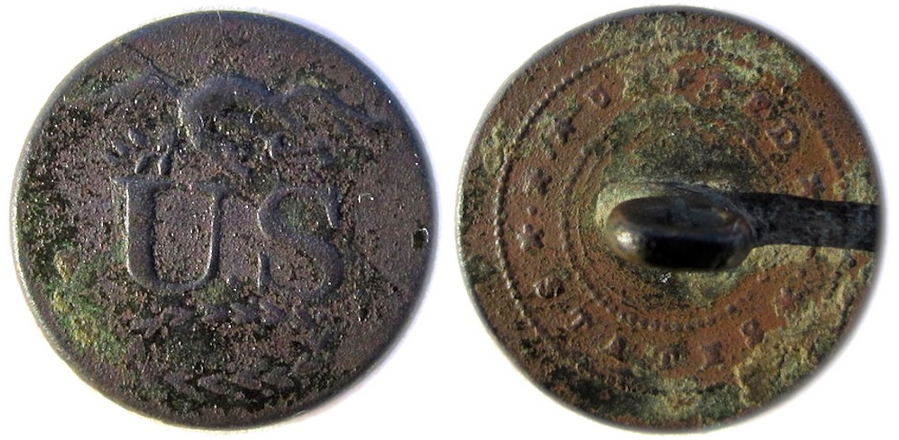
1820's Army General Service "The
Great Coat Buttons"
Color: A Pewter Brown with Green Encrustations.
Metal: Flat, 1-Piece, Raised Design, Cast Brass.
Size: 19.96mm. Coat Size
Albert's Number: GI 70-B: RV 25
Tice: GEN 199 B.1
Variation: Olive Branch with Six Petals / Close Space
Initials / Period In-between Initials / Arrow Heads Pointing
Toward the Right.
Present Condition: An Excavated Example, Strong
Planchet Casting, Good/Strong High Relief Pattern.
Isabela's Notes: This is the second known die variant
made by Scovills for this early one-piece pattern. The die's
pattern shows a slightly smaller version of the original.
This button's pattern also depicts a flying spread-wing
eagle that is looking down above the country's initials
while facing toward left. In the eagle's left talon is a
small bundle of three arrows, that are pointing toward the
left over the letter, "S". In the eagle's right talon is a
small
Olive Branch with Six Petals over the initial, "U". In
the center of the button are two large Roman style font
initials for the United States,
"US" that are Close Spaced.
This die variant shows a Period In-between the Initials.
Underneath the country's initials is an oval of
Arrow Heads
Pointing Toward the Right, with two raised dots flanking
each side of the arrow head. The high relief pattern is set
on a plain flat field with no raised edge border.
Reverse Button Analysis: This is a flat one-piece
button with a soldered loop shank. The shank is original and
intact. *.*.*UNITED STATES.*.*.* in a channel of 2 rings of
rm dots.
Excavated by a Train Depot in Rolla, Missouri.~
The RJ. Silverstein Collection.
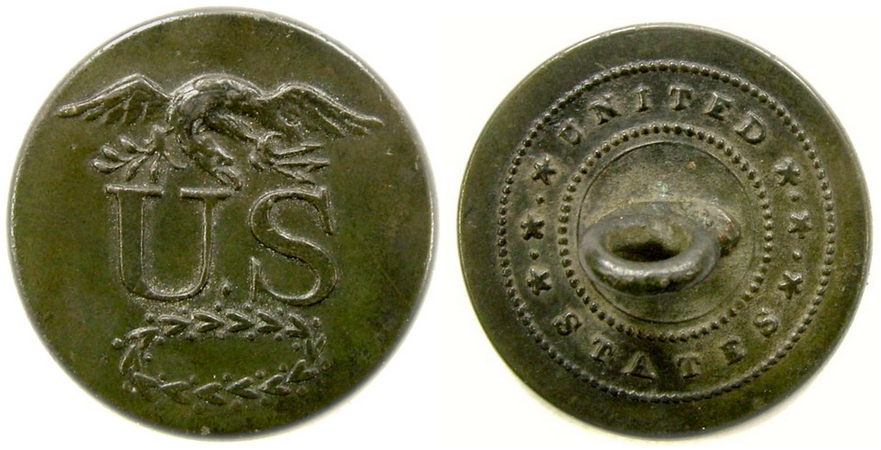
1820's Army General Service "The
Great Coat Buttons"
Color: Army Green.
Metal: Flat, 1-Piece, Raised Design, Cast Brass.
Size: 21mm. Coat Size
Albert's Number: GI 70-B: RV 25
Tice: GEN 199 B.1
Variation: Olive Branch with Six Petals / Close Space
Initials / Period In-between Initials / Arrow Heads Pointing
Toward the Right.
Present Condition: A Non Excavated Example,
Exceptional Planchet Casting, Exceptional High Relief
Pattern.
Present Condition: An Excavated Example, Strong
Planchet Casting, Good/Strong High Relief Pattern.
Isabela's Notes: This is the second known die variant
made by Scovills for this pattern. The die cut shows a
slightly smaller pattern then the original. The button's
pattern depicts a flying spread-wing eagle in the top
portion of the button. The eagle's head shows a side profile
that is turned downward, and facing toward the left. In the
eagle's left talon is a small bundle of three arrows, that
are pointing toward the left over the letter, "S". In the
eagle's right talon is a small
Olive Branch with Six Petals
over the initial, "U". In the center of the button are two
large Roman style font initials for the United States, "US"
that are
Close Spaced. This die variant shows a
Period
In-between the Initials. Underneath the country's initials
is an oval of Arrow Heads Pointing Toward the Right, with
two raised dots flanking each side of the arrow head. The
high relief pattern is set on a plain flat field with no
raised edge border.
Reverse Button Analysis: This is a flat one-piece
button with a soldered loop shank. The shank is original and
intact. *.*.*UNITED STATES.*.*.* in a channel of 2 rings of
rm dots.
The Picture is courteous of Harry
Ridgeway.

1826-39 Army General Service "The
Great Coat Buttons"
Color: Desert Brown.
Metal: Flat, 2-Piece, Raised Design, Gilded Brass.
Size: 20mm. Coat Size
Albert's Number: GI 71-A RV 10
Tice's Number: GEN 200A.1 PG 140
Variation: Arrows Pointing Down in-between Initials /
Olive Branch with Six Petals / Wide Spaced Initials / Robust
Arrow Heads.
Present Condition: An Excavated Example, Strong
Planchet Casting, Strong High Relief Pattern.
Isabela's Notes: This two-piece flat button is
extremely similar to the earlier GI 70 design, except the
arrows in the eagles talon are pointing in-between the
country's initials toward the button's center. There is only
one known die variant for this coat button, and two known
die variants for the cuff size. Under close examination,
this two-piece specimen appears to have a thin shell front
over a flat one-piece button. The button's pattern depicts a
flying spread-wing eagle. The eagle's head shows a side
profile that is turned downward, and facing toward the left.
In the eagle's left talon are three small
Arrows that are
Pointing Down in-between the Country's Initials. In the
eagle's right talon over the "U" is an
Olive Branch with Six
Petals. In the center of the button are two large
Roman Font
Wide Space Initials, "U . S" with a Period in-between.
Underneath the initials is an oval of tightly grouped
Robust
Arrow Heads pointing to the left. The high relief pattern is
set on a plain flat field with no raised edge border.
Reverse Button Analysis: This is a flat two-piece
button with a soldered loop shank. The shank is original and
intact. *.* UNITED STATES *.* in a channel of 2 rings of rm
dots.
The RJ. Silverstein
Collection.
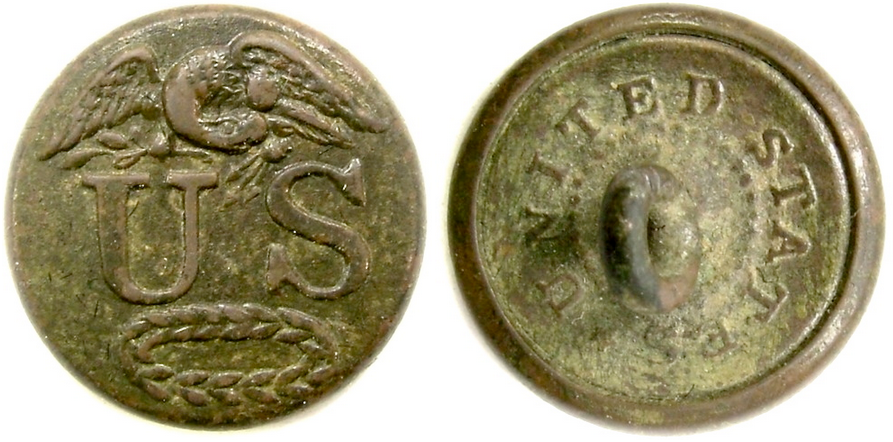
1826-39 Army General Service "The
Great Coat Buttons"
Color: Desert Brown.
Metal: Flat, 2-Piece, Raised Design, Gilded Brass.
Size: 14.7mm. Cuff Size
Albert's Number: GI 71-Av RV 25
Tice's Number: GEN 200-As.1
Variation: Arrows Pointing Down / Olive Branch with
three Petals / Wide Space / Robust Arrow Heads.
Present Condition: An Excavated Example, Strong
Planchet Casting, Strong High Relief Pattern.
Isabela's Notes: This two-piece flat button is
extremely similar to the earlier GI 70 design, except the
arrows in the eagles talon are pointing in-between the
country's initials toward the button's center. This is one
of the two die variants known for the small cuff or vest
size button. The button's pattern depicts a flying
spread-wing eagle in the top portion of the button. The
eagle's head shows a side profile that is facing toward the
left. In the eagle's left talon are three small
Arrows that are Pointing Down
in-between the Country's Initials. In the eagle's right
talon is a small
Olive Branch with Three
Petals and an Olive. In the center of the button is the
country's initials, "US" is in Roman Font Capital letters.
This die variant shows a Wide Space in-between. Underneath
the initials is an oval of tightly grouped
Robust Arrow
Heads pointing to the left. The high relief pattern is set
on a plain flat field with no raised edge border.
Reverse Button Analysis: This is a two-piece button
with a soldered loop shank. The shank is original and
intact. * UNITED / STATES with an inner rings of rm dots.
The Picture is courteous of Harry
Ridgeway.
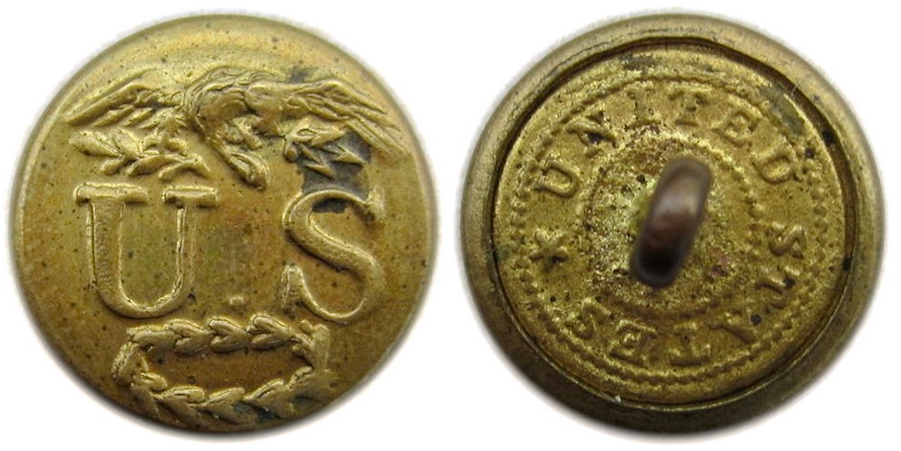
1826-39 Army
General
Service "The
Great Coat
Buttons"
Color:
Desert
Brown.
Metal:
Flat,
2-Piece,
Raised
Design,
Gilded
Brass.
Size:
14.77mm.
Cuff
Size
Albert's
Number:
GI
71-Bv
RV
25
Tice's
Number:
GEN
200-Bs.1
Variation: Arrows Pointing Outward Toward the Left / Olive Branch with Five Petals / Wide Spaced Initials with a Period / Robust Arrow Heads.
Present Condition: A Non Excavated Example, Strong Planchet Casting, Strong High Relief Pattern.
Isabela's Notes: This is the second known die variant in the series for the cuff size button. There are three major differences in this pattern from the first illustrated cuff button. The first difference is in the style eagle depicted, and also the downwardly direction of it's head. Second, the arrows are facing outward toward the left. Third, there is a period in-between the country's initials. The button's pattern depicts a flying spread-wing eagle in the top portion of the button. The eagle's head shows a side profile that is pointed more downward in-between the country's initials. In the eagle's left talon is a small bundle of three arrows over the letter, "S". They are Pointing Outward Toward the Left. In the eagle's right claw is a small Olive Branch with Five Petals over the initial, "U". In the center of the button is the country's initials, "US" is in Roman Font capital letters. This die variant shows a Wide Space initials with a Period in-between. Underneath the country's initials is an oval of Robust Arrow Heads pointing toward the right. The high relief pattern is set on a plain flat field with no raised edge border.
Reverse Button Analysis: This is a two-piece button with a soldered loop shank. The shank is original and intact. * UNITED / STATES in a channel of 2 rings of rm dots.
The RJ. Silverstein
Collection.
Robert's
Notes: There
was another
button made
by Horstman
that uses
the same
pattern as
the ones
used in GI
70 & 71, but
is a 2-piece
Convex
button. I
would list
this as a
separate
series.
The button pattern depicting a spread eagle with the
inscribed "I" on the shield was officially adopted in 1821.
Enlisted men used this design until 1854, when it was
replaced by the general Service button without the "I".
However, Infantry Officers continued to use the pattern
until 1902, when the Great Seal Pattern was officially
adopted. The new convex style Silver-Plated button started
to replace most flat infantry buttons at this point.
Companies like Armitage and L.H Scovills started producing
the earliest one-piece examples. These buttons would have
been worn in later years by both the northern and southern
state's militia units on the onset of the Civil War. After a
short time, there were many manufacturers producing this
button with their own version of the pattern. This style
pattern became the standard for all Infantry and Artillery
Units. Listed below will be a handful of examples to
represent the diversity of manufacturer's patterns. It
should also be noted, that some manufacturers used the same
obverse dies from their one piece buttons for the newer two
piece replacements. The list is incomplete, but enough
specimens will be shown to show the differences in the Style
Eagle, Arrows, and Olive branches depicted.
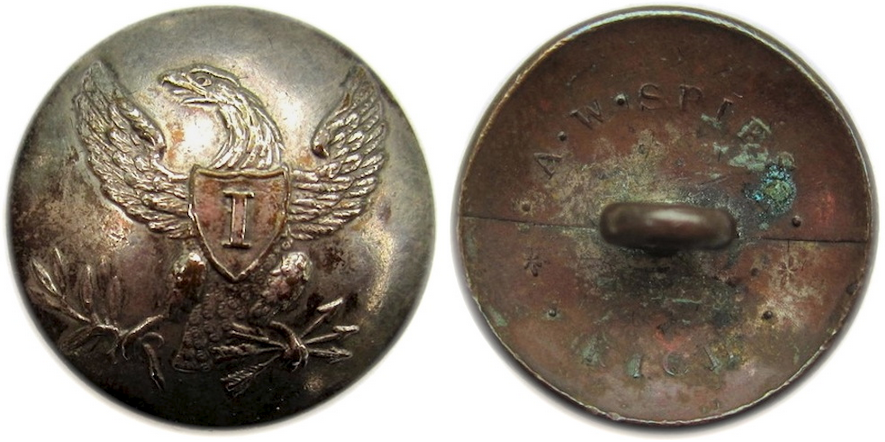
1821-40's Federal Infantry Officers
Color: A Silvery Copper.
Metal: 1-Piece, Low-Convex, Raised Design, Silver
Plated Copper.
Size: 20.6mm. Coat Size
Albert's Number: GI 79:
RV 5
Tice's Number: GI200B.3 / Tice PG 141 Back mark Book
Variation: Bent Stem Seven Petal Olive Branch /
Symmetrical Shield / Elongated Circular Tail Feathers / Tall
Thin Initial I.
Present Condition: A Non Excavated Example,
Exceptional Planchet Casting, Strong High Relief Pattern.
Isabela's Notes: The button's pattern depicts a
spread eagle facing right, with a
Bent Stem Seven Petal Olive Branch
in it's right talon. In it's left talon is a small bundle of
three Medium Spaced Arrows pointing unidirectional toward
the left. On the eagle's chest, there is a
Symmetrical Spade Shape Shield
with a raised outline edge border. Within the shield is a
Tall Thin Initial, "I"
for infantry. The high relief pattern is set on a plain
low-convex field with no edge border. This manufacturer's
notable difference is in the
Elongated Circular Tail
Feathers. This pattern has been dug around numerous Civil
War campsites. The A.W. Spies back mark for this particular
button dates to the early 1830's.
Reverse Button Analysis: This is a slightly concave
one-piece button with a loop shank. *.A.W.SPIES./RICH.* rm
The RJ. Silverstein Collection.
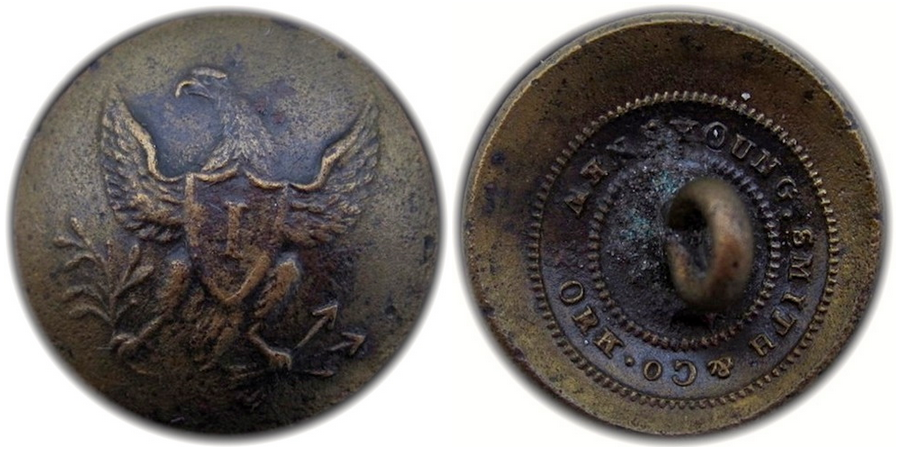
1821-30's Federal Infantry Officer's Button
Color: A Greenish-Coppery Brown.
Metal: 1-Piece, Convex, Raised Design, Brass.
Size: 20mm. Coat Size
Albert's Number: GI 79-C.1 B/M Unlisted Variant:
RV 5
Tice's Number: GI 200 B.5
Variation: Curved Stem Seven Petal & Two Olive, Olive
Branch / Three Wide Spaced Arrows / Long Narrow Pointed
Shield / Tall Thin I.
Present Condition: A Non Excavated Example,
Exceptional Planchet Casting, Strong High Relief Pattern.
Isabela's Notes: The button's pattern depicts a
spread eagle facing right, with right angled upraised wings.
In the eagle's right talon is a Curved Stem Seven Petal and
Two Olive Olive Branch. In it's left talon is a bundle of
Three Wide Spaced Arrows pointing unidirectional toward the
left. On the eagle's chest, there is a Long Narrow Pointed
Shield with a raised outline edge border. Within the shield
is a Tall Thin Initial, "I" for infantry. The high relief
pattern is set on a convex field with no edge border. This
manufacturer's notable difference is the style of eagle
depicted, and upraised wings right angle. This button would
be one of your earliest one-piece infantry buttons by Young
& Smith.
Reverse Button Analysis: This is a slightly concave
one-piece button with a loop shank. rm .YOUNG. SMITH & Co./
NEW YORK . within 2 inner rm dotted rings
RJ. Silverstein Collection.
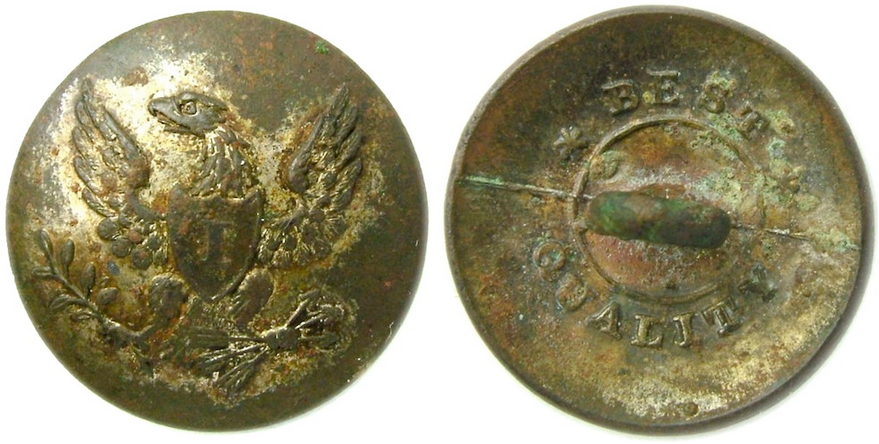
1821-40's Federal Infantry Officers
Color: An Ochre of Silver, Browns, Greens and
Oranges.
Metal: 1-Piece, Low-Convex, Raised Design, Silver
Plated Copper.
Size: 20mm. Coat Size
Albert's Number: GI 79: RV 5
Tice's Number: GI200C.2
Variation: Straight Stem Seven Petal Olive Branch /
Tightly Grouped Arrows / Raised Spade Shape Shield / Small
Initial I.
Present Condition: An Excavated Example, Strong
Planchet Casting, Good/Strong High Relief Pattern.
Isabela's Notes: The button's pattern depicts a
symmetrical spread eagle facing right, with a
Straight Stem Seven Petal Olive Branch in it's right talon. In it's left
talon is a small bundle of three
Tightly Grouped Arrows
pointing toward the left. On the eagle's chest, there is a
Raised Spade Shape Shield with a raised outline edge border.
Within the shield is a
Small Initial, "I" for infantry. The
high relief pattern is set on a plain low-convex field. This
manufacturer's notable difference is the style eagle used,
and the feathers depicted. This pattern has also been dug
around numerous Civil War campsites. The back mark of this
button indicates that it was manufactured by the English
during the 1820-30's.
Reverse Button Analysis: This is a slightly concave
one-piece button with a loop shank. * BEST QUALITY * rm
inner single ring.
Excavated by Chad Davis in Aldie, Virginia.~
Old Court House Civil War Museum.
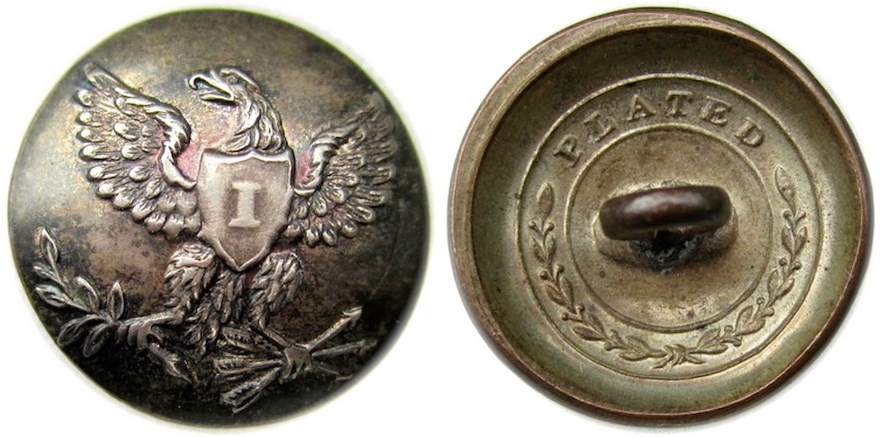
1821-40's Federal Infantry
Officer's Button
Color: A Silvered Kaki-Copper with Hints of Red.
Metal: 1-Piece, Convex, Raised Design, Silver Plated
Copper.
Size: 19.5mm. Coat Size
Albert's Number: GI 79: RV 5
Tice's Number: GI200D.3
Variation: Straight Stem Seven Petal Olive Branch /
Wide Spread Arrows / Slightly Slanted Elongated Shield /
Small Wide Initial I.
Present Condition: A Non Excavated Example,
Exceptional Planchet Casting, Exceptional High Relief
Pattern.
Isabela's Notes: The button's pattern depicts a
spread eagle facing right, with a
Straight Stem Seven Petal
Olive Branch in it's right talon. In the eagle's left talon
is a small bundle of three
Wide Spread Arrows pointing
unidirectional toward the left. On the eagle's chest, there
is a
Slightly Slanted Elongated Spade Shape Shield with a
raised outline edge border. Within the shield is a
Small
Wide Initial, "I" for infantry. The high relief pattern is
set on a convex field with no edge border. This
manufacturer's notable difference is the larger wing style,
and feathers depicted. The Plated Wreath back mark dates to
the early 1830's.
Reverse Button Analysis: This is a slightly concave
one-piece button with a loop shank. PLATED with WREATH
DESIGN in-between a rm rings.
The RJ. Silverstein Collection.
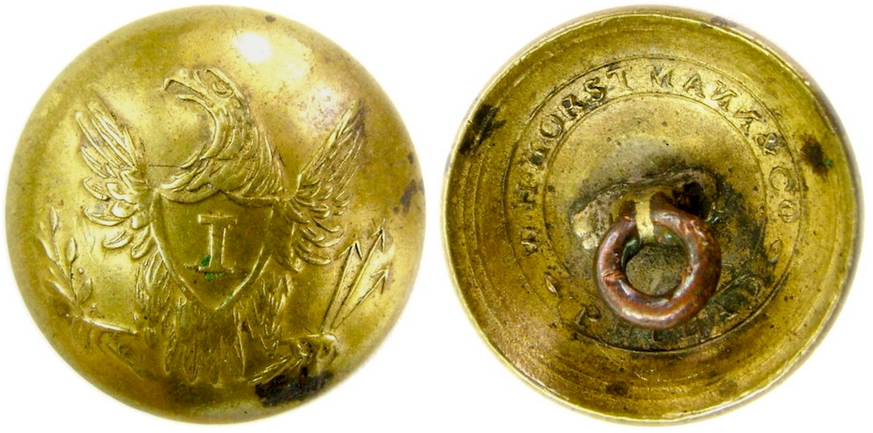
1830-40's Federal Infantry Button
Color: A Golden Brass.
Metal: 1-Piece, Convex, Raised Design, Plated Brass.
Size: 20mm. Coat Size
Albert's Number: GI 79: RV 5
Tice's Number: GI200E
Variation: Small Spread Eagle / Straight Stem Six
Petal & Three Olive, Olive Branch / Tightly Grouped Upward
Pointing Arrows / Small Wide Shield.
Present Condition: A Non Excavated Example,
Exceptional Planchet Casting, Exceptional High Relief
Pattern.
Isabela's Notes: The button's pattern depicts a Small
Spread Eagle facing right, with a Straight Stem Six Petal
and Three Olive, Olive Branch in it's right talon. In the
eagle's left talon is a small bundle of three
Tight Grouped
Upward Pointing Arrows. On the eagle's chest, there is a
Small Wide Spade Shape Shield with a raised outline edge
border. Within the shield is a tall thin initial, "I" for
infantry. The high relief pattern is set on a convex field
with no edge border. This manufacturer's notable difference
is in the smaller style eagle with short wings. The Horstman
& Co back mark for this button dates to the early 1830's.
Reverse Button Analysis: This is a concave one-piece
button with a copper loop shank. The shank is original and
intact, but slightly bent over. rm HORSTMANN&Co PHILD
in-between 2 rm rings
The RJ. Silverstein Collection.
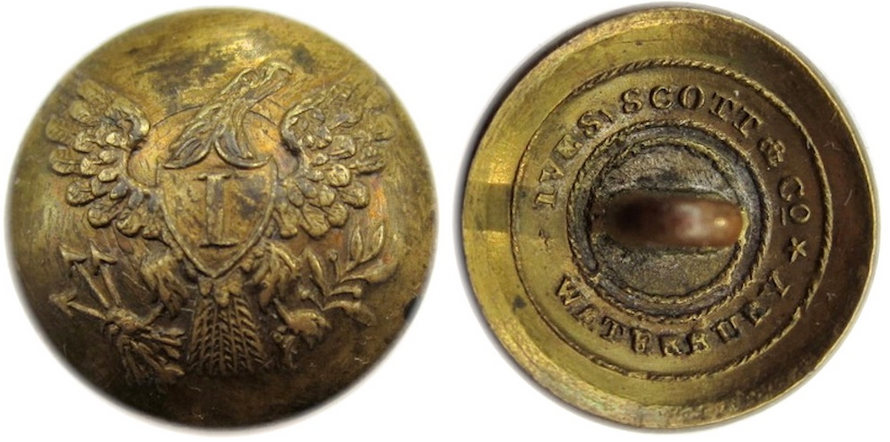
1835 Federal Infantry Button
Color: A Light Warm Brown.
Metal: 1-Piece, Low-Convex, Raised Design, Gilded
Brass.
Size: 18.5mm. Coat Size
Albert's Number: GI 80-A.1: RV 5
Tice's Number: GI203A.1
Variation: Eagle Facing Left / Hook Stem Five Petal &Three
Olive Olive Branch / Upward Pointing Arrows/Tall
Thin Initial I.
Present Condition: A Non Excavated Example,
Exceptional Planchet Casting, Exceptional High Relief
Pattern.
Isabela's Notes: There are two slightly different
face dies for this pattern. Unlike the other Infantry
buttons in the series, this specimen shows the pattern
depicted in an opposite direction. The button's pattern
depicts a symmetrical spread
Eagle Facing Left instead of
right. In the eagles left talon is
Hook Stem Five Petal and
Three Olive, Olive Branch. In the eagle's right talon, is a
small bundle of three unidirectional Upward Pointing Arrows.
On the eagle's chest, there is a
Wide Birth Spade Shape
Shield, with a raised outline edge border. Within the shield
is a
Tall Thin Initial, "I" for infantry. The high relief
pattern is set on a low-convex plain field with no edge
border. This manufacturer's notable difference in this
variation is the opposite direction of the pattern, and the
style eagle depicted. Not that it is extremely rare, but I
found this particular one-piece button a lot harder to come
by then Albert's rating allowance.
Reverse Button Analysis: This is a concave one-piece
button with a copper loop shank. The shank is original,
straight, and intact. * IVES,SCOTT & CO */ WATERBURY rm
The RJ Silverstein Collection.
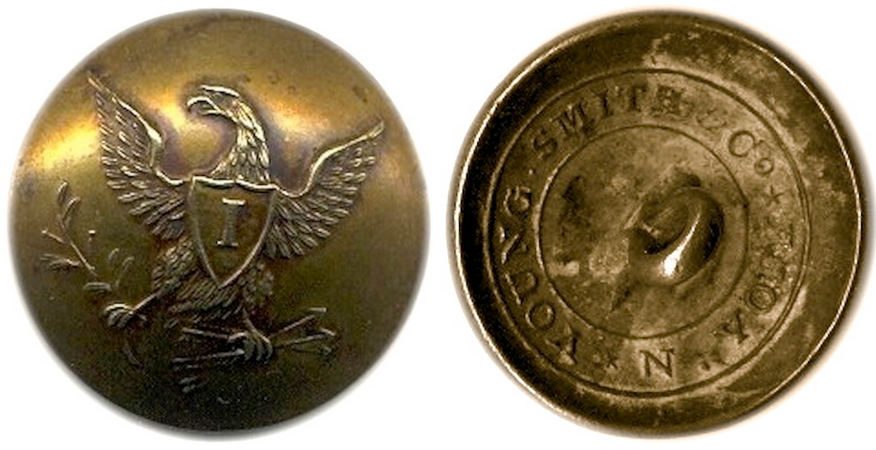
1830-40's Federal Infantry Officer's Button
Color: Tarnished Coppery Brown.
Metal: 1-Piece, Convex, Raised Design, Plated.
Size: 20mm. Coat Size
Albert's Number: GI 79-C.1: RV 5
Tice's Number: GI200.B Unlisted Back mark Variant of
Young & Smith
Variation: 7 Petal & Two Olive, Olive Branch /
Three Tightly Grouped Arrows / Long Narrow Pointed Shield /
Tall Thin I.
Present Condition: A Non Excavated Example,
Exceptional Planchet Casting, Strong High Relief Pattern.
Isabela's Notes: The button's pattern depicts a
spread eagle facing right, with a
Straight Stem Seven Petal and Two Olive Olive Branch
in it's right talon. In it's left talon is a small bundle of
Three Tightly Grouped Arrows
pointing left. On the eagle's chest, there is a
Long Narrow
Pointed Shield
with a raised outline edge border. Within the
shield is a
Tall Thin Initial, "I"
for infantry. The high
relief pattern is set on a convex field with no edge border.
This manufacturer's notable difference is the slim style
eagle depicted. This button would be one of your earlier
one-piece infantry buttons by Young & Smith.
Reverse Button Analysis: This is a slightly concave
one-piece button with a loop shank. rm *YOUNG.SMITH & Co./N.YORK
* with 2 inner rm rings.
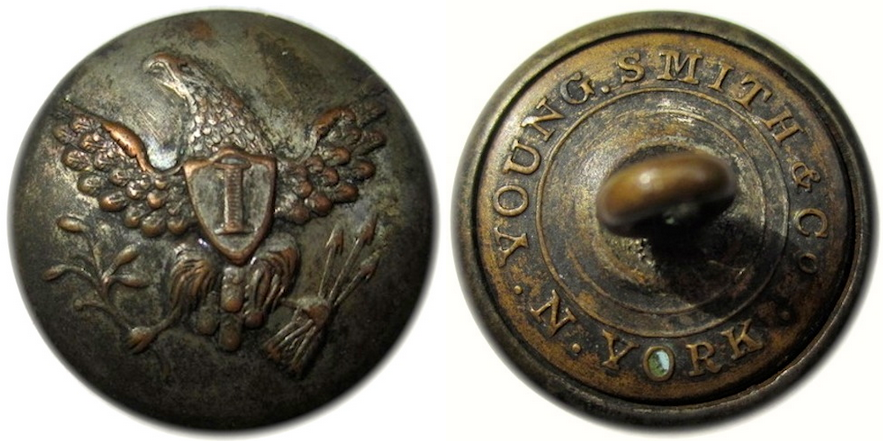
1830-40's Federal Infantry Officer's Button
Color: A Silvered Kaki Copper.
Metal: 2-Piece, Low-Convex, Raised Design, Silver
Plated Copper.
Size: 20mm. Coat Size
Albert's Number: GI 82: RV 3
Tice's Number: GI206.C Unlisted Back mark Variant of
Young & Smith
Variation: Crude Style Budding Olive Branch / Three
Close Spaced Arrows / Raised Shield with a large Roman style
Lined I.
Present Condition: A Non Excavated Example,
Exceptional Planchet Casting, Strong High Relief Pattern.
Isabela's Notes: This button would be one of your
earliest manufactured two-piece constructed buttons for
infantry officers. This is an example of how Young & Smith
utilized the same dies from the earlier one piece buttons.
This button's pattern depicts a spread eagle facing right,
with a
Crude Style Budding Olive Branch
in it's right talon.
In it's left talon is a small bundle of
Three Close Spaced
Arrows
pointing upward and to the left. On the eagle's chest
is a
Raised Shield with a Large Roman style Lined, "I"
on
top of the shield. As noted, the top and bottom line edges
of "I" touches the shield's inner perimeter outline. The
high relief pattern is set on a plain low-convex field with
no edge border. This manufacturer's notable difference is
the thick neck and head line of the eagle depicted. The
Young & Smith back mark on this example dates to the early
1830's.
Reverse Button Analysis: This is a slightly concave
one-piece button with a loop shank. .YOUNG.SMITH & Co./N.YORK.
rm with 2 inner rings rm.
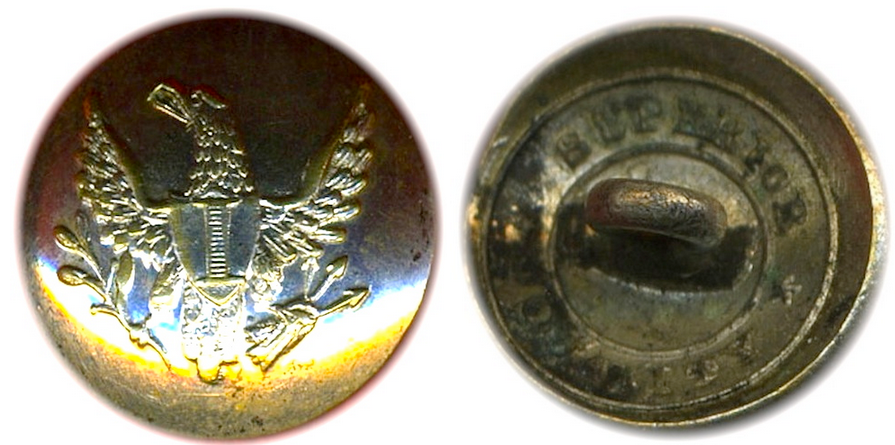
1821-36 Federal Infantry Officer's Epaulettes
Color: A Polished Silvered.
Metal: 1-Piece, Low-Convex, Raised Design, Silver
Plated Copper.
Size: 14mm. Cuff Size
Albert's Number: GI 79-Unlisted Variant: RV 5
Tice's Number: Similar to GI200Fs -Unlisted Variant
Variation: Crude Style Budding Olive Branch / Crude
Style Unidirectional Arrows / Raised Shield with Roman Style
I.
Present Condition: A Non Excavated Example,
Exceptional Planchet Casting, Exceptional High Relief
Pattern.
Isabela's Notes: These smaller size buttons were
usually used as officer's Epaulettes. This button's pattern
is extremely similar to GI206/Albert's GI82, but is a one
piece, not two. This particular die variant could be a
transitional button with the introduction of new two-piece
construction in late 20's. This obverse pattern is found on
a two piece example. This button's pattern depicts a spread
eagle facing right, with a small
Crude Style Budding Olive
Branch
in it's right talon. In it's left talon is a small
bundle of three
Crude Style Unidirectional Arrows
pointing
up and to the left. On the eagle's chest is a Raised Shield
with a
Large Roman style Lined, "I"
on top of the shield. As
noted, the top and bottom line edges of "I" touches the
shield's outside outline. The high relief pattern is set on
a plain low-convex field with no edge border. This
manufacturer's notable difference is in the crude style
arrows and olive branch depicted.
Reverse Button Analysis: This is a slightly concave
one-piece button, with a loop shank. Back mark: rm SUPERIOR
* QUALITY* within 2 rm rings.
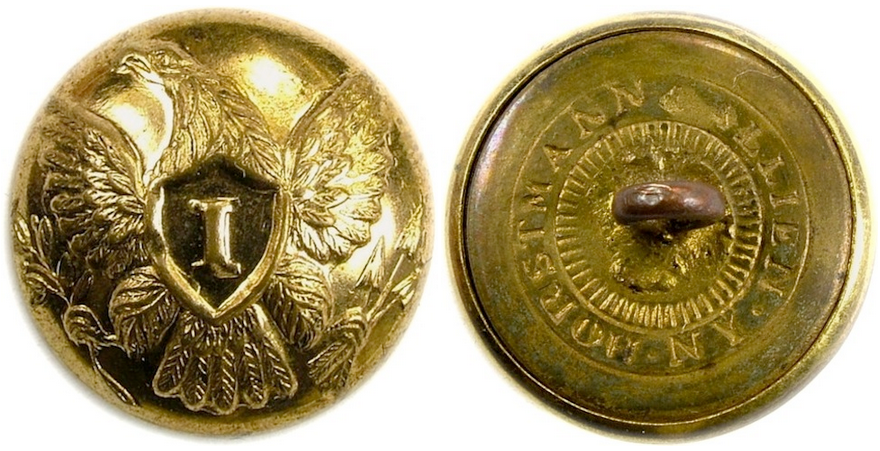
1845-65 Federal Infantry
Color: A Golden Brass.
Metal: 2-Piece, High-Convex, Raised Design, Brass.
Size: 20.8mm. Coat Size
Albert's Number: GI 85 or GI 88: RV 2
Tice's Number: GI215A.39
Variation: Curved Stem Seven Petal Olive Branch /
Deeply Recessed Spade Shape Shield / Small Raised Initial I
Present Condition: A Non Excavated Example,
Exceptional Planchet Casting, Exceptional High Relief
Pattern.
Isabela's Notes: They manufactured this particular
pattern up until 1875, but this particular back mark
indicates that it was made prior to 1865. During the Civil
War, Federal Infantry troops used this particular style with
the deep recessed shield frequently. The button's pattern
depicts a symmetrical spread eagle facing right, with a
Curved Stem Seven Petals and Two
Olive, Olive Branch in
it's right talon. In it's left talon is a small bundle of
three
Close Space Arrows
unidirectional pointing up and
toward the left. On the eagle's chest, is a
Deeply Recessed
Spade Shape Shield. Within the shield is a
Small Raised
Initial, "I" for infantry. The high relief pattern is set on
a high-convex field with no edge border. This manufacturer's
notable difference is the symmetrical style eagle depicted
with the exceptional design detail.
Reverse Button Analysis: This is a one-piece concave
button with a copper loop shank. rm HORSTMANN&Co PHILD
in-between 2 rm rings
The RJ. Silverstein Collection.
BACK - TOP
|

