|
U. S.
Artillery Buttons
1798-1860's
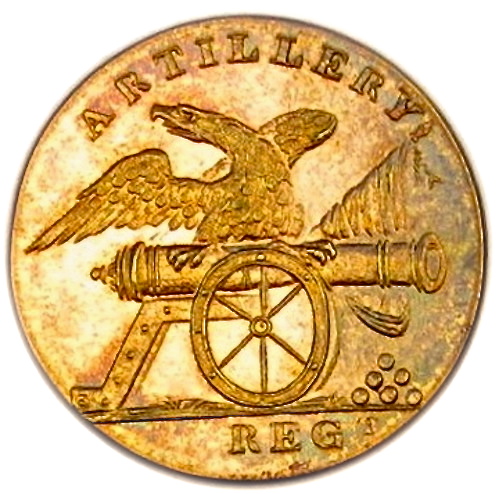
1808-11 Federal Artillery Regiment
In the beginning, the United States
field artillery branch of the armed services was known
as, "The Regiment of Artillery". It was founded under Colonel
Henry Knox. Knox was unanimously elected by the Continental
Congress on November 17, 1775, and on January 1, 1776, a
Regiment of Artillery formally entered service. Their
official mission statement was to destroy, neutralize, or
suppress the enemy by cannons. After the Revolutionary War,
the Continental Army along with it's Artillery units were
disbanded for the most part due to various reasons. In 1789,
after George Washington took office as the first President
of the United States, there was only one battalion which
consisted of four companies of Artillerists. However, after
his second inauguration in 1794, the
Corps of Artillerists and Engineers
was officially organized. This included the existing four
companies of Artillerists, and sixteen new companies divided
over four battalions. Then in 1802 under Thomas Jefferson's
administration, there was a reduction of the standing Army,
the Engineers were separated from the Artillery, and was
transposed into one regiment of 20 companies. In 1808, with
the fear of a foreign war, Jefferson added a regiment of ten
companies called "Light
Artillery". This was done
during the last year of his administration. In 1812, James
Madison added two more regiments to this. The real need
arouse for Artillery Units during the War of 1812. This is
where Federal Artillerists became the most active. They were
issued flat 1-piece buttons that came sewn on their
uniforms. Most of these buttons were manufactured prior to
their use in the war, but limited manufacturing continued up
until 1820.
Robert's Notes: Since the development of the cannon,
the word "Artillery" in practice usually meant
reference to the use of cannons. During the middle ages, and
the early modern period, artillery cannons on the
battlefield were positioned and moved with the assistance of
horse drawn teams.
There is a common misconception about the
use of Mortars by Artillerists. Mortars are not field
Artillery weapons as one might think, they are organic to infantry units, and
they are used by infantry personnel.
Antebellum: is a 19th Century Latin word that is defined as
either occurring, or existing before a particular war: Ante-
before, vellum-war. A lot of collectors like to use the
terminology when referencing their Pre-Civil War buttons.
"I agree with you Deb, if the button is dug you know it
carries the imbedded spirit of the person, place, and battle
within it's metal. When you first brush the
encrusted dirt from the obverse, you can feel the
electricity of excitement flow through the blood in your
veins. Your thoughts briefly wander to the
brave soldier who came to fight on this soil. You
know in this soldier's heart he took a brave stand for his
ideals and principles, and he fought for what he believed in. So behold your dug military trophy in reverence,
its the American Treasure Hunter's dream." -
Robert.
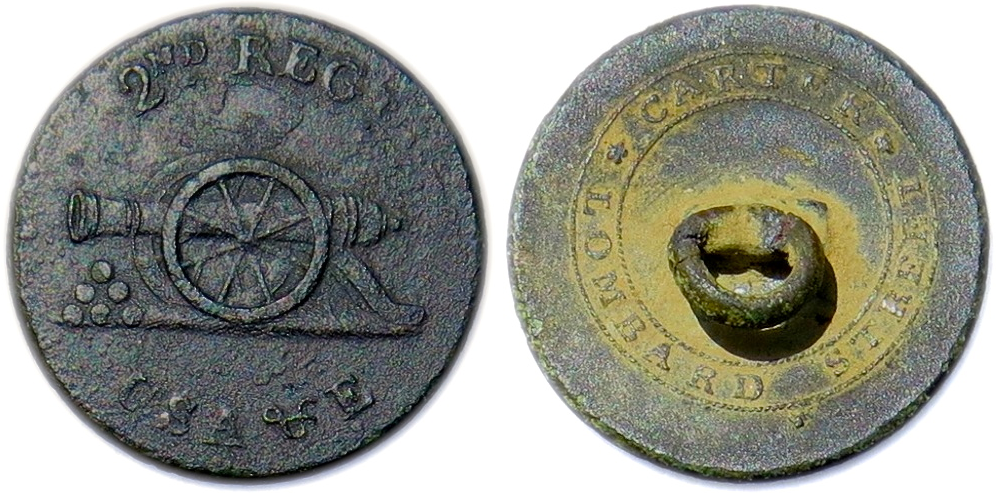
1799-1802 Artillerists & Engineers
2nd Regiment
Color: A Golden Pewter.
Metal: Flat, 1-Piece, Raised Design, Gilded Brass.
Size: 22mm. Coat Size
Albert's Number: AY 09: RV: 65
Tice's Number: AEO41
Variation: Ringed Cannon with a Large Breech / Six
Cannon Balls / 2nd REGt./
US
/ A
& E.
Present Condition: An Excavated Example, Good
Planchet Casting, Good High Relief Relief.
Isabela's Notes: The Regiment of Artillerist and
Engineers was originally organized on April 27, 1798. These
new regiments would consist of three battalions, and each
would have three companies within. On March 2, 1799, an
additional battalion was added, and on Mach 3, 1799 the
regiment was designated as the Second Regiment of
Artillerists and Engineers. The button's pattern depicts a
Ringed Cannon with a Large Breech sitting on a field
pointing right. Under the cannon's muzzle is a stack of
Six
Cannon Balls in a pyramidal shape. Above is the regiment
designation,
"2nd REGt." and below is the country's initials,
"US" and military units designation initials, "A & E" in all capital
letters. The high relief pattern is set on a plain flat
field. Specimens rarely surface on the market, and when they
do they usually demand a hefty premium.
Reverse Button Analysis: This is a flat one-piece
button with a loop shank. The shank is original and intact,
but bent inward. *CARTER*/LOMBARD STREET rm within a channel
of a rope rm rings.
Dug in Upstate New Hampshire.~
The RJ. Silverstein Collection.
Robert's Notes: On April 1, 1802, the
first and second regiment of Artillerists and Engineers
changed it's official designation to just the Regiment of
Artillerists. With this new re-designation came a new style
of button. From 1802-1808, the 1st Regiment of Artillery
would use a device depicting an eagle standing on a cannon
with a variety of military objects in the background. The
1st Regt. would be inscribed below.
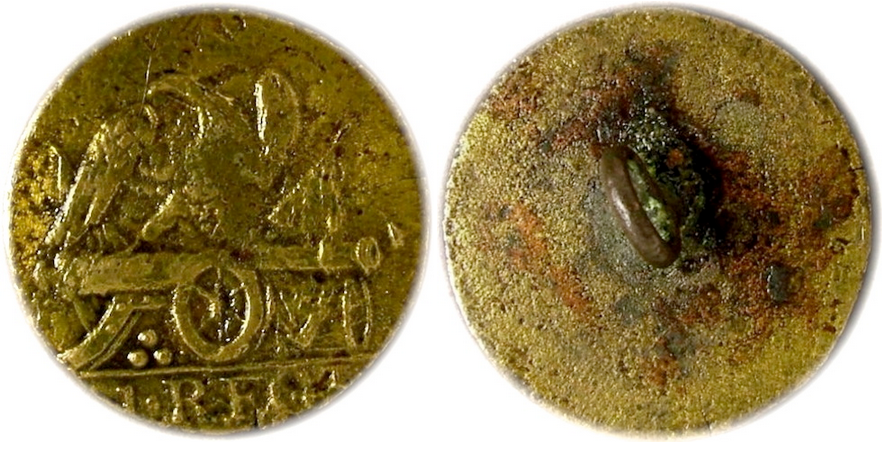
1802-1808 Artillery, 1st Regiment
Color: A Golden Brass Yellow.
Metal: Flat, 1-Piece, Raised Design, Gilded Brass.
Size: 20.5mm. Coat Size
Albert's Number: AY 15: RV 25
Variation: Draped Flag Behind the Cannon / Drum Lying
Sideways / 3 Cannon Balls / 1st Regt.
Present Condition: An Excavated Example, Good
Planchet Casting, Good High Relief Relief.
Isabela's Notes: From 1802 to 1811, the 1st Regiment
of Artillerist used a number of pattern variations depicting
an eagle standing on a cannon with various military objects
in the background. This early button depicts an eagle facing
right, while standing on a cannon with a ribbed breech
pointing to the left. On the left, there is a
Draped Flag
Behind the Cannon,
as well as a
Drum Lying Sideways
on the ground. On the right, there are
3 Cannon Balls
piled under
the carriage. The cannon's carriage only extends to the back
of the oval wheel, with six spokes. In the bottom legend,
the abbreviation for
1st Regiment, "1 . REGt."
is in Arabic numerals and Roman Font capital letters. The
high relief pattern is set on a plain flat field. Even
though issued earlier, this button was most likely used
during the War of 1812. This style pattern will be adopted
and issued in different variations for many years to come.
Reverse Button Analysis: This is a flat one-piece
button with a loop shank. This is a replacement shank, but
appears to be straight and intact No back mark.
Excavated in the Gulf Coast Vicinity of Mobil Alabama.~
Picture Courtesy of Harry Ridgeway.
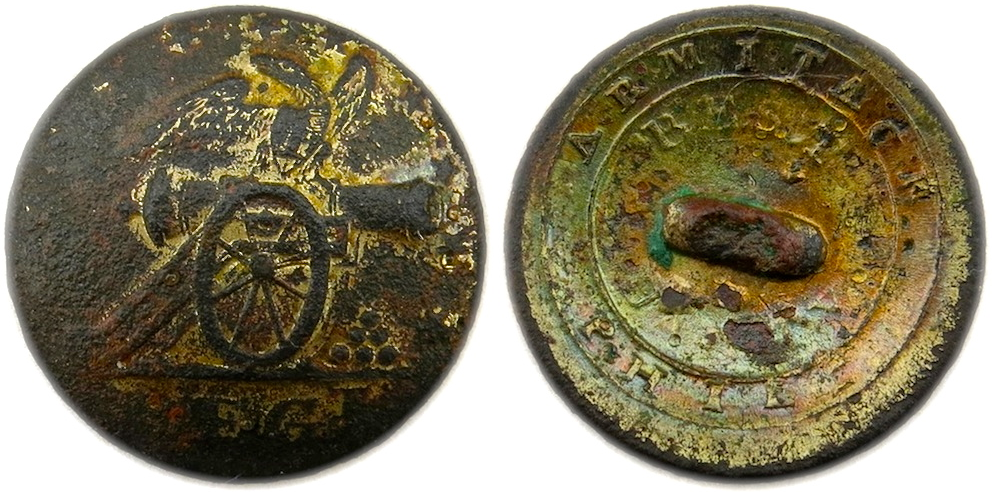
1802-1808
Artillery, 1st
Regiment
Color: Gilded
Brown.
Metal: Slightly
Convex, 1-Piece,
Raised Design, Gilt
Brass.
Size: 21.43mm.
Coat Button.
Albert's Number:
AY 17:
RV 50
Variation: Slanted
Federal Shield /
Ringed Cannon with A
Large Muzzle /
Carriage Wheel is
Oval with Eight
Spokes / Six Cannon
Balls / Eleven
Five Pointed Stars.
Present
Condition: An
Excavated
Example, Good
Planchet
Casting, Good
High Relief
Pattern.
Isabela's Notes: Very
tough button to
find for
collectors.
Armitage most
likely produced
these for
officers.
Collectors
should note the
star pattern
only circles
around the eagle
and cannon, and
does not circle
around the
entire button
edge. The
button's pattern
depicts an Eagle
Facing Right with
upraised wings.
On the eagle's
chest is a Slanted
Federal Shield with
the Regiment's
number, "1" set
on a lined
field. The eagle
is standing on a Short
Length Ringed
Cannon with a
Large Muzzle that
points to the
left. The
cannon's
carriage extends
past the
carriage's
wheel. There
are five
decorative
carriage bolts
illustrated in
the footing. The Carriage's
Wheel is Oval
Shaped with
Eight Spokes.
These are no decorative
lug nuts
depicted on the
wheel. Under the
cannon's muzzle
is Six
Cannon Balls in
a Pyramidal
Shape on
the ground. In
the bottom
legend, the
abbreviation for
Regiment, "REGt."
in Roman font
capital letters.
In a semi-circle
around the eagle
and cannon is Eleven
Five Pointed
Stars.
The high relief
pattern is set
on a plain
slightly convex
field with no
raised edge. I
think collectors
should obtain
any example they
can when one
comes available.
I only know
about two that
have ever
surfaced to
market.
Reverse Button
Analysis: This
is a slightly
concave
one-piece button
with a loop
shank. The shank
is unfortunately
missing.
ARMITAGE PHILa
within a 2
ringed rm
channel/ BEST
QUALITY rm
The RJ.
Silverstein
Collection.
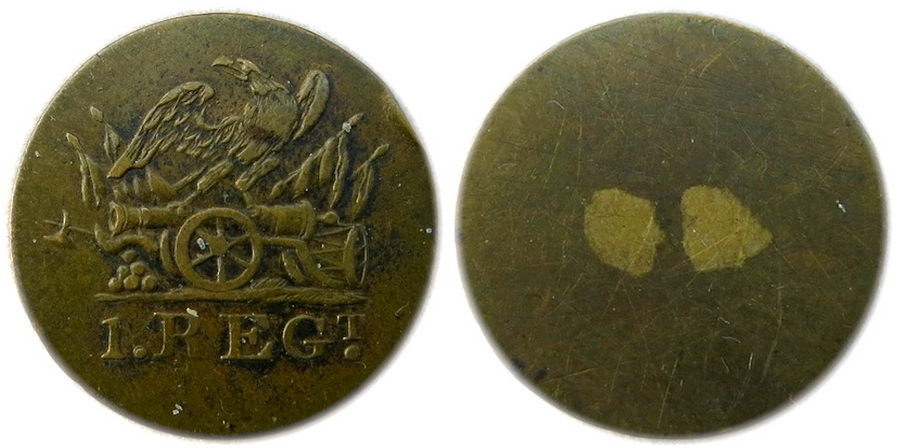
1802-1808 Artillery, 1st Regiment
Color: Antique Brass with Brown Spots.
Metal: Flat, 1-Piece, Raised Design, Brass.
Size: 20.67mm. Coat Size
Albert's Number: Similar to AY 20-A: RV 25
Variation: Two Draped Flags, a Battle Axe, and Six
Cannon Balls / Two Draped Flags, and a Drum Lying Sideways /
Round Wheel Six Spokes.
Present Condition: An Excavated Example, Exceptional
Planchet Casting, Exceptional High Relief Pattern.
Isabela's Notes: There are two known die variants
for this pattern. One has a round wheel with six pokes, and
one has an oval wheel with an extra cannon ball at the base. This button's pattern depicts an eagle
that is facing right, while standing on a ringed cannon that
also points to the right. On the right hand side, there are
Two Draped Flags, a Battle Axe, and Six Cannon Balls
stacked in a pyramidal shape on the ground. On the left hand
side, there are another Two
Draped Flags, and a Drum Lying Sideways.
The cannon's carriage extends to the back of a
Round Wheel with Six Spokes. In the bottom legend, the
abbreviation for 1st Regiment, "1 . REGt." is in Arabic
numerals and Roman Font capital letters. The high relief
pattern is set on a plain flat field with a plain edge.
Reverse Button Analysis: This is a flat one-piece
button with a loop shank. The shank is original, straight,
and intact. ARMITAGE PHIL.
The RJ. Silverstein Collection.
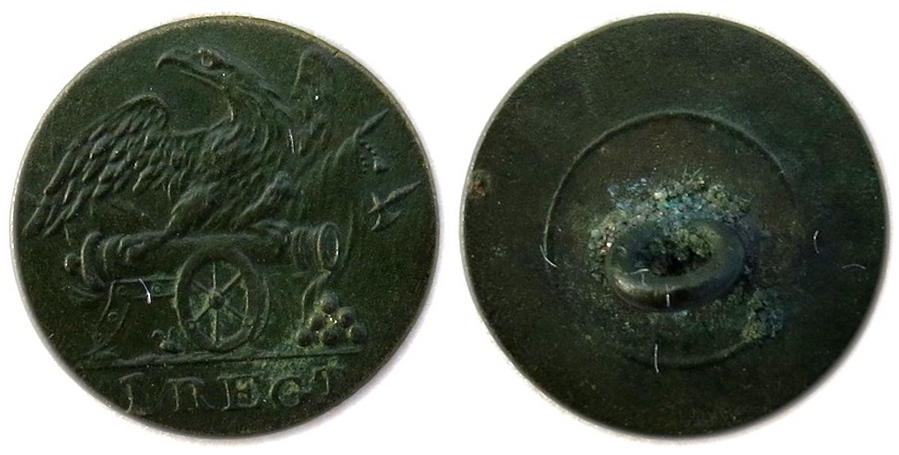
1802-1808 Artillery, 1st Regiment
Color: Seaweed Green.
Metal: Flat, 1-Piece, Raised Design, Brass.
Size: 14.02mm. Cuff or Vest Button.
Albert's Number: AY 24-Av: RV 25
Variation: Ringed Short Length Cannon / Draped Flag,
a Battle Axe, and Six Cannon Balls / Oval Wheel with Six
Spokes / 1st Regt.
Present Condition: An Excavated Example, Strong
Planchet Casting, Good High Relief Pattern.
Isabela's Notes: The button's pattern depicts an
eagle facing right, while standing on a
Ringed Short Length Cannon
that points to the left. On the right hand side, there is a
draped flag. On the left side there is a
Draped
Flag, a Battle Axe, and Six Cannon Balls
stacked in a
pyramidal shape on the ground. The cannon's carriage only
extends to the back of the carriages wheel. There are 4 or 5
decorative carriage bolts illustrated. The carriage has an
Oval Wheel with Six Spokes; with 6 decorative lug nuts. In
the bottom legend, the abbreviation for
1st Regiment, "1 . REGt." has a large Arabic numeral that is set next to
smaller Roman Font capital letters. The high relief pattern
is set on a plain flat field with a plain edge.
Reverse Button Analysis: This is a flat one-piece
button with a loop shank. The shank is original, and intact,
but crushed inward. Blank back mark.
The RJ. Silverstein Collection.
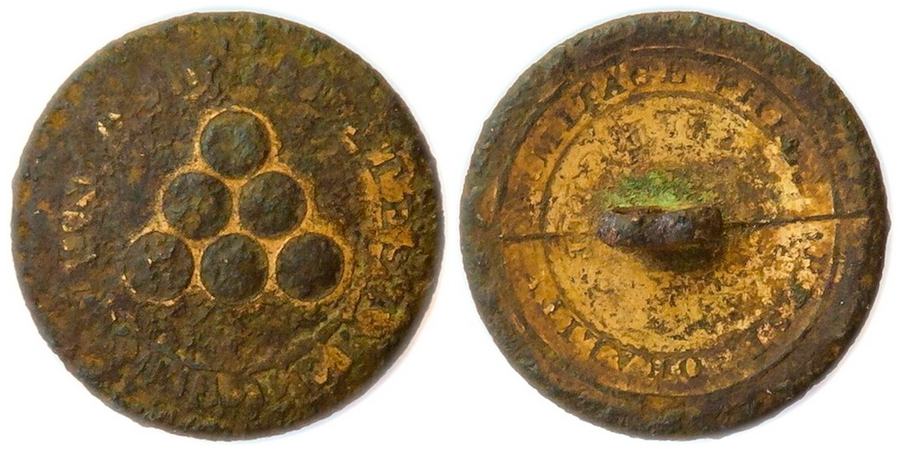
1808 Artillery, 2nd Regiment
Color: Rusty Brown with Gilt Highlights.
Metal: 1-Piece, Slightly Convex, Raised Design, Gilt
Brass.
Size: 23.22mm. Coat Size
Albert's Number: AY 30: RV 100
Variation: Six Cannon Balls / United States Artillery
/ Manufacturer Re-strike Reverse.
Present Condition: An Excavated Example, Strong
Planchet Casting, Good High Relief Pattern.
Isabela's Notes: The button's pattern depicts
Six Cannon Balls
stacked in a pyramidal shape in the center. Circling around the
cannon balls is the country's name and military designation,
"UNITED STATE ARTILLERY". The high relief pattern is set on a
plain field that is slightly convex. Armitage only made 300 of these
as samples for the Army, but never was contracted to produce this
specific pattern. Some of the samples made show a re-strike
of the manufacturer's name on the reverse. With the shortage
of materials during the 1812 War, a few of the samples got released,
or issued possibly as replacement buttons, and were used by
some Artillery soldiers during the 1812-15 war.
Very few of these Specimens Exist,
and so far, all have been found in 1812 encampments in New
York and New Jersey. Collectors must take the opportunity
and purchase any specimen that comes to market. I believe
there to be under 8 known, I only know of 3, and only "one
with re-strike reverse".
Reverse Button Analysis: This is a slightly concave
one-piece button with a loop shank. The shank is original,
straight, and intact, but slightly crushed inward. ARMITAGE PHIL./BEST QUALITY inside a
channel 2 rm ring. Mold Line.
Dug in an 1812 War Encampment in East Greenwich, New Jersey.
The RJ. Silverstein Collection.
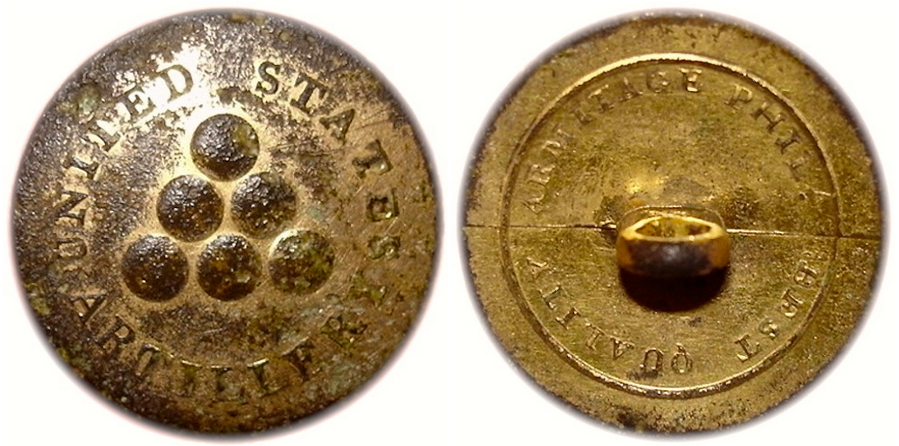
1808 Artillery, 2nd Regiment
Color: Golden Brown.
Metal: 1-Piece, Slightly Convex, Raised Design, Gilt
Brass.
Size: 23.mm. Coat Size
Albert's Number: AY 30: RV 100
Variation: Six Cannon Balls / United States Artillery
Present Condition: An Excavated Example, Strong
Planchet Casting, Strong High Relief Pattern.
Isabela's Notes: The button's pattern depicts
Six Cannon Balls
stacked in a pyramidal shape in the center. Circling around the
cannon balls is the country's name and military designation,
"UNITED STATE ARTILLERY". The high relief pattern is set on a
plain field that is slightly convex. Armitage only made 300 of these
as samples for the Army, but never was contracted to produce this
specific pattern. Some of the samples made show a re-strike
of the manufacturer's name on the reverse. With the shortage
of materials during the 1812 War, a few of the samples got released,
or issued possibly as replacement buttons, and were used by
some Artillery soldiers during the 1812-15 war.
Very few of these Specimens Exist,
and so far, all have been found in 1812 encampments in New
York and New Jersey. Collectors must take the opportunity
and purchase any specimen that comes to market. I believe
there to be under 8 known, I only know of 3, and only one
with re-strike reverse.
Reverse Button Analysis: This is a slightly concave
one-piece button with a loop shank. The shank is original,
straight, and intact. ARMITAGE PHIL./BEST QUALITY inside a
rm ring. Mold Line.
Excavated in New York in 2010
Robert's Notes: In 1811-13 a new
Foliated Pattern emerged just using the initials, "RA" for
Regiment of Artillerists. This new pattern was used along
with the eagle standing on the cannon throughout the War of
1812. The newly formed 3rd Regiment of Artillerist used the
original motif of an eagle standing on a cannon, but was
modified with an "A" emblazoned on the eagle's chest and the
cannon was turned around to point toward the left.
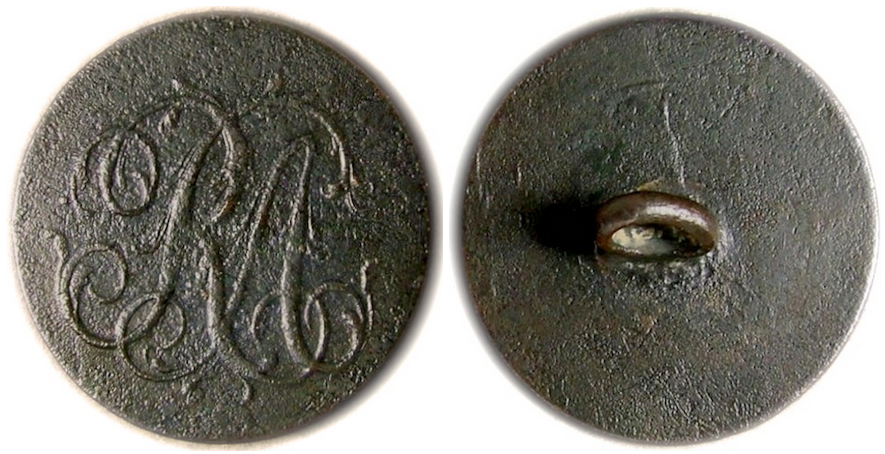
1811-1813 1st Regiment of Artillerists
Color: A Pewter Grey.
Metal: Flat, 1-Piece, Raised Design, Gilded Brass.
Size: 22mm. Coat Size
Albert's Number: AY 32: RV 25-35
Variation: 1st Regiment of Artillerists / Foliated
Intertwined Script Letters.
Present Condition: An Excavated Example, Strong
Planchet Casting, Strong High Relief Pattern.
Isabela's Notes: There is more then one die
variant known, with a slight differences in the foliated
letters. This button was specifically
manufactured for the 1st Regiment of Artillerists. The
button's pattern shows the Regiment of Artillerists
initials, "RA" with
Foliated Intertwined Script Letters. The
high relief pattern is set on a plain flat field with a
plain edge. For the1st Regiment, there is no designation number
in the pattern's design because it is automatically assumed
to be the
first. These buttons are usually found in dug condition
without shanks. It is very rare to see one offered in un-dug
condition.
Reverse Button Analysis: This is a flat one-piece
button, with a loop shank. The shank is original, straight,
and intact.
Excavated on the Gulf Coast near Mobile Alabama.
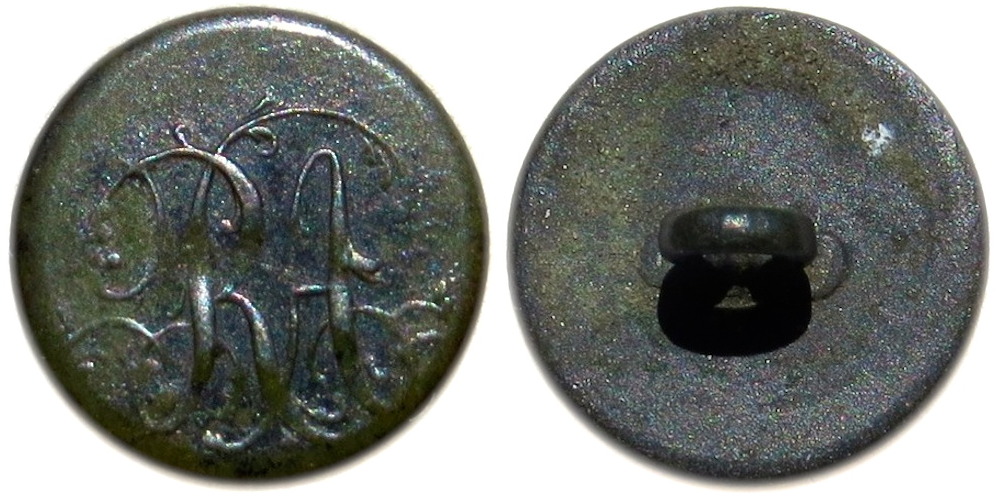
1811-1813 1st Regiment of
Artillerists
Color: A Forest Green with Dark Blue Undertones.
Metal: Flat, 1-Piece, Raised Design, Brass.
Size: 14.63mm. Cuff Size
Albert's Number: AY 32: RV 35
Variation: 1st Regiment of Artillerists / Foliated
Intertwined Script Letters / Foliated Arrow Pointing Right.
Present Condition: An Excavated Example, Strong
Planchet Casting, Exceptional High Relief Pattern.
Isabela's Notes: This cuff button was
manufactured for the
1st Regiment of Artillerists.
This is a slightly different die variant then the coat size
pattern. The
foliated swirls are more foliated, and the swirl is slightly
different. The button's pattern shows the Regiment of
Artillerists initials, "RA" with
Foliated Intertwined Script
Letters. Slightly above the letter, "A" is a
Foliated Arrow
Pointing Right. The high relief pattern is set on a plain
field with no edge border. Most likely fashioned to
accompany the larger coat size button. Collectors seek the
rarer specimens with shanks.
Reverse Button Analysis: This is a flat one-piece
button, with a loop shank. The shank is original, straight,
and intact.
Dug
at a Fort Site in Florida.~
The RJ Silverstein Collection.
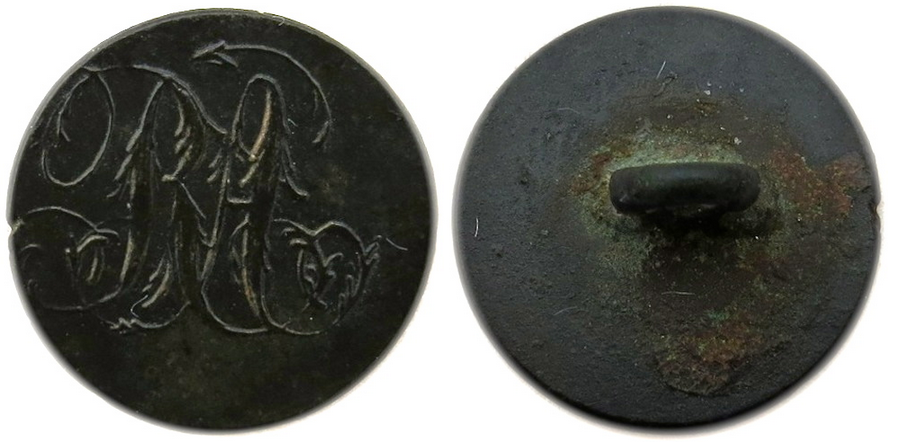
1811-1813 1st Regiment of
Artillerists
Color: A Dark Green with Yellow Undertones.
Metal: Flat, 1-Piece, Raised Design, Brass.
Size: 14.73mm. Cuff Size
Albert's Number: Unlisted Size Die Variant
Similar to AY 32: RV 35
Variation: 1st Regiment of Artillerists / Foliated
Intertwined Script Letters / Foliated Arrow Pointing Right.
Present Condition: An Excavated Example, Strong
Planchet Casting, Exceptional High Relief Pattern.
Isabela's Notes: This cuff button was
manufactured for the
1st Regiment of Artillerists.
This is a slightly different die variant then the coat size
pattern. The
foliated swirls are more foliated, and the swirl is slightly
different. The button's pattern shows the Regiment of
Artillerists initials, "RA" with
Foliated Intertwined Script
Letters. Slightly above the letter, "A" is a
Foliated Arrow
Pointing Right. The high relief pattern is set on a plain
field with no edge border. Most likely fashioned to
accompany the larger coat size button. Collectors seek the
rarer specimens with shanks.
Reverse Button Analysis: This is a flat one-piece
button, with a loop shank. The shank is original, straight,
and intact.
Dug
by J.B. in Fernandina Florida.~
The RJ Silverstein Collection.
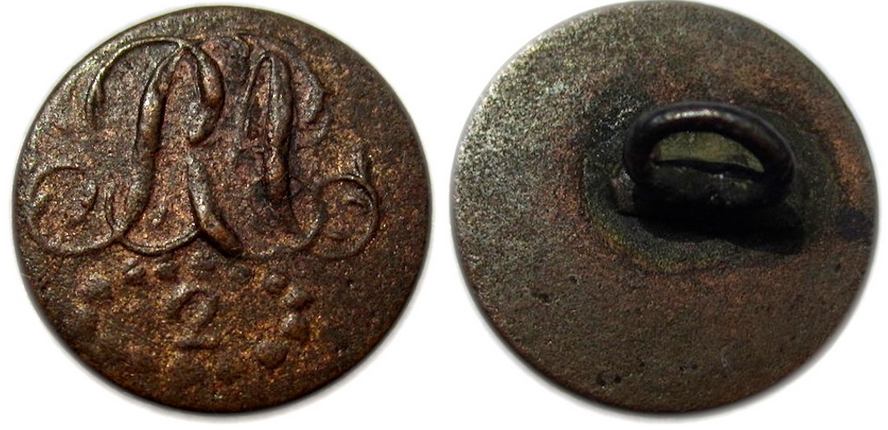
1811-1813 2nd Regiment of Artillerists
Color: A Charred Brown with Coppery Orange
Highlights.
Metal: Flat, 1-Piece, Raised Design, Brass.
Size: 14.65 mm. Cuff Size
Albert's Number: AY 33A: RV 25 in 20mm
Variation: 2nd Regiment of Artillerists / Arrows
Pointing Right / Arabic Number, "2"
Present Condition: An Excavated Example, Good
Planchet Casting, Good High Relief Pattern.
Isabela's Notes: This button was specifically
manufactured for the
2nd Regiment of Artillerists. The
button's pattern shows the Regiment of Artillerists
initials, "RA" with Foliated Intertwined Script Letters
above an oval circle made of
Arrows Pointing Right. Within
the oval is the
Arabic Number, "2"
for the regiment's
designation. The high relief pattern is set on a plain flat
field with a plain edge.
Reverse Button Analysis: This is a flat one-piece
button, with wedge shank. The shank is original, intact, but
slightly bent. Blank back mark.
Excavated from sandy soil in a Florida 1812 camp.
The RJ Silverstein Collection.
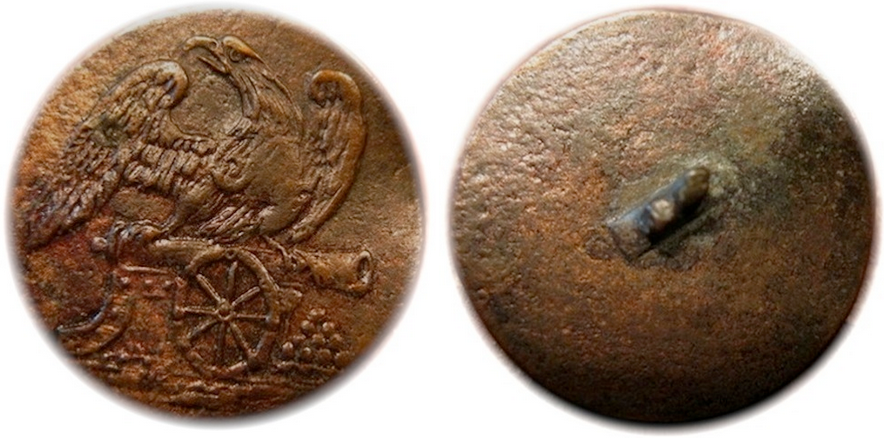
1811-1813 3rd Regiment of Artillerists
Color: A Clay Orange-Brown.
Metal: Flat, 1-Piece, Raised Design, Brass.
Size: 20mm. Coat Size
Albert's Number: AY 34-A.1: Die Variant. RV 15
Variation: Cannon with a Ringed Breech / Script "A"
with Foliated Ends / Oval Wheel with Eight Spokes / Ten
Cannon Balls.
Present Condition: An Excavated Example, Strong
Planchet Casting, Strong High Relief Pattern.
Isabela's Notes: There appears to be a few known die
variants known for this pattern. This button's pattern
depicts an eagle with upraised wings facing right, while
standing on a
Cannon with a Ringed Breech
pointing to the
left. There is a
Script "A" with Foliated Ends
placed on the
eagles chest to stand for Artillery. The carriage is
depicted with an
Oval Wheel with Eight Spokes. The
carriage's wheel shows round knob type lug bolts on the face
of the wheel. The cannon's carriage only extends to the back
of the wheel, and depicts six decorative bolts within. On
the lower left hand side of the button, there is a pile of
Ten Cannon Balls
that are stacked in a pyramidal shape on
the ground in front of the wheel. The high relief pattern is
set on a plain flat field with a plain edge.
Reverse Button Analysis: This is a flat one-piece
button, with a loop shank. The shank appears to be
re-soldered, but straight and intact. Blank back mark.
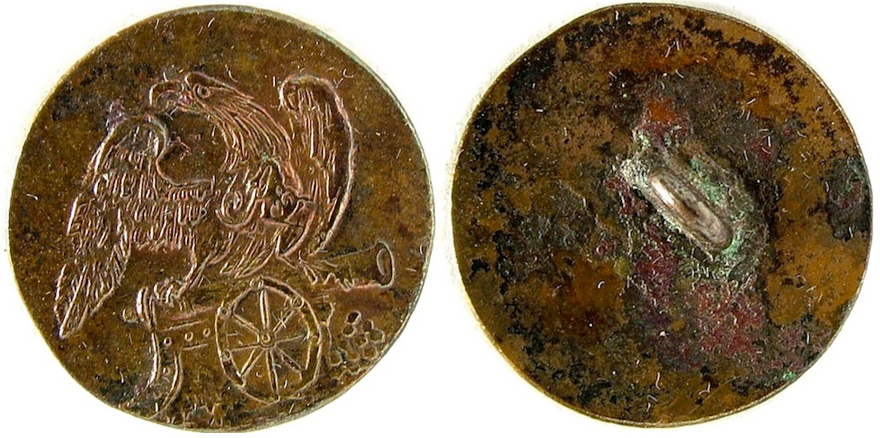
1811-1813 3rd Regiment of Artillerists
Color: An Earth-Tone Brown.
Metal: Flat, 1-Piece, Raised Design, Brass.
Size: 20mm. Coat Size
Albert's Number: AY 34-A.1: Die Variant: RV 15
Variation: Cannon with a Ringed Breech / Script A
with Foliated Ends / Oval Wheel with Eight Spokes
/Open-Circle Type Lug Bolts / Ten Cannon Balls.
Present Condition: An Excavated Example, Strong
Planchet Casting, Strong High Relief Pattern.
Isabela's Notes: This is another pattern used by
the 3rd Reg. of Artillerists. This button's pattern depicts
an eagle with upraised wings facing right, while standing on
a
Cannon with a Ringed Breech
that is pointing to the left. There is a
Script "A" with Foliated Ends
placed on the eagles chest to stand for Artillery. The
cannon's carriage is depicted with an Oval Wheel with Eight
Spokes. In this variant, the carriage wheel shows
Open-Circle Type Lug Bolts
on the face of the wheel. The cannon's carriage only extends
to the back of the wheel, and depicts six decorative bolts
within. On the lower left hand side of the button, there is
a pile of
Ten Cannon Balls
that are skewed in a pyramidal
shape on the ground in front of the wheel. Most likely this
particular button was struck off center since the cannon
balls are misaligned, and the carriage bolt only shows half
by the edge. The high relief pattern is set on a plain flat
field with a plain edge.
Reverse Button Analysis: This is a flat one-piece
button, with a loop shank. The shank appears to be
re-soldered, but straight and intact. Blank back mark.
Excavated in the Gulf Coast Vicinity of Mobil Alabama.~
Picture courtesy of Harry Ridgeway.
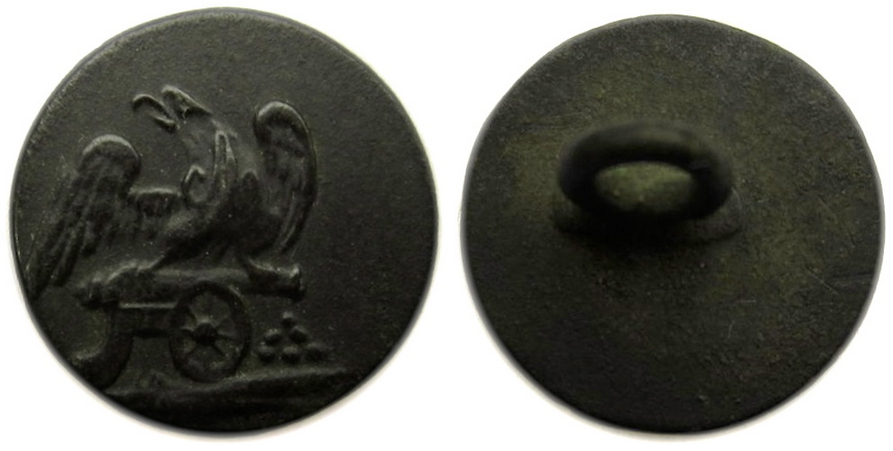
1811-1813 3rd Regiment of Artillerists
Color: A Dark Green.
Metal: Flat, 1-Piece, Raised Design, Copper.
Size: 14.98 mm. Cuff Size
Albert's Number: Unlisted Size Variant Similar to
AY 34-A:
RV 50
Variation: Small Cannon / Large Breech / Large Script
"A" with Curled Ends / Oval Wheel with Eight Spokes / 6
Cannon Balls.
Present Condition: An Excavated Example, Strong
Planchet Casting, Strong High Relief Pattern.
Isabela's Notes: This button's pattern depicts an
eagle with up-raised wings facing right; while standing on a
Small Cannon
with a
Large Breech
pointing to the left. There is a
Large Script "A" with Curled Ends
placed on the eagles
chest to stand for Artillery. The cannon's carriage is
depicted with an Oval Wheel with Eight Spokes. The
carriage's wheel shows round knob type lug bolts on the face
of the wheel. The cannon's carriage only extends to the back
of the wheel, and depicts only three decorative bolts
within. This smaller die variant only shows a pile of
6
Cannon Balls
instead of ten; that are stacked in a pyramidal
shape in front of the wheel. The high relief pattern is set
on a plain flat field with a plain edge.
Reverse Button Analysis: This is a flat one-piece
button with a loop shank. The shank is original, intact, and
intact. Blank back mark.
Dug in fresh water, Florida.~
The RJ Silverstein Collection.
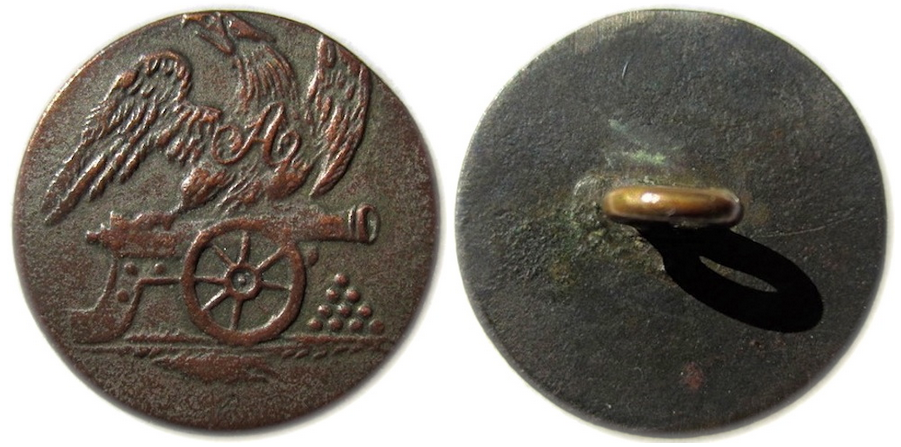
1811-1813 3rd Regiment of Artillerists
Color: A Dusty Silver Leather Brown.
Metal: Flat, 1-Piece, Raised Design, Silver Wash
Copper.
Size: 19.78 mm. Coat Size
Albert's Number: AY 34-B: RV 20
Variation: Large Ribbed Breech / Script A with
Foliated Ends / Round Eight Spoke Carriage Wheel /10 Cannon
Balls.
Present Condition: An Excavated Example, Strong
Planchet Casting, Strong High Relief Pattern.
Isabela's Notes: This is another die variant for
the 3rd Regiment of Artillerists pattern. The button's
pattern depicts an eagle with upraised wings facing right,
while standing on a cannon with a
Large Ribbed Breech
pointing left. There is a Script "A" with Foliated Ends
placed on the eagles chest for Artillery. The carriage has a
Round Eight
Spoke Carriage Wheel, and the wheel in this die variant
doesn't have spoke lugs on the face of the wheel. The
cannon's carriage has 5 raised decorative bolts within, and
it's length only extends to the back of the wheel. There is
a small piece in front of the wheel, but I believe this was
to give the larger cannon barrel from the rear a
proportional look. When a carriage extends past the wheel,
usually you can see the frame through the wheel leading up
to the front. On the lower left hand side of the button is a
pile of
10 Cannon Balls
that are stacked on the ground in a
pyramidal shape in front of the wheel. The high relief
pattern is set on a plain flat field with a plain edge.
Silver Wash examples are the rarity, and collectors seek
clearly depicted "A's".
Reverse Button Analysis: This is a flat one-piece
button, with a loop shank. The shank is original, intact,
and intact. Blank back mark.
The RJ Silverstein Collection.
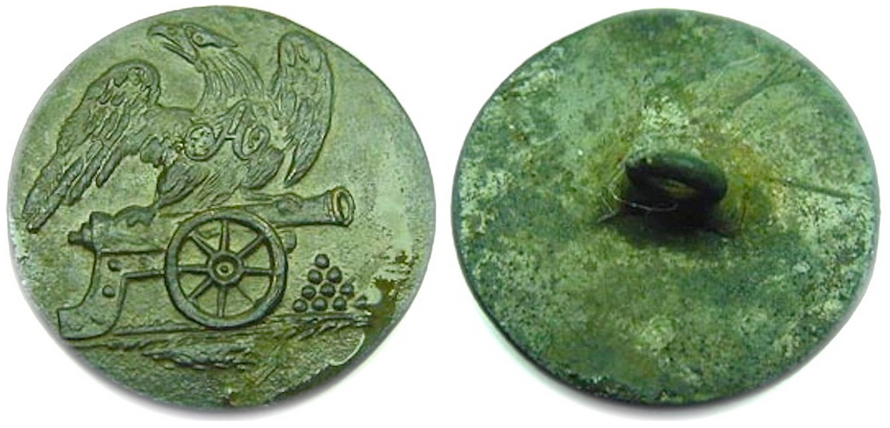
1811-1813 3rd Regiment of Artillerists
Color: A Silvery Green.
Metal: Flat, 1-Piece, Raised Design, Silvered Copper.
Size: 19.77mm. Coat Size
Albert's Number: AY 34-B: RV 20
Variation: Large Ribbed Breech / Script A with
Foliated Ends / Round Eight Spoke Carriage Wheel /10 Cannon
Balls.
Present Condition: An Excavated Example, Strong
Planchet Casting, Strong High Relief Pattern.
Isabela's Notes: This is the same die variant as
above, but not struck off center. The button's pattern
depicts an eagle with upraised wings facing right, while
standing on a cannon with a Large Ribbed Breech
pointing
left. There is a
Script "A" with Foliated Ends
placed on the
eagles chest for Artillery. The carriage has a
Round Eight
Spoke Carriage Wheel, and the wheel in this die variant
doesn't have spoke lugs on the face of the wheel. The
cannon's carriage has 5 raised decorative bolts within, and
it's length only extends to the back of the wheel. There is
a small piece in front of the wheel, but I believe this was
to give the larger cannon barrel from the rear a
proportional look. When a carriage extends past the wheel,
usually you can see the frame through the wheel leading up
to the front. On the lower left hand side of the button is a
pile of
Ten Cannon Balls
that are stacked on the ground in a
pyramidal shape in front of the wheel. The high relief
pattern is set on a plain flat field with a plain edge.
Silver Wash examples are the rarity, and collectors seek
clearly depicted "A's".
Reverse Button Analysis: This is a flat one-piece
button, with a loop shank. The shank is original, intact,
and intact. Blank back mark.
The J. Baldwin Collection.
Robert's Notes: In
1813-14 a new pattern was introduced which depicted a large
foliated script letter, "A" with the regiment number below
in a foliated oval.
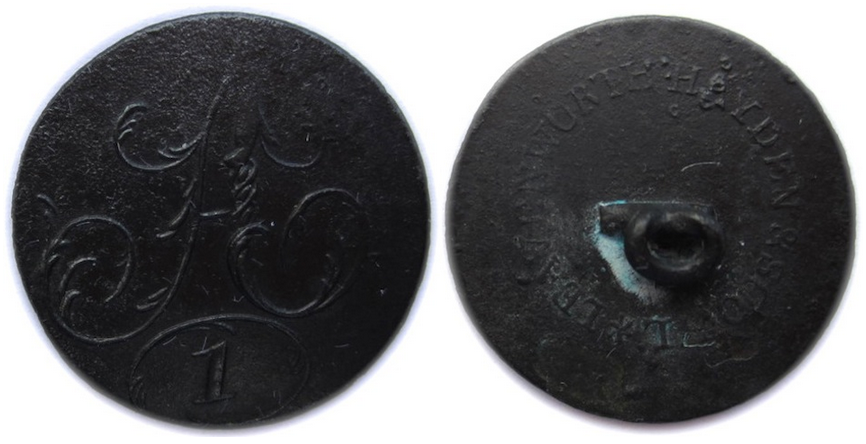
1813-14 1st Regiment of Artillerist
Color: A Deep Chocolate.
Metal: Flat, 1-Piece, Raised Design, Copper.
Size: 20.15 mm. Coat Size
Albert's Number: AY 36.A: RV 20
Variation: Large Foliated Script Letter A / Large
Foliated Oval / 1st Regiment's.
Present Condition: An Excavated Example, Exceptional
Planchet Casting, Strong Low-Relief Pattern.
Robert's Notes: This was the next transition button
from the original 1811-13 "RA" pattern buttons. All
Artillery Regiments and Light Artillery units changed over
to this new style button. The button's pattern depicts a
Large Foliated Script Letter "A"
in the center for
Artillerist. Underneath is a
Large Foliated Oval
with the
1st Regiment's
designation, "1" depicted in an Arabic Style
Number. The high relief pattern is set on a plain flat
field, and has a plain edge. The Leavenworth back mark is a
bit more rarer then the commonly found blank back marks
ones.
Reverse Button Analysis: This is a flat one-piece
button with a loop shank. The shank is original and intact,
but bent over. LEAVENWORTH HAYDEN & SCOVILL* rm
Excavated from sandy soil in a Florida encampment.
The RJ Silverstein Collection.
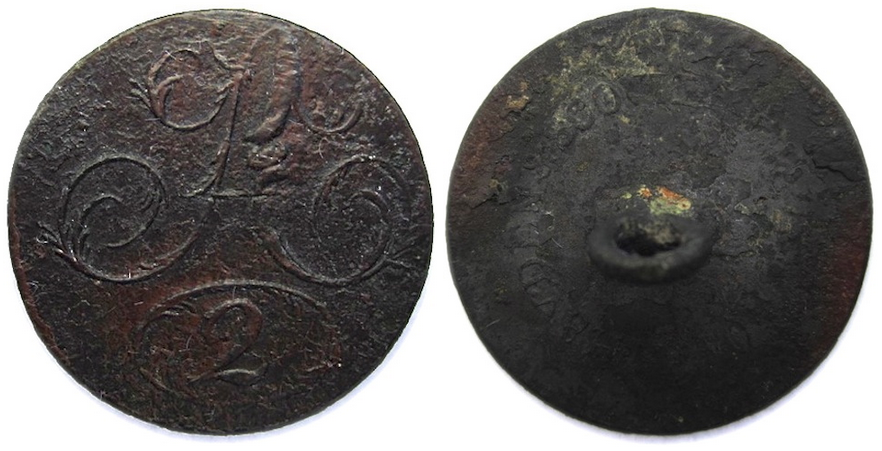
1813-14 2nd Regiment of Artillerist
Color: A Deep Chocolate with Red Undertones.
Metal: Flat, 1-Piece, Raised Design, Copper.
Size: 20.13 mm. Coat Size
Albert's Number: AY 37.A: RV 20
Variation: Large Foliated Script Letter A / Large
Foliated Oval / 2nd Regiment's.
Present Condition: An Excavated Example, Exceptional
Planchet Casting, Strong Low-Relief Pattern.
Robert's Notes: This was the next transition button
from the original 1811-13 "RA" pattern buttons. All
Artillery Regiments and Light Artillery units changed over
to this new style button. The button's pattern depicts a
Large Foliated Script Letter "A"
in the center for
Artillerist. Underneath is a
Large Foliated Oval with the
2nd Regiment's designation, "2" depicted in an Arabic Style
Number. The high relief pattern is set on a plain flat
field, and has a plain edge. The Leavenworth back mark is a
bit more rarer then the commonly found blank back marks
ones.
Reverse Button Analysis: This is a flat one-piece
button with a loop shank. The shank is original and intact.
LEAVENWORTH HAYDEN & SCOVILL* rm
The RJ Silverstein Collection.
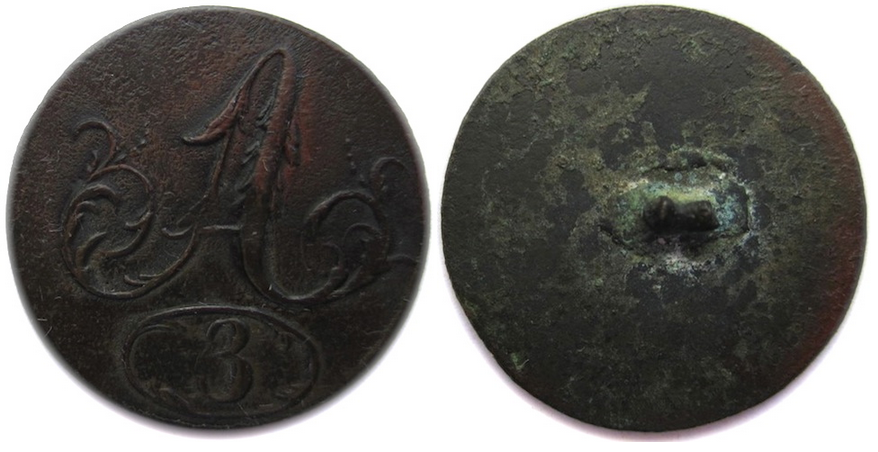
1813-14 3rd Regiment of Artillerist
Color: A Deep Chocolate with Red Undertones.
Metal: Flat, 1-Piece, Raised Design, Copper.
Size: 20.38 mm. Coat Size
Albert's Number: AY 38.A.1: RV 15
Variation: Large Foliated Script Letter A / Large
Foliated Oval / 3rd Regiment's.
Present Condition: An Excavated Example, Exceptional
Planchet Casting, Strong Bas-Relief.
Robert's Notes: This was the next transition button
from the original 1811-13 "RA" pattern buttons. All
Artillery Regiments and Light Artillery units changed over
to this new style button. The button's pattern depicts a
Large Foliated Script Letter "A"
in the center for
Artillerist. Underneath is a
Large Foliated Oval
with the
3rd Regiment's
designation, "3" depicted in an Arabic Style
Number. The high relief pattern is set on a plain flat
field, and has a plain edge. As noted earlier, the
Leavenworth back mark is a bit more rarer then the commonly
found blank back marks ones.
Reverse Button Analysis: This is a flat one-piece
button with a loop shank. The shank is broken off. Blank no
back mark.
Excavated from sandy soil in a Florida encampment.
The RJ Silverstein Collection.
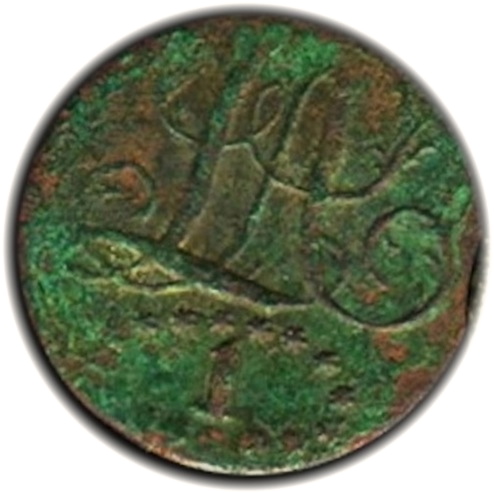
1808-21 Light Artillery, 1st Regiment
Color: A Green Patina With Orange & Browns..
Metal: Flat, 1-Piece, Raised Design, Gilt Brass?
Size: 20mm. Coat Size
Albert's Number: AY 41-A: RV 25
Variation: Large Intertwined Foliated Letters / 16
Six Pointed Asterisk Type Stars / Arabic Style Number 1 .
Present Condition: An Excavated Example, Good
Planchet Casting, Strong High Relief Pattern.
Isabela's Notes: As with the Artillerist buttons, the
Light Artillery units changed over to this new style pattern
button. There are four known die variants in this series for
the Light Artillery button. All use intertwined foliated
script letters, but the style of the swirls and the script
letters changes slightly with each variant. Also the kind of
oval depicted is different; Some with stars, and some with
varying types of arrows. This button's pattern depicts the
Light Artillery initials, "LA" in Large Intertwined Foliated
Letters. Underneath is a large oval that depicts 16 Six
Pointed Asterisk Type Stars. Within the oval is the 1st
Regiment's designation number, "1" depicted in an Arabic
Style Number. The high relief pattern is set on a plain flat
field, and has a plain edge.
Reverse Button Analysis: This is a flat one-piece
button with a loop shank. The shank condition is unknown. W.
C * GILT
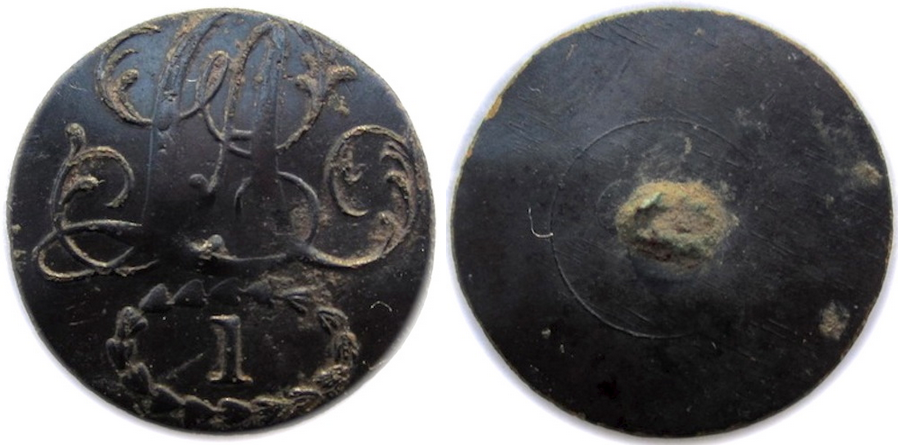
1808-21 Light Artillery, 1st Regiment
Color: Silver with Gold Highlights.
Metal: Flat, 1-Piece, Raised Design, Copper.
Size: 19.91mm. Coat Size
Albert's Number: AY 41-B: RV 25
Variation: Large Intertwined Foliated Letters / Solid
Arrow Heads, Open Arrow Heads with Shaft, Mixture of Both /
Arabic Style Number. .
Present Condition: A Non Excavated Example, Good
Planchet Casting, Strong High Relief Pattern.
Isabela's Notes: As with the Artillerist buttons, the
Light Artillery units changed over to this new style pattern
button. There are four known die variants in this series for
the Light Artillery button. All use intertwined foliated
script letters, but the style of the swirls and the script
letters changes slightly with each variant. Also the oval
depicted uses different style arrows for each variant. This
button's pattern depicts the Light Artillery initials, "LA"
in
Large Intertwined Foliated Letters. Underneath is a large
oval that shows three different styles of arrow heads. First
is the
Solid Arrow Heads, then there is the
Open Arrow Heads
with the Shaft showing, and then is a Mixture of Both. There
is a total of 16 arrow heads pointing toward the right in
this variant. Within the oval is the 1st Regiment's
designation number, "1" depicted in an
Arabic Style Number.
The high relief pattern is set on a plain flat field, and
has a plain edge.
Reverse Button Analysis: This is a flat one-piece
button with a wedge shank. The shank is broken off. Blank
back mark.
RJ & Debra Silverstein Collection.
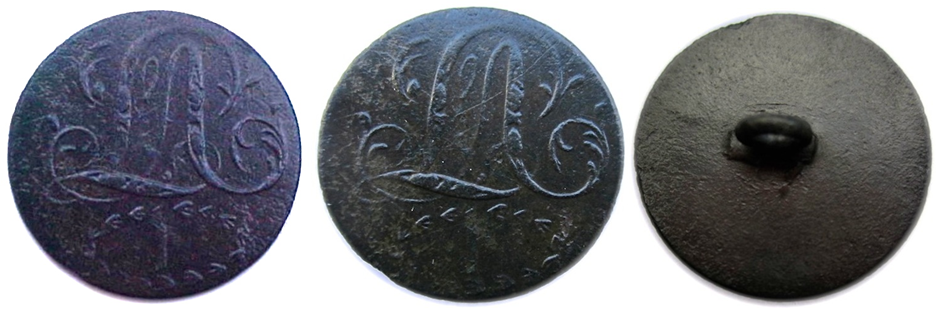
1808-21 Light Artillery, 1st Regiment
Color: A Brownish Red.
Metal: Flat, 1-Piece, Raised Design, Brass.
Size: 19.86 mm. Coat Size
Albert's Number: AY 41-C: RV 25
Variation: Open Arrow Head Design / Large Intertwined
Foliated Letters / Arabic Style Number.
Present Condition: An Excavated Example, Exceptional
Planchet Casting, Good High Relief Pattern.
Isabela's Notes: There are four known die
variants in this series used for this Light Artillery
button. All use intertwined foliated script letters, but the
style of the swirls and the script letters changes slightly
with each variant. Also the oval depicted uses different
style arrows for each variant. This button's pattern depicts
the Light Artillery initials, "LA" in
Large Intertwined Foliated Letters.
Underneath is a large oval that has an
Open Arrow
Head Design
which shows part of the shaft. Within the oval
is the 1st Regiment's designation number, "1" in an
Arabic
Style Number. The high relief pattern is set on a plain flat
field, and has a plain edge.
Reverse Button Analysis: This is a flat one-piece
button with a wedge shank. The shank is original, straight,
and intact. Blank back mark.
The RJ & Debra Silverstein Collection.
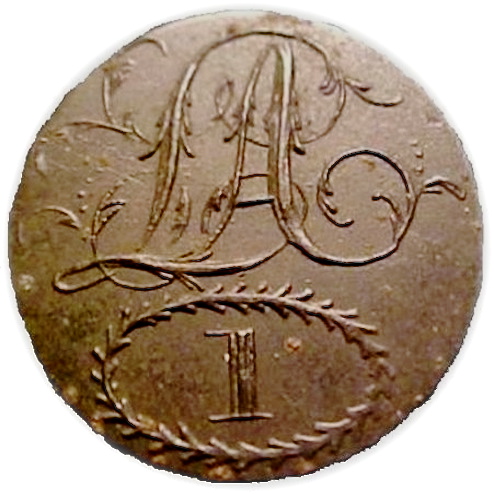
1808-21 Light Artillery, 1st Regiment
Color: Desert Brown.
Metal: Flat, 1-Piece, Raised Design, Copper.
Size: 20mm. Coat Size
Albert's Number: AY 41-D: RV 25
Variation: Large Intertwined Foliated Script Letters
/ Large Arrow Head Designed Oval / Lined Block Style Number
1.
Present Condition: An Excavated Example, Strong
Planchet Casting, Strong High Relief Pattern.
Robert's Notes: As with the Artillerist buttons,
the Light Artillery units changed over to this new style
pattern button. The button's pattern depicts the initials
for Light Artillery, "LA" in
Large Intertwined Foliated Script Letters.
Underneath is a
Large Arrow Head Designed Oval,
with an unusual
Lined Block Style Number, "1"
in the center.
The high relief pattern is set on a plain flat field, and
has a plain edge. This is the hardest die variant to come by
in the series. I found this extremely rare despite Albert's
RV 25 Rating.
Reverse Button Analysis: This is a flat one-piece
button with a soldered on loop shank. Blank, no back mark.
The Dale Collection.
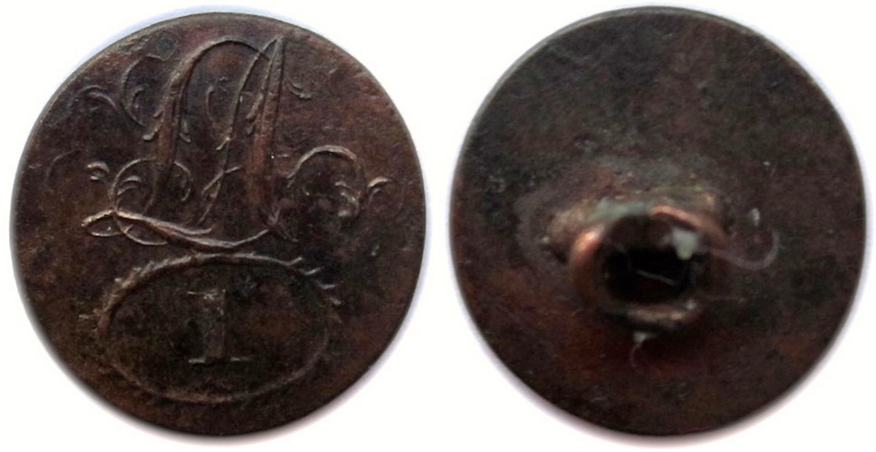
1808-21 Light Artillery, 1st Regiment
Color: A Olive Green.
Metal: Flat, 1-Piece, Raised Design, Copper.
Size: 15.22 mm. Cuff Size
Albert's Number: Unlisted Size Variant AY 41-D:
Robert's RV 75
Variation: Large Intertwined Foliated Script Letters
/ Large Arrow Designed Oval / Block Style 1.
Present Condition: A Non Excavated Example,
Exceptional Planchet Casting, Strong Relief Pattern.
Isabela's Notes: Albert doesn't list any cuff buttons
for this series. As mentioned earlier, I believe this
variant to be the rarest in the series, despite his RV 25
Rating. The button's pattern depicts the initials for Light
Artillery, "LA" in
Large Intertwined Foliated Script
Letters. Underneath is a
Large Arrow Head Designed Oval,
with an unusual
Lined Block Style Number, "1"
in the center.
The high relief pattern is set on a plain flat field, and
has a plain edge. This is the only specimen I have ever seen
in cuff size.
Reverse Button Analysis: This is a flat one-piece
button with a wedge shank. The shank is bent over, but
original, and intact. Blank back mark.
The RJ. & Debra Silverstein Collection.
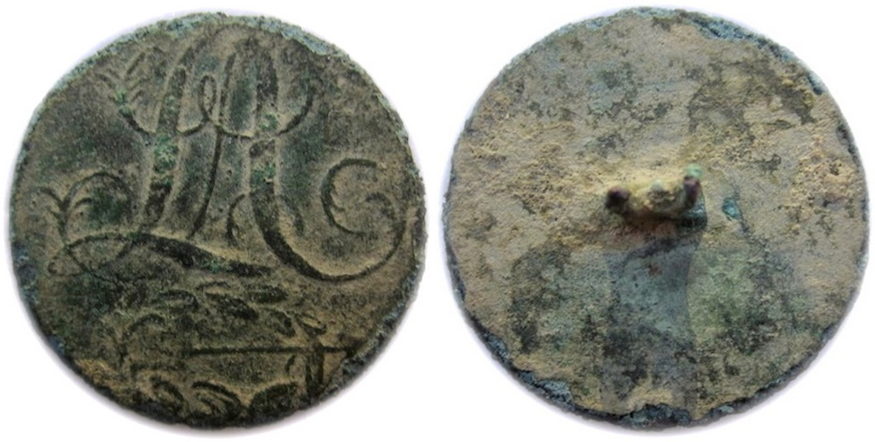
1808-21 Light Artillery
Color: A Whitewash Green.
Metal: Flat, 1-Piece, Raised Design, Brass.
Size: 19.33 mm. Coat Size
Albert's Number: AY 42: RV 25
Variation: Large Oval Wreath / Arrow Shooting Through
the Center / .
Present Condition: An Excavated Example, Good
Planchet Casting, Good/Strong High Relief Pattern.
Isabela's Notes: This is only one known die variant
for this button. This Light Artillery button is slightly
different from the earlier series with the regiment number
below; Even though they both share a similar pattern idea
The button's pattern depicts the initials for Light
Artillery, "LA" in Large Intertwined Foliated Script
Letters. Underneath is a
Large Oval Wreath, with an
Arrow
Shooting Through the Center. The Arrow is pointing toward
the left edge. The high relief pattern is set on a plain
flat field, and has a plain edge.
Reverse Button Analysis: This is a flat one-piece
button with a loop shank. The shank is harshly broken off.
Blank back mark.
Excavated in Hampton, Virginia.~
The RJ & Debra Silverstein Collection.
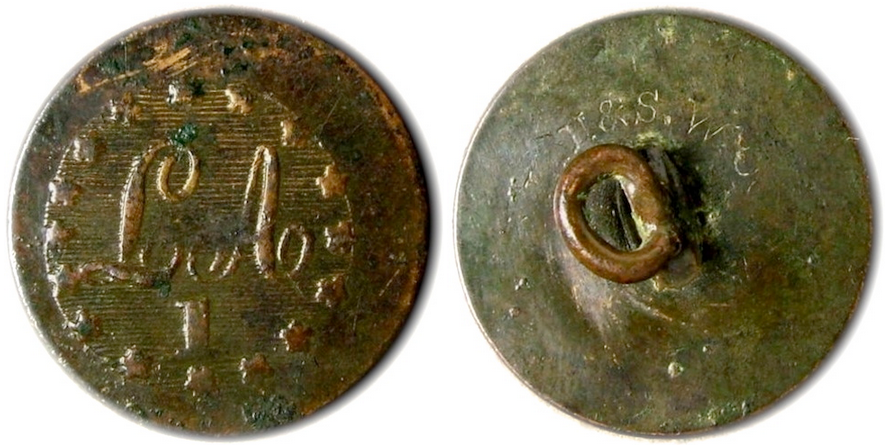
1808-21 Light Artillery, 1st Regiment
Color: A Brownish Yellow with Green Encrustations.
Metal: Flat, 1-Piece, Raised Design, Gilded Brass.
Size: 20.4mm. Coat Size
Albert's Number: AY 43-B: RV 20
Variation: Script Initials for Light Artillery / 15mm
Lined Field / Small Regiment Number 1 / 16 Raised Five Point
Stars.
Present Condition: An Excavated Example, Good
Planchet Casting, Strong High Relief.
Isabela's Notes: I found this button to be a very
crude style pattern for a several reasons. First, there was
only one size die made for both the coat and cuff buttons.
Second, there are three known die variants of the same
pattern. Specimen A, shows an inner 15mm. lined field with a
large number 1; B: uses the same outside size diameter with
a smaller 13.5mm. lined field, but a smaller number "1"; C:
has the same outer diameter, but only an inner 12.5mm. lined
field and uses a small number "1". This means that when the
coat buttons were struck, this unfortunately left a 5mm. or
more plain unfinished outside border. The manufacturers
thinking was that the smaller inner diameter buttons were
suppose to be the cuff for the larger coat. All buttons
would be uniform in size. This particular specimen would be
the second known die variant with the smaller number "1".
The button's pattern shows the
Script Initials for Light
Artillery, "LA" on a
15mm. Lined Field. Directly underneath
is a
Small Regiment Number, "1"
depicted by a
Wide Roman
Block Style Number. Encircling the outer perimeter of the
lined field is
16 Raised Five-Point Stars. The high relief
pattern is set on a lined field with a plain flat edge
border. Another interesting fact is that this was
manufactured by the partnership of Leavenworth, Hayden, and
Scovill, Waterville Company around 1811-20's making this the
earliest of the Scovill back marks.
Reverse Button Analysis: This is a flat one-piece
button with a loop shank. The shank is original, and intact,
but slightly bent over. L.H. & S.W C GILT dm.
Excavated in the Gulf Coast Vicinity of Mobil Alabama.~
Picture Courtesy of Harry Ridgeway.
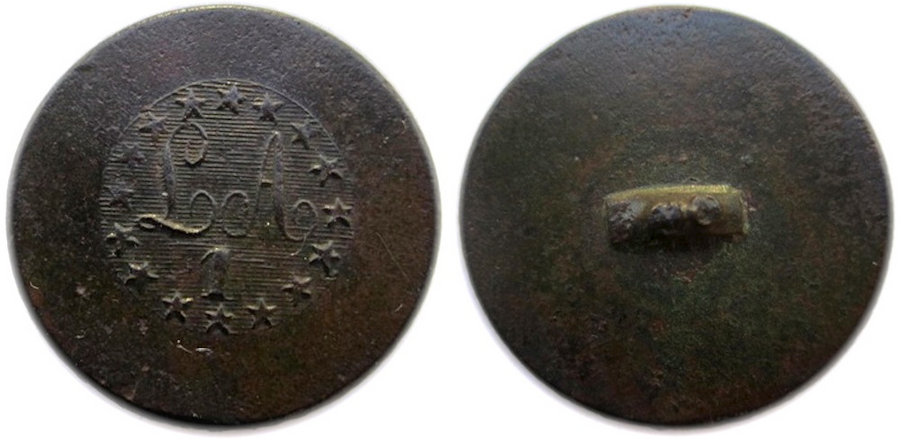
1808-21 Light Artillery, 1st Regiment
Color: A Plumb Patina.
Metal: Flat, 1-Piece, Raised Design, Brass.
Size: 20.52mm. Coat Size
Albert's Number: AY 43-C: RV 15
Variation: Script Initials for Light Artillery /
12.52 Lined Field / 16 Five Pointed Stars.
Present Condition: An Excavated Example, Good
Planchet Casting, Strong High Relief.
Isabela's Notes: This is the third known die
variant for this particular pattern. The button's pattern
shows the
Script Initials for Light Artillery,
"LA" on a smaller 12.52mm. Lined Field. Directly underneath
is a
Small
Regiment Number, "1"
depicted by a
Thinner Roman Block Style
Number. Encircling the outer perimeter of the lined field is
16 Raised Five-Point Stars. The high relief pattern is set
on a lined field with a plain flat edge border. This
particular variant, AY 43-C also has 2 types smaller
matching 15mm cuff buttons. The first variant has 16 stars
with a small number one on a 12.5mm lined field, and the
second variant has 13 stars and a large number 1 on a 12.5mm
lined field.
Reverse Button Analysis: This is a convex one-piece
button with soldered loop shank. The shank is unfortunately
missing. Blank back mark.
The Robert & Debra Silverstein Collection.
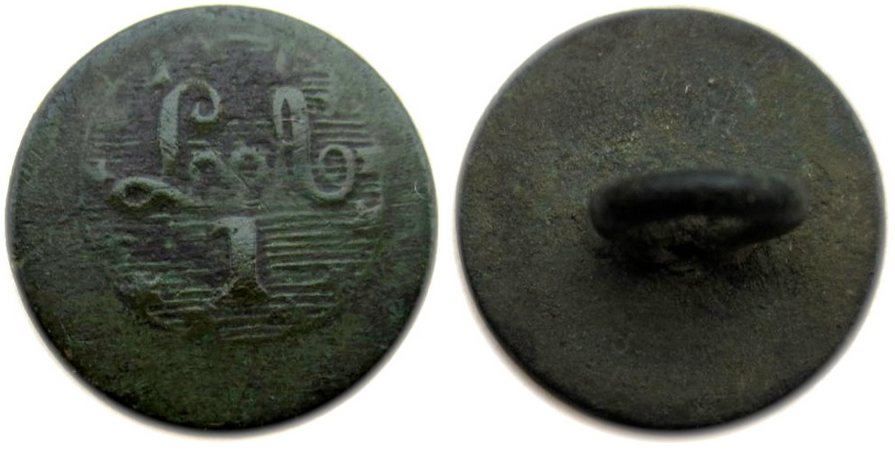
1808-21 Light Artillery, 1st Regiment
Color: A Seaweed Green.
Metal: Flat, 1-Piece, Raised Design, Brass.
Size: 14.43mm. Cuff Size
Albert's Number: AY 43-CV2: RV 8
Variation: Script Initials for Light Artillery /
12.5mm Lined Field / Small Regiment Number 1 / 16 Raised
Five Point Stars
Present Condition: An Excavated Example, Good
Planchet Casting, Strong High Relief.
Isabela's Notes: This is the smaller cuff size 15mm
diameter die variant with 13 stars. The button's pattern
shows the
Script Initials for Light Artillery, "LA" on a
12.52mm. Lined Field. Directly underneath is a
Small
Regiment Number,
"1"
depicted by a Roman Block Style Number.
Encircling the outer perimeter of the lined field is
16
Raised Five-Point Stars. The high relief pattern is set on a
lined field with a plain flat edge border.
Reverse Button Analysis: This is a convex one-piece
button with soldered loop shank. The shank is unfortunately
missing. Blank back mark.
The Robert & Debra Silverstein Collection.
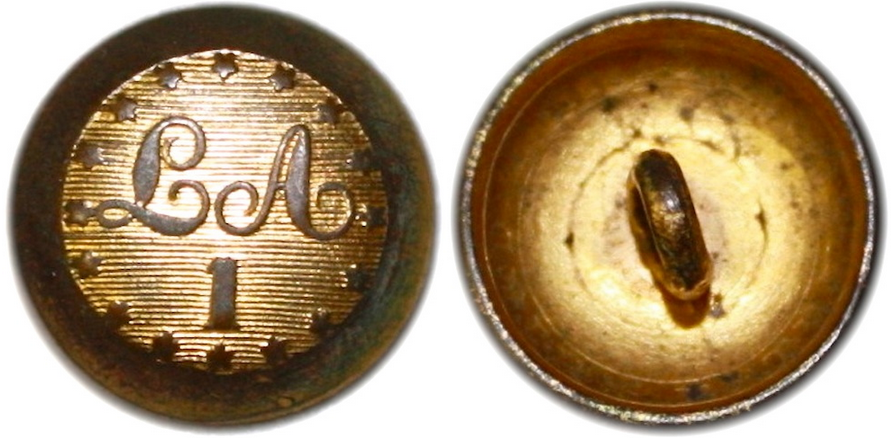
1808-21 Light Artillery, 1st
Regiment
Color: A Rusty Gold.
Metal: 1-Piece, Convex, Raised Design, Gilt Brass.
Size: 19mm. Coat Size
Albert's Number: AY 44 A:
RV 20
Variation: Convex / 16 Six Pointed Asterisk Type
Stars.
Present Condition: An Excavated Example, Exceptional
Planchet Casting, Exceptional Bas-Relief.
Isabela's Notes: This convex button uses the same
design as the original flat one piece examples, but has two
slight variations. First, the button itself is Convex, and
not flat. Second, the stars have six points instead of five.
I am thinking this might have been intended for officers
since it was issued during the same time period. The
button's pattern shows the Script Initials for Light
Artillery, "LA" on a 15mm. Lined Field. Directly underneath
is a Small Regiment Number, "1"depicted by a Roman Block
Style Number. Encircling the outer perimeter of the lined
field is 16 Raised Six-Point Asterisk Type Stars. The high
relief pattern is set on a convex lined field with a plain
edge border.
Reverse Button Analysis: This is a concave one-piece
button with soldered on loop shank. The shank is original,
straight, and intact. H.T & D / EXTRA SUPERFINE rm.
The Dave Gerber Collection.
-Rob, Here is a truly historic button from the
uniform of General Moses Porter. General Porter began his
career as an ensign of the 6th Mass. Regiment in Jan. of
1777. He was then commissioned 2nd LT.3rd Continental
Artillery in 1779 and served through out the balance of the
American Revolution. He was then retained for regular
service and commissioned Colonel, 1st LT. Artillery in March
1812. Then brevetted Brigadier General in 1813 for
distinguished service in the campaign of 1813. The Porter
Collection which included this button was acquired many
years ago by Famed author/dealer Mr. Jim Kochan. There were
a total of 7 buttons, 5 of which were sewed onto a linen
vest and two loose ones. This is one of the loose ones that
was then sold to dealer and collector Cary Delery of The
Historical Shop, who had it in his collection for a number
of years. I purchased it not long ago from him, and It has
now come to be in my collection. I am thrilled to have this
very historic and wonderful button. -Dave
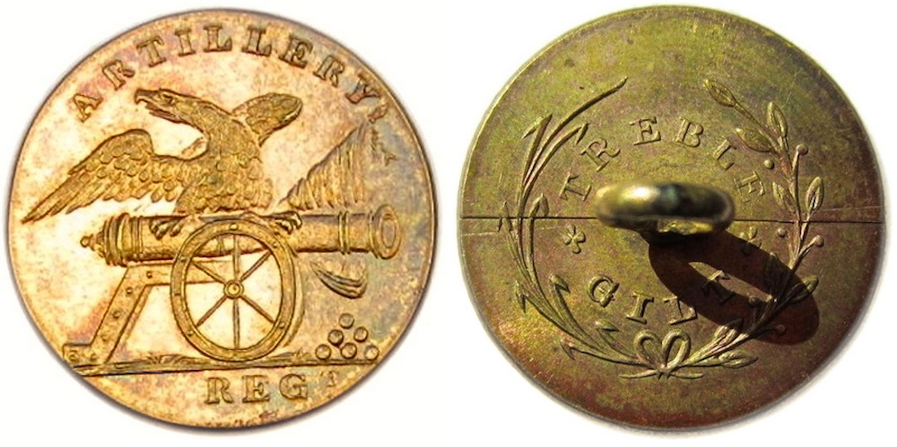
1808-11 Federal Artillery Regiment
Color: A Brass Yellow.
Metal: Flat, 1-Piece, Raised Design, Gilt Brass.
Size: 22.19 mm. Coat Size
Albert's Number: AY 46 B: RV 20
Variation: Ribbed Breech / The Carriage Extends to
the Axle/Carriage Wheel is Oval / Six Spokes.
Present Condition: A Non Excavated Example,
Exceptional Planchet Casting, Exceptional High Relief
Pattern.
Isabela's Notes: This early federal device has two
known die variants depicting a
Ribbed Breech.
The difference in the two variants is how far the gun
carriage extends. This button's pattern depicts a federal
style eagle facing right, while standing on a cannon with a
Ribbed Breech pointing left. On the left-hand side, there is
a draped flag that hangs below the cannon. In this die
variant, the cannons
Carriage Extends to the Wheel Axle.
The
Carriages Wheel is Oval
and shows
Six Spokes
with round knob lug bolts. There are six cannon balls on the
ground stacked in a pyramidal shape in front of the wheel.
The button's military designation, "ARTILLERY" is in large
raised capital letters arced above, and the abbreviation for
Regiment, "REGt" is in capital letters in the bottom legend.
The high relief pattern is set on a plain flat field with a
plain edge.
Reverse Button Analysis: This is a flat one-piece
button with a loop shank. The shank is original, straight,
and intact. TREBLE+ GILT+ within rm crown & laurel pattern.
The RJ Silverstein Collection.
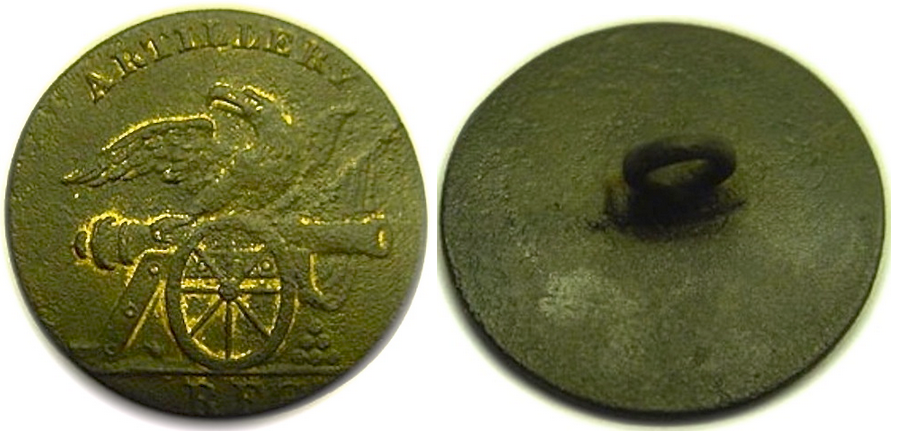
1808-11 Federal Artillery Regiment
Color: A Seaweed Green with Gold Highlights.
Metal: Flat, 1-Piece, Raised Design, Gilt Brass.
Size: 21mm. Coat Size
Albert's Number: AY 47-B: RV 15
Variation: Ringed Breech / Carriage Extends to the
Flag/ Carriage Wheel is Oval / Eight Spokes.
Present Condition: An Excavated Example, Good
Planchet Casting, Good High Relief Pattern.
Isabela's Notes: This federal artillery device has
two known die variants depicting a Ringed Breech. The first
variant has a wheel with six spokes, and the gun carriage
extends to the wheel's axle. The second variant, has a wheel
with eight spokes, and the gun carriage extends past the
wheel to the draped flag. This button's pattern depicts a
federal style eagle facing right, while standing on a cannon
with a
Ringed Breech
pointing left. The eagle is facing to the right with it's
left wing close to the body. There is a draped flag on the
left-hand side that hangs below the cannon just above the
cannon balls. In this variation, the cannons
Carriage Extends to the Flag.
The cannon's
Carriage Wheel is Oval,
and has
Eight Spokes
with round knob lug bolts. There are six cannon balls
stacked on the ground in a pyramidal shape below the draped
flag. The button's military designation, "ARTILLERY" is
arced above in large capital. The abbreviation for Regiment,
"REG" is in capital letters in the bottom legend. This is a
high relief pattern set on a plain flat field with a plain
edge. Most remaining specimens are known to be offset. This
could have been a result of a poorly cut die, or could have
been intended for a larger button.
Reverse Button Analysis: This is a flat one-piece
button with a loop shank. The shank is original, straight,
and intact. No back mark.
The J. Baldwin Collection.
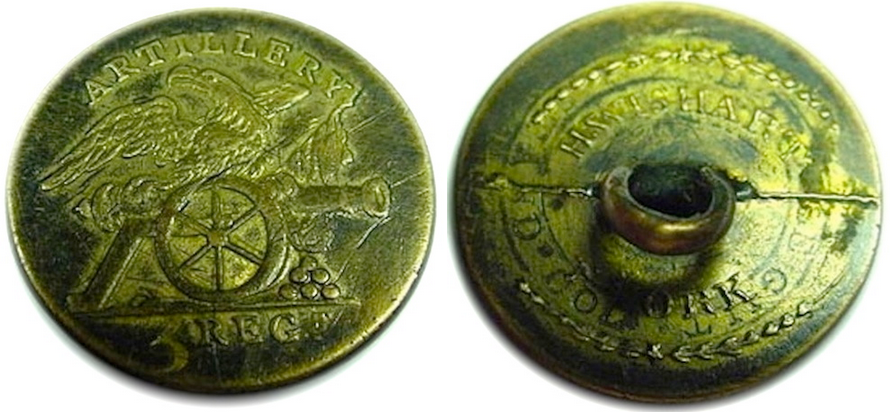
1808-1811 Artillery, 3rd Regiment
Color: A blackened Green.
Metal: Flat, 1-Piece, Raised Design, Gilt Brass.
Size: 23mm. Coat Size
Albert's Number: AY 48-R.3: RV 35
Variation: Ribbed Breech / Six Cannon Balls / Large
Arabic Regiment Number "3".
Present Condition: An Excavated Example, Strong
Planchet Casting, Strong High Relief Pattern.
Isabela's Notes: Wishart made these numbered
artillery regiment buttons in the early 19th century. All
the regiments were issued the same button pattern, the only
difference was the number of the regiment which was stamped
on the bottom. The button's pattern depicts a federal style
eagle facing right, while standing on a cannon with a
Ribbed Breech
pointing left. On the left hand side, there is a Draped Flag
hanging below the cannon barely above the canon balls. There
are
Six Cannon Balls
piled on the ground in a pyramidal shape in front of the
carriage wheel. Underneath the cannon in the bottom legend
is a
Large Arabic Regiment Number, "3"
before the Regiment abbreviation, "REGt". The high relief
pattern is set on a plain flat field with a plain edge.
Reverse Button Analysis: This is a flat one-piece
button with a loop shank The shank is original, and intact,
but bent over. H.WISHART/N.YORK rm half circle of arrows.
The J. Baldwin Collection.
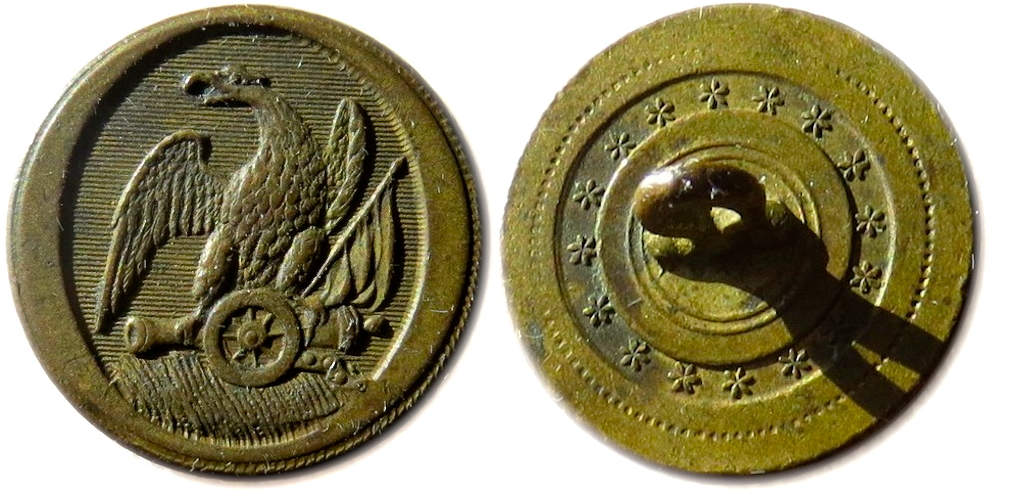
1808-21 Artillery General Use for Federal or State
Militia Units
Color: An Army Green with Gold Undertones.
Metal: Flat, 1-Piece, Raised Design, Gilded Brass.
Size: 22.12mm. Coat Size
Albert's Number: AY 50-A: RV 35-50
Variation: Small Old Style Cannon / Three Carriage
Bolts / The Large Carriage's Wheel is Round / Draped Flag.
Present Condition: A Non Excavated Example,
Exceptional
Planchet Casting, Exceptional High Relief Pattern.
Robert's Notes: This specific pattern gets Albert's
highest RV rating within this early series. This specimen
was most likely manufactured by A M Peasely, and used by either
the federal, or state militia artillery units. This button
is the only die variant in the 1808 Artillery series to
depict a draped flag. The button's pattern depicts a calling
eagle with upraised wings facing right. The eagle is
standing on a
Small Old Style Cannon
with a Large Breech that is pointing right. The cannon has a
short carriage which only reaches to the back of the wheel.
There are
Three Decorative Carriage Bolts
in this pattern.
The Large Carriage's Wheel is Round
with eight spokes. In this die variant, the cannon sits on a
farmers field. On the left side of the eagle is a
Draped Flag.
The high relief pattern is set on a lined field which has a
wide flat oval border, and a rope edge.
Reverse Button Analysis: This is a flat one-piece
button with a loop shank.
The RJ Silverstein Collection.
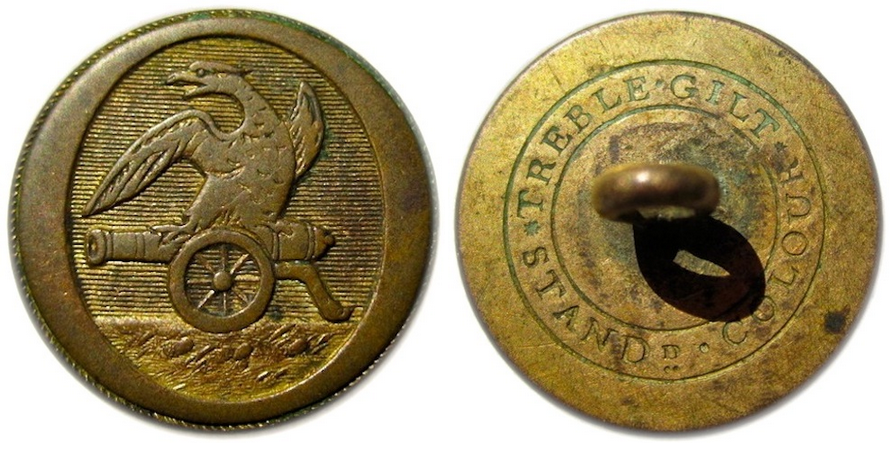
1808-30's Artillery General Use for Federal or State
Militia Units
Color: A Coppery-Brown Gilt.
Metal: Flat, 1-Piece, Raised Design, Gilt Brass.
Size: 23mm. Coat Size
Albert's Number: Unlisted Variant AY 51-B:
RV
10
Variation: Ringed Cannon with A Ribbed Breech / Five
Decorative Carriage Bolts / Cannon Sits on a Higher Ground.
Present Condition: A Non Excavated Example,
Exceptional Planchet Casting, Strong High Relief Pattern.
Robert's Notes: This federal style button was
manufactured in England, and could have been used by either
the federal, or state militia artillery units. Albert only
lists two die variants, one with a cannon on higher ground,
the other with a cannon on lower ground. After studying this
series for some time, I found there are several
manufacturers with their own unique variations to the eagle
depicted, as well as the style cannon, and also the
placement on the ground. The button's pattern above depicts
a calling eagle with upraised wings facing right. The eagle
is standing on a
Ringed Cannon with a Ribbed Breech.
The cannon has a short carriage which only extends to the
back of the wheel. There are
Five Decorative Carriage Bolts
in this pattern. The carriage's wheel is round with eight
spokes. The
Cannon Sits on a Higher Ground
in a field of grass. The high relief pattern is set on a
lined field, which has a wide plain oval border, and a rope
edge. This pattern was also made in a smaller size which was
used as an officer's epaulettes during the War of 1812.
Reverse Button Analysis: This is a flat one-piece
button with a loop shank. The shank is original and intact,
but slightly bent over. TREBLE GILT * STRANDd.. .COLOUR*
within a CHANNEL OF 2 dm rings.
The RJ Silverstein Collection.
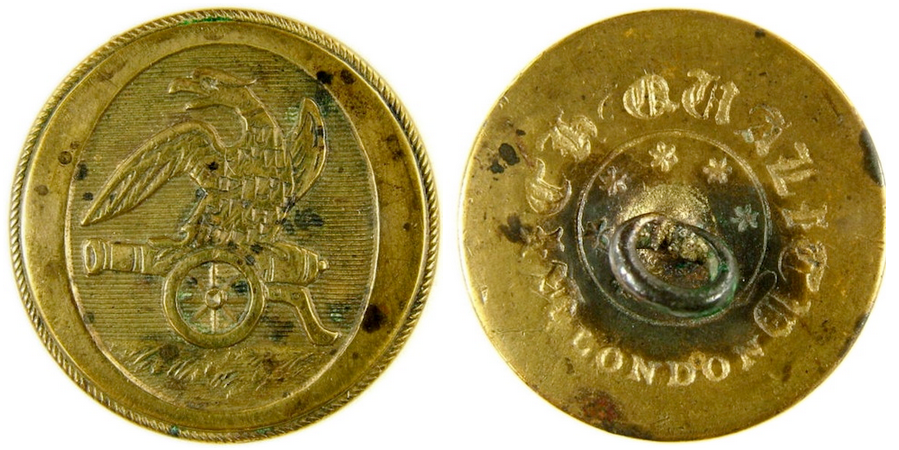
1808-30's Artillery General Use for Federal or State
Militia Units
Color: Black Speckled Yellow Brass.
Metal: Flat, 1-Piece, Raised Design, Gilded Brass.
Size: 23.4mm. Coat Size
Albert's Number: Unlisted Variant AY 51-B: RV
10
Variation: Ringed Cannon / Five Decorative Carriage
Bolts / Cannon Sits on higher ground.
Present Condition: A Non Excavated Example,
Exceptional Planchet Casting, Exceptional High Relief
Pattern.
Robert's Notes: This is another die variant that was
manufactured in England in the 1820-30's, and could have
been used by either the federal, or state militia artillery
units. The button's pattern above depicts a calling eagle
with upraised wings facing right. The eagle is standing on a
Ringed Cannon
pointing right. The cannon has a short carriage which only
reaches to the back of the wheel. There are
Five Decorative Carriage Bolts
in this pattern. The carriage's wheel is round with eight
spokes. The
Cannon Sits on a Higher Ground
in a field of grass. The high relief pattern is set on a
lined field, which has a wide plain oval border, and a rope
edge. The unusual trademark is the eagles breast feathers
depicted. They appear to be hand chased by special order.
Reverse Button Analysis: This is a flat one-piece
button with a loop shank. The shank is original and intact,
but slightly bent over. Old English Script lettering dm RICH
QUALITY/LONDON inner dm ring/ 8 asterisk type stars. (Rich03
Back mark 1820-30's)
Picture Courtesy of Harry Ridgeway.
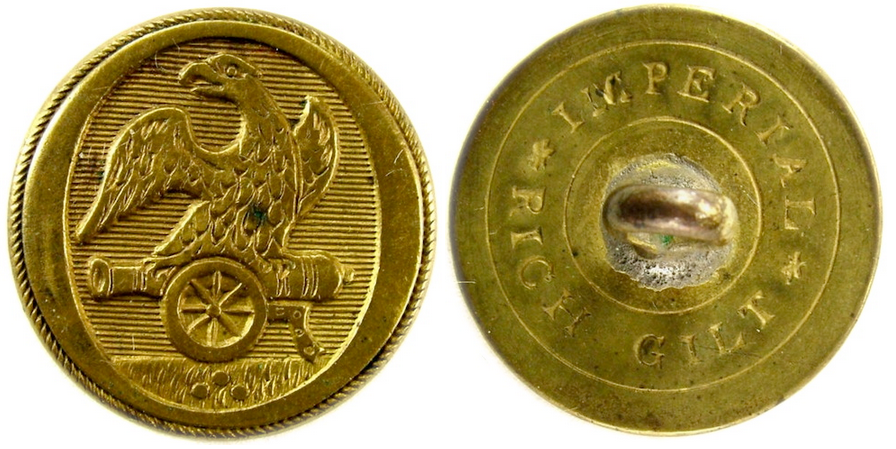
1820-30's Artillery General Use for Federal or State
Militia Units
Color: Aged Gilded Brass.
Metal: Flat, 1-Piece, Raised Design, Gilded Brass.
Size: 20.8mm. Coat Size
Albert's Number: AY 52-A:
RV 10
Variation: Ringed Cannon Large Ribbed Breech Cannon /
Four Carriage Bolts / Three Small Wide-Spaced Cannon Balls .
Present Condition: A Non Excavated Example,
Exceptional Planchet Casting, Exceptional High Relief
Pattern.
Robert's Notes: This series of buttons should have
been included in Albert's AY 51 series as just a
manufacturer's pattern variation. This specimen with the
cannon balls was manufactured in England, and could have
been used by either the federal, or state militia artillery
units. In this series, Albert only lists three earlier
manufacturer's backmarks and three die variants, but there
seem to be several manufacturers with their own unique
variations. There are several differences in the style of
eagle depicted, to the characteristics of the cannons and
their carriages. Also the cannon balls size and space can
differentiate. The button's pattern above depicts a calling
eagle with upraised wings facing right. The eagle is
standing on a
Ringed Cannon with a Large Ribbed Breech
pointing right. The cannon has a short carriage which only
reaches to the back of the wheel. There are
Four Decorative
Carriage Bolts
in this pattern. The carriage's wheel is
round with eight spokes. The cannon sits on a field of grass
with
Three Small Wide-Spaced Cannon Balls
stacked in a
pyramidal shape. The high relief pattern is set on a lined
field which has a wide flat oval border, and a rope edge.
Reverse Button Analysis: This is a flat one-piece
button with a loop shank. The copper shank appears to be
replaced. * IMPERIAL / RICH GILT * within a 2 RING dm.
(IMPERIAL03 Back mark dates to 1830's).
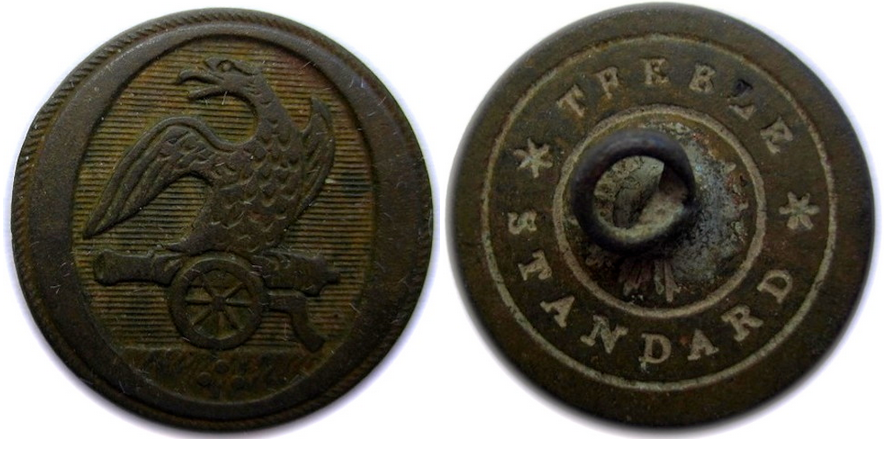
1820-30's Artillery General Use for Federal or State
Militia Units
Color: A Dark Brown With Orange-Yellow Undertones.
Metal: Flat, 1-Piece, Raised Design, Brass.
Size: 22mm. Coat Size
Albert's Number: Unlisted Variant AY 52-A: RV
10
Variation: Ringed Cannon with A Ribbed Breech Cannon
/ Three Small Wide-Spaced Cannon Balls / Four Decorative
Carriage Bolts.
Present Condition: A Non Excavated Example,
Exceptional Planchet Casting, Exceptional High Relief
Pattern.
Robert's Notes: This is another pattern variation in
the series. The button's pattern above depicts a calling
eagle with upraised wings facing right. The eagle is
standing on a
Ringed Cannon with a Large Ribbed Breech
pointing right. The cannon has a short carriage which only
reaches to the back of the wheel. There are
Four Decorative Carriage Bolts
in this pattern. The carriage's wheel is round with eight
spokes. The cannon sits on a field of grass with
Three
Small Wide-Spaced Cannon Balls
stacked in a pyramidal shape in front. The high relief
pattern is set on a lined field which has a wide flat oval
border, and a rope edge.
Reverse Button Analysis: This is a flat one-piece
button with a loop shank. The shank is original and intact,
but slightly bent over. TREBLE * STANDARD * within a 2 RING
dm.
The RJ Silverstein Collection.
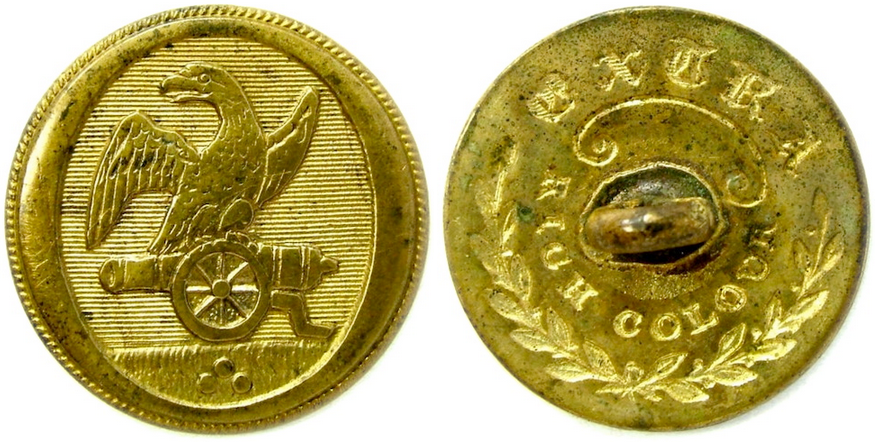
1820-30's Artillery General Use for Federal or State
Militia Units
Color: Yellow Gold.
Metal: Flat, 1-Piece, Raised Design, Gilded Brass.
Size: 21.5mm. Coat Size
Albert's Number: AY 52-B: RV 10
Variation: Ringed Cannon with a Curved Stock / No
Decorative Carriage Bolts / Three Large Close-Spaced Cannon
Balls
Present Condition: A Non Excavated Example,
Exceptional Planchet Casting, Strong High Relief Pattern.
Robert's Notes: This is another die variant that was
manufactured in England during the 1820-30's. As noted
prior, this series of buttons should have been included in
Albert's AY 51 series as just a pattern variation. The
button's pattern above depicts a calling eagle with upraised
wings facing right. The eagle is standing on a crude style
Ringed Cannon with a Curved Stock
pointing right. The cannon has a plain short carriage which
only reaches to the back of the wheel. There are
No Decorative Carriage Bolts
in this basic style pattern. The carriage's wheel is round,
and has eight spokes. The cannon sits on a field of grass
with
Three Large Close-Spaced Cannon Balls
that are stacked in a pyramidal shape in front. The high
relief pattern is set on a lined field which has a wide flat
oval border, and a rope edge.
Reverse Button Analysis: This is a flat one-piece
button with a loop shank. The shank is original, straight
and intact. EXTRA -above /WREATH- below / RICH COLOUR
graphic scroll (ExtraR20 back mark dates to 1820-30's).
Picture Courtesy
of Harry Ridgeway.
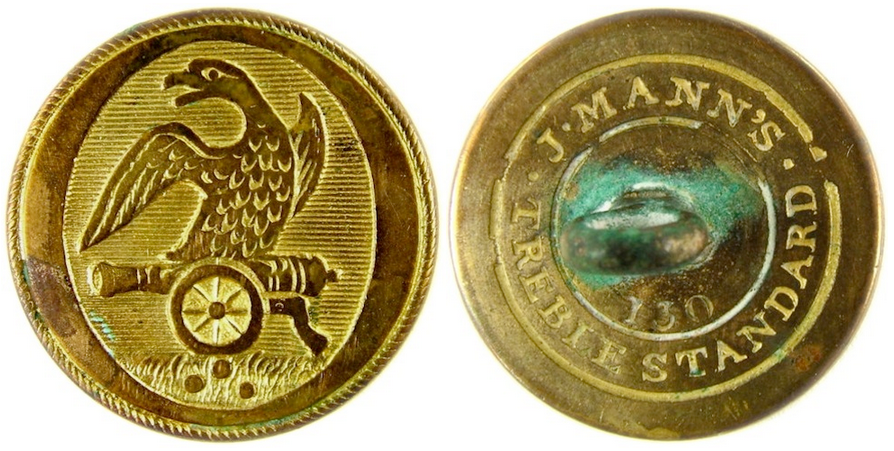
1820-30's Artillery General Use for Federal or State
Militia Units
Color: Yellow Coppery Gold.
Metal: Flat, 1-Piece, Raised Design, Gilded Brass.
Size: 21.2mm. Coat Size
Albert's Number: Unlisted Variant AY 52-B: RV
10
Variation: Ringed Cannon with A Large Ribbed Breech /
One Decorative Carriage Bolt / Large Skewed Wide-Spaced
Cannon Balls
Present Condition: A Non Excavated Example,
Exceptional Planchet Casting, Exceptional High Relief
Pattern.
Robert's Notes: This federal style button was
manufactured in England during the 1820-30's. The button's
pattern above depicts a calling eagle with upraised wings
facing right. The eagle is standing on a
Ringed Cannon with a Large Breech
pointing right. The cannon has a short carriage which only
reaches to the back of the wheel. There is
One Decorative Carriage Bolt
on the top. The carriage's wheel is round, and has eight
spokes. The cannon sits on a field of grass with
Three Large Skewed Wide-Spaced Cannon Balls
that are stacked in a pyramidal shape in front. The high
relief pattern is set on a lined field which has a wide flat
oval border, and a rope edge.
Reverse Button Analysis: This is a flat one-piece
button with a loop shank. The shank is original, straight
and intact. J.MANN'S.TREBLE STANDARD within a 2 dm
channel/130 stamped within inner ring. (Mann04 back mark
dates to 1820-30's).
Picture Courtesy of Harry Ridgeway.
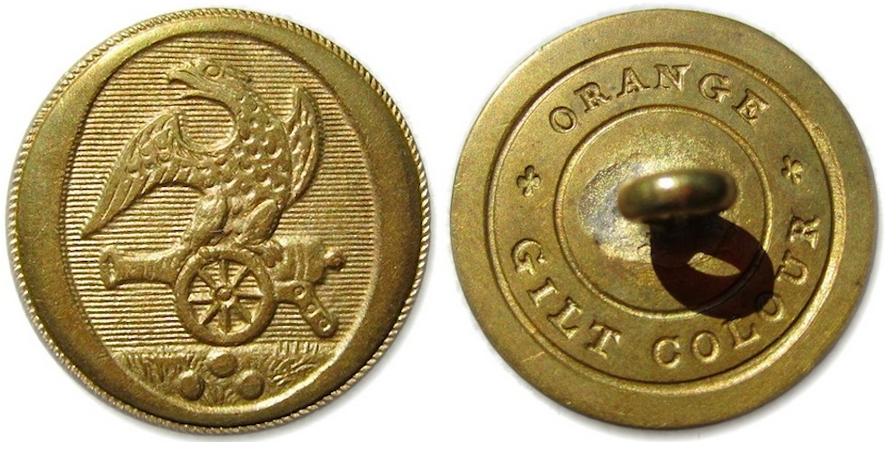
1820-30's Artillery General Use for Federal or State
Militia Units
Color: Golden Brown.
Metal: Flat, 1-Piece, Raised Design, Gilded Brass.
Size: 23mm. Coat Size
Albert's Number: Unlisted Variant AY 52-B:
RV 10
Variation: Small Ringed Cannon with a Large Ribbed
Breech / Three Decorative Carriage Bolts / Three Large
Wide-Spaced Cannon Balls.
Present Condition: A Non Excavated Example,
Exceptional Planchet Casting, Exceptional High Relief
Pattern.
Robert's Notes: This is another die variant
manufactured in England in the 1820-30's. The button's
pattern depicts a calling eagle with upraised-wings facing
right. The eagle is standing on a
Small Ringed Cannon with a Large Ribbed Breech.
The cannon has a short carriage which only extends to the
back of the wheel. There is
Three Decorative Carriage Bolts
in this die variant. The carriage's wheel is round with
eight spokes. The cannon sits on a field of grass with
Three Large Wide-Spaced Cannon Balls
stacked in a pyramidal shape in front. The high relief
pattern is set on a lined field with a wide flat oval
border, and a rope edge.
Reverse Button Analysis: This is a flat one-piece
button with a loop shank. The shank is original, straight
and intact. ORANGE + GILT COLOUR+ with in a 2 dm ring.
The RJ Silverstein Collection.
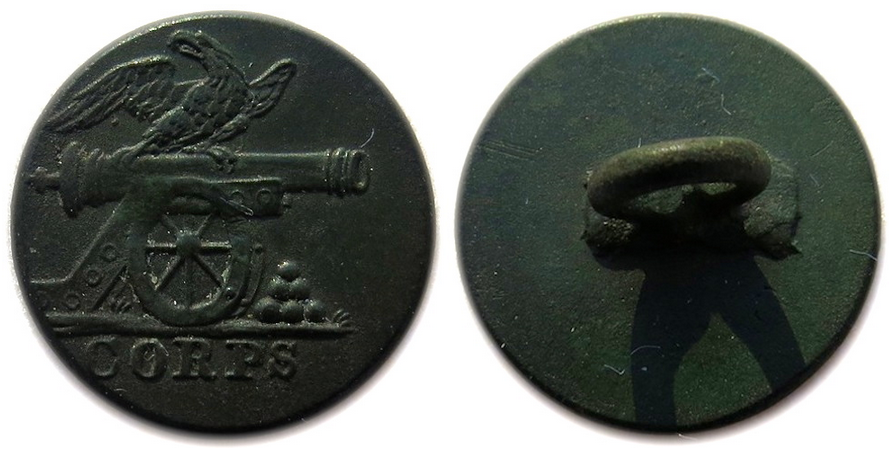
1814-21 Federal Artillery Corps
Color: Dark Sea Green.
Metal: Flat, 1-Piece, Raised Design, Brass.
Size: 14.57mm. Cuff Size.
Albert's Number: AY 55-Av: RV 5
Variation: Ringed Cannon Pointing Left / Four
Decorative Bolts / Carriage Wheel is Oval with Eight Spokes
/ Six Cannon Balls.
Present Condition: An Excavated Example, Exceptional
Planchet Casting, Strong/Exceptional High Relief Pattern.
Isabela's Notes: This smaller size cuff button
differs from the coat's die variant in two ways. First, the
cuff button's pattern only shows six cannon balls, instead
of ten. Second, the carriages decorate knobs only show four
instead of five. There are other possible die variants
produced for this cuff button, but none have surfaced that i
know of. The button's pattern depicts an eagle facing right
with upraised wings. The eagle is standing on a
Ringed
Cannon Pointing Left. The cannon's carriage extends past the
carriage's wheel, and has
Six
Decorative Bolts
showing.
The
Carriage Wheel is Oval with Eight Spokes. Each spoke has a
decorative lug nut. Just past the front cannon wheel is a
partial image of a second wheel with two lug nuts depicted. The military word, "CORPS" is written in
Roman Font capital letters below. The high relief pattern is
set on a plain flat field with a plain edge.
Reverse Button Analysis: This is a flat one-piece
button with a loop shank. The shank is original, straight,
and intact. Blank Back mark.
Dug at Traders Field in Georgia.~
RJ Silverstein Collection.
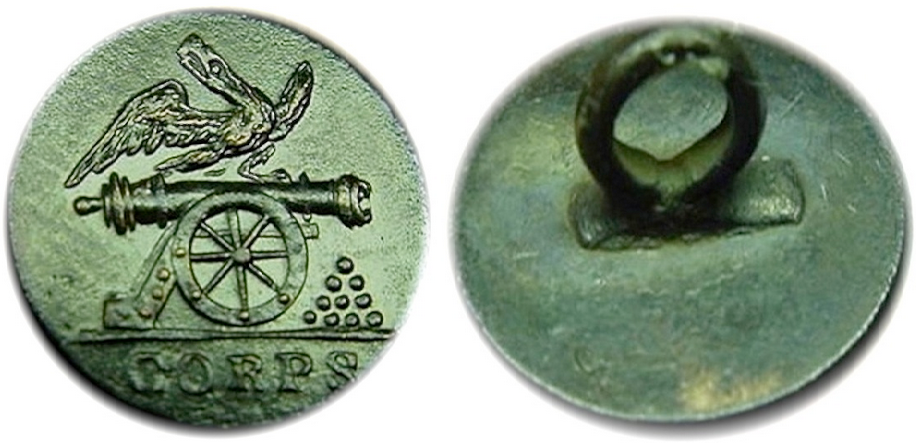
1814-21 Federal Artillery Corps
Color: A Pewter Green.
Metal: Flat, 1-Piece, Raised Design, Silvered Copper.
Size: 20mm. Coat Size
Albert's Number: Unlisted Die Variant Similar to AY 55-B: RV 25 for Variation
Variation: Large Flat Head / Wide Breech Cannon /
Large Round Eight Spoke Wheel / Ten Cannon Balls.
Present Condition: An Excavated Example, Strong
Planchet Casting, Strong High Relief Pattern.
Isabela's Notes: This is another die variant for
the Federal Artillery Corps button. Albert only lists three
known patterns, but there appears to be a few more that have
surfaced from metal detector enthusiasts. This button's
pattern depicts a Federal Style Eagle with a
Large Flat Head
facing up, and too the right. The eagle is spreading it's
wings while standing on a
Wide Breech Cannon, that is
pointing to the left. The eagle's head head is tucked-in
close to the top of the right wing. The cannon's carriage
extends past the
Large Round Eight Spoke Wheel. There are
four decorative round knobs on the carriage's base. The
wheel shows
Eight Round Knob Lugs
for the spokes on the face
of the wheel. There are
Ten Cannon Balls
stacked on the
ground in a pyramidal shape in front of the carriage wheel.
The word "CORPS" is written below the mound in Roman Font
capital letters. The high relief pattern is set on a plain
flat field with a plain edge.
Reverse Button Analysis: This is a flat one-piece
button with a loop shank. The shank is original, straight,
and intact. Blank Back mark.
Excavated by J. Baldwin at a known Andrew Jackson
encampment.
The J. Baldwin Collection.
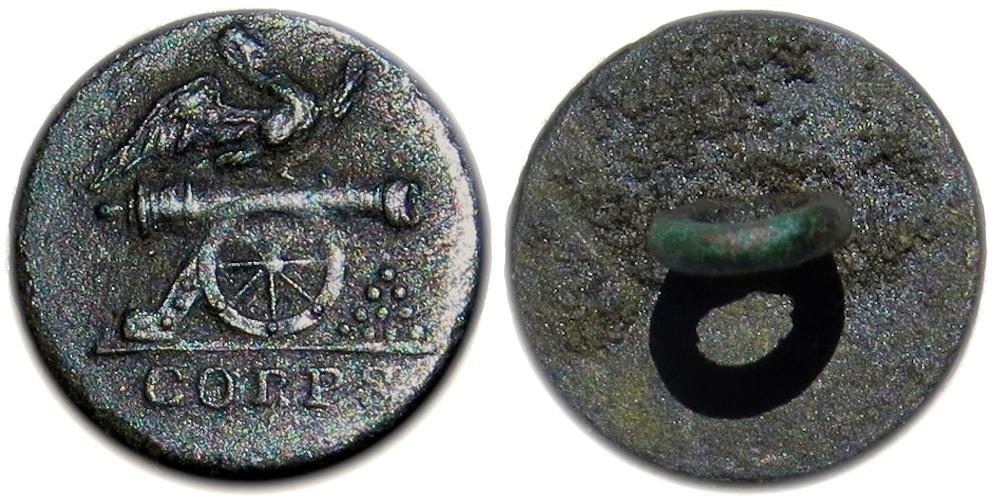
1814-21 Federal Artillery Corps
Color: A Silvery Green.
Metal: Flat, 1-Piece, Raised Design, Silvered Copper.
Size: 14.67mm. Cuff Size
Albert's Number: Unlisted Die Variant Similar to AY 55-B: RV
50 for Variation
Variation: Large Flat Head / Wide Breech Cannon /
Large Round Eight Spoke Wheel / Ten Cannon Balls.
Present Condition: An Excavated Example, Strong
Planchet Casting, Strong High Relief Pattern.
Isabela's Notes: This is another die variant for
the Federal Artillery Corps button. Albert only lists three
known patterns, but there appears to be a few more that have
surfaced from metal detector enthusiasts. This button's
pattern depicts a Federal Style Eagle with a
Large Flat Head
facing up, and too the right. The eagle is spreading it's
wings while standing on a
Wide Breech Cannon, that is
pointing to the left. The eagle's head head is tucked-in
close to the top of the right wing. The cannon's carriage
extends past the
Large Round Eight Spoke Wheel. There are
four decorative round knobs on the carriage's base. The
wheel shows
Eight Round Knob Lugs
for the spokes on the face
of the wheel. There are
Ten Cannon Balls
stacked on the
ground in a pyramidal shape in front of the carriage wheel.
The word "CORPS" is written below the mound in Roman Font
capital letters. The high relief pattern is set on a plain
flat field with a plain edge.
Reverse Button Analysis: This is a flat one-piece
button with a loop shank. The shank is original, straight,
and intact. Blank Back mark.
The RJ Silverstein Collection.
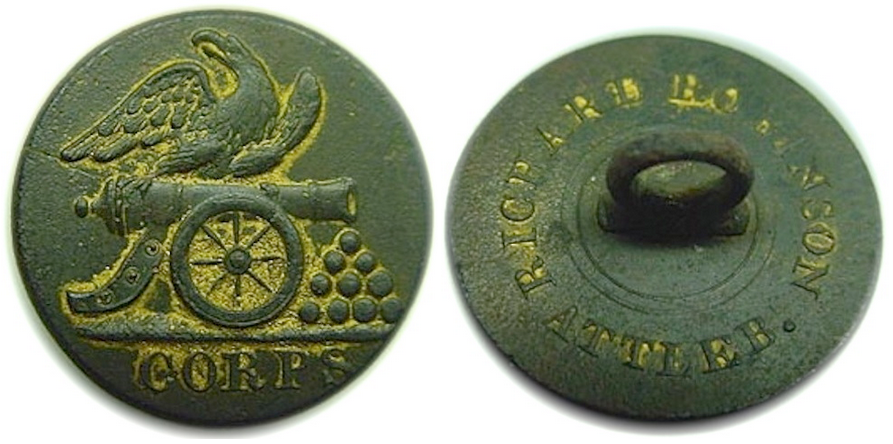
1814-21 Federal Artillery Corps
Color: A Golden Brown.
Metal: Flat, 1-Piece, Raised Design, Gilt Brass.
Size: 22mm. Coat Size
Albert's Number: AY 55-C:
RV 10
Tice's Number: AM209B
Variation: Ringed Cannon with a Curved Stock / Eight Spoke
Round Carriage Wheel / Ten Cannon Balls.
Present Condition: An Excavated Example, Strong Planchet
Casting, Strong Bas-Relief Pattern.
Isabela's Notes: This is another style used by the Artillery
Corps This button could have been used by either the federal
or state's militia artillery. There is four die variants
known in this series for the coat size, and one for the cuff
size. Variations include the style cannon, carriage, and
wheel shape depicted. The cuff's variation is in the number
of cannon balls depicted (6). The button's pattern depicts a
Federal Style Eagle facing right, while standing on a
Ringed Cannon with a Curved Stock
pointing left. In this die variant, the cannons carriage
goes up into the cannon instead of a platform style mount.
There is a Large Round
Carriage's Wheel with Eight Spoke.
There are Ten Cannon Balls
stacked in a pyramidal shape in front of the carriage's
wheel. The word "CORPS" is written below in large capital
letters. This style is very similar to the Artillery Corps
Buttons of 1814-21.
Reverse Button Analysis: This is a flat one-piece button
with a loop shank. The shank is original, straight, and
intact. RICHARD ROBINSON.ATTLEB. rm rings.
The J. Baldwin Collection.
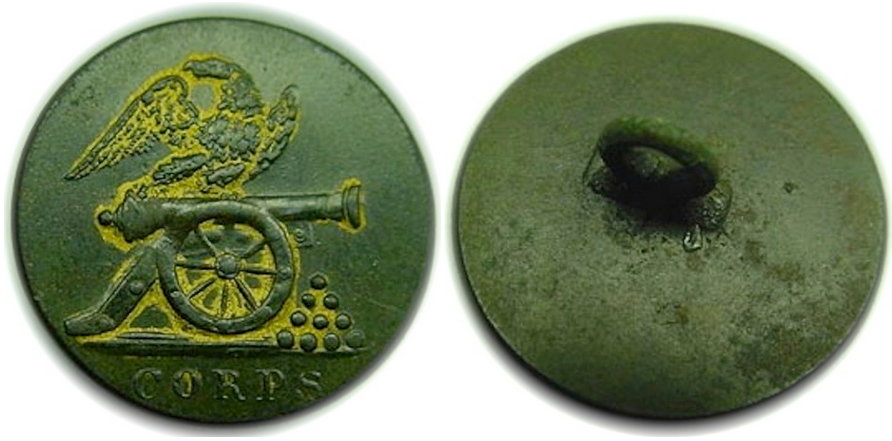
1814-21 Federal or Militia Artillery Corps
Color: A Forest Green with Gold Highlights.
Metal: Flat, 1-Piece, Raised Design, Gilded Brass.
Size: 20mm. Coat Size
Albert's Number: Unlisted Die Variant Similar to
AY 55 C or 58 B: RV 25 for Variation
Variation: Small Head Eagle / Wide Breech Cannon /
Large Round Eight Spoke Wheel / Ten Cannon Balls.
Present Condition: An Excavated Example, Strong
Planchet Casting, Strong High Relief Pattern.
Isabela's Notes: Here is another unlisted die
variant for the Artillery Corps pattern. This could either
be early Federal Artillery Corps, or a later
State Militia Artillery Corps,
just not sure. This button's pattern depicts a Federal Style
Eagle with a Small Head Eagle facing right. The eagle's head
in this die variant is tucked in close to the body, and it's
beak is uniformly straight with the right wing. The eagle is
standing on a
Wide Breech Cannon
that is
pointing to the left. The cannon's carriage extends past the
Large Round Eight Spoke Wheel. There are two decorative
round knobs on the carriage's foot, and one under the
cannon. The carriage's wheel shows eight round knob
spoke-lugs on the face of the wheel. In this die variant,
there are
Ten Cannon Balls
stacked on the ground in a
pyramidal shape in front of the carriage wheel. The word
"CORPS" is written below the mound in Roman Font capital
letters. The high relief pattern is set on a plain flat
field with a plain edge.
Reverse Button Analysis: This is a flat one-piece
button with a loop shank. The shank is original, straight,
and intact. Blank Back mark.
The J. Baldwin Collection.
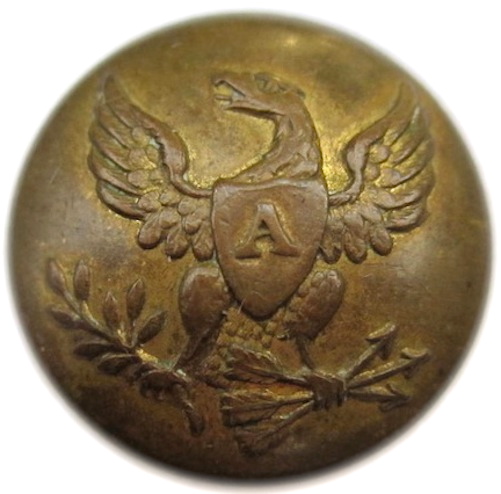
In
1821, there was a change from the Corps of Artillery to a
new
Regimental formation. This change was also accompanied by a change
in the style of buttons to be used. In the first series
(1821-30's) there were several styles of eagle with shield
patterns made. The various manufacturers were
able to produce their own die variants according to the Army's
specifications and guidelines. There were a lot of slight variations
from one manufacturer to another.
These
differances usually pertained to the size and shape of the shield, or the
angle of the eagle's head, and even most notably the
design of the feathers. When
studying these buttons you will be able to see some of the
tell-tale signs that indicate who manufactured a certain pattern. I recommend you
examine the number of petals and berries on the olive
branches, and the pattern of the eagle's feathers depicted on the
wings, neck, and bottom tail feathers. Just to note, there were some
manufactures that made two-piece buttons in the late 1820's,
but this new change over in construction was more prevalent in the early
1830's.
Below are just a few examples of the
different Die Variations.
~
G.O. Adjt. & Insp. General's Office March 27, 1821 Article 65,
specified: "The button of the Artillery, will be of yellow
metal, cupped in form, three-fourths of an inch in diameter,
with an Eagle impressed on it, and a letter "A" in the
shield thereon."
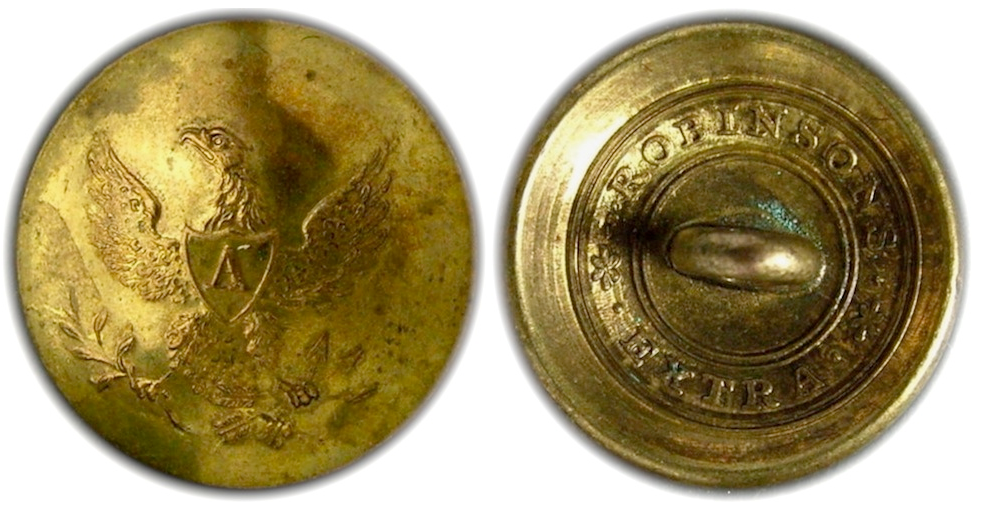
1821-30's Federal Artillery Officer's Button
Color: Aged Brass Yellow.
Metal: 1-Piece, Convex, Raised Design, Gilded Brass.
Size: 20mm. Coat Size
Albert's Number: AY 64-A.1
RV 4
Tice's Number: AY 199-D.4
Variation: Small Recessed Shield / Short Laurel Stem with
Six Petals.
Present Condition: A Non Excavated Example, Exceptional
Planchet Casting, Exceptional High Relief Pattern.
Isabela's Notes: In 1821, this was the new style button
ordered for Artillery officers. There are several
spread-eagle die variants known that were made by lots of
manufacturers. The button's pattern depicts a spread eagle
facing right. On the eagle's chest is a small shield with a
raised outline. Within the center is a raised letter "A" for
Artillery. In the eagle's right talon is a small short
laurel stem with six petals. In it's left talon is a small
bundle of three arrows that are pointing upward and to the
left. The high relief pattern is set on a plain convex field
with no edge border. This Robinson's backmark is over struck
on Robinson & Co/Attleborough/ Rich earlier specimens.
Reverse Button Analysis: This is a concave one-piece button
with a loop shank. The shank is original, straight, and
intact. ROBINSON .*. EXTRA .*.
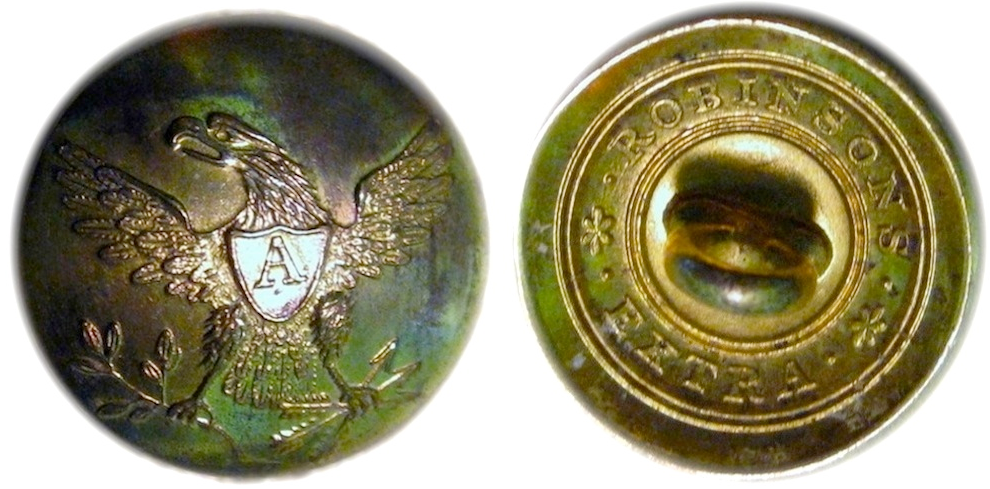
1821-30's Federal Artillery Officer's Button
Color: A Greenish Brass Yellow.
Metal: 1-Piece, Convex, Raised Design, Gilt Brass.
Size: 22mm. Coat Size
Albert's Number: AY 64-A.1 RV 4
Tice's Number: AY 199-D.4
Variation: Slightly Slanted Small Shield / Eight Petal
Laurel Stem.
Present Condition: A Non Excavated Example, Exceptional
Planchet Casting, Exceptional High Relief Pattern.
Isabela's Notes: In 1821, this was the new style button were
introduced for Artillery officers. There are several
spread-eagle die variants known that were made by lots of
manufacturers. The button's pattern depicts a spread eagle
facing right. On the eagle's chest is a slightly slanted
small shield with a raised outline. Within the center is a
raised letter "A" for Artillery. In The eagle's right talon
is a small laurel stem with eight petals. In it's left talon
is a small bundle of three arrows that are pointing upward,
to the left, and downward. The high relief pattern is set on
a plain convex field with no edge border. This Robinson's
back mark dates then there first variant to the early 1830's.
Reverse Button Analysis: This is a concave one-piece button
with a loop shank. The shank is original, straight, and
intact. ROBINSON .*. EXTRA .*.
The RJ. & Debra Silverstein Collection.
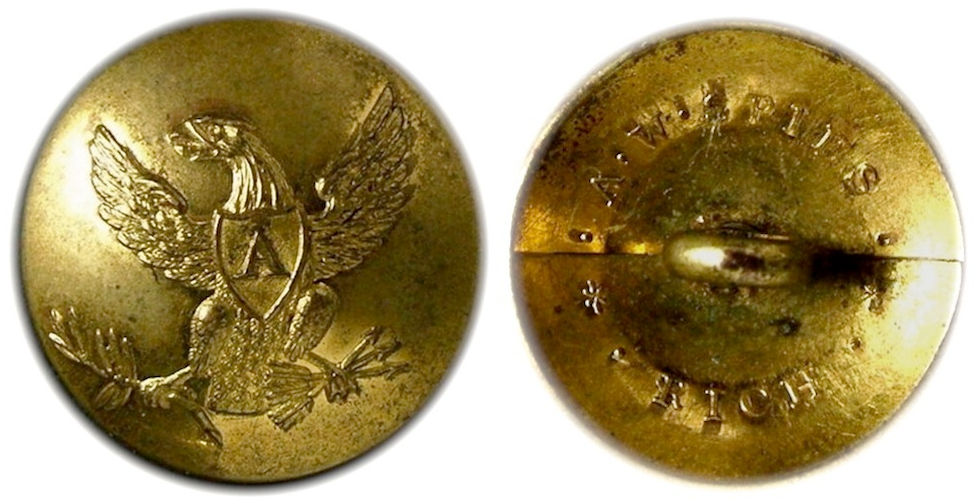
1821-30's Federal Artillery Officer's Button
Color: Tarnished Gold.
Metal: 1-Piece, Low-Convex, Raised Design, Gilt Brass.
Size: 20mm.
Albert's Number: AY 64-A.4 RV: 4
Tice's Number: AY 199-D.9
Variation: Long Pointed Shield / Bent Stem Laurel with Eight
Petals.
Present Condition: A Non Excavated Example, Exceptional
Planchet Casting, Exceptional High Relief Pattern.
Isabela's Notes: This is another die variant in this early
series that was manufactured by A.W. Spiers. The button's
pattern depicts a spread eagle facing right. On the eagle's
chest is a long pointed shield with a raised outline. Within
the center is a raised letter "A" for Artillery. In the
eagle's right talon is a bent laurel stem with eight petals.
In it's left talon is a small bundle of three arrows that
are pointing to the left. The high relief pattern is set on
a low convex field with no edge border. This A.W. Spies back
mark dates to the early 1830's.
Reverse Button Analysis: This is a concave one-piece button
with a loop shank. The shank is original, straight, and
intact. . A.W.SPIES./*RICH.*
Picture Courteous of Harry Ridgeway.
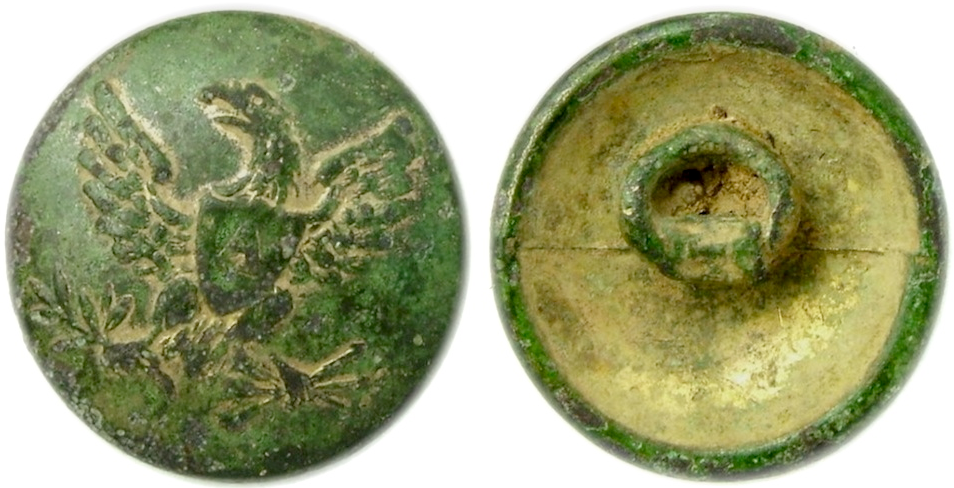
1821-30's Federal Artillery Button
Color: A Grass Green with Brown Outlines.
Metal: 1-Piece, Low-Convex, Raised Design, Brass.
Size: 16mm. Hat or Sleeve Button.
Albert's Number: Similar to AY 64
RV 20
Tice's Number: AY 199-D -Unlisted Manufacturer Variant.
Variation: Large Raised Shield / Short Stem Laurel with Nine
Symmetrical Petals.
Present Condition: An Excavated Example, Strong Planchet
Casting, Good High Relief Pattern.
Isabela's Notes: This button was made to be worn on either a
hat or shirt sleeve. The die variant for the laurel stem,
crude eagles feathers and arrows is a different style
pattern from the commonly known manufacturers. Being one
piece, I presume it was manufactured during the 1820 or
1830's. The button's pattern depicts a spread eagle facing
right. On the eagle's chest is a large raised shield with
the letter, "A" for Artillery. In the eagle's right talon is
a short stem laurel with nine symmetrical petals. In it's
left talon is a small bundle of three crude style arrows
that are pointing upward, to the left, and downward. The
high relief pattern is set on a plain low-convex field with
no edge border.
Reverse Button Analysis: This is a slightly concave
one-piece button with a loop shank. The shank is original,
and intact, but bent over. No backmark, but a mold line.
The Old Court House Civil War Museum Collection
Excavated by Chad Davis in Aldie, Virginia.
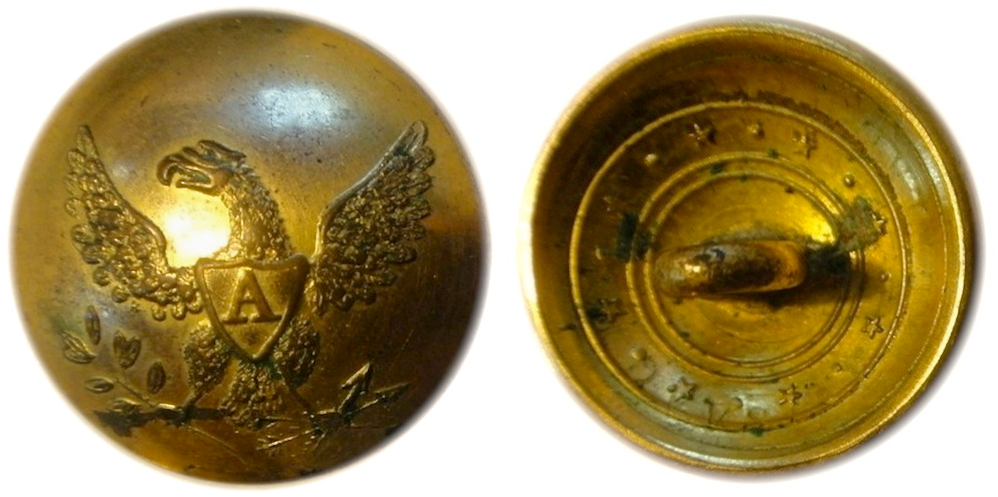
1821-30's Federal Artillery Officer's Button
Color: A Comfortably Worn Brassy Brown.
Metal: 1-Piece, High Convex, Raised Design, Gilded Brass.
Size: 23mm. Coat Size
Albert's Number: AY-64 RV: 4
Tice's Number: AY 199-D.19
Variation: Long Narrow Wings / Small Shield / Nine Laurel
Petals.
Present Condition: A Non Excavated Example, Strong Planchet
Casting, Strong High Relief Pattern.
Isabela's Notes: In 1820-30's, this was the style button
ordered for Artillery officers. There are several
spread-eagle die variants known that were made by lots of
manufacturers. The button's pattern depicts a spread eagle
with long narrow wings facing right. On the eagle's chest is
a small shield with a raised outline. Within the center is a
raised letter "A" for Artillery. In the eagle's right talon
is a thin long stem laurel with nine petals. In it's left
talon is a small bundle of three arrows that are pointing
upward, to the left, and downward. The high relief pattern
is set on a plain high-convex field with no edge border.
Reverse Button Analysis: This is a concave one-piece button
with a loop shank. The shank is original, straight, and
intact. .*.*.*.*.*.*.*.* rm channel.
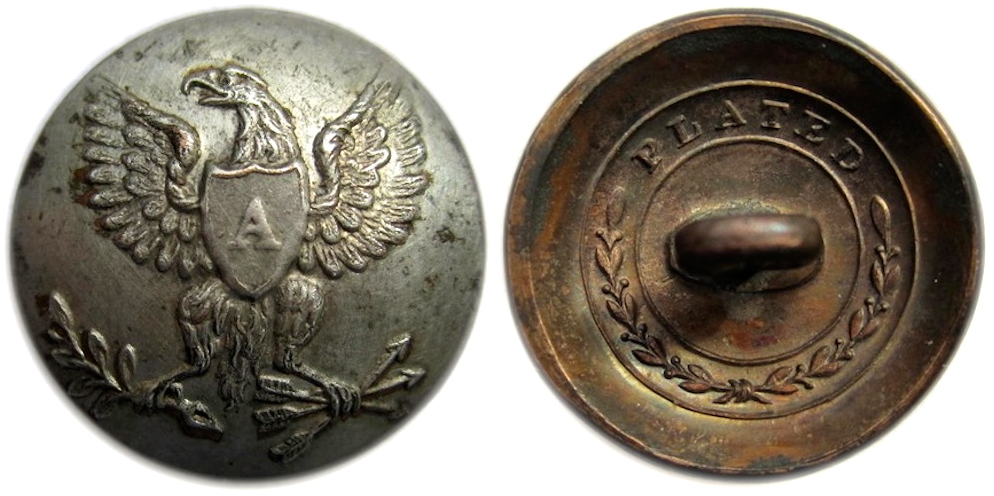
1821-30's Federal Artillery Officer's Button
Color: Silver Ghost.
Metal: 1-Piece, Convex, Raised Design, Silver Plated Copper.
Size: 19.5mm. Coat Size
Albert: AY 64 RV: 4
Tice's Number: AY 199-D.15
Variation: Large Raised Shield / Small Artillery letter /
Freshly Cut Laurel Stem.
Present Condition: An Excavated Example, Strong Planchet
Casting, Strong High Relief Pattern.
Isabela's Notes: In 1820-30's, the regulation was for yellow
buttons, but some silver ones were ordered for Artillery
officers. The button's pattern depicts a spread eagle with
symmetrical upraised wings facing right. On the eagle's
chest is a large raised shield with a raised outline. Within
the center is a raised small letter, "A" for Artillery. In
the eagle's right talon is a short freshly cut laurel stem
with six petals and a top berry. In it's left talon is a
small bundle of three arrows that are pointing to the left,
and downward. The high relief pattern is set on a plain
convex field with no edge border.
Reverse Button Analysis: This is a slightly concave
one-piece button with a loop shank. PLATED rm with wreath of
laurel branches rm.
The RJ Silverstein Collection.
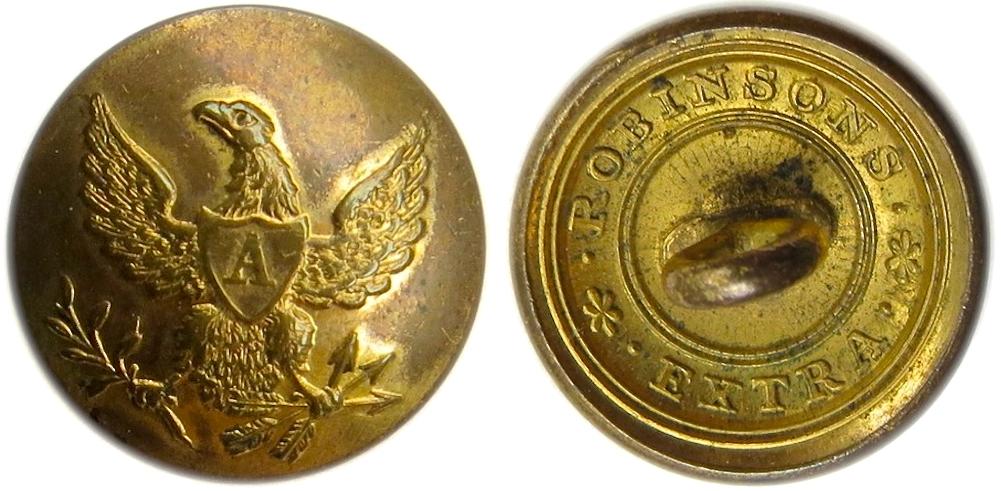
1830-40's Federal Artillery Officer's Button
Color: A Soft Brown With Gold Highlights.
Metal: 1-Piece, Convex, Raised Design, Gilt Brass.
Size: 18.10mm. Vest Size
Albert's Number: AY 64-A.1
RV 4
Tice's Number: AY 200 - Unlisted Back mark.
Variation: Eagle with Upraised Wings / Small Raised
Shield / "A" for Artillery / Three Wide Space Arrows.
Present Condition: A Non Excavated Example, Exceptional
Planchet Casting, Exceptional High Relief Pattern.
Isabela's Notes: This button was made between
1834-48 by Robinson for cadets. The button's pattern depicts an
Eagle with Upraised Wings
facing right. The
eagle's head is also tilted upward. On the eagle's chest is
a
Small Raised Shield
with a raised outline. Depicted on
the center is a small raised initial,
"A" for Artillery.
In the eagle's right talon is an olive branch with six
petals and one lower berry. In it's left talon is a small
bundle of
Three Wide Space Arrows
pointing upward. The high relief pattern is set on a plain
convex field with no edge border.
Reverse Button Analysis: This is a slightly concave
one-piece button with a loop shank. .*.ROBINSON.*.EXTRA
inner and outer double rm rings.
The RJ Silverstein Collection.
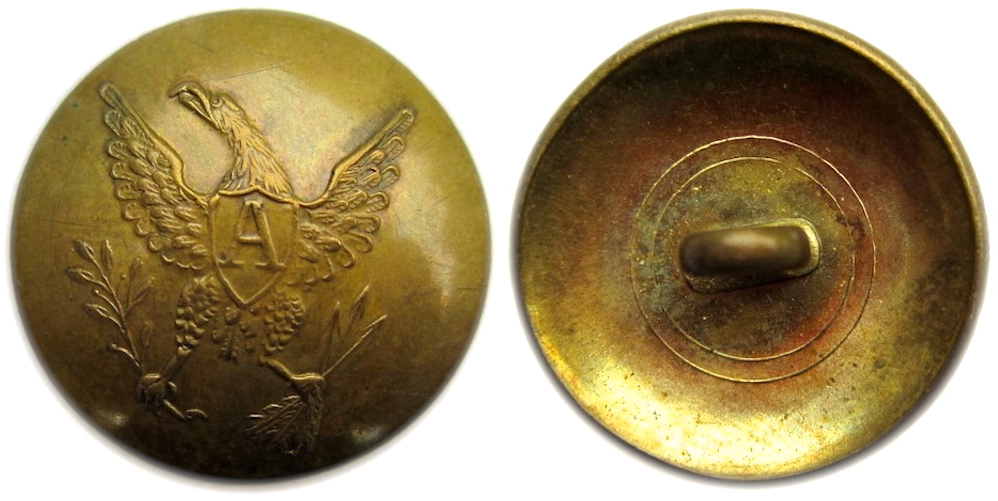
1830's Federal Artillery Officer's Button
Color: A Dark Golden Mustard.
Metal: 1-Piece, Convex, Raised Design, Brass.
Size: 20mm. Coat Size
Albert's Number: AY 66-A RV 4
Tice's Number: AY 199 or AY 200 - Unlisted Die and Backmark
Variant.
Variation: Eagle's Head is Tilted Upward / Large Raised
Initial / Seven Petals & Three Berries.
Present Condition: A Non Excavated Example, Exceptional
Planchet Casting, Exceptional High Relief Pattern.
Isabela's Notes: This button's pattern depicts a
spread-eagle with long narrow wings facing right. The
eagle's head is also tilted upward. On the eagle's chest is
a large narrow pointed shield with a raised outline. Within
the center is a large raised initial, "A" for Artillery. In
the eagle's right talon is a short stem laurel with seven
petals and three berries. In it's left talon is a small
bundle of three arrows pointing upward. The high relief
pattern is set on a plain convex field with no edge border.
Tice's book does not have this eagle's die variant pictured,
but Albert's NY 66 seems to have an exact eagle match
pictured for this die variant, but different backmark.
Reverse Button Analysis: This is a slightly concave
one-piece button with a loop shank. No backmark, but two
concentric, raised rings.
The RJ Silverstein Collection.
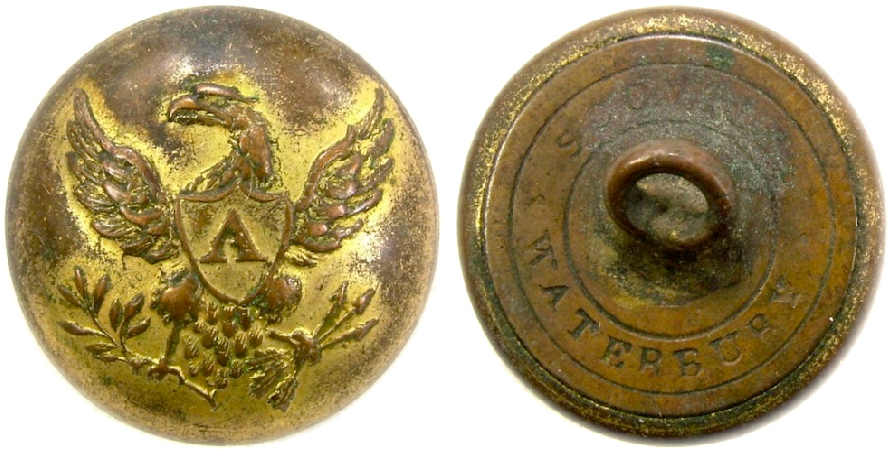
1830's Federal Artillery Officer's Button
Color: Gold with Copper Highlighted Areas.
Metal: 2-Piece, Low-Convex, Raised Design, Gilt Brass.
Size: 19.1mm.
Albert's Number: AY 71-A RV 3
Tice's Number: AY 206-A.9
Variation: Goose Neck / Wide Slightly Raised Shield /
Crooked Laurel Stem
Present Condition: An Excavated Example, Strong Planchet
Casting, Strong High Relief Pattern.
Isabela's Notes: This early two-piece Federal Artillery
button was manufactured by Scovills in the 1830's. The
button's pattern depicts a spread eagle with a goose neck
facing right. On the eagle's chest is a wide slightly raised
shield with a raised outline. Within the center is a small
raised letter, "A" for Artillery. In the eagle's right talon
is bent or crooked laurel stem with nine laurel petals. In
it's left talon is a small bundle of three arrows that are
pointing upward, and to the left. The high relief pattern is
set on a plain low-convex field with no edge border.
Reverse Button Analysis: This is a two-piece button with a
loop shank. The shank is original, straight, and intact.
SCOVILL. WATERBURY dm.
The H Ridgeway Collection.
.png)
1820-40's Federal Artillery Officer's Button
Color: A Soft Leather Brown with A Golden Outline.
Metal: 2-Piece, Low-Convex, Raised Design, Gilded Brass.
Size: 20mm. Coat Size
Albert's Number: AY 71 Unlisted Variant. RV 3/Backmark-10
Tice's Number: AY 206-A.17
Variation: Screeching Eagle / Slightly Slanted Raised Shield
/ Goose Neck.
Present Condition: A Non Excavated Example, Strong Planchet
Casting, Exceptional High Relief Pattern.
Isabela's Notes: According to the backmark, this two-piece
specimen was most likely manufactured in England during the
late 1830's or early 1840's. The button's pattern depicts a
screeching spread eagle with a goose-type neck facing right.
This die variant shows the eagle's beak open with a flailing
tongue. In the eagle's right talon is a laurel stem with
eight petals. In it's left talon is a small bundle of three
arrows that are pointing to the left and downward. On the
eagle's chest is a slightly slanted raised shield. Centered
on top of the shield is a raised letter "A" for Artillery.
The high relief pattern is set on a low-convex field with no
edge border. This is an outstanding example of an earlier
two-piece button.
Reverse Button Analysis: This is a two-piece button with a
loop shank. The shank is original, straight, and intact.
TREBLE GILT *** dm with an outer ring of dots, inner dm ring
around the shank.
The RJ Silverstein Collection.
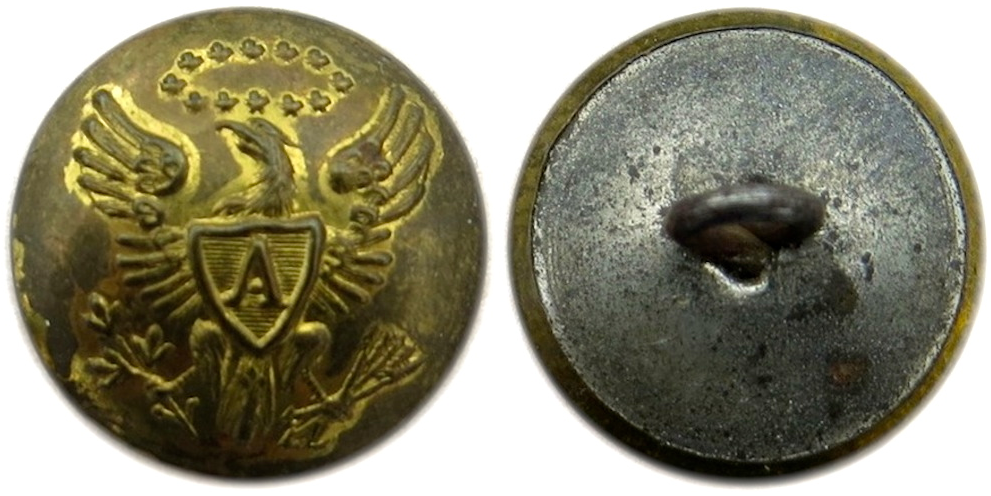
1840's Federal Artillery Prototype Button?
Color: Antique Brass With Gilt Highlights.
Metal: 2-Piece, Low Convex, Raised Design, Gilded Brass, Tin
Back.
Size: 19.3mm. Coat Size
Albert's Number: Unknown Die Variant RV 250
Tice's Number: Unknown Die Variant
Variation: Twelve Five Pointed Stars / Slightly Slanted
Shield with a Raised Outline / Lined Field / Bundle of
Arrows Facing Down.
Present Condition: A Non Excavated Example, Strong Planchet
Casting, Strong Exceptional High Relief Pattern.
Isabela's Notes: The tin back dates this button to
1840's-50's. The button's pattern depicts a spread eagle
facing right with a circle of Twelve Five Point Stars. On
the eagle's chest is a Slightly Slanted Shield with a Raised
Outline. Within the shield is a thin raised letter, "A" for
Artillery on a Lined Field. In the eagle's right talon is an
Olive Branch with three sets of three petals and two berries
on a straight stem. In it's left talon is a small Bundle of
Three Arrows Pointing Downward towards the tail feathers.
The middle arrow is longer then the other two flanking
arrows. The high relief pattern is on a low-convex plain
field with no edge border. The maker of the button is
undetermined.
Reverse Button Analysis: This is a tin back two-piece button
with a loop shank. The shank is original, straight, and
intact.
The RJ Silverstein Collection.
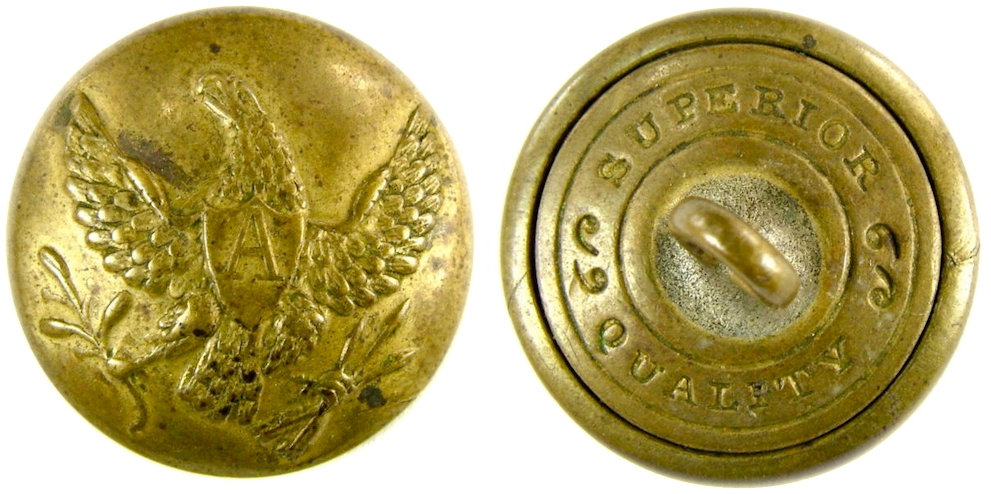
1840's Federal Artillery Officer's Button
Color: Gilded Brass Yellow.
Metal: 2-Piece, Low Convex, Raised Design, Gilded Brass.
Size: 19.3mm.
Albert's Number: Similar to AY 71-76 Styles. RV 3
Tice's Number: AY 206-A.16
Variation: Head Angle Upward / Large Raised Shield /
Present Condition: A Non Excavated Example, Strong Planchet
Casting, Strong High Relief Pattern.
Isabela's Notes: The backmark dates this two-piece button to
the early 1840's. The button's pattern depicts a spread
eagle facing right with it's head angled upward. On the
eagle's chest is a large raised shield slightly slanted. On
the shield is a large thin raised letter, "A" for Artillery.
In the eagle's right talon is a an Olive Branch with a
curved stem and three petals and three berries. In it's left
talon is a small bundle of three arrows pointing upward and
to the left. The middle arrow is longer then the other two
flanking arrows. The high relief pattern is on a plain
low-convex field with no edge border. The maker of the
button is undetermined.
Reverse Button Analysis: This is a two-piece button with a
loop shank. The shank is original, straight, and intact.
SUPERIOR(Graphic Swirls) QUALITY (Graphic Swirls) within a 2
ring dm.
The H Ridgeway Collection.
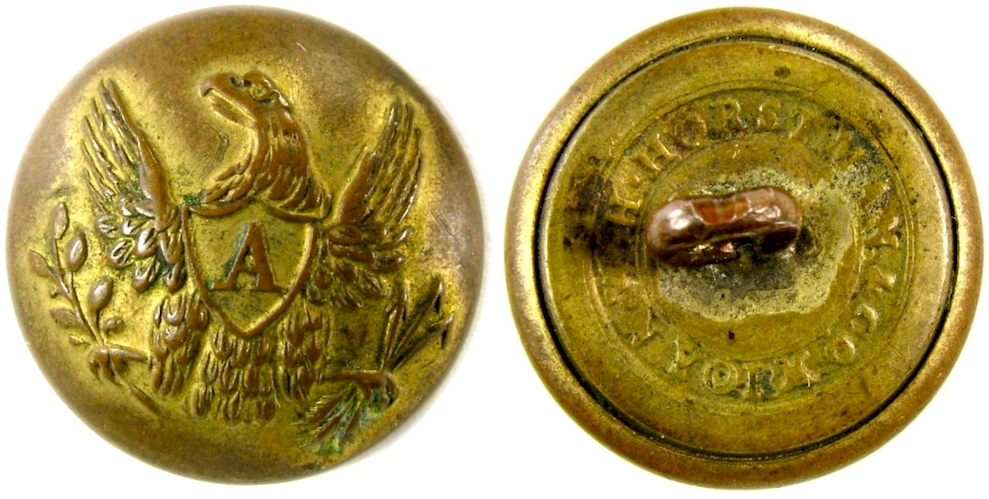
Late 1840-50's Federal Artillery Officer's Button
Color: Leather Brown with Gold Outlines.
Metal: 2-Piece, Convex, Raised Design, Gilt Brass.
Size: 19.7mm.
Albert's Number: Similar to AY 73/74 Style: RV 3
Tice's Number: AY 206 Unlisted Variant
Variation: Stout Neck / Lined Wing Feathers / Wide Shield.
Present Condition: An Excavated Example, Strong Planchet
Casting, Strong High Relief Pattern.
Isabela's Notes: This Horstman backmark dates to the
1840-50's. The button's crude pattern depicts a stout neck
spread eagle facing right. This die variant shows lined wing
feathers pointing upward. There only appears to be a small
amount of fanning bottom feathers. On the eagle's chest is a
wide shield with a raised outline. Within the center is a
stout initial, "A" for Artillery. In the eagle's right talon
is a Olive Branch with five petals and three berries. In
it's left talon is a small bundle of three arrows pointing
upward. The high relief crude pattern is set on a plain
convex field with no edge border.
Reverse Button Analysis: This is a two-piece button with a
loop shank. The shank is a replacement, but straight, and
intact. W H.HORSTMAN &CO N YORK rmdc.
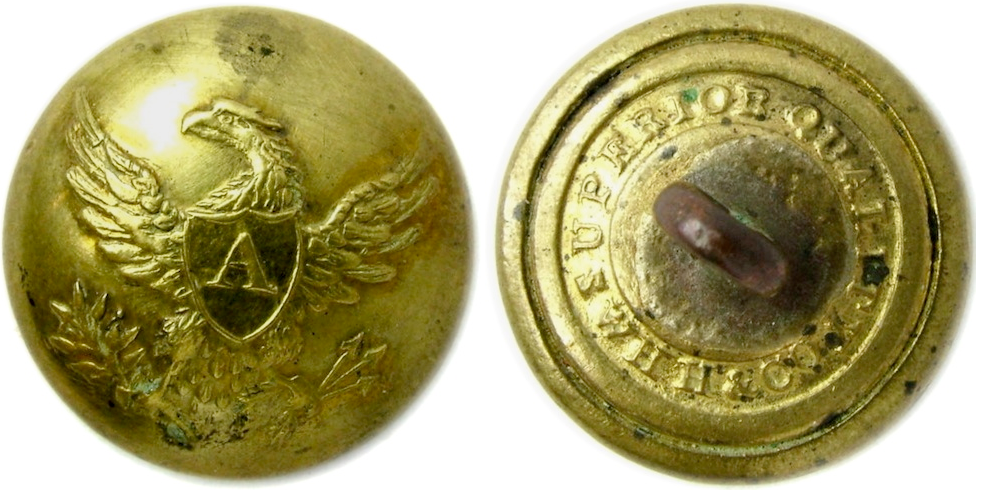
1840-50's Federal Artillery Officer's Button
Color: Polished-Up Yellow Brass.
Metal: 2-Piece, Convex, Raised Design, Gilded Brass.
Size: 20mm.
Albert's Number: Similar to AY 71 Style: RV 3-5
Tice's Number: AY 206-A.8 / Horstman BackmarkVariant
Variation: Short Goose Neck / Wide Slanted Shield
Present Condition: An Excavated Example, Strong Planchet
Casting, Strong High Relief Pattern.
Isabela's Notes: This two-piece Federal Artillery button was
made for Horstman by Scovills in the 1840-50's. The button's
pattern depicts a spread eagle with a short goose neck
facing right. On the eagle's chest is a slightly slanted
wide shield with a raised outline. Within the center is a
small stout raised letter, "A" for Artillery. In the eagle's
right talon is a Olive Branch with nine petals. In it's left
talon is a small bundle of three arrows that are pointing to
the left. The high relief pattern is set on a plain convex
field with no edge border.
Reverse Button Analysis: This is a two-piece button with a
loop shank. The shank is a copper replacement SHANK, but it
is straight, and intact. W H H & CO SUPERIOR QUALITY rmdc.
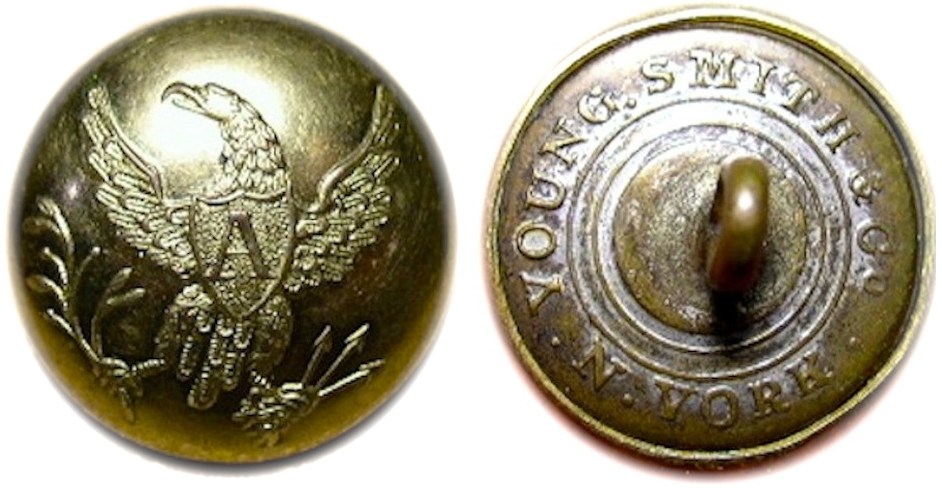
1830's Federal Artillery Officer's Button
Color: Dark Brass Yellow.
Metal: 2-Piece, Convex, Raised Pattern, Gilded Brass.
Size: 20mm.
Albert's Number: AY 76: RV 3
Tice's Number: AY 206-D.2
Variation: Long Thin Wings / Raised Stippled Shield.
Present Condition: A Non Excavated Example, Exceptional
Planchet Casting, Exceptional High Relief Pattern.
Isabela's Notes: This two-piece Federal Artillery button was
intended for officers, and it's Young Smith backmark dates
to the 1830's. The button's pattern depicts a spread eagle
with long thin detailed wings facing right. On the eagle's
chest is a slightly slanted stippled shield with a raised
outline. Within the center is a large raised letter, "A" for
Artillery. In the eagle's right talon is whimsical laurel
stem with five petals and three berries. In it's left talon
is a small bundle of three arrows pointing upward and to the
left. The high relief pattern is set on a plain convex field
with no edge border.
Reverse Button Analysis: This is a two-piece button with a
loop shank. The shank is original, straight, and intact. .YOUNG.SMITH
& Co./N.YORK. 2 inner ring rm.
The Jim Dews Collection.
|

