|
GWI 21-A & B THE SWIRLY DOTTED SCRIPT GW MONOGRAM WITH EAGLE ABOVE:
This elaborate button was manufactured in only Gilded Brass. (There
could have possibly been Silver Plated Copper examples were made, but
known are known). GWI 21-A is an engraved pattern; and GWI 21-B's
pattern is made high relief. The Size for both GWI 21 A & B
is 25mm., and both share an R-7 Rarity Rating. Both buttons are flat
one-piece buttons with soldered on loop shanks. The button's pattern
shows a
Federal Style Spread Eagle
on the top half of the button. In the eagle's left talon is a
Bundle of Thirteen Arrows
pointing upward toward the left. The arrows symbolize our country's
Willingness, Strength and Readiness against foreign aggressors, and
the unity of the 13 states. In
the Eagles right talon is an
Olive Branch
to symbolize our country's willingness, and desire for peace. This
metaphor was actually taken from the ancient Romans. As with all GW
varieties but one, the Eagle's head is wisely turned toward the
olive branch. In GWI 21 A & B there is a
Federal Shield with Thirteen Stripes
covering the Eagle's chest.
Four stripes going horizontally across the top half, and nine
stripes going vertical across the lower portion. (In GWI 21-C
Reproduction there
is a "Y" pattern on the shield). Situated below the
eagle is George Washington's,
"GW" Monogram with a flamboyant Diamond Cut Swirl Pattern
off the letters.
This unique pattern uses a
Dot pattern to Accent the Letter's Swirls.
The current theory is that this style button was specially designed
to catch the sun or candle light in different positions, and give a
glimmering diamond effect to on lookers. This would have been an
exceptional item to wear for the Grand Balls during that era.
I decided to introduce
GWI 21-B
as a new sub-variety. This will allow students and collectors of GW
buttons to make the distinction between both known design types. I
felt this new introduction is justified because of how the same
design pattern was fashioned in similar, but distinct ways. The
first major difference in GWI 21-B is that it is high relief, and
not engraved or impressed like GWI 21-A. This high relief pattern
allowed the design to be fashioned in what is known as a Diamond
Style Cut, which is used for it's reflective nature. The next few variations
are in the design itself. First is the style eagle used in the
design. In GWI 21-A, the button depicts and old style Federal Eagle
with an open beak, as if calling. It's wing span is wide spaced, and
away from the shield. GWI 21-B's depicts a more of the modern style
Federal Eagle with a closed beak. It's wings are closer to the to
the shield, and closer to the shield. GWI 21-B is the more elaborate
of the two versions, and probably was fashioned in the era's Art
Deco elegance.
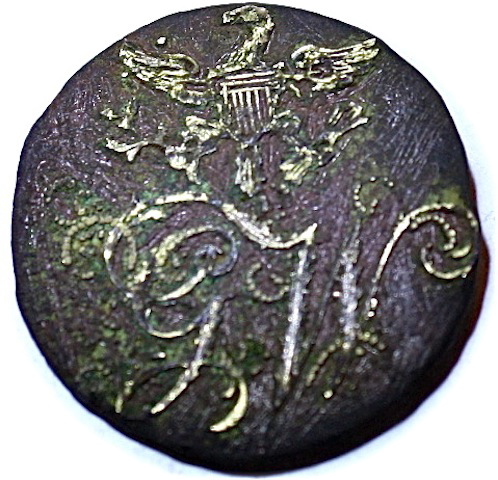
When you throw a Political Grand Ball for his Excellence,
This Would be The Patriotic Button to Show Your Allegiance!
~ The Dale Collection ~
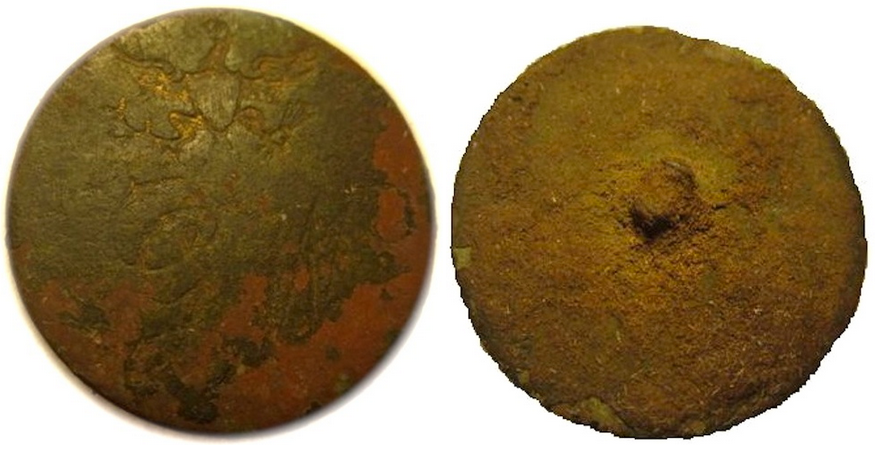
GWI 21-A THE SWIRLY DOTTED SCRIPT GW MONOGRAM WITH EAGLE ABOVE
Color: A Silvery Charcoal with Red Clay Encrustations.
Metal: Flat, 1-Piece, Impressed Design, Gilt Brass.
Size: 25mm.
Rarity: R-7
Variety Type: Old Style Calling Eagle / Impressed Design.
Present Condition: An Excavated Example, Strong Planchet
Casting, Strong Relief
Obverse Button Analysis: This is a wonderful re-discovered
button that recently entered the GWI button world with a Bang! The
brass planchet is solid and flat, but unfortunately shows
deterioration and flaking on the surface. The surface texture is a
bit coarse, and shows micro porosity throughout. The button has an
aged green patina with a reddish-orange undertone as noted in the
oxidized flaked areas. The Federal Eagle holds a nice image with a
good outline. Unfortunately, the inner feather details are a bit
muted with a flat spots. The Federal Shield still shows a strong
outline, but the inner line detail has partially decayed into the
surface. The Olive Branch still shows an outline, but no inner
detail. The Bundle of Arrows still has a nice impression and shows
the individual shafts clearly, unfortunately the tips and nock
feathers are partially muted. The swirly dotted script "GW" Monogram still
has a readable image, but lacks depth of the original impression.
The letter lines are either decayed, or worn almost flat into the
surface. The dotted swirl pattern is unfortunately lost to decay.
The button's impressed pattern is set on a flat plain field.
Reverse Button Analysis: This is a flat one-piece button with
a soldered on loop shank. The shank was reportedly broken off by
digger after
excavation. The surface still retains a good amount of gilt, but has
pockets of corrosion and porosity.
Library Records Has Limited Information GWI 21 A-1:
History: Yes
Recorded Sales Price: Digger is owner
Current Button Owner and Location: ~
Massachusetts ~
Dug in a cellar hole in Western Massachusetts with a Rev War Belt
Plate in 2012!
The Dale Collection.
"Robert, If I had my jelly with me this day when the button was dug,
I could have saved 100% of the original finish that is dark green
now if treated when it was dug. First time ever I did not have my
jelly with me. I left it on my shelf when I pulled the 21st Regiment
Belt Plate out of my hunting pouch two days earlier. Anyway this is
where we are at. I saved 65% of the original surface of the button
which seems terrible, but this is what the button will look like if
I wanted to condition it for display. Keep in mind that after you do
this the original finish is gone forever, but at this point as it is
now, I have two options for the button still looks good as it is
now. If I wanted to make it look great, I would remove the dark
green patina except on the eagles dark green head, dark green tail,
claws and shield. What you have left is a master piece of red with a
porous surface. There would be dark green in the recessed script GW,
and that would look great against the red of the cleaned button."
~Dale
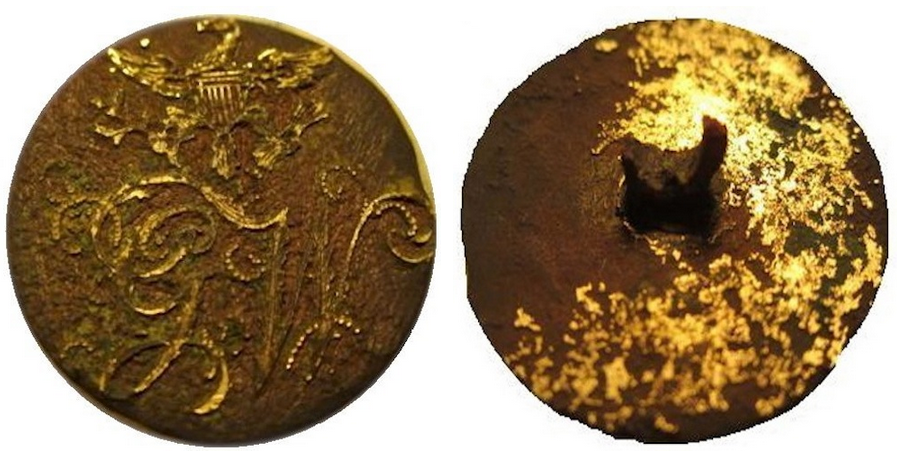
GWI 21-B THE SWIRLY DOTTED SCRIPT GW MONOGRAM WITH EAGLE
Color: A Nicely Aged Charcoal-Brown Base with a Pleasing
Greenish-Gold Patina.
Metal: Flat, 1-Piece, Raised Design, Gilt Brass.
Size: 25mm.
Rarity: R-7
Variety Type: New Style Eagle / Raised Design.
Present Condition: An Excavated Example, Strong Planchet
Casting, Strong Relief
Obverse Button Analysis: This is the only GW Inaugural button that was
fashioned in high relief. The brass planchet is still solid, but
shows some corrosive properties that caused deterioration to the
integrity of the metal. There also appears to be edge loss, but this
could be due to poor collaring during the manufacturing process. The
surface is very corroded, coarse, porous, and there are noticeably
scratches around the design. On a positive note, the
Federal Eagle
is nicely raised, and has a good strong outline and clear image. The
inner detail of the wings and neck can still be clearly seen. There
are a few spots of decay and flatness, but for the most part the
design is still intact. The
Federal Shield
is still nicely elevated
with a strong image, and clearly shows all inner detail of the
horizontal and vertical stripes. The
Olive Branch
only shows a partial
image, and the petals show decay in the relief. The
Bundle of Arrows
is stands out with a clear image, and still shows some individual
details of the
Arrow Tips, Shafts, and Nock Feathers. A few of the
arrows have flat pressed on tops, but still is easy to identify. The
swirly dotted script
"GW" Monogram
is nicely elevated, and shows it's
diamond cut lines nicely. The fancy
Dotted Script Swirls
off the
letters are clearly defined, and still exhibit some reflective "Bling"!
This is one of the most important re-discovered buttons in the world
of GW's next to GWI 24-A Isabela's Heraldic Eagle with Inverted
Diamond Shaped Indentees!
Reverse Button Analysis: This is a flat one-piece button with
a soldered on loop shank. Unfortunately, the shank was broken off
because of
sloppy excavation techniques.
Correct field training for this individual is highly recommended
before future digs. The surface still retains a good amount of gilt,
but has pockets of corrosion and porosity.
Library Records Has Limited Information GWI 21 B-1:
History: Yes
Recorded Sales Price: Digger is Owner
Current Button Owner and Location: ~
Massachusetts ~
Excavated on the Massachusetts/Connecticut Border
The Dale Collection.
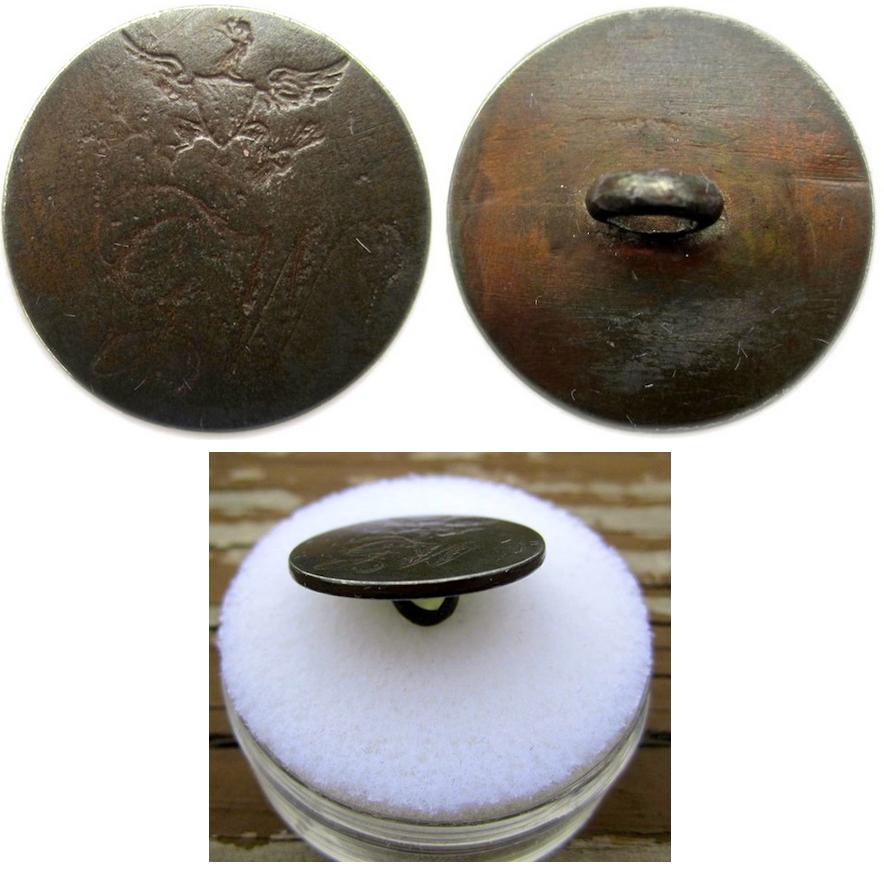
(A. Albert's Example Illustrated in American Uniform & Historical
Buttons)
GWI 21-C THE SWIRLY DOTTED SCRIPT GW MONOGRAM WITH EAGLE ABOVE
Most Likely Made for the 25th or 50th Year
Anniversary of the American Revolution.
Color: A Brownish Charcoal Red With a Silvery Undertone.
Metal: Flat, 1-Piece, Impressed Eagle, Hand-Engraved
Monogram, White Metal.
Size: 23.33mm.
Rarity: R-6
Variety Type: Foliated GW Monogram / Federal Eagle / Impressed Design / T
Shape Shield / Swirly Dotted Script GW.
Present Condition: A Non Excavated Example, Strong Planchet
Casting, Good Impressions
Obverse Button Analysis: This was the specimen A. Albert uses
in his book of American Uniform and Historical Buttons on page 396.
I did find another one of these rare specimens with the same shield
pattern that he published in
his 1949 book on George Washington Inaugural Buttons. There appears
to be some conjecture on it's origins. This button could have been
manufactured in England, as well as in America. Albert didn't know
of any authentic examples (made of copper or brass) to use as
examples; But he also knew who ever made these early white
metal or pewter buttons knew about the various patterns made during the
late 18th century. Using his only available option open to him,
he used this button as plate specimens to illustrate the point in his
book of known patterns, but incorrectly listed the alloy as: Copper.
(Neither here nor there, the originals would have probably been made
in brass because of the gilt finish). The button depicts a
decorative
Foliated GW Monogram
that is
hand engraved in the die.
The planchet on this specimen is very thick, and is very reminiscent
of GWI 17 & GWI 20's planchet. This thicker planchet is solid and
flat, and shows evidence of being some kind of White Metal,
reminiscent of early English made buttons. If this is Pewter, it would be a more updated
mix of Tin with Copper, and Antimony, then Tin with Lead mixture. (I referenced a side
view picture to illustrate the thickness, and exceptional clean
workmanship). The button's surface is very smooth to the touch. The
button has a nice aged brown patina, and has a silvery white
undertone. The
Federal Eagle
has a strong image with a good deep
outline. The inner feather details of the neck, wings, and legs, are
still clear, but the tail feathers are weakly struck, and barely
outlined. The
federal shield
in this die variant is an unusual
"T" Shape.
There is a half a dozen short diagonal lines
going across the upper portion of the shield, and two horizontal
lines made of dots reaching downward through the lower portion of
the shield. The shield still has a strong outline, but the inner horizontal lines in the top
portion are weak and barely visible. The two vertical dotted lines in the
lower portion of the shield do have remnants of an image, but are
also
faint. The Olive Branch in the Eagle's right talon only has a
light foot print for an impression, and barely shows a viewable image. The Bundle of Arrows
fortunately still has a nice impression, and shows all the individual
Arrow heads and shafts clearly.
The Swirly Dotted Script "GW" Monogram
is still easy
to read, but lacks a good strike depth. The various dotted swirl
patterns are still visible in most areas, but lost it's panache.
Overall, because of the rarity of this variety, a collector would be
fortunate to get any specimen available.
Reverse Button Analysis: This is a flat one-piece button with
a soldered on loop shank. The shank is original, straight, and
intact.
The Isabela Collection.~
|

